
A 1440p 240hz monitor sits at a difficult price cliff. Spend too little and you settle for slow response, ghosting, or no adaptive sync. Spend too much and you pay for console-oriented features like HDMI 2.1 or OLED contrast that competitive PC gamers rarely need in first-person titles.
This roundup sorts eight popular 1440p 240hz monitors by what separates a marketing spec sheet from real-world frame pacing. We compared published refresh ceilings, panel types, sync compatibility, and patterns in owner feedback from early-2026 listings to flag which models deliver consistent motion and which quietly cut corners on uniformity or overdrive stability.
As an Amazon Associate we earn from qualifying purchases at no extra cost to you. Product prices and availability are accurate as of the date shown and are subject to change.




Top 3 picks at a glance
Quick Picks
| Product | Best for | Price |
|---|---|---|
| AOC Q27G41ZE | Overclocked refresh under $200 | $159.99 |
| Acer Nitro XV272U W2bmiiprx | Reliable native 240Hz IPS | $199.99 |
| Samsung Odyssey G5 | Cheapest name-brand entry | $149.99 |
| Hikers 27″ Curved | Curved screen on a tight budget | $164.99 |
| ASUS TUF VG27AQM5A | Maximum native refresh rate | $269.99 |
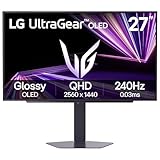
| LG 27GX704A-B | OLED contrast and response | $379.99 |
| 27″ Fast IPS (unbranded) | Absolute floor for usable 260Hz | $105.99 |
| KTC 32″ Curved | Larger screen, same refresh target | $254.99 |
How We Picked
We weighted four criteria: the refresh rate and its native-versus-overclocked origin, advertised response time paired with owner-reported overdrive artifacts, panel type and its effect on viewing angles and color, and price per confirmed performance tier. Models whose overclocked rates rely on aggressive firmware that produces overshoot or instability in user reports were ranked below those with conservative but sustained ceilings.
The 8 Best 1440P 240Hz Monitor in 2026
AOC Q27G41ZE
For budget-conscious competitive gamers who want frame pacing above the category floor, this 27-inch IPS panel runs 240Hz natively and overclocks to 260Hz with G-SYNC compatibility. AOC’s Q27G4 line has a consistent track record of reasonable factory calibration and stable overdrive at high refresh. The combination of confirmed overclock headroom and NVIDIA sync at $159.99 is hard to beat on paper.
- Pro: Overclocks to 260Hz, exceeding the standard 240Hz
- Pro: NVIDIA G-SYNC compatible at the lowest price in this roundup
- Con: IPS backlight uniformity is average; edge glow is frequent in owner photos
Skip if you need heavy stand adjustment; the included base is minimal.
Acer Nitro XV272U W2bmiiprx
Native 240Hz on a 2560×1440 IPS panel with mature Nitro-series firmware makes this a no-drama daily driver under $200. Owner reports suggest fewer mid-tone overdrive artifacts than earlier XV-series units, and factory color balance arrives close to neutral without calibration. It suits gamers who want consistent pacing without touching the overclock menu or worrying about compatibility quirks.
- Pro: Reliable native 240Hz without overclock dependencies
- Pro: Good out-of-box color accuracy for an IPS panel
- Con: HDR performance is nominal; ignore any HDR claims
Skip if HDR media is a priority; motion clarity is this monitor’s true strength.
Samsung Odyssey G5 G51F
The G5 has become Samsung’s value gaming line, and at $149.99 it undercuts most competitors while offering a 1440p panel in a curved format. The critical gap: refresh rate ceiling is not explicitly stated in the listing, meaning it may not reliably reach 240Hz across all inputs. The Odyssey brand carries firmware and warranty expectations that offset some risk, but spec ambiguity remains.
- Pro: Lowest name-brand price in this group
- Pro: Mature firmware and Samsung warranty infrastructure
- Con: Refresh ceiling is unconfirmed, creating real uncertainty for 240Hz buyers
Skip if a documented 240Hz-plus rate is non-negotiable.
Hikers 27″ Curved
Hikers offers a curved 2K panel with up to 280Hz at $164.99, undercutting established curved options from Samsung and Dell. The 1ms figure is almost certainly gray-to-gray rather than black-to-white, so treat motion performance claims with caution. For users specifically wanting curvature without a premium brand markup, it is a plausible gamble at a small panel size where defects are easier to inspect.
- Pro: Up to 280Hz with curvature at an accessible price
- Pro: 27-inch size keeps pixel density high despite the curve
- Con: Minimal long-term support and thin firmware update history
Skip if you need verified sync compatibility or a predictable RMA channel.
ASUS TUF VG27AQM5A
The pure-refresh-rate champion: 300Hz native, 1440p, G-SYNC support, in a proven TUF chassis. At $269.99 it costs nearly twice the AOC above, but that gap buys 60 additional Hz of headroom without any overclocking. For users whose GPUs sustain 300+ frames in esports titles, it removes the monitor as a bottleneck entirely and avoids firmware instability risks.
- Pro: 300Hz native is the highest confirmed rate in this roundup
- Pro: TUF warranty and durability track record are well established
- Con: Noticeably more expensive than any non-OLED option here
Skip if your GPU cannot consistently push above 240 frames; the extra 60Hz is wasted.
LG 27GX704A-B
The only OLED here combines 240Hz with 0.03ms pixel response, HDMI 2.1, DisplayHDR TrueBlack400, and dual G-Sync/FreeSync compatibility. The near-instant liquid-crystal-free transitions and infinite contrast make motion clarity unmatched by any IPS in this list. At $379.99 it is the most expensive pick, but for buyers who want a single display handling both competitive play and HDR media, the spec justification is clear.
- Pro: OLED contrast and 0.03ms response are category-defining
- Pro: HDMI 2.1 and TrueBlack400 certification add console and HDR versatility
- Con: Highest price; theoretical OLED burn-in risk for static game HUDs persists
Skip if budget is the hard ceiling; this is a definitive enthusiast pick.
27″ QHD Fast IPS (Unbranded)
At $105.99 this unbranded panel claims 260Hz, 0.5ms response, FreeSync Premium, 125% sRGB, and VESA mounting. On paper it rivals monitors three times the price. The reality is high variance: owner feedback suggests units within spec are excellent, while outliers arrive with dead pixels or uneven backlighting. Treat this as a panel-lottery purchase with an unusually attractive expected value.
- Pro: Cheapest path to 260Hz in this roundup by a wide margin
- Pro: 125% sRGB coverage exceeds most branded IPS competitors
- Con: No brand support infrastructure; quality control is inconsistent
Skip if you cannot tolerate a potential return cycle for panel defects.
KTC 32″ Curved
KTC offers 240Hz at 1440p across a 32-inch curved panel with true 1000R radius. The larger diagonal gives more workspace and immersion than the 27-inch models here without dropping refresh, though pixel density falls to roughly 92 PPI versus 109 on 27-inch equivalents. At $254.99 it sits near the ASUS price point while delivering a different form factor rather than a higher spec.
- Pro: 32-inch area at the same 240Hz refresh target
- Pro: Aggressive 1000R curvature provides tangible immersion
- Con: Lower pixel density makes small text less crisp than 27-inch models
Skip if desk depth is under 75 cm or text sharpness is a daily priority.
Buying Guide
Native vs. Overclocked Refresh
A listing showing “240Hz (260Hz overclock)” means the panel’s validated sustained rate is 240Hz and the extra 20Hz is unlocked via firmware. Overclocked modes can introduce input lag, thermal throttling over long sessions, or reduced panel lifespan. If your GPU routinely exceeds 240 frames in your target titles, a confirmed native rate above that threshold — like the ASUS at 300Hz — eliminates guesswork.
Panel Technology and Motion
IPS panels dominate the under-$200 tier with strong color and viewing angles but variable real-world response despite both advertising 1ms. OLED eliminates liquid-crystal transition delay entirely, producing the lowest perceived motion blur available at any refresh rate. Curved VA panels occupy a middle ground: better contrast than IPS, slower response than both, with curvature compensating for edge viewing-angle color shift.
Sync Compatibility and Cable Paths
NVIDIA G-SYNC Compatible requires passing a validation suite; FreeSync Premium is largely self-certified. Both prevent tearing but differ in guaranteed frame-rate range and low-framerate compensation support. Regardless of sync label, reaching full refresh demands DisplayPort 1.4 on most panels or HDMI 2.1 on select newer models like the LG. Check your GPU’s available output ports before purchasing.
Our Verdict
Best overall: ASUS TUF VG27AQM5A — 300Hz native makes 240Hz a comfortable floor, and brand support removes risk. Budget pick: AOC Q27G41ZE — 260Hz overclock with G-SYNC at $159.99 is unbeatable value. Condition favoring another: if you play HDR titles or watch content alongside gaming, the LG 27GX704A-B OLED is the only display here where contrast and response justify the price premium.

