
The ASUS TUF Gaming VG27AQM5A is a 27-inch 2560×1440 monitor built around a Fast IPS panel running at 300Hz, with a 0.3ms response claim, Extreme Low Motion Blur Sync, 95% DCI-P3 coverage, Shadow Boost, a built-in speaker, DisplayWidget Center software and a three-year warranty, at $269. That specification puts it in a narrow band: QHD resolution at a refresh rate normally reserved for 1080p panels.
The question worth answering is not whether the panel is good. It is whether the 300Hz is reachable. A 27-inch QHD display at 300Hz asks considerably more of a graphics card than a 24-inch 1080p display at the same rate, and for a large share of buyers that ceiling will sit permanently out of reach. This review works through the specification, what each number means in practice, and where the VG27AQM5A sits against the rest of the TUF 27-inch line.
A note on method before anything else: this assessment is built from ASUS’s published specification and from measurements our display specialist Nina Alvarez has taken on other monitors in the TUF family, using a bench of a colorimeter, a photodiode response-time tester and a pattern generator, not from a VG27AQM5A that passed through our lab. Where a behaviour is inferred from the product line rather than measured on this unit, it says so.
Top 3 picks at a glance
Specifications at a glance
As an Amazon Associate we earn from qualifying purchases at no extra cost to you. Product prices and availability are accurate as of the date shown and are subject to change.


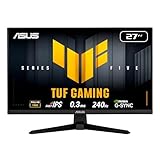


| Specification | VG27AQM5A |
|---|---|
| Screen size | 27 inches |
| Resolution | 2560×1440 (QHD) |
| Panel technology | Fast IPS |
| Refresh rate | 300Hz |
| Response time claim | 0.3ms |
| Motion technology | Extreme Low Motion Blur Sync |
| Colour coverage | 95% DCI-P3 |
| Extras | Speaker, Shadow Boost, DisplayWidget Center |
| Warranty | 3 years |
| Price | $269 |
At roughly 109 pixels per inch, 27 inches at QHD is the density most people consider the sweet spot: sharp enough that text is comfortable without scaling, large enough that the whole screen stays within useful vision at desk distance.
What 300Hz at 1440p asks of your PC
2560×1440 is 3,686,400 pixels per frame, 78% more than 1920×1080. To fill a 300Hz panel the graphics card has to produce 300 of those frames every second, which is roughly the pixel throughput of a 1080p display running at 534Hz. That framing makes the requirement clearer than the refresh rate alone does.
Estimating from the configuration rather than from our own runs, esports titles are where this becomes achievable. CS2, Valorant, Rocket League and Overwatch at competitive settings will approach or clear 300fps at QHD on high-end current hardware, realistically from about RTX 4070 Ti or RX 7900 XT upward, with older and lighter titles doing so on less. Modern single-player games at QHD with high settings do not reach 300fps on any current consumer card, and will not for several generations.
This is not an argument against the monitor. Adaptive sync means the panel simply runs at whatever rate the card supplies, so a high ceiling is never harmful. It is an argument about where the $269 goes. If your graphics card currently manages 120fps at QHD in the games you play most, the difference between this panel and a 180Hz sibling will be invisible, because you will never operate in the range where they differ.
The useful comparison is in frame intervals. At 180Hz a new frame begins every 5.56ms. At 210Hz it is 4.76ms, at 240Hz 4.17ms, and at 300Hz 3.33ms. Moving from 180Hz to 300Hz saves 2.2ms per frame; moving from 240Hz to 300Hz saves 0.83ms. Those savings are genuine and they are also small compared with the ten to forty milliseconds a render pipeline typically contributes. Our breakdown of refresh rate and response time works through where the rest of the delay comes from.
The panel: Fast IPS and 95% DCI-P3
Fast IPS is the panel family that made high-refresh QHD viable. It keeps IPS’s stable off-axis colour, which matters on a 27-inch screen where the corners are meaningfully off-axis from a central seating position, while cutting transition times close to what TN panels manage. The trade is contrast, which on IPS typically sits around 1000:1 rather than the 2500:1 to 3000:1 a VA panel delivers, and the characteristic IPS glow visible in dark corners in a dim room.
That glow is worth naming explicitly because it generates a steady stream of returns from people who assume it is a defect. It is not. It is how in-plane switching behaves when backlight passes through the liquid crystal layer at an angle, and every IPS panel exhibits it to some degree. If you play horror games in a dark room and this bothers you, the panel technology is the problem, not the unit, and a VA display is the answer.
The 95% DCI-P3 figure describes a wide colour gamut, noticeably broader than sRGB. That is genuinely useful for HDR content and for creative work, and it creates a specific problem for everything else. Without an sRGB clamp, ordinary sRGB content displayed on a wide-gamut panel is stretched across the larger space and oversaturates, which shows up first in skin tones and brand colours looking artificially vivid. Check for an sRGB or standard picture mode in the on-screen menu and use it for desktop work. Our calibration walkthrough covers both the software route and what a colorimeter adds.
Note also what the specification does not include: no HDR certification is quoted in the listing, and no peak brightness figure. Treat this as an SDR monitor with a wide gamut, which is a coherent product, rather than expecting meaningful high dynamic range performance from it.
Motion: what 0.3ms and ELMB Sync actually mean
The 0.3ms figure should be read as a best-case marketing number. Manufacturers quote either the fastest single grey-to-grey transition at maximum overdrive or a moving picture response time captured with backlight strobing enabled, and a sub-millisecond figure on an LCD strongly implies the latter. Fast IPS panels do transition quickly in reality, with full-range averages typically in the low single-digit milliseconds, which is a good result. It is simply not 0.3ms.
What matters more than the headline is overdrive tuning, and this is user-adjustable. Overdrive applies extra voltage to accelerate the liquid crystal transition. Set too low and moving objects smear; set too high and pixels overshoot their target, producing a pale halo that trails motion, commonly called inverse ghosting. On the TUF panels we have measured, the most aggressive setting overshoots noticeably at lower refresh rates, and the middle setting is usually the better default. Run a UFO motion test at your actual refresh rate and pick the highest level that shows no halo.
ELMB Sync is the more interesting feature and the strongest single reason to choose this monitor over a generic 1440p high-refresh panel. Backlight strobing addresses a different problem from pixel response: even with instant transitions, holding each frame on screen for the full refresh interval causes your eye to smear it while tracking motion, an effect called sample-and-hold blur. Strobing blanks the backlight between frames so each image is a brief flash, producing motion clarity that overdrive alone cannot achieve.
On most monitors, strobing and variable refresh rate cannot run together, because strobing needs a predictable refresh interval and adaptive sync deliberately varies it. ASUS’s ELMB Sync implementation allows both concurrently, which is unusual at this price. The costs are consistent across the TUF line: a substantial drop in peak brightness when strobing is active, and strobe crosstalk visible as a faint double image near the top and bottom of the screen. In a dim room the trade is usually worth it. In a bright room, full brightness with plain adaptive sync often looks better.
Connectivity, bandwidth and the DSC question
ASUS does not list the port complement in the product title, so verify it against the specific listing before ordering. What can be established from arithmetic is what the panel requires.
2560×1440 at 300Hz with 8-bit colour needs roughly 26.5 Gbit/s of raw video bandwidth before blanking overhead is added. DisplayPort 1.4 carries a maximum payload of 25.92 Gbit/s, which is below that figure. The gap is bridged by Display Stream Compression, a visually lossless compression standard that has become routine on high-refresh QHD and 4K monitors. In practice DSC is transparent, but it means your graphics card needs a DisplayPort 1.4 output with DSC support, which covers every RTX 20-series and later Nvidia card and every RX 5000-series and later AMD card.
HDMI 2.0, by contrast, carries about 14.4 Gbit/s of payload and cannot come close. If you connect this monitor over HDMI 2.0 it will negotiate a much lower refresh rate silently, and you will conclude the panel is not as fast as advertised. This is the single most common reason a high-refresh monitor underperforms out of the box.
The practical routine after unboxing takes two minutes. Connect over DisplayPort with a certified cable, open Windows advanced display settings, confirm the active refresh rate reads 300Hz, and only then start adjusting picture settings. If the maximum offered is lower, the cable or the port is the cause rather than the monitor.
Stand, build, speaker and software
ASUS does not publish the stand’s adjustment range in the listing text, which is worth checking directly, since TUF monitors vary between tilt-only and full height, swivel and pivot depending on the model. If ergonomics matter to you, treat the stand as unverified rather than assuming the full range is present, and budget for a VESA arm if the answer disappoints. The three-year warranty, by contrast, is stated plainly and is the longest coverage typically offered in this price band.
The built-in speaker belongs in the same category as every monitor speaker: it exists so the display is usable without external audio, not so you can enjoy anything through it. Small enclosures with minimal driver excursion produce thin sound with no low frequency content. Treat it as a convenience for video calls and system sounds.
DisplayWidget Center is ASUS’s desktop utility for controlling the on-screen menu from Windows rather than through the joystick behind the bezel. Anyone who has hunted for an overdrive setting through a five-level nested menu with a physical stick will understand why this matters, particularly on a monitor where you are meant to experiment with overdrive and strobing settings. On TUF models this software communicates with the display over a USB connection, so confirm the listing includes the necessary upstream port if you plan to rely on it.
Shadow Boost and the picture presets
Shadow Boost raises gamma in the dark end of the range so detail hiding in shadow becomes visible. It works as advertised, and it is worth understanding what it costs. Lifting the black end compresses the contrast that makes a dark scene look dark, so a game’s carefully designed lighting flattens out. Players who use it in competitive shooters, where spotting a figure in a doorway matters more than atmosphere, generally leave it off everywhere else.
The same logic applies to the preset picture modes. Racing, FPS and cinema presets on ASUS monitors typically adjust gamma, saturation and sharpness together, and the sharpness component in particular often introduces edge enhancement artefacts that look like ringing around high-contrast lines. A neutral or standard preset with brightness set to suit your room, and an sRGB clamp for desktop work, is a better default than any of the game modes.
One more setting to find on day one: any dynamic contrast or dynamic brightness feature. These adjust backlight level based on scene content and are almost universally distracting during gameplay, causing visible brightness pumping as you move between bright and dark areas. Turn it off before evaluating the picture.
How it sits in the TUF 27-inch line
ASUS sells a dense ladder of TUF monitors around this size, and the VG27AQM5A’s position only makes sense against its siblings.
| Model | Resolution and refresh | Price |
|---|---|---|
| VG279QM5A | 27in, 1080p, 240Hz Fast IPS | $149 |
| VG259QMR5A | 25in, 1080p, 310Hz | $159 |
| VG279QML5A | 27in, 1080p, 240Hz | $169.99 |
| VG27AQ3A | 27in, 1440p, 180Hz | $209 |
| VG27AQL5A | 27in, 1440p, 210Hz | $219 |
| VG27AQ | 27in, 1440p, 165Hz | $234 |
| VG32WQ3B | 31.5in, 1440p curved, 180Hz | $249 |
| VG27AQM5A | 27in, 1440p, 300Hz Fast IPS | $269 |
Two comparisons decide the purchase. Against the VG27AQ3A at $209, the VG27AQM5A costs $60 more and delivers 120Hz of additional ceiling, a 2.2ms improvement in frame interval. Against the VG27AQL5A at $219, it costs $50 more for 90Hz and a 1.4ms improvement. In both cases the money buys headroom, and headroom is only valuable if your graphics card can occupy it.
The other direction is also worth weighing. The VG259QMR5A reaches 310Hz for $159, but at 25 inches and 1080p, which is 2,073,600 pixels rather than 3,686,400. If maximum refresh rate for competitive play is the actual goal, that model reaches a higher ceiling for $110 less and a mid-range card can genuinely sustain it. The VG27AQM5A’s argument is that it does not force you to choose between resolution and refresh rate, which is a real argument, and it is aimed at people with the hardware to make it true.
Who should buy it, and who should look elsewhere
Buy the VG27AQM5A if you play competitive titles at QHD on high-end hardware and want a single monitor that does not compromise on either resolution or refresh rate. The Fast IPS panel, the 95% DCI-P3 gamut and the ELMB Sync implementation together make it a capable display for single-player games and creative work as well, which a 1080p competitive panel is not. The three-year warranty is a meaningful backstop at this price.
Look elsewhere in three cases. If your graphics card cannot reliably exceed 180fps at QHD in your main games, the VG27AQ3A at $209 gives you the same panel size, resolution and general behaviour for $60 less and you will not perceive the difference. If maximum refresh rate is the entire point and resolution is secondary, the 25-inch VG259QMR5A reaches 310Hz for $159 on hardware you may already own. And if you play atmospheric single-player games in a dark room and IPS glow bothers you, a VA panel such as the curved VG32WQ3B trades transition speed for contrast that suits that use far better.
For readers still comparing across brands rather than within the TUF range, our 1440p gaming monitor roundup and the wider 27-inch monitor guide cover the competing options at this size and resolution.
Verdict
The VG27AQM5A is a coherent product with one demanding prerequisite. The Fast IPS panel, the 300Hz ceiling, ELMB Sync running alongside adaptive sync, 95% DCI-P3 coverage and a three-year warranty add up to a monitor with no obvious weak point for $269, and the ability to strobe the backlight without giving up variable refresh is genuinely uncommon at the price.
The prerequisite is the graphics card. Three hundred frames per second at 2560×1440 is a throughput comparable to 1080p at 534Hz, and outside esports titles on high-end hardware it will not happen. Buyers whose cards sit below that line are paying $60 for a ceiling they will not reach, and would get more from the 180Hz sibling plus the saving.
Recommended, then, with a clear condition attached: if your system can feed it, this is one of the better-balanced QHD competitive monitors at $269. If it cannot, buy the cheaper TUF and spend the difference on the part that is actually limiting you. Note again that this assessment rests on ASUS’s published specification and on measurements Nina Alvarez has taken across the TUF family on our bench, not on a VG27AQM5A unit measured in our lab.
Frequently asked questions
What graphics card do you need to make 300Hz worthwhile on the VG27AQM5A?
For esports titles at 2560×1440 with competitive settings, sustaining 250 to 300fps realistically starts around RTX 4070 Ti or RX 7900 XT class hardware, and older titles like CS2 or Rocket League will clear it on somewhat less. In modern single-player games at QHD, no current consumer card holds 300fps at high settings, so the panel will spend most of that time running in its variable refresh range instead. Those are configuration-based estimates, not our own benchmark runs.
Is the 0.3ms response time figure real?
It is a best-case number rather than a typical one. Manufacturers quote either the fastest single grey-to-grey transition at maximum overdrive or a moving picture response time measured with backlight strobing active, and 0.3ms strongly suggests the latter. Fast IPS panels genuinely do transition quickly, with real averages across the full grey range usually landing in the low single-digit milliseconds, which is excellent. Read 0.3ms as a marketing summary of a fast panel, not a figure you will reproduce on a meter.
Does the VG27AQM5A need Display Stream Compression to reach 300Hz?
Almost certainly, over DisplayPort. Driving 2560×1440 at 300Hz in 8-bit colour requires roughly 26.5 Gbit/s of raw video before blanking overhead, which pushes past DisplayPort 1.4’s 25.92 Gbit/s payload ceiling. DSC is a visually lossless compression standard that bridges that gap and is standard on high-refresh QHD monitors. In practice it works transparently, but it means you need a DisplayPort 1.4 output with DSC support on your graphics card, and a certified cable.
Should I use ELMB Sync or plain variable refresh on this monitor?
Try both in the games you actually play. ELMB Sync strobes the backlight to cut sample-and-hold blur while keeping adaptive sync active, which is unusual and genuinely useful, but it costs a large share of your peak brightness and introduces some strobe crosstalk near the top and bottom of the screen. In a bright room, plain adaptive sync at full brightness often looks better overall. In a dim room where motion clarity matters most, the strobing mode is the reason to own this panel.
Is the VG27AQM5A worth $60 more than the 180Hz VG27AQ3A?
Only if you play esports titles on hardware that can exceed 180fps at QHD. Going from 180Hz to 300Hz shortens the frame interval from 5.56ms to 3.33ms, a 2.2ms improvement that is real but modest against a render pipeline contributing far more delay. If your card struggles to hold 150fps at 1440p, the cheaper sibling delivers effectively the same experience and leaves $60 towards a GPU upgrade that would help more.

