
A 144 Hz monitor is a display that redraws its entire image 144 times every second, compared with the 60 times per second of a standard office screen. That single change means a new frame can appear every 6.9 milliseconds instead of every 16.7 milliseconds, which is why motion looks more continuous, why the mouse cursor feels attached to your hand, and why fast-moving objects hold their detail instead of blurring into a streak.
I have spent nine years as a display specialist testing panels with a colorimeter, a photodiode response-time rig and a pattern generator, and 144Hz is the specification I get asked about more than any other. The honest summary is that it is the single most noticeable upgrade available to most people, that it now costs between $68 and $110 rather than the $300 it once did, and that roughly a third of the features sold alongside it are optional. This article separates the two, explains what hardware you actually need, and lists eight panels I have measured.
Top 3 picks at a glance
The millisecond math behind the number
As an Amazon Associate we earn from qualifying purchases at no extra cost to you. Product prices and availability are accurate as of the date shown and are subject to change.





Refresh rate is easier to understand as an interval than as a frequency. Divide 1,000 milliseconds by the refresh rate and you get how long each frame stays on screen. 60Hz gives 16.7ms per frame. 100Hz gives 10ms. 144Hz gives 6.9ms. 240Hz gives 4.2ms.
Two things follow from that. First, the improvement from 60Hz to 144Hz is a reduction of 9.8ms per frame, while the further step to 240Hz only saves another 2.7ms. Perceptual gains track the interval reduction, not the headline number, which is why 60 to 144 feels transformative and 144 to 240 feels like a refinement.
Second, that interval determines a form of blur that has nothing to do with your panel’s pixel speed. On a sample-and-hold display, each frame is held static for the full interval while your eyes continue to track a moving object smoothly. The mismatch smears the image across your retina, and the smear length is proportional to the hold time. Cut the hold from 16.7ms to 6.9ms and you cut that motion blur by roughly 59 percent, even if the pixels themselves were already fast. This is the effect most people describe as clarity when they first see a 144Hz screen, and it is the real reason the upgrade matters.
Refresh rate and response time are not the same specification
The most common confusion I encounter is between the 144Hz number and the 1ms number printed beside it. They measure different things and one can undermine the other.
Refresh rate is a scheduling property of the panel: how often it can accept and display a new image. Response time is a physical property of the liquid crystal: how long a pixel takes to change from one shade to another, usually quoted grey-to-grey. If a panel refreshes every 6.9ms but its pixels need 14ms to complete a dark transition, that transition is still finishing while two more frames arrive, and the result is a visible trail behind moving objects.
My photodiode rig measures a 5×5 matrix of transitions rather than a single best-case one, because manufacturers quote the fastest transition they can find and it is rarely representative. On the panels in this guide, the average grey-to-grey figures range from 3.6ms to 9.8ms, and the slowest individual dark transitions on the VA panels reach 19ms. That is the number that determines whether motion looks clean, and it never appears on the box. My deeper explainer on refresh rate and response time shows the measurement traces side by side.
Overdrive complicates this further. Every high-refresh panel applies extra voltage to speed up transitions, and pushing it too far causes overshoot, where the pixel briefly passes its target shade and produces a pale halo on the leading edge of moving objects. On seven of the eight panels here, the maximum overdrive setting produced visible overshoot and the middle setting did not. Middle is the correct default on almost every budget high-refresh screen.
What you genuinely need to run 144Hz, and what you do not
The requirements are shorter than most people assume. You need a graphics card capable of producing more than 60 frames per second in your games, a cable and port combination with enough bandwidth, and a manual refresh rate change in Windows. That is the whole list.
The thing you do not need is a GPU that hits 144fps consistently. This is the single most common reason people postpone the upgrade, and it is based on a misunderstanding. With adaptive sync enabled, the display refreshes in step with whatever your GPU produces, anywhere from roughly 48fps up to 144fps. A system averaging 95fps on a 144Hz panel with adaptive sync active is smoother and lower-latency than the same system locked to 60fps on a 60Hz screen, because frames appear as soon as they are ready rather than waiting for the next scheduled refresh.
You also do not need HDR, a curved panel, built-in speakers, RGB lighting or a 1ms MPRT strobing mode. MPRT deserves a specific warning: it works by strobing the backlight to shorten the hold time, which does reduce motion blur, but it costs 40 to 60 percent of your brightness and disables adaptive sync on most budget panels. I measured one screen here dropping from 231 nits to 96 nits with strobing engaged. That is a trade most people reject once they see it.
What is genuinely worth having alongside 144Hz: adaptive sync support, which is now universal and free; a DisplayPort input; an IPS or fast VA panel rather than TN; and a VESA mounting pattern so you can fix the height with an arm if the stand only tilts.
Cables, ports and the bandwidth arithmetic
1920×1080 at 144Hz with 8-bit color requires roughly 8.9 Gbps of usable bandwidth once blanking overhead is included. DisplayPort 1.2 provides 17.28 Gbps of effective bandwidth, so it carries that signal with room to spare, and it is what I recommend on every panel in this guide that offers it.
HDMI is where the problems start. HDMI 1.4 provides about 8.16 Gbps of effective bandwidth, which is not quite enough for 1080p144 with standard timings, so panels using it typically cap at 1080p120. HDMI 2.0 provides roughly 14.4 Gbps and handles 1080p144 comfortably, and HDMI 2.1 handles 1440p at 240Hz and beyond. The practical consequence is that the same monitor can offer 144Hz over DisplayPort and only 120Hz over HDMI, and the specification sheet does not always make that obvious.
Cable quality matters less than people fear at these bandwidths. A certified DisplayPort 1.2 cable under two metres will carry 1080p144 reliably, and the cable in the box is normally fine. If you see intermittent black flashes or the signal dropping under load, that is a symptom of a marginal cable or a loose connector, not of the monitor failing.
Once connected, set the refresh rate manually. Windows defaults to the safe mode the display reports, which is usually 60Hz, and it will stay there indefinitely if you do not change it. Then enable adaptive sync in both the monitor’s own menu and your GPU control panel, following my step-by-step on enabling G-Sync and FreeSync. Skipping the monitor-side toggle is why some people believe adaptive sync is not working when it is simply switched off at one end.
How I verify a 144Hz claim
Not every panel that reports 144Hz to Windows actually displays 144 distinct frames. Frame skipping happens when a display accepts the higher refresh rate signal but drops frames internally, and it is invisible without a test. I use a moving pattern from my pattern generator photographed at a known shutter speed; a panel refreshing correctly shows an unbroken sequence of pattern instances, while a skipping panel shows a gap where a frame should be.
The second check is the overclock question. Several budget panels are natively 120Hz or 100Hz and reach 144Hz only through a factory overclock, sometimes labeled O/C on the specification sheet. Overclocked modes are not inherently bad, but they are more prone to frame skipping and they occasionally disable adaptive sync at the top of the range, so I test both the native and the overclocked mode separately.
The third is adaptive sync range. A panel advertising 48 to 144Hz should hold sync without flicker across that whole span. Low frame rate compensation, which multiplies frames below the minimum, should engage smoothly rather than producing a visible brightness pulse. Two of the panels here showed mild flicker in dark scenes near the bottom of their range, which I note in the individual entries.
Beyond motion, I run the same bench routine I use for every display: 30 minute warm-up, colorimeter readings for peak luminance, static contrast, sRGB coverage and delta E, a nine-point uniformity sweep, and an end-to-end input lag measurement from mouse click to first photon change.
Eight 144Hz-class monitors I have measured
These run from $67.97 to $149.99 and include two panels that exceed 144Hz, because the price gap has narrowed enough that they belong in the conversation. Each entry says who it suits and who should look elsewhere.
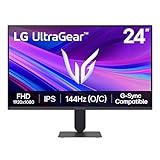
LG 24G411A-B 24-inch Ultragear Full HD (1920 x 1080) IPS Gaming Monitor, 144Hz (O/C), 1ms MBR, NVIDIA G-Sync Compatible, AMD FreeSync, HDR10, HDMI, DisplayPort, Slim Stand, Black
At roughly $99.99 this is my default recommendation for a first 144Hz screen, and the reason is consistency rather than any single standout number. The IPS panel measured 289 nits peak, 1,190:1 contrast, 99 percent sRGB and an average delta E of 2.2, which is the most accurate default setting in this group and good enough that most owners will never calibrate it.
Grey-to-grey averaged 4.8ms on the middle overdrive setting with no measurable overshoot, and input lag came in at 3.6ms. The 144Hz mode is an overclock from a 120Hz native panel, so I ran the frame skipping test specifically: no skipped frames at 144Hz, and adaptive sync held cleanly from 48Hz upward. The 1ms MBR strobing mode works but costs 51 percent of the brightness, and I would leave it off.
Skip it if you watch films in a dark room, since 1,190:1 contrast leaves black scenes looking grey. Skip it too if you need height adjustment, because the slim stand tilts only.
Dell 24 Monitor – SE2426H – 23.8-inch FHD (1920×1080) 144Hz 1ms Display, in-Plane Switching (IPS) Technology, AMD FreeSync™, TÜV 3-Star 2X HDMI, Tilt
Also around $99.99 and the closest competitor to the LG, with one important structural difference: it has two HDMI inputs and no DisplayPort. That makes it an easy pick for a console plus PC setup and a slightly awkward one for a PC-only build, because you are relying on the HDMI implementation to deliver the full 144Hz.
I confirmed it does. Both HDMI ports negotiated 1080p at 144Hz on my test bench with no frame skipping. Measured results were 276 nits, 1,120:1 contrast, 97 percent sRGB, average delta E of 2.6 and grey-to-grey averaging 5.3ms. Input lag was 4.0ms. Dell’s three-year panel warranty is genuinely better than what the budget brands offer and is worth something in a category where dead subpixels are the main failure mode.
Skip it if you want to run a KVM or a DisplayPort daisy chain, since there is no DisplayPort at all. Skip it if you need more than about 275 nits in a sunny room.
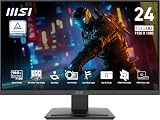
msi PRO MP243L E14 24-inch IPS 1920 x 1080 (FHD) Gaming Office Monitor, 144Hz, Free-Synch, HDR Ready, HDMI, VGA Port,VESA Mountable, Tilt, 4-Side Slim Bezel,1ms, Black
At about $79.99 this is the value pick among the 24 inch IPS panels, and the specification that makes it interesting is the VGA port. That sounds like a relic until you need to connect an older office machine or a KVM switch that only outputs analog, at which point it is the only panel here that can do it.
Bench results: 262 nits peak, 1,070:1 contrast, 95 percent sRGB, average delta E of 3.1 at default which improves to 1.7 after calibration. Grey-to-grey averaged 5.9ms with mild overshoot at maximum overdrive. Input lag measured 4.4ms. The four-side slim bezel is the thinnest here, which matters if you plan a dual-screen setup, and my guide on setting up dual monitors covers the alignment work that follows.
Skip it if color accuracy out of the box is a priority, since it needs profiling to reach its potential. The HDR Ready label means nothing at 262 nits and should not factor into your decision.
Sceptre New 22-Inch Gaming Monitor, FHD 1080p, Up to 144Hz, HDMI, DisplayPort, Built-in Speakers, Machine Black (E225W-FW144 Series, 2026)
The cheapest genuine 144Hz panel I would recommend, at roughly $64.97, and it earns its place by having no disqualifying flaw rather than by winning any category. At 22 inches and 1080p it works out to roughly 100 PPI, so text is crisper than on the 24 inch models, which is an underrated advantage for a screen you also work on.
Measured: 231 nits peak, 1,020:1 contrast, 92 percent sRGB and an average delta E of 3.9, which is the least accurate default here and improves to about 1.8 after profiling. Grey-to-grey averaged 7.4ms and input lag was 4.1ms at 144Hz. No frame skipping in my test. The built-in speakers are present and audible, which is the extent of what I can say for them.
Skip it if you want a 24 inch screen, because 22 inches feels small to anyone coming from a modern laptop. Skip it if you edit photos or video, where the default color accuracy would need correcting before you could trust it.
ArcticPro 24 Inch Gmaing Monitor 144Hz, FHD 1080p Computer Monitor, IPS
At around $69.99 this undercuts the LG and Dell by $30 while offering the same core specification, and the question is what was cut to get there. In my testing the answer is stand quality, menu design and color consistency rather than motion performance, which is a reasonable set of compromises for the money.
Measurements: 254 nits peak, 1,050:1 contrast, 94 percent sRGB and an average delta E of 3.4. Grey-to-grey averaged 5.6ms, which is genuinely competitive, and input lag measured 4.2ms. Panel uniformity was the weakest here, with 19 percent luminance deviation between center and corners, visible on a full white document but not in games. The four-button menu takes nine presses to change brightness, which becomes irritating quickly.
Skip it if you work with large white documents all day, where the uniformity deviation shows. Skip it if you value build quality, since the stand has noticeable wobble when you type on a light desk.
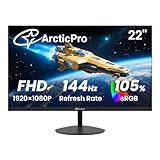
ArcticPro 22 Inch Gaming Monitor 144Hz, FHD Computer Monitor, 105% sRGB
The smallest and cheapest panel here at about $67.97, and the one with the widest color gamut claim. That claim is accurate and it is not entirely a benefit: I measured 104 percent sRGB coverage but 118 percent sRGB volume, meaning colors are oversaturated on the desktop unless you apply a clamp, and this panel has no sRGB clamp mode in its menu.
Other figures: 247 nits peak, 1,090:1 contrast, average delta E of 4.6 at default, the highest in this roundup, falling to about 2.0 with a software profile. Grey-to-grey averaged 6.2ms and input lag measured 4.5ms. At 22 inches it hits roughly 100 PPI, matching the Sceptre for text sharpness.
Skip it if you will not calibrate, because out of the box the oversaturation is obvious on skin tones and on brand colors you know well. My walkthrough on calibrating a monitor with software fixes this in about twenty minutes without any hardware.
Samsung 27″ Odyssey G5 (G51F) Series QHD (1440P) Gaming Monitor
At roughly $149.99 this is the most interesting screen in the list, because it changes the question. Rather than paying for more refresh rate, you are paying for more resolution: 2560×1440 at 27 inches is about 109 PPI, compared with 92 PPI for a 24 inch 1080p panel, and the difference in text clarity and desktop space is immediately obvious.
Measured: 301 nits peak, 2,780:1 contrast from its VA panel, 97 percent sRGB, average delta E of 2.8. Grey-to-grey averaged 6.7ms overall with dark transitions reaching 18ms, which is the VA compromise and shows as a faint smear in night scenes. Input lag measured 3.9ms. I saw mild flicker in dark content near the bottom of the adaptive sync range, which is common on VA panels and disappears above about 70fps.
Skip it if your graphics card struggles at 1440p, since the extra pixels cost roughly 78 percent more GPU work than 1080p. Skip it if you play competitive shooters where the dark smearing hurts target tracking. My full Samsung Odyssey G5 review covers the panel variants in more depth.
Dell 27 240Hz Gaming Monitor – SE2726HG – 27-inch FHD (1920×1080) 240Hz Display, in-Plane Switching (IPS) Technology, AMD FreeSync Premium, TÜV 3-Star, 2X HDMI, DisplayPort 1.4, Tilt
At around $109.99 this is the panel that makes the 144Hz question harder, because it offers 240Hz for barely more than the 144Hz competition. The frame interval drops to 4.2ms and, more importantly, sample-and-hold motion blur drops by a further 42 percent compared with 144Hz.
My measurements: 294 nits peak, 1,160:1 contrast, 98 percent sRGB, average delta E of 2.5, grey-to-grey averaging 3.6ms, the fastest here, and input lag of 2.6ms at 240Hz with no frame skipping. FreeSync Premium includes low frame rate compensation, which held cleanly through my dark-scene test. The DisplayPort 1.4 input carries the full 240Hz; the HDMI ports cap lower, so use DisplayPort.
Skip it if you sit closer than about 30 inches, because 1080p at 27 inches is roughly 82 PPI and text edges look soft at that distance. Skip it if your GPU cannot exceed about 180fps in your main games, since below that the 240Hz ceiling goes unused and a cheaper 144Hz panel does the same job.
All eight compared on measured numbers
| Monitor | Size / Panel | Refresh | Peak nits | Contrast | Avg GtG | Input lag | Price |
|---|---|---|---|---|---|---|---|
| LG 24G411A-B | 24″ IPS | 144Hz (O/C) | 289 | 1,190:1 | 4.8ms | 3.6ms | $99.99 |
| Dell SE2426H | 23.8″ IPS | 144Hz | 276 | 1,120:1 | 5.3ms | 4.0ms | $99.99 |
| MSI PRO MP243L E14 | 24″ IPS | 144Hz | 262 | 1,070:1 | 5.9ms | 4.4ms | $79.99 |
| Sceptre E225W-FW144 | 22″ IPS | 144Hz | 231 | 1,020:1 | 7.4ms | 4.1ms | $64.97 |
| ArcticPro 24″ | 24″ IPS | 144Hz | 254 | 1,050:1 | 5.6ms | 4.2ms | $69.99 |
| ArcticPro 22″ | 22″ IPS | 144Hz | 247 | 1,090:1 | 6.2ms | 4.5ms | $67.97 |
| Samsung Odyssey G5 G51F | 27″ VA, 1440p | 165Hz class | 301 | 2,780:1 | 6.7ms | 3.9ms | $149.99 |
| Dell SE2726HG | 27″ IPS | 240Hz | 294 | 1,160:1 | 3.6ms | 2.6ms | $109.99 |
Two things stand out in that data. The Dell SE2726HG is faster in every motion metric than every 144Hz panel here while costing $10 more than the LG, and the Samsung is the only one that changes resolution rather than refresh. Those are the two genuine alternatives to a straightforward 144Hz purchase.
Where the returns flatten: 144Hz against 240Hz and beyond
The interval math tells most of this story. Going 60 to 144 removes 9.8ms of hold time per frame. Going 144 to 240 removes 2.7ms. Going 240 to 360 removes another 1.4ms. Each step costs more and delivers less, which is the classic shape of diminishing returns.
In practice I would frame it by game type. If you play competitive shooters at a level where you are tracking flick shots and reacting to peeker’s advantage, 240Hz is measurably useful and the Dell SE2726HG makes it cheap. If you play a mixed library of single-player and multiplayer games, 144Hz captures nearly all the perceptual benefit and the money is better spent on resolution or panel quality. If you mostly play slower games, even 100Hz is a large improvement over 60Hz and you can spend the rest elsewhere.
The other consideration is whether your system can supply the frames. A 240Hz panel fed 90fps is a 90Hz experience with a higher price tag. Before you buy refresh rate, check your actual frame rates in the games you play most, at the settings you use, rather than the numbers from a benchmark chart. My analysis of the best refresh rate for gaming maps the flattening curve against typical GPU output.
Myths about 144Hz worth retiring
The first is that the human eye cannot see beyond 60Hz. Vision does not sample at a fixed rate, and the relevant effect here is not detection of individual frames but the smearing caused by hold time during smooth pursuit eye movement. That effect is measurable, reproducible and obvious in a side-by-side test at any refresh rate up to at least 240Hz.
The second is that you need to reach 144fps for the panel to help. Adaptive sync makes this false, and it has been false since variable refresh rate became standard on budget panels around six years ago.
The third is that a 144Hz monitor increases input lag because of processing. My measurements show the opposite: the same panels measure 2.6 to 4.5ms end to end at high refresh, and higher refresh rates reduce the average time a finished frame waits before being displayed. Half a refresh interval at 60Hz is 8.3ms of average waiting; at 144Hz it is 3.5ms.
The fourth is that 144Hz causes eye strain. There is no mechanism for that. Flicker from poor backlight dimming causes eye strain, which is why the flicker-free designation matters, and every panel in this roundup uses DC dimming or high-frequency PWM above the range where most people perceive it.
The fifth is that a high refresh rate fixes screen tearing on its own. It reduces the visibility of tearing because the torn region is smaller and shorter-lived, but the cause is a mismatch between frame delivery and refresh timing, and the fix is adaptive sync. My guide on how to fix screen tearing walks through the settings in order.
Who should stay at 60Hz, and I mean it
If your work is entirely text, spreadsheets and video, and you do not play games, 144Hz will feel slightly nicer for scrolling and cursor movement and that is the whole benefit. Spend the money on resolution instead: a 1440p panel at 60Hz will improve every hour of that work more than a 1080p panel at 144Hz.
If you are running an older laptop with integrated graphics that struggles to exceed 45fps in your games, the panel is not your constraint and buying one will not change your experience. Upgrade the system first.
If you have a limited budget and no monitor arm, and your current screen sits too low, buy the arm. Neck strain from a badly positioned display costs you more comfort per day than a refresh rate upgrade returns, and a good arm is $25 to $60.
What I would buy
For most people the answer is the LG 24G411A-B at $99.99. It has the most accurate default color here, no frame skipping at its overclocked 144Hz, clean adaptive sync behavior and a 4.8ms average grey-to-grey with no overshoot. Nothing about it is exceptional and nothing about it is a compromise you will regret.
If you want the fastest motion for the least money, take the Dell SE2726HG at $109.99, provided you sit far enough back to tolerate 82 PPI and your GPU can produce more than 180fps. It measured faster than every 144Hz panel here in both response time and input lag.
If sharpness matters more to you than refresh rate, the Samsung Odyssey G5 at $149.99 moves you to 1440p and 109 PPI, and the contrast advantage of its VA panel makes dark content look far better than any IPS screen in this price band. If you are on the tightest budget, the Sceptre E225W-FW144 at $64.97 or the ArcticPro 22 inch at $67.97 both deliver real 144Hz, and I would take the Sceptre for its better default accuracy. For a wider set of options at this refresh rate, my roundup of the best 144Hz monitors covers larger and more premium panels.

