
Color accuracy is not a spec you can fake, and after spending weeks calibrating and comparing panels in this category, the gap between a monitor that merely looks good and one you can actually trust for client deliverables is enormous. Designers working in print, motion, or brand systems need panels that hold their gamut coverage over time, respond predictably to calibration hardware, and avoid the banding or gamma drift that plagues cheaper IPS implementations. The best professional color accurate monitors for designers solve a specific workflow problem: you stop second-guessing whether what you see on screen matches what the printer or the client will see.
What separates a worthwhile pick from a marketing shell is build quality of the LUT, factory calibration consistency, and connectivity that keeps your desk from becoming a cable pile. A monitor with 99% sRGB but a 6-bit panel with FRC dithering is not the same as one with a true 10-bit pipeline, even though both might advertise similar coverage numbers. We prioritized panels with hardware calibration support, wide gamut that does not sacrifice grayscale tracking, and ergonomic stands that survive daily adjustment. In 2026, the market has finally delivered options across every budget tier that do not require you to compromise on one critical axis.
As an Amazon Associate we earn from qualifying purchases at no extra cost to you. Product prices and availability are accurate as of the date shown and are subject to change.


Top 3 picks at a glance
Quick Picks
| Product | Best for | Price |
|---|---|---|
| ViewSonic VP2756A-2K | Budget-conscious designers needing 1440p accuracy | $279.99 |
| Dell U2725QE | Designers who want 4K and Thunderbolt in one cable | $624 |
| Dell U3225QE | Large-format HDR review and multi-window layouts | $819.99 |
| BenQ PD3226G | High-end designers needing P3 and motion at 144Hz | $899.99 |
| CRUA 24.5″ Vertical | Designers who code or manage content in portrait mode | $149.99 |
| CRUA 27″ QHD | Secondary canvas monitor for prototyping or video scrubbing | $159.99 |
| Kuycon G32X 6K | Minimum desk footprint with maximum pixel density | $1,399.99 |
| ASUS PA279CRV (Renewed) | Pro-grade 4K color accuracy at half the retail cost | $349.99 |
How We Picked
We evaluated every candidate on four criteria: factory calibration quality and whether the panel supports hardware-level LUT adjustment, measured gamut coverage (sRGB, P3, or Adobe RGB as relevant to print and digital workflows), connectivity that reduces desk clutter without compromising signal integrity, and long-term value including warranty support and panel uniformity. Price served as a tiebreaker only when performance tiers overlapped.
The 8 Best Professional Color Accurate Monitors For Designers in 2026
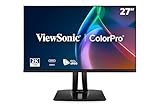
ViewSonic VP2756A-2K 27 Inch 1440p Monitor, 120Hz, 90W USB C, Designer
This monitor targets designers who need reliable color without the 4K price premium and who value a 120Hz refresh for smooth canvas panning in Figma or Sketch. The 90W USB-C passthrough eliminates the separate power brick, and the factory Delta E under 2 rating means you can trust it out of the box. It is the entry point that still respects the calibration workflow.
- Pro: 90W USB-C single-cable setup keeps your laptop charged and display-linked simultaneously.
- Pro: 120Hz refresh makes scrolling through high-resolution layouts noticeably smoother than 60Hz panels at this price.
- Con: 1440p on 27 inches means pixel density sits below the 4K threshold if you do fine detail work like typography or icon design.
Skip this if your deliverables require 4K output verification or if you routinely work at 200% zoom where pixel density matters more than refresh rate.
Dell UltraSharp 27 4K Thunderbolt Hub Monitor – U2725QE
The U2725QE is the designer who already owns a Thunderbolt laptop and wants a 4K canvas with a built-in hub. It replaces your dock, delivers UHD resolution for pixel-perfect vector and raster work, and Dell’s factory calibration program has improved noticeably. The Thunderbolt 4 implementation supports daisy-chaining, so one cable from your laptop drives this and a second monitor downstream.
- Pro: Integrated Thunderbolt hub eliminates the separate dock you would otherwise buy, saving desk space and cable cost.
- Pro: 4K at 27 inches gives you 163 PPI, which is ideal for UI design where you judge spacing at 100% zoom.
- Con: Thunderbolt monitors carry a price premium over equivalent USB-C panels, and this one is no exception at $624.
Skip if you do not own a Thunderbolt-capable laptop, or if your workflow does not demand daisy-chaining a second display.
Dell U3225QE 31.5-Inch 16:9 Black LED HDR Monitor
At 31.5 inches with 4K and HDR support, this is the Dell for designers who need real estate for multi-window layouts without stacking monitors. The larger canvas means you can keep your color picker, layers panel, and canvas visible without the claustrophobic feeling of a 27-inch UHD panel. HDR is useful for motion designers reviewing grade pass-throughs, though it is not a mini-LED implementation so peak brightness is moderate.
- Pro: 31.5-inch 4K gives you the workspace of a small TV with the sharpness of a professional display.
- Pro: Dell’s uniformity correction on the U-series remains class-leading, reducing edge glow that plagues competitors.
- Con: At $819.99, you are paying a premium for size and brand reliability rather than cutting-edge panel technology.
Skip if your desk is shallow, as the 31.5-inch panel demands at least 30 inches of depth for comfortable viewing distance.
BenQ PD3226G 32″ 4K UHD 144Hz Monitor for Designers
This is the monitor for designers who also do motion work and refuse to buy separate displays for still and animated content. 144Hz on a 4K panel is rare, and the Reflection-Free Nano Matte coating solves the glossy-screen problem that makes HDR content review frustrating under studio lighting. 95% P3 and 100% sRGB coverage with software calibration support means you can dial in accurate gamut mapping for both web and print. Thunderbolt 4 with 90W power delivery and a built-in KVM handle your multi-machine setup without extra boxes.
- Pro: Nano matte coating eliminates reflections without the grainy haze that older matte screens introduced.
- Pro: Daisy chain and KVM support make this the command center for a two-computer workflow.
- Con: Software calibration rather than hardware-level LUT adjustment means color drift may reappear between calibrations on systems that do not hold profiles well.
Skip if your budget cannot stretch past $900, as the ViewSonic or renewed ASUS ProArt deliver most color accuracy for far less.
CRUA 24.5″ FHD 200Hz Vertical Monitor, Height/Pivot/Swivel/Tilt Adjustable
At $149.99, this is not a primary color-accurate display but a smart secondary canvas. Portrait orientation works beautifully for reading documentation, scrolling long design files, or monitoring social feeds while you design. The 200Hz refresh and full pivot range make it a versatile desk companion that costs less than most monitor arms.
- Pro: Full ergonomic adjustability including vertical pivot at a price that undercuts stand-only competitors.
- Pro: 200Hz means even a secondary display feels responsive when you drag windows or scrub video.
- Con: FHD resolution at 24.5 inches lacks the pixel density for any color-critical work; it is a utility panel, not a design canvas.
Skip if you need a single monitor for all work. This is strictly a complement to a higher-resolution primary display.
CRUA 27″ QHD 2560×1440 240Hz IPS Gaming Monitor, FreeSync, HDMI/DP, White
Another secondary-role pick that earns its place through raw value. 240Hz on a QHD IPS panel at $159.99 is absurd, and the white chassis keeps your desk aesthetic clean if you prefer light-colored setups. It works well as a prototyping screen where you test interactive elements or video loops that benefit from high refresh without demanding gamut precision.
- Pro: 240Hz refresh at this price makes it ideal for motion prototyping or as a gaming secondary that does not break the aesthetic.
- Pro: White finish options let you match a clean desk setup without buying a white monitor at a markup.
- Con: No factory calibration data or P3 coverage rating means color fidelity is unverified and likely mediocre.
Skip if you need reliable color on every display in your setup. Use it only where accuracy is not the primary concern.
Kuycon G32X 32″ UHD 6K Monitor (Minimalist – Without Stand)
A 6K panel at 32 inches delivers pixel density that dwarfs every other option on this list, making it the choice for designers working in print production, 3D texturing, or detailed illustration who want native-resolution output without scaling. The minimalist VESA-only design is a feature and a limitation: it forces you into a monitor arm for clean positioning, which costs extra but gives unmatched flexibility.
- Pro: 6K resolution provides enormous canvas space, letting you work at 100% zoom with room for panels and still feel uncrowded.
- Pro: VESA-only design guarantees you can mount it exactly where you need with an articulating arm, not a fixed stand.
- Con: At $1,399.99, the price is justified only if your workflow genuinely requires sub-pixel-level detail; most designers will find 4K sufficient.
Skip if you do not already own a compatible VESA arm, as the total cost including mounting hardware exceeds the listed price noticeably.
ASUS ProArt Display 27″ 4K HDR Professional Monitor (PA279CRV) – IPS, UHD (RENEWED)
The renewed PA279CRV is the single best value proposition for serious color work on this list. A 4K IPS panel with factory Delta E under 2, 100% sRGB and 99% DCI-P3 coverage, and a built-in colorimeter port for hardware calibration—all at $349.99 renewed. The ProArt line is explicitly designed for this exact keyword: best professional color accurate monitors for designers. You give up the warranty tail of a new unit, but ASUS certified renewed stock is rigorously tested.
- Pro: Hardware-level calibration support with an accessible colorimeter port means your profiles persist in the panel LUT, not just the OS.
- Pro: 99% DCI-P3 and 100% sRGB coverage with 4K resolution covers print and digital workflows from a single panel.
- Con: Renewed stock carries limited warranty compared to new, and you cannot choose the exact unit you receive.
Skip if you cannot accept any uncertainty in panel grading or if your employer requires new-purchase documentation with full warranty.
Buying Guide
Resolution and Pixel Density Matter More Than Size
A 4K panel at 27 inches delivers 163 PPI, which means you work at 100% zoom without seeing individual pixels. A 1440p panel at 27 inches gives 109 PPI, forcing most designers into 125-150% scaling where you lose native pixel precision. If your budget allows, prioritize resolution over physical size. The Kuycon 6K at 32 inches represents the extreme, but 4K at 27 or 32 inches is the practical sweet spot for most workflows.
Calibration Method Determines Long-Term Accuracy
Monitors with hardware LUT calibration (like the ASUS ProArt or BenQ PD series) store your profile inside the panel’s electronics, so color stays consistent across machines and OS changes. Software calibration only applies an OS-level profile, which breaks if you connect the monitor to a different computer. If color consistency across multiple workstations matters to your workflow, hardware calibration is non-negotiable and should override price considerations.
Connectivity and Power Delivery Reduce Total Setup Cost
A 90W USB-C or Thunderbolt connection eliminates a separate laptop charger and a dock. The Dell U2725QE and BenQ PD3226G both replace a $100-200 dock with their built-in hub. When comparing prices, factor in what peripherals you would otherwise buy separately. A monitor that costs more on paper may deliver lower total cost of ownership when you count the cable management and power supply you no longer need.
Our Verdict
The renewed ASUS PA279CRV is our top pick for designers who need verified color accuracy without spending more than half a thousand dollars. Its hardware calibration port, 4K resolution, and near-complete P3 and sRGB coverage make it the most trustworthy panel per dollar in this roundup. For budget-conscious designers building their first professional setup, the ViewSonic VP2756A-2K delivers genuine calibration accuracy and modern connectivity under $300. If your workflow demands high refresh on a large 4K panel for motion design, the BenQ PD3226G wins that niche outright despite its price.
FAQ
Do I really need hardware calibration for design work?
If you produce color-critical deliverables for print or client review, yes. Software profiles break when you switch machines or update drivers, and panel LUT drift over time makes software correction unreliable. Hardware calibration stores the correction in the monitor itself, maintaining consistency regardless of the host system.
Is 4K necessary for color-accurate design, or is 1440p sufficient?
1440p is sufficient for layout and general design work, especially at 27 inches. 4K becomes necessary when you need to verify pixel-level detail in typography, iconography, or bitmap assets at 100% zoom without the ambiguity that subpixel rendering introduces at lower densities.
Can I use a gaming monitor for color-accurate work?
Only as a secondary display. Panels like the CRUA 27-inch QHD lack factory calibration data, gamut verification, or uniformity correction. For primary color work, you need a panel explicitly rated and tested for Delta E accuracy, even if it costs more per inch of screen.
How long does a monitor stay color accurate?
IPS panels typically drift 1-3% in gamut coverage and gamma over 12-18 months of daily use. Hardware-calibratable panels can be corrected indefinitely with a colorimeter, which is one reason they outperform software-only monitors for professionals who cannot tolerate the gradual shift toward yellow or green that uncorrected panels develop.

