
Setting up a high-productivity workstation or an immersive gaming battle station often leads to one ultimate layout: dual 32-inch displays. The sheer screen real estate of two 32-inch monitors is unmatched, but it comes with a major spatial challenge. These screens are physically massive, and mounting them on a desktop bracket requires careful planning. If you underestimate the footprint, you risk a cramped workspace, screens hovering too close to your eyes, or a structural desktop failure.
Before purchasing your mounting hardware, you must calculate the exact spatial requirements of your workstation. This comprehensive guide breaks down the dimensions, weight considerations, and desktop requirements to ensure your workspace is both functional and safe.
As an Amazon Associate we earn from qualifying purchases at no extra cost to you. Product prices and availability are accurate as of the date shown and are subject to change.
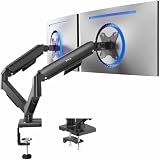

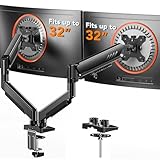

Top 3 picks at a glance
The Short Answer
To comfortably accommodate a dual 32-inch monitor arm, your desk must be at least 55 to 60 inches wide and at least 30 inches deep. Because a standard 32-inch monitor has a physical width of roughly 28 to 30 inches, placing two of them side-by-side creates a total horizontal screen span of 56 to 60 inches.
When determining the exact desk space needed for dual 32 inch monitor arm setups, depth is just as critical as width. You need a minimum desk depth of 30 inches to ensure that the articulating arms can bend properly and that the screens sit at an ergonomically safe viewing distance (at least 20 to 30 inches from your eyes). Additionally, your desk surface must be at least 0.75 to 1 inch thick, made of solid wood, birch plywood, or thick metal, to support the concentrated weight of the mount clamp, which typically holds 30 to 50 pounds of equipment.
Standard Sizes
To plan your layout, you need to understand the physical dimensions of the screens and how they behave when mounted. The table below outlines the recommended desk sizes based on how you plan to configure your dual 32-inch monitors.
| Monitor Configuration | Recommended Desk Width | Recommended Desk Depth | Minimum Desk Thickness | Typical Setup Weight (Monitors + Arm) |
|---|---|---|---|---|
| Side-by-Side (Flat Alignment) | 60″ – 72″ (152 – 183 cm) | 30″ – 36″ (76 – 91 cm) | 0.8″ – 3.0″ (2.0 – 7.6 cm) | 35 – 50 lbs (16 – 23 kg) |
| Side-by-Side (Angled / Curved) | 55″ – 60″ (140 – 152 cm) | 30″ (76 cm) | 0.8″ – 3.0″ (2.0 – 7.6 cm) | 35 – 50 lbs (16 – 23 kg) |
| Stacked (Vertical Alignment) | 36″ – 48″ (91 – 122 cm) | 24″ – 30″ (61 – 76 cm) | 1.0″ – 3.5″ (2.5 – 8.9 cm) | 40 – 55 lbs (18 – 25 kg) |
| Portrait / Landscape Combo | 48″ – 55″ (122 – 140 cm) | 30″ (76 cm) | 0.8″ – 3.0″ (2.0 – 7.6 cm) | 35 – 50 lbs (16 – 23 kg) |
How to Measure Your Space
Do not guess your measurements when dealing with screens of this size. Follow these step-by-step instructions to verify if your current desk—or the one you plan to buy—can handle a dual-arm setup.
- Step 1: Measure the Physical Width of Your Monitors. Remember that “32 inches” is a diagonal measurement. The actual physical width of a standard 16:9 ratio 32-inch monitor is usually between 28 and 29.5 inches. Multiply this by two to get your raw horizontal screen requirement (approx. 56 to 59 inches).
- Step 2: Account for the Angle of the Screens. If you plan to tilt your screens inward toward your seat (which is highly recommended for ergonomics), the overall horizontal footprint will shrink by 4 to 6 inches, but the screens will protrude further forward over your desk.
- Step 3: Measure Your Desk Depth. Sit at your desk and extend your arm. Your fingertips should barely touch your screens. With 32-inch monitors, a 24-inch deep desk is often too shallow because the monitor arms push the screens forward, leaving you with little to no room for a keyboard, mouse, or wrists. A 30-inch depth is the industry sweet spot.
- Step 4: Check Behind-the-Desk Wall Clearance. Articulating mechanical or gas-spring arms require space to bend. If your desk is pushed flush against a wall, the arms will hit the wall, forcing the monitors forward. Measure a clearance gap of 3 to 6 inches between the back of your desk and the wall to allow the arms to bend freely.
- Step 5: Inspect the Under-Desk Frame. Look underneath your desktop. Many desks have metal support beams, cable trays, or structural bevels running along the back edge. Ensure there is a flat, unobstructed surface of at least 3 to 4 inches deep for the C-clamp or grommet base to grip securely.
By Room or Use Case
Depending on where you set up your workstation, your spatial constraints and aesthetic requirements will vary. Here is how to plan your dual 32-inch configuration for different environments.
The Dedicated Home Office
As remote work trends evolve toward highly immersive setups in 2026, professionals are prioritizing ergonomics over minimalism. In a dedicated home office, a 60-inch by 30-inch standing desk is the gold standard for this setup. This size provides enough room to flank your monitors with desktop speakers, a webcam, and a dedicated document space. Because standing desks are prone to slight wobbles when extended, ensure you use a heavy-duty steel mount with a wide C-clamp base to distribute the weight evenly and prevent screen shaking while typing.
The Gaming Station
Gamers often prefer curved 32-inch monitors to maximize their field of view. Curved displays pull the outer edges of the screens closer to your eyes, which slightly reduces the required desk width to around 55 inches. However, because curved screens have a deeper physical profile, they eat up more desktop depth. For a gaming setup, a 72-inch wide by 30-inch deep desk is ideal, as it allows you to showcase a mid-tower PC case on the desk alongside your dual screens without feeling crowded.
The Compact Multi-Purpose Room
If you are squeezing a dual 32-inch setup into a small bedroom or a studio apartment, a horizontal side-by-side configuration is rarely practical. Instead, opt for a stacked configuration where one 32-inch monitor sits directly above the other on a tall vertical pole. This vertical arrangement allows you to use a compact 36-inch to 48-inch wide desk, saving massive amounts of lateral floor space while still giving you the benefit of dual-screen multitasking.
Common Sizing Mistakes
Avoid these frequent pitfalls to keep your screens secure and your workspace comfortable:
- Using Hollow-Core Desks: Many budget-friendly desks (such as paper-honeycomb filled tops) cannot handle the concentrated clamping force of a dual 32-inch monitor mount. The metal bracket will eventually crush the cardboard core, causing the mount to tilt forward or break the desk entirely. Always stick to solid wood, plywood, or reinforced metal desks.
- Ignoring the Focal Distance: Placing two massive 32-inch screens on a shallow 24-inch desk places the panels too close to your face. This leads to eye fatigue, neck strain from turning your head too wide, and general discomfort.
- Neglecting Arm Weight Limits: Entry-level dual monitor arms often have weight capacities maxing out at 17.6 to 19.8 pounds per arm. While some modern 32-inch screens are lightweight, older models or heavy gaming monitors can easily exceed 20 pounds. Always check the net weight of your monitors (excluding their original desktop stands) against the weight limit of the mounting arm.
FAQ
Can I mount dual 32-inch monitors on a standard cheap desk?
It depends entirely on the desk’s material. If your desk is made of solid wood or thick particleboard, it will easily support the weight. However, if it is a hollow-core desk (like some budget Swedish flat-pack options), the clamp will likely crush the desk surface. If you must use a cheaper desk, purchase a steel monitor mount reinforcement plate (usually priced between $15 and $25) to distribute the clamping force over a wider surface area.
How much space behind the desk do I need for articulating arms?
Most mechanical or gas-spring articulating arms require 3 to 6 inches of clearance behind the desk to fold and adjust properly. If your desk must sit flush against a wall, you may need to pull it forward a few inches, or opt for a static, vertical pole-mount setup which requires almost zero rear clearance.
What is the typical price range for a reliable dual 32-inch monitor mount?
Basic, heavy-duty steel mechanical mounts (which use manual hex-key adjustments) generally range from $30 to $50. If you want fluid, gas-spring or counterbalanced mechanical arms that let you adjust the screen positions on the fly with a light touch, expect to spend between $60 and $150. Premium, commercial-grade options designed for heavy displays can range from $180 to over $300.
Do I need a curved desk for dual 32-inch monitors?
No, a straight desk works perfectly fine. Because dual monitor arms are fully adjustable, you can easily angle the outer edges of your flat monitors inward to create a customized “cockpit” viewing angle, mimicking the ergonomic benefits of a curved workspace without the need for specialized furniture.
