
If you are staring at two massive screens taking up your entire desktop, learning how to select desk mount for dual 32 inch displays is the single best ergonomic upgrade you can make. However, this is not a purchase where you can simply buy the cheapest option on a whim. While a standard 24-inch monitor is highly forgiving, a 32-inch monitor is a completely different beast.
The most common mistake buyers make is trusting a simple “fits up to 32 inches” label without looking at the underlying engineering. When you mount two 32-inch monitors, you are suspended anywhere from 24 to 44 pounds of expensive hardware in mid-air. If the mount’s articulation joints are weak, your screens will sag, tilt downward, or constantly drift out of alignment. Furthermore, because of the massive width of 32-inch panels (typically around 28 to 30 inches wide per monitor), many generic dual mounts will not actually allow you to angle the screens toward each other, forcing you into a flat, neck-straining layout. To avoid these headaches, you need to know exactly what specifications to look for.
As an Amazon Associate we earn from qualifying purchases at no extra cost to you. Product prices and availability are accurate as of the date shown and are subject to change.

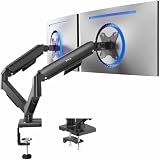
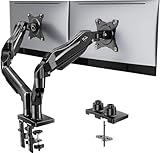

Top 3 picks at a glance
Decide These 3 Things First
Before diving into product listings, you must clarify three foundational aspects of your workspace. Making these decisions early will instantly filter out 70% of the mounts that will not work for your specific desk.
- Mechanical Spring vs. Gas Spring vs. Static Pole: Static pole mounts (like the ErGear Dual Monitor Stand at $29.99) are highly stable and budget-friendly, but height adjustments require manual loosening with an Allen key. Mechanical spring and gas spring mounts (like the HUANUO FlowLift™ at $59.99) use internal tension to let you raise or lower the monitors with a gentle touch. If you plan to transition between sitting and standing, or share the desk with a partner, pick a spring-assisted arm.
- Desk Material and Thickness: A dual 32-inch mount exerts massive concentrated pressure on a single point of your desk. If you have a solid wood or thick butcher block desk (1.0 to 3.5 inches thick), a standard C-clamp is perfect. If you have a glass desk, or a hollow-core desk made of paper honeycomb (such as many popular budget flat-pack desks), a standard clamp can crush the surface. You will need to budget for a reinforcement plate or opt for a grommet mount that bolts directly through a hole in the desktop.
- Wall Clearance: Articulating arms require room to bend. If your desk is pushed completely flush against a wall, the elbow joints of the arms will need to protrude backward. If you cannot pull your desk 4 to 7 inches away from the wall, you will need a specialized short-throw mount or a straight-pole system that keeps the monitors closer to the mounting post.
1. Weight Capacity: The Non-Negotiable Metric
When learning how to select desk mount for dual 32 inch setups, weight is far more important than screen size. A typical modern 32-inch monitor weighs between 12 and 20 pounds without its original stand. Some curved gaming monitors or high-end color-accurate displays can push past 22 pounds.
Always look for the weight capacity per arm, not the combined total. For example, the VIVO STAND-V032 ($44.99) supports up to 22 pounds per arm, making it highly secure for heavy screens. Conversely, other entry-level options might top out at 17.6 pounds per arm. If your monitor weighs 18 pounds and your arm is rated for 17.6, the tilt mechanism will slowly fail, forcing your monitor to face the desk. Weigh your monitors on a kitchen scale (with the desktop stand removed) before buying.
2. Pole Height and Arm Reach
As we look forward to 2026, the standard office desk is no longer dominated by small 24-inch screens; dual 32-inch setups are becoming the baseline for creative professionals and remote workers alike. To stack or side-by-side these larger screens comfortably, you need sufficient vertical and horizontal clearance.
To angle two 32-inch monitors inward for a comfortable viewing arc, the total arm reach must be wide enough. A 32-inch monitor is roughly 28 inches wide. To place two of them side-by-side and angle them toward you, you need a mount with an arm span of at least 34 to 40 inches from the center pole. If the arms are too short, you will be forced to mount the screens completely flat, which causes extreme eye strain at the outer edges of your field of view.
3. VESA Compatibility and Offsets
Almost all dual mounts use standard VESA patterns of 75x75mm or 100x100mm. However, with 32-inch displays, you must look at where the VESA mount is positioned on the back of the monitor. If the mounting holes are recessed into a deep circular pocket (common on Samsung and LG displays), standard square VESA plates will not fit without plastic spacers and longer screws.
Additionally, check if the VESA plate on the mount is detachable. Sliding a 15-pound, 32-inch monitor onto a pre-installed arm bracket is incredibly easy. Trying to hold a 15-pound monitor perfectly still while threading tiny screws into a fixed arm bracket is a recipe for a dropped screen.
4. Adjustment Range: Tilt, Swivel, and Rotation
Ergonomics rely on micro-adjustments. When dealing with large 32-inch panels, slight reflections or off-angle viewing can ruin your visual clarity. Look for these minimum specifications:
- Tilt: At least -45° to +45° (or -90° to +90° for high-angle setups). This allows you to eliminate glare from overhead lighting.
- Swivel: 180° rotation at the arm joints, allowing you to swing a monitor out of the way to show a colleague your screen.
- Rotation: 360° for portrait-to-landscape rotation. Note that rotating a 32-inch monitor to portrait mode requires a mount with extra vertical height (at least 18 inches from the desk surface to the VESA center) so the corner of the monitor does not hit the desk during the rotation.
5. Material and Build Quality
Avoid mounts that rely heavily on plastic structural components. Look for heavy-duty steel, die-cast aluminum, or aircraft-grade alloy constructions. A quality mount for dual 32-inch monitors should weigh at least 10 to 15 pounds on its own. If the entire mounting system only weighs 5 pounds, the metal is too thin to prevent your screens from wobbling every time you type or knock against your desk.
6. Price Tiers and What You Get
Understanding the budget landscape helps you align your expectations with reality:
- Budget ($25 – $40): These are usually static pole designs with steel articulating joints (like the ErGear Dual Monitor Stand at $29.99). They are incredibly strong and stable, but adjusting the height requires manual tools. Best for users who rarely change their monitor height.
- Mid-Range ($41 – $80): This is the sweet spot for most users. Here you will find mechanical spring and entry-level gas spring arms (such as the VIVO STAND-V002O at $49.99 or the HUANUO FlowLift at $59.99). They offer fluid movement, integrated cable channels, and sleek aesthetics.
- Premium ($100 – $250+): Built with heavy-duty polished aluminum, premium gas cylinders, and extended warranties. These mounts are designed for heavy creative workstations and can hold monitors up to 30+ pounds each without any drift or vibration.
Spec Checklist
Use this checklist to quickly evaluate any dual mount you are considering for your 32-inch screens:
| Feature / Specification | Budget Tier ($25–$40) | Mid-Range Tier ($41–$80) | Premium Tier ($81–$250+) |
|---|---|---|---|
| Weight Capacity (Per Arm) | 14 to 17.6 lbs | 19.8 to 22 lbs | 25 to 33+ lbs |
| Adjustment Mechanism | Static Pole / Manual clamp | Gas Spring or Mechanical Spring | Premium Gas/Counterbalance Spring |
| Primary Material | Powder-coated Steel | Steel & Die-Cast Aluminum | Aircraft-grade Polished Aluminum |
| VESA Plate Style | Fixed / Non-detachable | Detachable keyhole design | Quick-release click-in system |
| Cable Management | External plastic clips | Integrated internal channels | Hidden routing with magnetic covers |
| Desk Thickness Range | 0.4″ to 3.0″ | 0.4″ to 3.2″ | 0.4″ to 3.5″+ (Heavy-duty clamps) |
Red Flags
When shopping, watch out for these warning signs that indicate a mount may not be fit for dual 32-inch monitors:
- “Fits up to 32 inches” but only holds 14 lbs: This is a major red flag. Many modern, high-quality 32-inch monitors exceed this weight limit. If your monitor is too heavy, the tilt joint will fail, leaving your screen permanently pointing downward.
- No tension adjustment screw: For spring arms, there must be a hex screw to increase or decrease the lift tension. If this is missing, the arm is preset and will either slam your light monitor to the ceiling or drop your heavy monitor to the desk.
- Unusually short arm span: If the total arm span (tip to tip) is under 32 inches, you will not be able to run two 32-inch screens side-by-side unless they are completely flat against each other, which defeats the purpose of an ergonomic dual-monitor workspace.
FAQ
Can I mount one curved 32-inch and one flat 32-inch monitor on the same dual mount?
Yes, but you must pay close attention to the weight and center of gravity. Curved monitors naturally project their weight forward, which puts extra stress on the tilt joint of the mount. Ensure the mount’s weight rating exceeds your curved monitor’s weight by at least 2 to 3 pounds to prevent the screen from drooping forward.
What should I do if my desk is made of particle board or MDF?
MDF is prone to warping and crushing under concentrated loads. If you are mounting dual 32-inch monitors (which can create a combined downward force of over 40 pounds including the mount), do not use a narrow C-clamp directly on the wood. Buy a steel monitor mount reinforcement plate. These plates distribute the clamping force over a wider surface area, preventing the desk from bowing or cracking.
How do I know if my monitors are VESA compatible?
Look at the back of your monitors. You should see a square pattern of four screw holes spaced either 75mm (approx. 3 inches) or 100mm (approx. 4 inches) apart. If the back of your monitor is completely smooth and has no holes, it is non-VESA. You will need to purchase a separate VESA adapter kit that clamps onto the outer edges of your monitor frame.
Should I choose a dual-arm mount with a single base or two single-arm mounts?
For dual 32-inch screens, two single-arm mounts often provide much better flexibility than a single dual-arm mount. A single base with dual arms forces the mounting points close together, which limits your positioning options for screens this large. Two independent single mounts allow you to place the bases wherever you want on the desk, giving you unlimited layout freedom, including stacking them vertically or placing them at extreme angles.

