
Upgrading to a massive ultrawide or super-ultrawide monitor is one of the most satisfying desk upgrades you can make. Whether you are managing complex timelines, immersive flight simulators, or endless spreadsheets, the expansive screen real estate is a game-changer. However, mounting these giant panels presents a serious engineering challenge. Many buyers make the mistake of purchasing a standard monitor arm, only to watch their expensive screen slowly droop forward, shake with every keystroke, or, in the worst-case scenario, crash down onto their desk.
The primary error is shopping by screen diagonal size alone. An advertising label that claims an arm supports “up to 49-inch screens” is only telling half the story. Ultrawide monitors, particularly those with aggressive curves, shift the center of gravity forward, exerting massive rotational force (torque) on the arm’s tilt joint. To keep your screen stable, safe, and perfectly positioned, you must understand the mechanics of heavy-duty support.
As an Amazon Associate we earn from qualifying purchases at no extra cost to you. Product prices and availability are accurate as of the date shown and are subject to change.
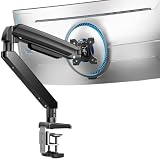


Top 3 picks at a glance
Decide These 3 Things First
Before you begin browsing product listings or comparing prices, you must establish three critical baselines regarding your specific monitor and desk setup. This will immediately filter out incompatible options and save you from the hassle of a return.
- The True Weight of Your Screen (Minus the Stand): Manufacturers list the “shipping weight” and the “product weight with stand.” You must find the net weight of the panel itself. For example, a 49-inch super-ultrawide might weigh 42 pounds in the shipping box, but only 26 to 31 pounds once you remove its heavy stock desktop stand. This net weight is the only number that matters for the arm’s capacity.
- Your Monitor’s Curve Radius (R-Rating): The curve of an ultrawide is measured in millimeters of radius, denoted by an “R” (e.g., 1800R, 1500R, or 1000R). A 1000R curve is much deeper than an 1800R curve. Deep curves push the outer edges of the monitor forward, which shifts the center of gravity away from the VESA mounting plate. This requires a much stronger tilt joint to prevent the screen from drooping face-down.
- Your Desk’s Structural Integrity: A heavy-duty monitor arm concentrates the weight of a 30-pound monitor and a 15-pound arm onto a tiny footprint on your desktop. If your desk is made of hollow-core particle board (such as paper-honeycomb filled tops), the clamping force can easily crush the wood. You need a solid wood, thick MDF, or metal-framed desk, or you must plan to use a steel reinforcement plate to distribute the load.
Monitor Size and Weight Limits
When dealing with ultrawide monitors, weight capacity is the ultimate safety metric. Standard monitor arms are typically rated for weights up to 17.6 or 22 pounds. If you mount a 34-inch or 49-inch ultrawide on these, the internal gas cylinder or mechanical spring will immediately bottom out, leaving your monitor resting flat on the desk surface.
Heavy-duty monitor arms are engineered with reinforced internal springs to handle the load. For a standard 34-inch ultrawide, a weight capacity of up to 33 pounds—such as the limit found on the WALI Ultrawide Single Monitor Arm ($33.99)—is generally sufficient. However, if you are stepping up to a 49-inch super-ultrawide, you should target an arm with a capacity of at least 37.4 pounds (like the ErGear Heavy Duty model at $39.99) or up to 44 pounds (featured on the HUANUO TitanLift at $97.99 and the WALI Heavy Duty 1000R model at $59.99).
Always leave a safety buffer of at least 15% to 20% between your monitor’s actual weight and the arm’s maximum rated capacity. Running an arm at 99% of its weight limit accelerates wear on the internal gas spring and makes fine-tuning the tension incredibly difficult.
Material and Structural Integrity
The materials used in the construction of a heavy-duty arm dictate its long-term durability and resistance to wobbling. Cheap monitor arms rely heavily on stamped sheet metal and plastic decorative shrouds. Under the weight of a premium ultrawide, these materials flex, causing your screen to bounce every time you type or bump your desk.
High-quality heavy-duty mounts utilize die-cast aluminum or heavy-gauge structural steel. Aluminum, used extensively in premium options like the HUANUO TitanLift, offers an excellent strength-to-weight ratio. The arm itself is lighter, which puts less cumulative stress on your desk, yet it remains incredibly rigid. Steel components are typically used in the base, clamp, and main vertical pole where maximum resistance to bending is required.
Pay close attention to the joints. Look for arms that feature heavy-duty steel pivot pins and dual-link construction. If the joints contain thin plastic bushings, they will degrade under the constant tension of a heavy screen, leading to a loose, shaking display within a few months of use.
Tilt and Adjustment Construction
The tilt mechanism is the single most common failure point for ultrawide monitor setups. Because curved screens sit forward of the VESA plate, they act as a lever, constantly trying to tilt the monitor downward. On standard arms, the tilt joint is held in place by simple friction washers tightened by a small nut. Under ultrawide loads, these washers slip, causing the screen to tilt forward toward the desk.
To prevent this, look for a tilt joint specifically designed with a reinforced mechanism. This can include dual-sided locking bolts, heavily textured friction plates, or specialized mechanical springs inside the tilt head itself. For aggressive 1000R curved screens, you should look for models like the WALI Heavy Duty 1000R Monitor Arm ($59.99), which are engineered with reinforced tilt joints to neutralize the forward rotational torque of deep curves.
Before purchasing, check the tilt range adjustment. A good heavy-duty arm should offer at least +45 to -45 degrees of tilt adjustment, allowing you to lock the angle securely once you find your preferred viewing position.
Ergonomic Comfort and Range of Motion
A heavy-duty monitor arm should not sacrifice adjustability for strength. The goal of mounting your screen is to achieve perfect ergonomic alignment: the top third of your screen should be at eye level, and the panel should sit roughly an arm’s length away from your face.
To achieve this, evaluate the following adjustment ranges:
- Height Adjustment (Vertical Lift): Look for an arm that offers at least 10 to 13 inches of tool-free vertical height adjustment. This allows you to easily transition between sitting and standing if you use a height-adjustable desk.
- Extension and Retraction: The arm should be able to extend forward by at least 20 inches and retract back to sit almost flush against the rear wall. This is crucial for clearing desk space when you need to do non-computer work.
- Swivel and Rotation: The arm should allow for 180 degrees of swivel at the base and mid-joints. While rotating a 49-inch ultrawide into portrait mode is rarely practical, having 90-degree rotation is helpful during installation and cable routing.
Gas spring mechanisms provide the smoothest, most fluid movement, allowing you to adjust the position of your heavy screen with a light touch. Mechanical spring arms are slightly stiffer but offer unmatched long-term durability, as they do not suffer from the gradual pressure loss that can affect gas cylinders over several years of continuous use.
Price Tiers and Budget Realities
The market for heavy-duty monitor arms has expanded dramatically. While premium commercial-grade arms used to be the only viable option for heavy screens, there are now highly capable options across three distinct price tiers.
Budget ($30 – $50): In this tier, you will find options like the WALI Ultrawide ($33.99) and the ErGear Heavy Duty ($39.99). These arms are excellent for entry-level 34-inch ultrawides or lighter 38-inch screens. They often feature steel construction and basic gas springs. However, their tilt joints may require significant tightening to hold heavier or curved screens, and they may exhibit minor wobble on thinner desks.
Mid-Range ($50 – $120): This is the sweet spot for most 49-inch super-ultrawide owners. Products like the WALI Heavy Duty 1000R ($59.99) and the HUANUO TitanLift ($97.99) live here. These arms feature upgraded aluminum components, heavy-duty dual C-clamps, and reinforced tilt heads engineered specifically to combat the droop associated with curved gaming monitors. They offer a stable, premium experience without a massive financial investment.
Premium ($150 – $350+): These are commercial-grade, heavy-duty arms engineered for maximum durability. They feature pristine finishes, internal cable management tracks, and heavy mechanical springs that will last for decades. As we look ahead to workspace trends in 2026, these high-end arms remain the gold standard for users who frequently adjust their monitor’s position throughout the day or who own exceptionally heavy professional displays.
Assembly, Desk Delivery, and Mounting Requirements
Installing a heavy-duty arm is a two-person job. Attempting to mount a 30-pound curved monitor onto an arm by yourself is a recipe for damaged hardware. When evaluating an arm, look at the mounting hardware and installation process.
Most heavy-duty mounts offer two installation methods: C-clamp and grommet. For ultrawides, a dual C-clamp design (found on the ErGear and HUANUO models) is highly recommended. By utilizing two clamping screws instead of one, the mount distributes the downward and rotational forces across a wider section of your desktop, reducing desk flex and improving overall stability.
Check the thickness compatibility of the clamp. Most heavy-duty clamps require a desk thickness of 0.4 inches to 3.3 inches. If your desk has a chamfered edge or an under-desk support beam close to the edge, ensure you have at least 3 to 4 inches of flat clearance underneath for the clamp bracket to grip securely.
Spec Checklist
Use this quick reference table to compare what you should expect across different price tiers when shopping for a heavy-duty monitor arm.
| Spec | Budget ($30 – $50) | Mid-Range ($50 – $120) | Premium ($150+) |
|---|---|---|---|
| Weight Capacity | Up to 33 – 37.4 lbs | Up to 44 lbs | Up to 44 – 50 lbs |
| Max Screen Size | 34″ to 49″ (Flat/Light Curve) | Up to 49″ (Deep 1000R Curve) | Up to 49″ – 57″ (Extreme Curves) |
| Material | Stamped Steel & Plastic | Die-Cast Aluminum & Steel | Aircraft-Grade Aluminum |
| Clamping Style | Single or Basic Dual C-Clamp | Heavy-Duty Dual C-Clamp | Reinforced Low-Profile Clamp |
| Tilt Mechanism | Friction Bolt (Requires high torque) | Reinforced Tilt Head / Spring Assisted | Heavy-Duty Mechanical Counterbalance |
| Warranty | 1 – 3 Years | 3 – 5 Years | 10+ Years / Lifetime |
Red Flags
When shopping for a heavy-duty monitor arm, be on the lookout for these critical warning signs that indicate an arm may not be up to the task of holding an ultrawide screen:
- Vague Weight Ratings: If a listing repeatedly mentions “up to 49 inches” but buries the actual weight capacity in the fine print, or if the capacity is under 30 pounds, it is not a true heavy-duty arm.
- Single-Bolt C-Clamps: A single, narrow C-clamp bracket concentrates all the stress on one small point on your desk. For a heavy 49-inch monitor, this can easily warp or crack your desktop. Look for dual-bolt clamps or wide-base designs.
- No Mention of Curve Compatibility: If the manufacturer does not explicitly state that the arm supports 1000R or deeply curved monitors, the tilt joint is likely a standard friction design that will struggle with forward weight distribution.
- Lightweight Product Weight: A heavy-duty arm needs mass to support mass. If the entire shipping weight of the arm is under 8 pounds, it is likely made of thin, flexible metal and plastics that will wobble under heavy loads.
FAQ
Can I mount a 1000R curved monitor on a standard heavy-duty arm?
You can, but you will likely experience screen droop. Standard heavy-duty arms are rated for weight, but not necessarily for the forward center of gravity shift caused by a 1000R curve. For these deep curves, it is best to choose an arm specifically engineered with a reinforced tilt joint, such as the WALI Heavy Duty 1000R model, to ensure the screen stays level.
Do I need a desk reinforcement plate for an ultrawide monitor arm?
If your desk is made of solid hardwood (like oak, walnut, or butcher block), you do not need a reinforcement plate. However, if your desk is made of MDF, particle board, or thin wood veneer, a steel reinforcement plate is highly recommended. It spreads the clamping force over a larger surface area, preventing the desk from bowing or cracking under the weight.
What is the difference between gas spring and mechanical spring arms?
Gas spring arms use a pressurized gas cylinder to counterbalance the monitor’s weight, providing incredibly smooth, one-handed adjustments. However, gas cylinders can slowly lose pressure over many years. Mechanical spring arms use physical steel coils. They are slightly stiffer to adjust and can require more effort to set up, but they are virtually indestructible and will never lose their tension over time.
Why does my ultrawide monitor keep tilting downward on my new arm?
This is almost always due to the tilt joint bolt not being tightened sufficiently. Heavy-duty arms require a massive amount of tension to lock the tilt joint against the leverage of an ultrawide screen. Locate the primary hex bolt at the very pivot point behind the VESA plate and tighten it firmly with the included Allen wrench. Do not be afraid to apply significant force; these joints are designed to be clamped down tight.

