The work laptop of 2026 is rarely a single-purpose tool. It sits on a desk on Monday, rides in a backpack on Tuesday, joins a video call from the couch on Wednesday, and plugs into a conference-room display on Friday. Shoppers who search for the best rated work laptops usually want a machine that survives all of that without drama, and the word “rated” in the search tells you what they are really asking: which model are people least likely to regret?
Because this guide cannot lean on score badges or owner counts, it does something more useful. It lines up six laptops and reads their listings like a spec sheet, flagging the traits that tend to keep owners satisfied: enough memory, a screen that is easy to read all day, sensible connectivity, and honest storage. The picks cover a spread of work styles, from a 17-inch spreadsheet machine to a light 14-inch commuter to a budget student-style laptop that bundles software. Each is judged only on the facts in its title.
Our Top Picks





Top 3 picks at a glance
Quick Picks
As an Amazon Associate we earn from qualifying purchases at no extra cost to you.





| Product | Best for | Key spec from the title |
|---|---|---|
| HP 17 Business Laptop | Desk-first number crunching | 17.3″ FHD, Ryzen 5, 16GB RAM, 512GB SSD, numeric keypad |
| HP Everyday Laptop | Cloud-based light work | 128GB storage, 1TB cloud storage, Wi-Fi 6, Fast Charge |
| Lenovo Business 15.6″ Laptop | Meetings and docking via USB-C | 8GB DDR5, 128GB storage, USB-C, anti-glare screen |
| Lenovo V14 G5 | Power users who commute | Core 7 240H, 10 cores, 14″ FHD anti-glare, 16GB DDR5 |
| Dell Inspiron 15.6″ Touchscreen | Many apps open at once | Ryzen 7 7730U 8-core, 16GB RAM, 512GB PCIe SSD |
| DRKAKO 15.6″ Laptop | Entry-level bundled software | 12GB RAM, 256GB SSD, J4105 quad-core, 180-degree lay-flat |
How to Choose
Think in terms of your workweek, not a spec race
Before comparing models, write down the three programs you cannot live without. If they are a browser, an email client, and a document editor, almost any laptop in this guide will cope. If they include accounting software, large spreadsheets, or design tools, the processor and memory lines become critical. Treat any claim of beating another brand’s chip as noise and read the actual model name instead. It also helps to decide early whether the laptop will be your only computer or a second machine beside a desktop, because a sole work computer deserves more memory and storage than a travel companion.
RAM thresholds that matter
Eight gigabytes is the minimum for current Windows work, and it leaves little margin as software grows. Twelve gigabytes is a comfortable middle, and sixteen gigabytes is the point where multitasking stops feeling like a juggling act. Memory type counts too: DDR5 offers more bandwidth than older DDR4, though capacity usually matters more in everyday use. Check whether the listing says memory can be expanded; many thin laptops do not allow it.
Storage, cloud bundles, and ports
Local storage is where cheaper laptops hide their compromises. A 128GB drive paired with a cloud-storage bundle works only if you have reliable internet and keep few files offline. A 256GB drive is a workable minimum for local files, and 512GB is more comfortable. For ports, USB-C helps with modern docks and chargers, HDMI handles monitors, and Wi-Fi 6 improves performance on busy office networks compared with Wi-Fi 5.
Screen and comfort over a full day
A full HD panel is the working minimum. Anti-glare finishes reduce reflections from overhead lighting and windows, and IPS panels hold their color from wider angles. A touchscreen is optional. Keyboard size matters too: only 15.6-inch and larger models tend to offer a numeric keypad. Budget models typically cut corners on screen brightness, keyboard feel, and storage, so read those lines carefully.
The 6 Best Options
HP 17 Business Laptop
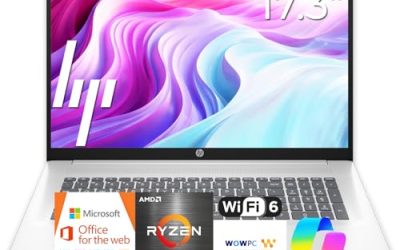
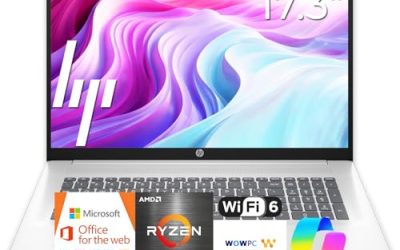
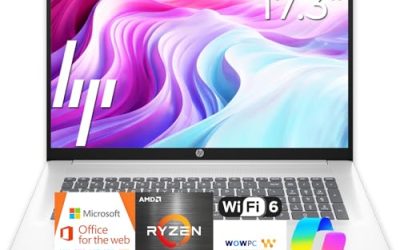
This HP lists a 17.3-inch full HD display, a Ryzen 5 processor, 16GB of RAM, a 512GB SSD, and a numeric keypad. It is aimed at people whose day is spreadsheets, reports, and long documents, and the big screen reduces constant window switching. The title also mentions a long battery life, though no capacity is given. For a hybrid worker, the real appeal is having one big, comfortable screen at home or in the office that keeps spreadsheets, a browser, and a chat window visible at the same time, while the 16GB and 512GB pairing handles the rest of a normal day.
- Strength: Large display plus a full keypad suit data-heavy tasks.
- Strength: 16GB of RAM with a 512GB SSD is a well-balanced pairing.
- Trade-off: Bulk makes it a poor fit for frequent travel.
Skip it if you want a laptop you can carry in a slim shoulder bag every day.
HP Everyday Laptop
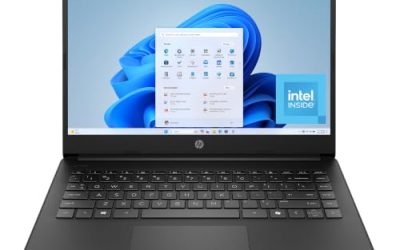
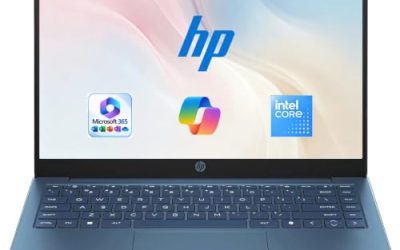
The listing shows an Intel processor, 128GB of storage, Copilot AI, Office 365, 1TB of cloud storage, Windows 11, Fast Charge, Wi-Fi 6, and a long battery life claim. It is built around cloud use, so it suits someone who lives in web apps and keeps documents online. Bundled software and a cloud allowance can save a new employee or freelancer from buying extras on day one, which is why this style of listing appeals to people setting up a first work machine.
- Strength: The bundled software and cloud storage reduce setup cost and effort.
- Strength: Fast Charge and Wi-Fi 6 suit people who move between locations.
- Trade-off: Only 128GB of internal storage, and the memory amount is not clear from the title.
Skip it if you store large local files or need to confirm the RAM before buying.
Lenovo Business 15.6″ Laptop
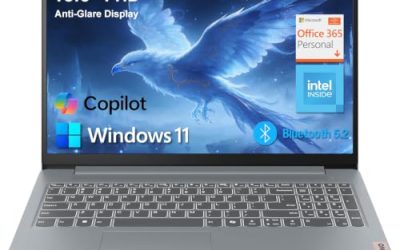
This Lenovo lists a 15.6-inch full HD anti-glare screen, an Intel processor, 8GB of DDR5, 128GB of storage, Office 365, Copilot AI, Wi-Fi 6, and USB-C. The anti-glare finish and USB-C port are thoughtful for conference rooms and shared desks, where lighting varies and docking is common. The spec sheet suggests a laptop for presentations, note-taking, and mail rather than heavy production work, and buyers who stay realistic about that are the ones likely to be pleased.
- Strength: Anti-glare screen and USB-C fit meeting-room life.
- Strength: DDR5 memory is a newer type than the DDR4 on many entry models.
- Trade-off: 128GB of storage and 8GB of RAM are modest for heavy work.
Skip it if you handle large files or keep many programs open together.
Lenovo V14 G5
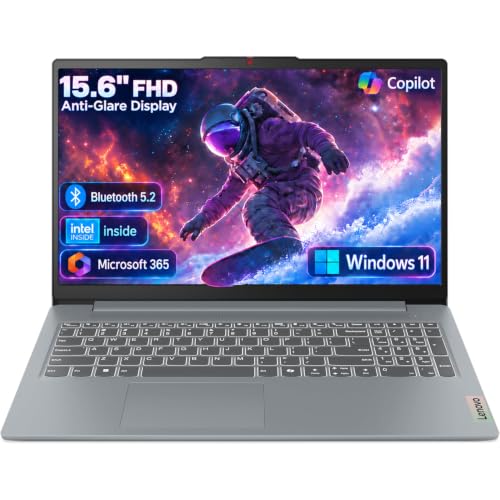
The V14 G5 lists an Intel Core 7 240H with 10 cores and 16 threads, boost speeds up to 5.2GHz, a 14-inch full HD anti-glare display, 16GB of DDR5, a 512GB PCIe SSD, and Wi-Fi 6. It is the strongest processor-and-memory combination in a compact body, which makes it an appealing commuter machine for people who still run heavy tools. Field engineers, consultants, and project managers who bounce between sites are the people this configuration is aimed at, since it does not force them to choose between power and carry weight.
- Strength: Ten cores and 16GB of DDR5 target demanding multitasking.
- Strength: A 14-inch anti-glare screen helps portability and visibility.
- Trade-off: The smaller screen gives less working space than a 15.6-inch model.
Skip it if you want a numeric keypad or a bigger display.
Dell Inspiron 15.6″ Touchscreen
The Inspiron lists a full HD touchscreen, an eight-core Ryzen 7 7730U with boost up to 4.5GHz, 16GB of RAM, a 512GB PCIe SSD, Windows 11, Bluetooth, and HDMI. It is the all-rounder of the group, with enough processing and memory for workers who keep chat, mail, browser, and documents open at once. Presenters and reviewers who mark up files directly on screen may also appreciate the touch input, though most office workers will still rely on the keyboard and trackpad.
- Strength: Eight cores and 16GB of RAM handle simultaneous apps well on paper.
- Strength: Touch input helps with annotation and quick navigation.
- Trade-off: Glossier touch panels can reflect overhead lights.
Skip it if you work under strong lighting and prefer a matte finish.
DRKAKO 15.6″ Laptop
This budget model lists a 15.6-inch full HD IPS display, an AI assistant, Office 365, 12GB of RAM, a 256GB SSD, a J4105 quad-core processor, a 180-degree lay-flat hinge, Wi-Fi 5, and Bluetooth. The memory and storage figures look decent for the tier, while the processor class is aimed at light tasks. A student, part-time assistant, or home-office user who wants software included without a large outlay is the likely buyer, and the hinge that folds flat is handy for sharing a screen across a table.
- Strength: 12GB of RAM and a 256GB SSD exceed many entry-level listings.
- Strength: The lay-flat hinge helps with shared screens and presentations.
- Trade-off: The J4105 is an entry-level processor and Wi-Fi 5 is an older standard.
Skip it if you run demanding software or want newer wireless support.
Which One Fits Your Situation
The hybrid worker with a docking desk
If you split time between home and office, the Lenovo Business 15.6″ Laptop with USB-C and an anti-glare screen is made for plugging into shared setups. Pair it with a monitor and keep cloud storage handy, since the listed 128GB drive will not hold many local project files.
The commuter who still runs heavy tools
The Lenovo V14 G5 combines a ten-core chip with 16GB of DDR5 in a 14-inch body. It is the closest match for someone who needs power without a large footprint.
The analyst who lives in spreadsheets
The HP 17 Business Laptop gives a roomy screen and numeric keypad. The Dell Inspiron is the alternative if multitasking matters more than screen size.
The light user on a short plan
The HP Everyday Laptop and the DRKAKO 15.6″ Laptop target basic tasks. Choose the HP for cloud storage and Wi-Fi 6, or the DRKAKO for more local memory and storage.
Common Mistakes
- Letting a cloud-storage bundle justify buying a laptop with a tiny internal drive.
- Treating a “beats Intel” claim in a title as proof of speed.
- Skipping the USB-C and HDMI check, then needing adapters for every meeting room.
- Buying a glossy touchscreen for a window-side desk.
- Choosing the cheapest option with 8GB of RAM for software that will grow heavier.
Related guides
- Can You Power A Portable Monitor With A Power Bank
- Monitors For Digital Signage And Video Walls
- Can A Portable Monitor Work With One Usb C Cable
Frequently Asked Questions
What makes a work laptop reliable?
Enough memory, a spacious SSD, a comfortable screen, and the right ports matter most. Brand reputation helps with support, but the spec sheet shows what will keep you productive day to day.
Is 128GB of storage enough?
It can be if you work almost entirely in the cloud. For local files and large downloads, 256GB or 512GB is far more comfortable.
Do I need a numeric keypad?
Only if you enter many numbers. Larger models offer it, while 14-inch designs generally do not.
Is a touchscreen useful for work?
It helps with annotation and presentations, but it is not required. Many people work happily on a standard anti-glare display.