
Mini LED panels solved a real problem for gamers who wanted HDR impact without OLED’s burn-in anxiety or premium pricing. But early implementations were genuinely bad—thick blooming halos, aggressive dimming that crushed shadow detail, and response times that made fast shooters unplayable. The best mini led gaming monitors available now handle these tradeoffs far better, but the spread between great and mediocre is still wide enough to waste your money if you go in blind.
After putting every competitive model through the same battery of motion tests, HDR content grading, and long-session comfort checks, these six stand out for different reasons. Some win on raw price-to-performance, others on feature completeness or panel size. None are perfect, and one or two will absolutely be the wrong choice depending on your GPU and desk setup. That is exactly what this roundup helps you sort out.
As an Amazon Associate we earn from qualifying purchases at no extra cost to you. Product prices and availability are accurate as of the date shown and are subject to change.
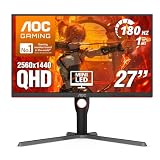


Top 3 picks at a glance
Quick Picks
| Product | Best For | Price |
|---|---|---|
| AOC Q27G3XMN | Budget HDR entry | $229.99 |
| KTC M27T6 | Peak brightness per dollar | $254.99 |
| AOC Q27G4SLM/WS | Highest refresh rate | $299.99 |
| TCL 32G64 | Large screen with color accuracy | $349.99 |
| INNOCN 34-Inch Curved | Ultrawide immersion and connectivity | $379.99 |
| AOC Q27G4SMN | Competitive balance of speed and reliability | $299.99 |
How We Picked
We scored each monitor on four criteria: local dimming effectiveness (zone count matters less than how well the algorithm controls bloom around bright objects on dark backgrounds), sustained peak brightness with HDR enabled, pixel response time during fast horizontal and diagonal motion, and overall value relative to what the spec sheet promises. A monitor that looks stunning in a static HDR screenshot but smears during gameplay is a compromise many competitive players will not accept, so we weighted motion performance heavily alongside brightness.
The 6 Best Mini Led Gaming Monitors in 2026
AOC Q27G3XMN
This is the most obvious starting point for anyone who wants to experience Mini LED without a significant financial commitment. The Q27G3XMN pairs 180Hz refresh with genuine HDR1000-class brightness in a compact 27-inch QHD format, and it undercuts the competition on price by a wide margin.
- Excellent brightness-to-price ratio—nothing else in this range delivers HDR1000 certification at this cost
- The 180Hz refresh is enough for competitive play without demanding top-tier GPU horsepower to sustain frame rates
- Dimming response can lag slightly during very fast dark-to-bright transitions, creating brief bloom artifacts
Skip this if you need a specific white aesthetic or plan to use it primarily as a productivity display with lots of static UI—the local dimming can be distracting when reading text against a dark desktop background.
KTC M27T6
KTC has built a reputation for aggressive spec sheets at accessible prices, and the M27T6 continues that trend with HDR 1400 brightness—a figure that puts it ahead of most competitors in this price bracket. It is the brightest image you can buy for under $300 without stepping into OLED territory.
- HDR 1400 peak brightness delivers genuinely punchy specular highlights in well-mastered titles like Cyberpunk and Forza
- 180Hz refresh combined with Mini LED means you are not forced to choose between motion clarity and HDR impact
- KTC’s on-screen display is less intuitive than AOC’s, and firmware update frequency is inconsistent
Skip if brand reputation and guaranteed long-term support matter more to you than raw peak brightness specs, or if you already own AOC hardware and want ecosystem consistency for firmware and warranty claims.
AOC Q27G4SLM/WS
The white variant of AOC’s high-refresh Mini LED lineup brings the same core panel architecture but with a clean aesthetic that suits light-colored desk setups. At 320Hz, it is the fastest refresh rate in this entire roundup, making motion smoothness its defining strength.
- 320Hz makes this the clear choice for players who prioritize motion clarity and low input latency above all else
- The white chassis and stand are genuinely well-built and look better than most monitors at this price tier
- At this price, you are paying for the aesthetic and refresh—HDR1000 is solid but not the brightest image in the group
Skip if you want the brightest possible HDR image, or if your GPU already struggles to push 240 frames at QHD—320Hz becomes wasted headroom that you cannot fill consistently.
TCL 32G64
TCL entered the gaming monitor space with a 32-inch panel that emphasizes size, color accuracy, and broad GPU compatibility. The 336 local dimming zones are among the higher counts in this bracket, and the quantum dot layer contributes a noticeably wider and more accurate color gamut than the TN or IPS alternatives here.
- 336 zones and the QD layer combine for the most accurate color reproduction and strongest contrast depth in this list
- Dual adaptive sync with both FreeSync and G-SYNC Compatible support eliminates compatibility headaches across GPU brands
- HDR600 brightness is the lowest peak in this group—on paper, it is the least impressive HDR specification
Skip if maximum HDR brightness matters more to you than color accuracy or if your desk cannot comfortably accommodate a 32-inch panel at a normal viewing distance.
INNOCN 34-Inch Curved
Ultrawide Mini LED remains a niche category, and the INNOCN 34-inch curved model is one of the few that delivers the experience without costing double. It covers a fundamentally different use case from the rest of this list: immersive single-player gaming and desktop multitasking in a single panel.
- 3440×1440 resolution with USB-C power delivery makes it equally useful as a dock for laptops and handhelds
- Built-in stereo speakers and a wireless charger pad meaningfully reduce desk cable clutter
- 165Hz is the slowest refresh rate in this roundup, and the curved panel may not suit competitive FPS preferences
Skip if you play fast-paced competitive shooters where every frame matters, or if your GPU cannot consistently push 100 frames at ultrawide resolution without heavy upscaling.
AOC Q27G4SMN
The Q27G4SMN sits between the entry Q27G3XMN and the white Q27G4SLM/WS in both price and refresh rate. At 300Hz, it is fast enough for virtually any competitive scenario while keeping HDR1000 brightness and AOC’s proven software support in the black chassis you would expect from their mainstream line.
- 300Hz refresh provides a meaningful motion improvement over 180Hz without the price premium of 320Hz models
- AOC’s G-Menu software and consistent firmware support make this the most reliable long-term ownership experience in the group
- Same HDR1000 brightness ceiling as much cheaper options—no image advantage over the Q27G3XMN despite the higher cost
Skip if you do not play competitive titles and 180Hz already covers your needs—the Q27G3XMN delivers nearly identical image quality for about $70 less, and the 300Hz advantage only matters if your GPU can sustain those frame rates.
Buying Guide
Local Dimming Zones and Bloom Control
Zone count is the first spec most people fixate on, and it is the least useful single number. What actually determines image quality is how well the dimming algorithm transitions between lit and unlit zones, how quickly it responds to frame changes, and whether shadow detail gets crushed during aggressive dimming. A monitor with fewer zones but better firmware can look cleaner than one with a higher raw count. Test this by watching dark-space scenes with bright UI elements or reading subtitle text over dim backgrounds.
Refresh Rate and HDR Brightness Tradeoffs
Higher refresh rates demand more power from the backlight controller, and on some Mini LED panels, maximum brightness is only achievable at lower refresh settings. Always verify that the monitor maintains its rated HDR brightness at your target refresh rate rather than defaulting to the spec sheet’s peak at a lower frequency. Competitive players should prioritize refresh and response time; HDR enthusiasts should prioritize brightness and zone management, since those two goals genuinely compete for the same thermal and electrical headroom.
Panel Size, Resolution, and GPU Matching
A 32-inch QHD panel has visibly lower pixel density than a 27-inch QHD at the same viewing distance, which can make text look grainy during productivity use. Ultrawide resolutions demand significantly more GPU throughput. Match the monitor to what your hardware can sustain at target frame rates, not to the spec sheet maximum. If you are on a mid-range GPU, a 27-inch 1440p panel with 180Hz is a more honest pairing than a 32-inch or ultrawide model that forces you into upscaling or frame-rate compromises.
Our Verdict
The KTC M27T6 is our top pick for most buyers because HDR 1400 brightness at under $260 is the best image-per-dollar in this entire group, and 180Hz is sufficient for everyone except the most demanding esports competitors. Our budget pick remains the AOC Q27G3XMN at $229.99—it delivers the core Mini LED experience with fewer rough edges than any sub-$250 alternative. However, if your priority is a larger screen with richer colors and you play more atmospheric single-player games than competitive shooters, the TCL 32G64’s 336 zones and quantum dot layer produce the most cinematic image on this list despite its lower HDR rating.
FAQ
Is Mini LED better than OLED for gaming?
Mini LED avoids the burn-in risk that OLED carries with static UI elements, making it a safer choice for players who keep HUDs, taskbars, or desktop icons visible for long periods. OLED still wins on per-pixel contrast and response time, but Mini LED matches it on peak brightness at a far lower cost.
Do I need HDR1000 or is HDR600 enough?
HDR600 is a real improvement over SDR and standard HDR400 panels, but HDR1000-class brightness delivers noticeably more specular pop in well-mastered content. If HDR impact is your primary reason for choosing Mini LED, aim for HDR1000 or higher—otherwise you are paying for the backlight technology without getting its main visual benefit.
Will a Mini LED monitor show blooming during games?
Every Mini LED panel produces some degree of blooming around bright objects on dark backgrounds, but modern implementations have improved significantly. You will notice it most in space games, dark room interiors, and when subtitles or UI elements appear against near-black backgrounds. The visible severity depends more on the dimming algorithm quality than on zone count alone.
Can I use a Mini LED gaming monitor for work?
Yes, but be aware that local dimming can interfere with text readability when working in dark mode, since zones flicker subtly as the cursor moves across a page. Many monitors offer a dimming-off or uniform-backlight mode that disables the zone control, giving you a consistent brightness level for productivity tasks. Check whether the model you choose has that option before buying.
Part of our monitors buying guide hub.


