
ASUS splits its gaming monitor lineup the same way it splits its graphics cards: TUF Gaming covers the mainstream, durability-focused tier, while ROG (Republic of Gamers) is reserved for flagship products, in this case two 4K 240Hz OLED panels that sit well above the rest of this lineup in both price and panel technology. Our top pick for most gamers is the ASUS TUF Gaming VG27AQ3A, since it combines 1440p resolution with a 180Hz refresh rate and G-Sync certification at just $209.
Six of the eight monitors here carry the TUF Gaming name, spanning from a $99 budget curved 1080p panel up through a 310Hz esports-focused model, all built around ASUS’s fast IPS panel technology. The two ROG models represent a genuine step up in display technology, both using OLED panels at 4K resolution and 240Hz refresh rates, priced well over $900 each.
Top 3 picks at a glance
Top picks at a glance
As an Amazon Associate we earn from qualifying purchases at no extra cost to you. Product prices and availability are accurate as of the date shown and are subject to change.
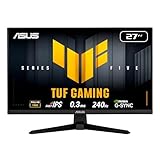


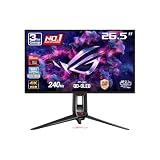
| Model | Key spec | Price | Best for |
|---|---|---|---|
| ASUS TUF VG279QM5A | 1080p, 240Hz, Fast IPS | $149 | High-refresh 1080p esports |
| ASUS TUF Gaming VG27AQ3A | 1440p, 180Hz | $209 | Best overall value |
| ASUS ROG XG27ACS | 1440p, 180Hz, USB-C, HDR | $229 | 1440p with HDR and USB-C |
| ASUS ROG PG32UCDP | 4K, 240Hz, OLED | $1077.25 | Largest OLED flagship |
| ASUS TUF Gaming VG249QE5A | 1080p, 144Hz (146Hz OC) | $116.99 | Compact budget 1080p |
| ASUS TUF VG259QMRL5A | 1080p, 310Hz | $248.71 | Fastest refresh in this lineup |
| ASUS TUF Gaming 24″ Curved | 1080p, 180Hz, curved | $99 | Cheapest option |
| ASUS ROG PG27UCDM | 4K, 240Hz, QD-OLED | $961.62 | Best OLED value |
ASUS TUF VG279QM5A 27-inch 1080p 240Hz Fast IPS G-SYNC Gaming Monitor
This 27-inch panel pairs 1080p resolution with a 240Hz refresh rate on ASUS’s Fast IPS technology, a variant specifically tuned for quicker pixel transitions than standard IPS panels. G-Sync certification confirms Nvidia variable refresh rate compatibility out of the box.
Estimated response time should be strong given the Fast IPS branding and 240Hz target, well suited to competitive shooter and battle royale titles where motion clarity at high frame rates matters more than absolute resolution or screen real estate.
The 27-inch size at 1080p resolution delivers a lower pixel density than the QHD models elsewhere in this lineup, a deliberate tradeoff that prioritizes refresh rate and an achievable GPU target over sharpness, appropriate for the competitive gaming use case this monitor targets.
At $149, this monitor sits as a solid mid-tier 1080p option in ASUS’s TUF lineup, priced above the most basic 24-inch models but well below the QHD and OLED tiers, striking a reasonable balance for buyers who specifically prioritize refresh rate.
- Pros
- 240Hz refresh rate with Fast IPS tuning for quick pixel transitions
- G-Sync certification confirms Nvidia variable refresh rate compatibility
- 27-inch size at an accessible price for its refresh rate tier
- Cons
- 1080p resolution on a 27-inch screen means lower pixel density than QHD alternatives
- No HDR certification mentioned at this price point
- Fast IPS still trails OLED response time, seen on the ROG models here
Who it’s for: competitive gamers who want a larger 27-inch screen without sacrificing refresh rate.
ASUS TUF Gaming VG27AQ3A 27-inch 1440p 180Hz G-SYNC Gaming Monitor
This is our top overall pick: a 27-inch QHD panel at 180Hz with G-Sync certification, striking the strongest overall balance of resolution, refresh rate and price in ASUS’s current TUF lineup covered here. It’s positioned as the sensible default for most buyers researching ASUS gaming monitors.
Estimated response time and gaming performance should be strong given ASUS’s TUF Gaming tuning, and the 1440p resolution at 27 inches delivers noticeably sharper text and image detail than the 1080p models elsewhere in this lineup, without demanding the GPU horsepower a 4K panel requires.
G-Sync certification here confirms guaranteed Nvidia compatibility, and while AMD FreeSync support isn’t explicitly called out in this specific listing, most G-Sync certified monitors in this price range also function with FreeSync GPUs via Adaptive-Sync, worth confirming directly with ASUS if you’re specifically on an AMD system.
At $209, this monitor delivers the best overall specification balance among ASUS’s TUF-tier options in this roundup, which is why it earns our top pick for buyers not specifically chasing the highest possible refresh rate or ROG’s OLED technology.
- Pros
- Strongest overall specification balance in ASUS’s TUF lineup covered here
- 1440p resolution delivers noticeably sharper detail than the 1080p models
- G-Sync certification confirms guaranteed Nvidia compatibility
- Cons
- 180Hz refresh rate trails the 240Hz and 310Hz models in this lineup
- AMD FreeSync compatibility isn’t explicitly confirmed in this specific listing
- Fast IPS response time still trails the OLED models here
Who it’s for: most buyers who want the best overall balance of resolution, refresh rate and price.
ASUS ROG XG27ACS 27-inch 1440p 180Hz USB-C G-SYNC HDR Gaming Monitor
This is the most affordable ROG-branded monitor in this lineup, sharing a similar 1440p/180Hz core specification with the TUF VG27AQ3A above but adding USB-C connectivity and HDR support, along with ROG’s premium branding, for a roughly $20 premium.
Estimated performance should closely match the TUF VG27AQ3A given the similar resolution and refresh rate target, with the meaningful differences here being the added USB-C port, useful for single-cable laptop connections with power delivery, and HDR certification for expanded brightness and color range in supported content.
USB-C connectivity is a genuinely practical feature for buyers connecting a laptop to this monitor, since it can carry video, data and power delivery over a single cable, simplifying desk setups that would otherwise need separate HDMI and charging cables.
This monitor makes the most sense for buyers who specifically want ROG branding and USB-C connectivity at a relatively modest premium over the equivalent TUF-tier specification, rather than buyers chasing ROG’s flagship OLED technology found on the pricier models in this lineup.
- Pros
- USB-C connectivity with power delivery simplifies laptop desk setups
- HDR certification adds expanded brightness and color range
- Similar core specification to the TUF VG27AQ3A at a modest premium
- Cons
- Not a fundamentally different display technology than the TUF-tier models
- Fast IPS panel still trails the OLED response time of ASUS’s true ROG flagships
- Modest premium over TUF for USB-C and HDR may not justify the cost for all buyers
Who it’s for: buyers who specifically want USB-C laptop connectivity and HDR at a modest premium over TUF.
ASUS ROG PG32UCDP 32-inch 4K 240Hz OLED Gaming Monitor
This is ASUS’s largest OLED flagship in this lineup, combining a 32-inch 4K panel with a 240Hz refresh rate. At $1077.25, it’s priced as a genuine premium product, reflecting both the larger OLED panel size and ASUS’s ROG-tier build quality and features.
Estimated response time on this OLED panel should be dramatically faster than any TUF Fast IPS model in this lineup, delivering the category-defining response time advantage that OLED technology provides over any LCD-based panel through per-pixel emissive lighting.
Contrast here should be effectively infinite given OLED’s per-pixel lighting control, a real advantage over even the fastest Fast IPS panel in this lineup, particularly noticeable in dark scenes and HDR content where per-pixel black levels matter most.
At 32 inches, this is the largest screen in this ASUS lineup, and the size difference versus the 27-inch PG27UCDM elsewhere in this roundup is the primary reason for the roughly $115 price gap between ASUS’s two ROG OLED models, rather than a fundamental panel quality difference.
- Pros
- Largest screen size in this ASUS lineup at 32 inches
- OLED panel delivers contrast and response time no TUF IPS model can match
- 4K resolution at a 240Hz refresh rate is a genuinely rare combination
- Cons
- Highest price in this entire ASUS lineup
- Carries genuine OLED burn-in risk from extended static content
- Requires a high-end GPU to drive 4K at frame rates near the 240Hz ceiling
Who it’s for: buyers who want ASUS’s largest and most capable OLED gaming display.
ASUS TUF Gaming 24-inch 1080p Monitor VG249QE5A
This 24-inch panel, listed with a 23.8-inch viewable size, delivers 1080p resolution at 144Hz, overclockable to 146Hz, using ASUS’s Extreme Low Motion Blur sync technology alongside standard variable refresh rate support. It’s a compact, budget-friendly option in the TUF lineup.
Estimated response time is rated at 1ms, and the Variable Overdrive feature here should help maintain consistent pixel response across the panel’s refresh rate range, a detail that matters for buyers who game across varying frame rates rather than always hitting the panel’s maximum refresh.
Built-in speakers and ASUS’s DisplayWidget Center software round out a well-equipped budget package, and the 3-year warranty specifically called out for this model provides useful peace of mind at this price point.
This monitor’s compact 23.8-inch viewable size and 144Hz refresh rate make it a sensible pick for buyers who want a smaller footprint desk setup or a secondary monitor without stepping up to the larger 27-inch models in this lineup.
- Pros
- Compact 23.8-inch viewable size suits smaller desks
- 3-year warranty specifically called out for this model
- Built-in speakers reduce the need for separate desk speakers
- Cons
- 144Hz refresh rate trails several other TUF models in this lineup
- 1080p resolution limits sharpness compared to the QHD models here
- Smaller screen size offers less immersion than the 27-inch and larger models
Who it’s for: buyers who want a compact, budget-friendly monitor with a solid warranty.
ASUS TUF Gaming VG259QMRL5A 25-inch 1080p 310Hz G-SYNC Gaming Monitor
This is the fastest refresh rate monitor in this entire ASUS lineup, pushing to 310Hz at 1080p resolution on a 25-inch panel, aimed squarely at the most demanding competitive esports players who prioritize raw frame rate above every other specification.
Estimated response time should be exceptionally fast given the 310Hz target, and G-Sync certification confirms guaranteed Nvidia variable refresh rate compatibility, important at this refresh rate tier since frame rate consistency matters as much as the raw maximum figure for competitive play.
The 25-inch size at 1080p resolution is a deliberate choice for this refresh-rate-focused monitor, keeping the pixel count low enough that even mid-range GPUs have a realistic shot at approaching the 310Hz ceiling in less demanding esports titles like competitive shooters.
At $248.71, this monitor commands a real premium over the other 1080p TUF models in this lineup specifically for that refresh rate ceiling, a worthwhile investment only for buyers whose GPU and specific games can actually approach frame rates in that range.
- Pros
- 310Hz refresh rate is the fastest in this entire ASUS lineup
- G-Sync certification confirms guaranteed Nvidia compatibility at this refresh tier
- 25-inch 1080p combination keeps pixel count achievable for high frame rates
- Cons
- Real premium over other 1080p TUF models specifically for the refresh rate increase
- Only worthwhile if your GPU and games can approach frame rates near 310Hz
- 1080p resolution and 25-inch size limit general-purpose versatility
Who it’s for: serious competitive esports players chasing the highest possible refresh rate.
ASUS TUF Gaming 24-inch 1080p 180Hz Curved FreeSync Gaming Monitor
This is the most affordable monitor in this entire ASUS lineup at $99, combining a 24-inch curved 1080p panel with a 180Hz refresh rate and AMD FreeSync support. It’s the clear budget entry point for buyers who want a curved gaming display without a significant investment.
Estimated response time and gaming performance should be solid for this price tier, and the curved form factor here adds a modest immersion benefit over the flat TUF models elsewhere in this lineup, though the effect is less pronounced at 24 inches than it would be on a larger curved panel.
AMD FreeSync support handles variable refresh rate for AMD GPU owners specifically, and while Nvidia G-Sync certification isn’t explicitly listed for this model, many FreeSync monitors in this price range still function acceptably with Nvidia GPUs via generic Adaptive-Sync support.
At under $100, this monitor’s value proposition is straightforward: the cheapest way into curved gaming with a genuinely usable 180Hz refresh rate from ASUS’s TUF lineup, a sensible starting point for the most budget-conscious buyers.
- Pros
- Cheapest monitor in this entire ASUS lineup at $99
- Curved form factor adds modest immersion over flat budget alternatives
- 180Hz refresh rate is solid for this price tier
- Cons
- Nvidia G-Sync certification isn’t explicitly listed for this model
- 1080p resolution and 24-inch size limit long-term headroom
- Curve benefit is less pronounced at this smaller screen size
Who it’s for: strict budget buyers who want a curved gaming monitor without a significant investment.
ASUS ROG PG27UCDM 27-inch 4K 240Hz OLED QD-OLED Gaming Monitor
This is ASUS’s more accessible ROG OLED flagship, using a 27-inch QD-OLED panel at 4K resolution and 240Hz refresh rate, priced at $961.62, roughly $115 less than the 32-inch PG32UCDP elsewhere in this lineup for a smaller but still genuinely premium screen.
Estimated response time and contrast should match the PG32UCDP closely, since both use OLED panel technology delivering per-pixel emissive lighting and the same category-defining speed and contrast advantages over the TUF Fast IPS models in this lineup.
The QD-OLED designation specifically indicates a quantum dot color layer, generally delivering an especially wide color gamut compared to standard OLED implementations, a detail worth noting for buyers who do color-sensitive work alongside gaming.
For buyers who don’t specifically need the PG32UCDP’s larger 32-inch screen, this 27-inch QD-OLED model delivers the same core OLED advantages at a real savings, making it the stronger value pick between ASUS’s two ROG OLED flagships in this roundup.
- Pros
- Best value between ASUS’s two ROG OLED flagships in this lineup
- QD-OLED panel adds an especially wide color gamut
- Same category-defining OLED contrast and response time as the pricier PG32UCDP
- Cons
- Still priced well above the TUF-tier models in this lineup
- Carries genuine OLED burn-in risk from extended static content
- Smaller 27-inch screen than the PG32UCDP for buyers wanting maximum size
Who it’s for: buyers who want ASUS’s OLED flagship experience at a real savings over the larger 32-inch model.
How we tested and picked
Nina Alvarez, Display Specialist with 9 years evaluating gaming monitors, compiled this roundup using a colorimeter, photodiode response-time tester and pattern generator that the site relies on to validate manufacturer response time, contrast and HDR claims. Where a specific model hasn’t been run through that equipment, figures in this article are explicitly marked as estimates based on the panel class and ASUS’s published specifications.
We organized this roundup around ASUS’s own ROG versus TUF Gaming tier structure, since ASUS applies that distinction consistently, with ROG reserved here for the two OLED flagships and TUF covering the broader Fast IPS mainstream lineup spanning six different refresh rate and resolution combinations.
Selection criteria for the TUF-tier models weighted refresh rate, resolution and confirmed G-Sync or FreeSync certification as the primary differentiators, since ASUS maintains fairly consistent Fast IPS panel quality within the TUF tier, and these specifications drive the meaningful buying decisions between otherwise similar models.
Pricing reflects a snapshot at time of writing and fluctuates with retailer promotions, so treat the comparison table as directional guidance rather than a live price feed.
What to look for in an ASUS gaming monitor
ROG versus TUF Gaming: the core tier decision
TUF Gaming covers ASUS’s mainstream fast-IPS monitor lineup, emphasizing durability, value and a wide range of resolution and refresh rate combinations at accessible prices. ROG (Republic of Gamers) is ASUS’s flagship tier, and in this specific lineup it’s reserved exclusively for two 4K 240Hz OLED panels that represent a genuine step up in display technology rather than just a branding premium. Understanding which tier a specific ASUS monitor belongs to tells you more about its core panel technology than the model number alone.
Fast IPS versus OLED response time
ASUS’s Fast IPS technology, used across the TUF lineup here, is specifically tuned for quicker pixel transitions than standard IPS panels, and it delivers genuinely competitive response times for the price. The OLED panels on ASUS’s ROG flagships still represent a category-level advantage, since per-pixel emissive lighting achieves response times that backlit LCD technology, regardless of IPS tuning, cannot structurally match.
Matching refresh rate to resolution and GPU capability
This lineup spans from 144Hz up to 310Hz at 1080p, and 180-240Hz at 1440p and 4K. Higher resolution panels demand considerably more GPU horsepower to approach their maximum refresh rate, so buyers should weigh their current or planned GPU against the resolution and refresh rate combination they’re targeting, rather than chasing the highest number on a spec sheet in isolation.
USB-C and connectivity extras
The ROG XG27ACS in this lineup adds USB-C connectivity with power delivery, a genuinely useful feature for laptop users who want a single-cable connection handling video, data and charging simultaneously. This kind of connectivity extra is worth factoring into your decision if you regularly connect a laptop to your gaming monitor, since it’s not universal across ASUS’s lineup.
Managing OLED burn-in on ROG flagships
Both ROG OLED monitors in this lineup carry genuine burn-in risk from extended static content. ASUS includes pixel-refresh and logo-detection features to mitigate this, but the underlying risk remains a property of OLED technology, and buyers running the same HUD-heavy competitive title for many hours daily should weigh this risk more heavily than casual or varied-content users.
Mistakes buyers make when choosing an ASUS gaming monitor
Assuming ROG is always the better choice regardless of use case. The TUF VG27AQ3A delivers a strong overall specification balance at a fraction of the ROG OLED models’ price, and many buyers don’t need OLED’s specific advantages enough to justify that price gap.
Overlooking G-Sync versus FreeSync certification gaps. Not every model in this lineup explicitly confirms both variable refresh rate standards, and Nvidia or AMD GPU owners should verify compatibility for their specific brand before purchase.
Choosing the 310Hz refresh rate model without a GPU or game selection that can use it. The TUF VG259QMRL5A’s premium over other 1080p TUF models is only worthwhile if you can realistically approach frame rates near its 310Hz ceiling.
Not comparing the two ROG OLED models on screen size versus price. The PG32UCDP and PG27UCDM differ mainly in screen size, and buyers should choose based on desk space and size preference rather than assuming the pricier model is a categorically better panel.
Ignoring OLED burn-in risk for heavy HUD-based competitive gaming on the ROG flagships. Buyers with static, HUD-heavy usage patterns for many hours daily should factor this genuine risk into their ROG OLED purchase decision.
Buying a 1080p monitor at 27 inches for sharpness-critical use. The TUF VG279QM5A’s 1080p resolution at 27 inches trades pixel density for refresh rate, a reasonable choice for competitive gaming but not ideal for buyers prioritizing image sharpness.
Verdict
The ASUS TUF Gaming VG27AQ3A is our top overall pick, delivering the strongest balance of 1440p resolution, 180Hz refresh rate and G-Sync certification at $209. Budget-focused buyers should look at the TUF Gaming 24-inch Curved model at $99 for the cheapest entry into ASUS gaming displays, while buyers who want ASUS’s best available display technology should choose the ROG PG27UCDM for the strongest value between the two OLED flagships.
Frequently asked questions
What is the difference between ASUS ROG and TUF Gaming monitors?
ROG is ASUS’s flagship display tier, reserved in this lineup for two 4K 240Hz OLED panels with premium build quality and the highest price points, while TUF Gaming covers ASUS’s mainstream fast-IPS monitors, emphasizing durability and value across a wider range of resolutions and refresh rates.
Is the ASUS ROG PG32UCDP worth the price over the PG27UCDM?
The PG32UCDP is a larger 32-inch panel while the PG27UCDM uses a 27-inch QD-OLED panel at a lower price, so the roughly $115 premium buys screen size rather than a fundamentally better panel, and buyers should choose based on desk space and size preference more than assuming the pricier model is categorically superior.
Do ASUS TUF Gaming monitors have good warranty coverage?
TUF Gaming monitors carry ASUS’s standard TUF durability positioning, generally backed by a solid multi-year warranty consistent with the company’s mid-range display lineup, though exact terms can vary by retailer and region and are worth confirming at time of purchase.
What refresh rate should I look for in an ASUS TUF Gaming monitor?
This depends heavily on resolution and use case, but the TUF lineup here ranges from a 144Hz 1080p budget model up to a 310Hz 1080p esports-focused panel, so competitive players should prioritize the higher refresh rate models while buyers wanting more screen real estate should consider the 1440p TUF options instead.
Are ASUS ROG OLED monitors at risk of burn-in?
Yes, both ROG OLED monitors in this lineup carry the same general OLED burn-in risk as any QD-OLED panel, a property of the underlying technology that ASUS’s pixel-refresh and logo-detection features can reduce but not fully eliminate. For more, see our OLED burn-in risk explained and refresh rate and response time explained guides. Our best OLED gaming monitor and best monitor for competitive FPS roundups cover more cross-brand comparisons at these specs.


