
The most useful free online monitor test tools are the Lagom LCD test pages for general calibration and pixel/uniformity checks, and the UFO Test site from Blur Busters for motion clarity and refresh-rate-related testing. Both run directly in a browser with no download required, and together they cover dead pixel detection, contrast and gamma checks, and how well a display actually renders motion at its rated refresh rate.
Top 3 picks at a glance
Quick answer
Open Lagom’s LCD test pages in a browser for dead pixel checks, black/white level, contrast, and gamma testing. Open Blur Busters’ UFO Test for motion blur and refresh rate perception testing, particularly useful for confirming a high refresh rate monitor is actually delivering visibly smoother motion. Run both shortly after unboxing a new monitor, while return windows for pixel defects are still open.
As an Amazon Associate we earn from qualifying purchases at no extra cost to you. Product prices and availability are accurate as of the date shown and are subject to change.


| Tool | What it checks | Best used for |
|---|---|---|
| Lagom LCD test | Dead pixels, contrast, gamma, black level, viewing angle | General calibration and defect checking |
| UFO Test (Blur Busters) | Motion blur, refresh rate, ghosting | Confirming high refresh rate actually helps |
Why free browser tests are worth running before anything else
Before investing in a colorimeter or dedicated calibration hardware, covered in our monitor calibration guide, these free browser tools catch the most common and most disqualifying issues: dead or stuck pixels, obvious backlight bleed, and gross color or uniformity problems that no calibration profile can fix anyway since they’re physical panel defects rather than a color accuracy issue.
They’re also genuinely useful for anyone who isn’t planning to buy calibration hardware at all; a monitor with contrast, gamma, and black level adjusted using Lagom’s test pages looks meaningfully better than an unadjusted out-of-box setup, even without a colorimeter’s objective measurement backing it up.
For gaming specifically, motion clarity testing through UFO Test answers a question raw refresh rate specs alone can’t: whether a monitor’s actual pixel response time is fast enough to take real advantage of its rated refresh rate, since a 240Hz panel with slow pixel transitions can show more visible ghosting than a well-tuned 144Hz panel, something a spec sheet number won’t reveal on its own.
None of this replaces the more detailed panel technology considerations in our IPS vs VA vs TN comparison, but running these free tests first gives you concrete, specific things to look for rather than a vague sense that something “looks off” about a new display.
Lagom LCD test: dead pixel and uniformity checking
Lagom’s dead pixel test pages display full-screen solid colors, typically cycling through pure red, green, blue, black, and white, making stuck or dead pixels far easier to spot against a uniform background than they would be in normal mixed content. A dead pixel appears as a small black dot that stays black regardless of the background color; a stuck pixel instead shows a persistent single color (commonly red, green, or blue) that doesn’t match whatever the rest of the screen is displaying.
Run through each solid color page slowly, ideally in a dimly lit room for better contrast against the screen, and look systematically across the entire panel rather than just the center, since defects can appear anywhere including near the edges. It helps to view from a normal seated distance rather than pressing close to the screen, since panel-level viewing angle characteristics can sometimes create false impressions of unevenness when viewed too close or at an angle.
The same solid-color pages double as a basic uniformity check, revealing backlight bleed (light leaking around the panel edges, most visible on the black screen test in a dark room) or clouding (uneven brighter patches, particularly noticeable on VA panels under certain conditions). Some degree of minor bleed or clouding is common and within normal manufacturing tolerance even on well-reviewed monitors; it becomes a return-worthy issue mainly when it’s severe enough to be distracting during actual dark-scene content, which is a judgment call best made against your own tolerance rather than a fixed numeric threshold.
Lagom LCD test: contrast, gamma, and black level
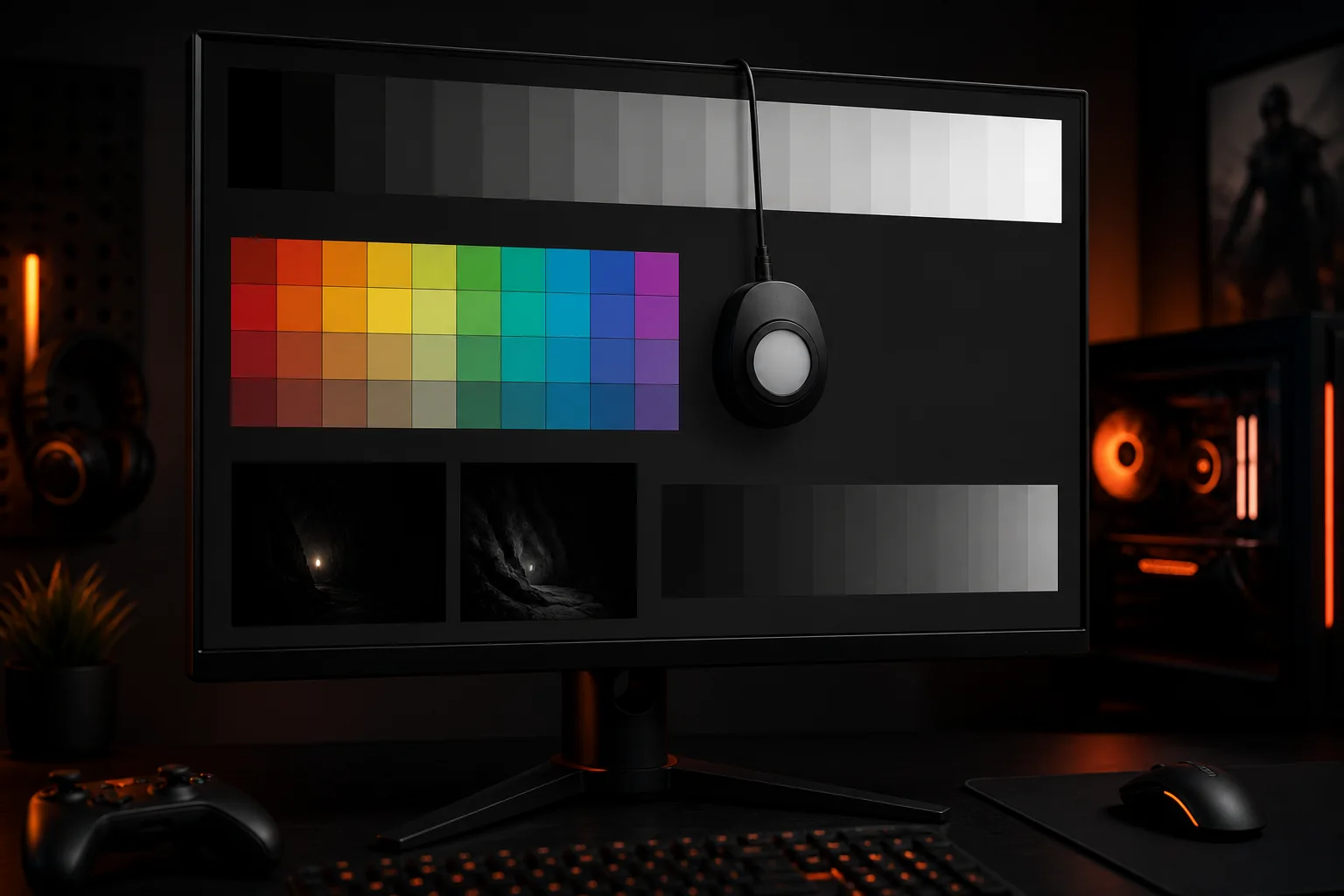
Beyond defect checking, Lagom’s contrast test page displays a grid of blocks at varying brightness levels, with instructions for adjusting your monitor’s contrast setting in its OSD until the brightest and darkest blocks are distinguishable at the intended threshold without either crushing shadow detail together or washing out highlight detail. This is a genuinely actionable calibration step usable without any hardware.
The black level test page works similarly for the darker end of the range, helping set the OSD’s brightness/black level control so near-black tones remain distinguishable rather than crushing into pure black, a common out-of-box issue on monitors set to an aggressively high contrast default.
The gamma test page uses a striped pattern design where, at the correct gamma setting, a striped area should visually blend into a smooth gray field when viewed from a normal distance; if the stripes remain clearly visible or the blended field looks too dark or too light compared to a reference gray patch on the same page, it indicates the display’s gamma is set away from the standard target, adjustable through the monitor’s OSD gamma setting if available, or through the graphics driver’s color settings otherwise.
UFO Test (Blur Busters): motion clarity and refresh rate
UFO Test, hosted by Blur Busters, is a browser-based moving test pattern specifically designed to visualize motion blur and ghosting in a way static images cannot. The core test displays a small UFO-shaped object moving horizontally across the screen at a controllable speed, letting you directly observe how sharply or blurrily the panel renders that motion at your monitor’s current refresh rate and response time settings.
Running the test at different refresh rates, if your monitor supports multiple rates, gives a direct visual comparison of how much smoother, or in some cases how much ghosting-reduced, higher refresh rates actually look on your specific panel rather than relying on the spec sheet number alone. This is particularly informative when deciding whether upgrading from, say, 144Hz to 240Hz is likely to produce a difference you’ll actually perceive, related to the tradeoffs covered in our refresh rate and response time guide.
The UFO Test site also includes dedicated ghosting and frame skipping test patterns, useful for identifying whether a specific overdrive setting on your monitor (the OSD setting controlling how aggressively the panel drives pixel transitions to reduce blur) is producing visible ghosting or inverse ghosting artifacts; if the trailing edge of the moving UFO shows a dark or bright halo rather than a clean edge, trying a different overdrive setting level in your monitor’s OSD is worth testing against the visual result.
For monitors supporting variable refresh rate technology, Blur Busters also hosts dedicated test content for confirming G-Sync or FreeSync is actually engaging correctly, which pairs well with the setup steps covered in our G-Sync vs FreeSync guide.
Other useful free test resources
Beyond Lagom and UFO Test, a handful of other free browser-based resources are worth knowing about for specific checks: dedicated input lag test pages exist that measure the round-trip time between a visual cue and your reaction, though these measure your own reaction time as much as display lag and are less precise than dedicated hardware testing; they’re more useful as a rough comparative tool across your own display settings than as an absolute lag measurement.
Viewing angle test patterns, sometimes included as part of broader test suites like Lagom’s, help visualize how color and brightness shift when viewed off-axis, which is particularly relevant for anyone considering a wide desk setup or multiple viewers, and ties into the panel technology tradeoffs discussed in our IPS vs VA vs TN comparison.
Refresh rate verification pages, distinct from UFO Test’s motion clarity focus, can confirm your display is actually running at its intended refresh rate rather than silently defaulting to a lower one, which is a surprisingly common oversight worth ruling out early, particularly right after connecting a new high refresh rate monitor for the first time.
Using both tools together on a new monitor
A sensible order for a freshly unboxed monitor: run the Lagom dead pixel and uniformity checks first while the return window is freshest in your mind, since defect-based returns are the most time-sensitive category. Follow with the contrast, black level, and gamma pages to get basic OSD settings into a reasonable range even before any hardware calibration. Finish with UFO Test to confirm motion clarity and overdrive settings are behaving as expected at your intended refresh rate.
This whole process takes well under 30 minutes and catches the large majority of issues worth knowing about before you’ve settled into daily use and potentially missed a return window. It’s a reasonable habit to repeat any time you significantly change OSD settings or overdrive levels later, just to confirm the new configuration hasn’t introduced a new visible issue.
What these tools can’t tell you
Browser-based visual tests are excellent for catching obvious, visible problems and getting OSD settings into a broadly reasonable range, but they cannot produce objective numeric measurements the way dedicated hardware can. A colorimeter reports exact color accuracy in measurable Delta E values; a photodiode-based response time tester reports exact millisecond figures for pixel transitions. Browser tools rely on your own visual judgment, which is useful but inherently more subjective.
They also can’t measure input lag, the delay between a physical input (mouse click or controller button) and the corresponding change appearing on screen, which is a separate characteristic from response time or refresh rate and generally requires specialized hardware timing equipment to measure precisely; published reviews using dedicated lag testing hardware remain the more reliable source for input lag figures than any browser tool.
Color accuracy specifically is better assessed with objective hardware measurement, covered in our monitor calibration guide, since human perception of color is influenced by ambient lighting, screen brightness, and even recent exposure to other colors, none of which a browser test can control for the way a colorimeter’s direct light measurement can.
When test results suggest a return or exchange
Most manufacturers and retailers have specific, sometimes strict policies around dead pixel counts that qualify for return or exchange, often requiring a minimum number of defective pixels (commonly a handful, though this varies significantly by brand and specific policy) rather than accepting any single dead pixel as automatic grounds for replacement; checking your specific retailer and manufacturer’s stated policy before assuming a single found pixel guarantees a return is worthwhile.
Severe backlight bleed or clouding visible during normal, non-dark-room content, rather than only under the specifically dark testing conditions Lagom’s black test creates, is a stronger case for return than mild bleed only visible in a fully darkened room during a pure black test pattern, since the latter is common even on well-functioning panels to some degree.
Troubleshooting testing issues
If UFO Test’s motion pattern doesn’t appear smooth even at your monitor’s rated maximum refresh rate, first confirm your browser and graphics driver are actually delivering that refresh rate to the test page; check your Windows display settings or graphics driver’s refresh rate setting to confirm the monitor is set to its maximum supported rate rather than defaulting to 60Hz, a surprisingly common oversight after connecting a new high refresh rate monitor.
Dead pixel tests that show inconsistent results between attempts, with a spot appearing then not appearing on a retest, can sometimes indicate dust or a small particle on the screen surface rather than an actual pixel defect; gently cleaning the screen with an appropriate microfiber cloth (never harsh chemicals) before retesting rules this out.
If Lagom’s gamma test pattern looks correct on one part of the screen but noticeably different on another area of the same panel, this points toward a uniformity issue rather than a global gamma setting problem, worth noting specifically if pursuing a return, since it’s a different and often more serious category of defect than a globally incorrect gamma setting that a simple OSD adjustment would fix.
Browser test pages rendering with visible banding or color inaccuracy that seems inconsistent with what you’d expect can sometimes be affected by your graphics driver’s own color output settings (for instance, an incorrectly set color depth or dynamic range in the NVIDIA, AMD, or Intel control panel); checking that your graphics driver is set to full RGB range and the correct bit depth for your connection is worth confirming before concluding the monitor itself is the source of an odd-looking test result.
Frequently asked questions
Are free online monitor test tools accurate?
For visual checks like dead pixels, uniformity, and motion blur perception they’re genuinely useful and reliable, but they can’t give you objective numeric measurements the way dedicated hardware like a colorimeter or response-time tester can, so treat them as diagnostic and comparative tools rather than lab-grade instruments.
Can I test my monitor’s actual response time in milliseconds using a website?
Not precisely; browser-based tools like UFO Test can show you the visible effect of response time and refresh rate through motion clarity patterns, but measuring an exact millisecond figure requires a dedicated hardware photodiode tester, which is what independent reviewers use for published response time numbers.
Do I need special software installed to run these tests?
No, tools like Lagom LCD test and UFO Test (Blur Busters) run directly in a web browser with no installation required, which is part of why they’re a convenient first step before considering dedicated calibration hardware.
Should I run these tests immediately after unboxing a new monitor?
Yes, checking for dead pixels and obvious uniformity issues while a return window is still open is one of the most valuable times to run these tests, since most manufacturers have specific policies and time limits around pixel defect returns.
Will browser test tools work correctly over an HDMI or DisplayPort connection either way?
Yes, these are purely visual test patterns displayed by your browser and don’t depend on the specific cable type, though very old HDMI cables with limited bandwidth could in theory limit resolution or refresh rate for the test pattern itself, unrelated to the test’s own accuracy.
Nina Alvarez, Display Specialist, runs Lagom and UFO Test on every monitor that comes through the testbench before it ever touches the colorimeter or photodiode response-time tester, since a panel with a real uniformity or ghosting problem needs to be identified before objective numbers are worth measuring at all. Once you’ve run through these checks, our guides to best gaming monitors and best 240Hz monitors cover models with a track record of passing them cleanly.


