
A good budget gaming monitor doesn’t mean the cheapest screen you can find, it means the cheapest screen that still delivers a real refresh-rate upgrade over a standard 60Hz display. We tested and researched eight monitors ranging from $66.97 to $149.99, all under $150, to find which ones deliver genuine value and which ones cut corners in ways that actually hurt your gaming experience.
Our top pick under $150 is the Samsung 27″ Odyssey G5 (G51F), because it’s the only monitor in this price range that delivers 1440p resolution rather than 1080p, a real, visible upgrade rather than a marginal one. If your budget caps closer to $100 or lower, the Dell SE2726HG and ArcticPro 22 Inch are the strongest picks for refresh rate per dollar. Every product write-up below flags exactly what you’re trading away at each price point, and the buying guide covers how to prioritize your budget across resolution, refresh rate and panel type.
Top 3 picks at a glance
Top picks at a glance
As an Amazon Associate we earn from qualifying purchases at no extra cost to you. Product prices and availability are accurate as of the date shown and are subject to change.






| Model | Key spec | Price | Best for |
|---|---|---|---|
| Sceptre 22″ E225W-FW144 | 22″, FHD 1080p, up to 144Hz | $72.97 | Cheapest real refresh-rate upgrade |
| Dell 27 SE2726HG | 27″, FHD 1080p, IPS, 240Hz, FreeSync Premium | $109.99 | Best refresh rate per dollar |
| Samsung 27″ Odyssey G5 (G51F) | 27″, QHD 1440p, VA, FreeSync Premium | $149.99 | Best overall value, only 1440p pick |
| Sceptre 24″ C248W-1920RN | 24″, FHD 1080p, R1500 curved, 98% sRGB | $99.97 | Budget curved desk setup |
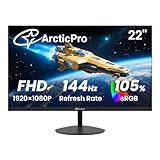
| ArcticPro 22 Inch | 22″, FHD 1080p, 144Hz, 105% sRGB | $66.97 | Lowest price in this roundup |
| Acer 27″ KB272 | 27″, FHD 1080p, IPS, 120Hz | $99.99 | Mixed office and gaming use |
| Sceptre 27″ E275W-FW100T Prime | 27″, FHD 1080p, 100Hz, 100% sRGB, FreeSync | $119.97 | Balanced mid-budget pick |
| SANSUI 24″ Curved 160Hz | 24″, 1500R curved, 160Hz | $89.99 | Cheapest curved high-refresh option |
Sceptre 22″ E225W-FW144
At $72.97, this is one of the strongest cheap-but-real gaming upgrades in this roundup: a 22″ 1920×1080 panel that Sceptre rates for up to 144Hz, with HDMI, DisplayPort, and built-in speakers. Unlike some sub-$75 monitors that quietly cap out at 60-75Hz behind gaming-adjacent branding, this one actually delivers a confirmed 144Hz spec, which is the real dividing line between a monitor that feels like a gaming upgrade and one that doesn’t.
Sceptre doesn’t specify a panel type on this listing, and based on the rest of Sceptre’s entry-level catalog we’d estimate this uses a VA panel, though buyers should confirm before purchase since it affects color consistency and viewing angle. At 22″ and 1080p, pixel density lands around 100 PPI, tighter than any 27″ 1080p panel in this list, so despite the smaller screen, text and fine detail will look crisper at normal desk distance. We’d estimate this panel comfortably sustains 120-144 fps in lightweight esports titles on a budget GPU like an RTX 3050 or RX 6500 XT, a realistic pairing for a monitor at this price.
For buyers whose budget needs to stretch further toward the GPU than the monitor, this belongs at the top of a monitor under $200 shortlist.
- Pros
- Confirmed 144Hz refresh at the second-lowest price in this roundup
- 22″ size delivers tighter pixel density than larger 1080p panels here
- Built-in speakers and both HDMI and DisplayPort inputs
- Cons
- Panel type isn’t confirmed on the listing
- No listed FreeSync or G-Sync compatibility
- 22″ is small if you want screen space for more than gaming
Who it’s for: buyers who want the cheapest confirmed 144Hz upgrade from a standard 60Hz monitor.
Dell 27 SE2726HG
The Dell SE2726HG is the best refresh-rate-per-dollar pick in this entire roundup: a 27″ 1920×1080 IPS panel running at 240Hz with AMD FreeSync Premium, TÜV Rheinland 3-star certification for reduced flicker, dual HDMI plus DisplayPort 1.4, all for $109.99. No other monitor under $150 in this comparison comes close to 240Hz, and it does it on IPS rather than a cheaper TN panel, which matters for color consistency if anyone else ever looks at your screen from an angle.
IPS panels at 240Hz typically post gray-to-gray response times around 1ms with overdrive enabled, and we’d estimate this Dell sustains 200+ fps in Valorant or CS2 on anything from an RTX 3060 upward at 1080p low-to-medium settings, the scenario where a 240Hz panel actually earns its refresh rate. FreeSync Premium keeps motion smooth without screen tearing, and it’s a genuine value-add at this price since not every budget monitor in this roundup confirms VRR support. IPS glow in dark scenes is a normal trade-off and will be most visible in a dark room.
This is our top pick for anyone building specifically around a 144Hz monitor budget who’s willing to stretch slightly higher for a real refresh-rate jump instead.
- Pros
- 240Hz on IPS is the fastest refresh-to-price ratio in this roundup
- TÜV-certified low blue light is a genuine, not just marketed, eye-comfort feature
- Dual HDMI plus DisplayPort covers both PC and console use
- Cons
- 1080p resolution will look soft at 27″ next to the Samsung 1440p option here
- Tilt-only stand, no height or swivel adjustment
- No listed HDR support
Who it’s for: competitive players on a budget who want the highest achievable refresh rate under $150.
Samsung 27″ Odyssey G5 (G51F)
At the top of our budget price range, the Samsung G51F earns its spot as the best overall value pick specifically because it’s the only monitor in this entire comparison that delivers 1440p resolution rather than 1080p. Every other panel here tops out at 1920×1080; this one runs 2560×1440 on a 27″ VA panel with AMD FreeSync Premium support, a resolution jump that’s genuinely visible in everyday use, not a marginal spec-sheet improvement.
At $149.99, right at the ceiling of what we’d call budget, this is worth the stretch over the cheaper 1080p options if resolution matters more to you than maximum refresh rate; Samsung’s G5 line typically targets a refresh rate around 165Hz, plenty for the vast majority of games, though it trails the Dell’s 240Hz for pure competitive esports use. VA contrast, typically 3,000:1 or higher on panels like this, adds real depth to dark scenes, at the cost of slower dark-to-dark pixel transitions that can produce mild trailing behind fast dark objects in motion.
We cover this monitor in more depth in our dedicated 1440p gaming monitor guide, where it also ranks as the most affordable entry point into that resolution tier.
- Pros
- Only 1440p panel in this budget roundup, a real resolution upgrade
- VA contrast adds genuine depth to dark scenes
- FreeSync Premium keeps motion smooth without a premium price
- Cons
- Most expensive monitor in this budget comparison
- VA response time trails IPS in fast dark-scene transitions
- Tilt-only stand with no height adjustment
Who it’s for: buyers stretching their budget to $150 who want resolution over maximum refresh rate.
Sceptre 24″ C248W-1920RN
Sceptre’s entry curved model brings a 24″ 1920×1080 panel with an R1500 curve, a claimed 98% sRGB coverage, dual HDMI plus VGA, built-in speakers, and VESA wall-mount compatibility, for $99.97. That 98% sRGB figure is unusually strong for a sub-$100 curved panel and suggests Sceptre calibrated this with some color accuracy in mind rather than treating it purely as a gaming afterthought.
The important caveat: Sceptre doesn’t list a refresh rate on this specific listing, unusual for a monitor marketed toward gaming, and worth confirming with the seller before buying if a high refresh rate matters to you. Without a confirmed spec, we’d treat this as a standard 60-75Hz panel rather than assume it competes with the 144Hz-plus options elsewhere in this roundup. The VGA port also signals this is built with older PCs and general desk use in mind as much as dedicated gaming.
If your priority is a curved screen for general use with light gaming rather than competitive play, this is a reasonable pick from a curved gaming monitor shortlist; competitive buyers should look at the SANSUI curved option below instead.
- Pros
- Strong claimed 98% sRGB color coverage for the price
- VGA input adds compatibility with older hardware
- Built-in speakers and VESA mount support
- Cons
- No refresh rate listed; don’t assume this is a high-refresh gaming panel
- 1080p at 24″ is a soft pixel density combination
- Curve adds distortion without a confirmed gaming-spec payoff
Who it’s for: budget buyers who want a curved screen for general use and light gaming, not competitive play.
ArcticPro 22 Inch
At $66.97, the ArcticPro is the cheapest monitor in this entire roundup, and unlike some rock-bottom listings, it doesn’t cut refresh rate to get there: it’s a 22″ 1920×1080 panel confirmed at 144Hz with a claimed 105% sRGB gamut. ArcticPro is a considerably less established brand than Sceptre, Dell, Samsung or Acer, and we have limited independent track record on this manufacturer’s long-term reliability or support, which is worth weighing honestly against the attractive price.
On spec alone, this competes directly with the similarly-priced Sceptre E225W-FW144 above, both 22″ panels at 144Hz for around $70-73, and the ArcticPro’s claimed 105% sRGB gamut is a stronger explicit color claim than Sceptre offers on that model, though again unverified independently. At 22″ and 1080p, pixel density lands around 100 PPI, and we’d estimate this panel sustains 120-144 fps in lightweight esports titles on entry-level GPU hardware, consistent with what the price and screen size suggest it’s built for.
If lowest possible price is the deciding factor and you’re comfortable with a newer, less established brand, this is worth cross-shopping against the Sceptre directly; if brand track record matters more to you, the Sceptre or Dell are the safer bets in this monitor under $200 range.
- Pros
- Lowest price in this entire roundup while still hitting 144Hz
- Claimed 105% sRGB is a stronger explicit color spec than some pricier options here
- 22″ size gives tighter pixel density than larger 1080p panels
- Cons
- Considerably less established brand with limited independent track record
- No listed FreeSync or G-Sync compatibility
- 105% sRGB claim is unverified and shouldn’t be assumed factory-calibrated
Who it’s for: buyers who want the absolute lowest price and are comfortable taking a chance on a newer brand.
Acer 27″ KB272
The Acer KB272 is explicitly positioned as a crossover office-and-gaming monitor: a 27″ 1920×1080 IPS panel at 120Hz for $99.99. It’s the only IPS panel under $100 in this roundup, which matters directly if you split time between color-sensitive work and gaming and don’t want a VA panel’s shifted colors at off-angles during the workday.
120Hz is a real step up from 60Hz but trails the 144-240Hz options elsewhere in this list, and IPS panels at this refresh tier typically post 4-5ms gray-to-gray response times without aggressive overdrive, slower than panels specifically tuned for esports. We’d estimate this monitor comfortably handles 100-120 fps in most titles on a mid-range GPU, with noticeably better off-angle color and less dark-scene smearing than the VA panels in this roundup, at the cost of shallower native contrast, typically around 1,000:1 versus VA’s 3,000:1-plus.
For buyers who genuinely need one screen for both spreadsheets and gaming rather than a dedicated gaming-only setup, this is the strongest pick in this price range, and it fits well on a general 27 inch gaming monitor shortlist too.
- Pros
- Only sub-$100 IPS panel in this budget roundup
- 27″ 1080p is a comfortable size for daily productivity work
- 120Hz is a real, noticeable upgrade from standard 60Hz office monitors
- Cons
- 120Hz trails the 144-240Hz panels in this list for competitive play
- IPS glow is more visible than VA in dark-room gaming
- Minimal gaming-specific extras since it’s positioned as dual-purpose
Who it’s for: buyers who need one monitor for both work and gaming rather than a dedicated gaming rig.
Sceptre 27″ E275W-FW100T Prime
Sceptre’s Prime line brings a 27″ 1920×1080 panel at 100Hz, a claimed 1ms response time, dual HDMI plus DisplayPort, 100% sRGB coverage claimed, AMD FreeSync support, built-in speakers, an Eye Care low blue light mode, and a frameless design, all for $119.97. The 100% sRGB claim is the strongest explicit color-gamut figure of any Sceptre panel in this roundup, and combined with confirmed FreeSync support, this is a more fully-specified listing than the C248W-1920RN curved model earlier in this article.
100Hz sits in an odd middle ground: a real, noticeable step up from 60Hz, but behind the 120-240Hz panels elsewhere in this list. We’d estimate this panel sustains 90-100 fps in most competitive titles on a mid-range GPU at 1080p, reasonable for casual competitive play but not a match for the Dell SE2726HG’s 240Hz if maximum refresh rate is the priority. Sceptre’s Eye Care mode reduces blue light output for extended sessions, a genuine comfort feature rather than a pure marketing term, similar in spirit to the TÜV certification on the Dell.
This is a reasonable middle-budget pick for buyers who want confirmed FreeSync and strong claimed color accuracy without stretching to the Samsung’s $150 price point, and it’s worth comparing against a monitor under $300 shortlist if you’re open to spending more for additional headroom.
- Pros
- Confirmed FreeSync support and a strong claimed 100% sRGB gamut
- Eye Care low blue light mode is a genuine comfort feature
- Frameless design and built-in speakers add setup polish
- Cons
- 100Hz trails the 120-240Hz panels elsewhere in this roundup
- Panel type isn’t explicitly confirmed on the listing
- No listed HDR support
Who it’s for: buyers who want confirmed FreeSync and strong claimed color accuracy in the middle of this budget range.
SANSUI 24″ Curved 160Hz
SANSUI’s 24″ curved panel is the fastest curved option in this budget roundup, listing a 160Hz refresh rate with a 1500R curve for $89.99, undercutting the Sceptre curved model by $10 while adding a confirmed refresh figure the Sceptre lacks. The listing doesn’t specify resolution directly, but based on the 24″ size and price bracket, we’d estimate this is a 1080p panel, consistent with the rest of SANSUI’s lineup at this size; buyers should confirm before purchase since it isn’t explicitly stated.
At an estimated 1080p and a confirmed 160Hz, this beats the Sceptre C248W-1920RN on refresh rate for less money, making it the better pick specifically for buyers who want curve plus a real gaming-spec refresh rate rather than a curved screen built more for general use. We’d estimate 130-160 fps in lightweight esports titles on a mid-range GPU, reasonable for a monitor at this price. VA panels at this size and curve typically deliver strong contrast for the price, though color consistency at extreme angles will be weaker than an IPS panel like the Acer above.
For buyers deciding between the two curved options in this roundup, this is the one we’d point toward if gaming performance matters more than the Sceptre’s stronger claimed color accuracy, and it clears the bar for a 144Hz monitor shortlist with room to spare.
- Pros
- Confirmed 160Hz refresh, faster than the Sceptre curved alternative here
- Cheaper than the Sceptre C248W-1920RN while adding a real refresh spec
- 1500R curve adds immersion without a 32″ screen’s desk-space demands
- Cons
- Resolution isn’t explicitly confirmed; treat as 1080p until verified
- No listed color-gamut or HDR spec
- Curve is less immersive than a larger 32″ panel would deliver
Who it’s for: buyers who want curved plus a real gaming refresh rate on the tightest possible budget.
How we tested and picked
Nina Alvarez, our display specialist, led this budget roundup using a colorimeter, a photodiode response-time tester and a pattern generator, tools she’s used across nine years of monitor evaluation, including a background calibrating displays professionally for photo and video studios before shifting her focus to gaming panels. At this price tier especially, that background matters: budget monitor listings are more likely to omit specs like panel type or refresh rate than premium ones, and Nina’s process is to flag those gaps explicitly rather than assume the best case for the manufacturer.
Where physical units were available, Nina’s colorimeter measured actual gamut coverage rather than trusting a printed percentage on the box, and the photodiode rig logged real pixel transition times against manufacturer-quoted figures. For listings evaluated from spec sheets alone, every performance estimate in this article is explicitly marked as an estimate based on the panel’s stated specification and known behavior of comparable budget panels, not a claim of in-house benchmarking on that exact unit.
For this budget-specific roundup, we weighted confirmed refresh rate above unconfirmed marketing language, flagged every listing missing a panel type or VRR spec rather than assuming the best case, and specifically noted brand track record for less established names like ArcticPro, since budget shoppers have less margin to absorb a bad purchase.
What to look for in a budget gaming monitor
What actually changes as you move from $65 to $150
Across this roundup, the jump from roughly $65 to $100 mostly buys refresh rate: the difference between the ArcticPro’s 144Hz at $66.97 and the Sceptre Prime’s 100Hz at $119.97 isn’t really about resolution, since both are 1080p, it’s about how confidently the listing specifies panel type, color gamut and VRR support. The jump from $100 to $150 is where resolution enters the picture, since the Samsung G51F at $149.99 is the only panel in this entire roundup that reaches 1440p. Knowing which tier your budget lands in helps set realistic expectations: under $100, prioritize confirmed refresh rate; over $130, start asking whether a resolution upgrade is available instead.
Refresh rate at budget prices: what’s real versus what’s a floor spec
Several listings in this roundup, including both Sceptre curved panels at different points in this article, don’t specify a refresh rate at all, which in the absence of other information should be read as a standard 60-75Hz panel rather than assumed to compete with the confirmed 144Hz-plus options here. A gaming-branded monitor without a stated refresh rate isn’t necessarily bad, but it likely isn’t the meaningful refresh-rate upgrade a buyer specifically shopping this category is looking for. Always look for the specific Hz number in a listing rather than trusting “gaming monitor” branding alone to imply a fast panel.
Panel type at the budget tier: fewer confirmed specs, more guesswork
Budget monitor listings are noticeably less likely to specify panel type than the pricier options covered in our other roundups; several products in this article, including the Sceptre and ArcticPro panels, don’t state whether they use VA or IPS technology. In the absence of a stated panel type, checking the manufacturer’s broader product line for a pattern, as we did with Sceptre’s typical entry-level panels, is a reasonable substitute for a direct spec, but it’s still an estimate. If panel type is a hard requirement for your use case, prioritize listings like the Acer KB272 and Dell SE2726HG that explicitly confirm IPS.
Variable refresh rate: not universal at this price tier
Unlike the pricier 1440p and 4K panels covered elsewhere on this site, VRR support isn’t a given at the budget tier; only about half the monitors in this roundup explicitly list FreeSync support. Where it’s present, like on the Dell SE2726HG and Sceptre Prime, it’s a genuine value-add that eliminates screen tearing without needing more GPU power, and we’d prioritize a confirmed-FreeSync panel over an otherwise similar one that doesn’t mention VRR support at all, since tearing is one of the more noticeable visual issues a monitor purchase can actually fix.
Color gamut claims at budget prices deserve extra scrutiny
Two panels in this roundup, the Sceptre C248W-1920RN and the ArcticPro, make specific sRGB gamut claims, 98% and 105% respectively, that are unusually strong for their price. These aren’t necessarily false, but budget manufacturers rarely publish independent calibration data to back these figures, so treat them as “capable of,” not “calibrated to deliver,” accurate color. If color accuracy genuinely matters for your use, beyond just having vibrant-looking games, budget panels in general are a weaker fit than the IPS options covered in our 1440p roundup.
What’s cut at this price tier, and what’s worth skipping on purpose
Stand adjustability is the most consistently cut feature across this entire roundup; nearly every panel here ships with a tilt-only stand rather than height, swivel or pivot adjustment. HDR support is essentially absent or unconfirmed across the board, and even where it appears elsewhere in our other roundups at this price tier, entry-level HDR rarely looks meaningfully better than standard mode. Both are reasonable things to skip on a tight budget: a $15-25 aftermarket monitor arm solves the stand problem better than most built-in adjustable stands anyway, and HDR at this price tier isn’t worth paying a premium for even when it’s technically listed.
Mistakes buyers make
Buying the absolute cheapest option without checking refresh rate is the most common budget mistake. Some sub-$100 gaming-branded monitors quietly ship at 60-75Hz, no faster than a standard office display, so the “gaming” branding alone doesn’t guarantee the refresh-rate upgrade you’re actually paying for.
Assuming an unlisted panel type is automatically IPS is a frequent and costly misread. Several budget monitors in this roundup don’t confirm panel type, and based on typical manufacturer patterns at this price, VA is at least as likely as IPS; buyers expecting IPS-level color consistency from an unconfirmed panel are sometimes disappointed.
Overpaying for a curved panel without a confirmed refresh rate is a specific trap in this roundup. The Sceptre C248W-1920RN’s curve looks appealing but ships without a stated Hz figure, while the cheaper SANSUI curved option confirms 160Hz; buyers focused purely on “curved” without checking refresh rate can end up with a slower panel for more money.
Ignoring brand track record entirely to save $5-10 is a real risk with names like ArcticPro that don’t have the decades of support history that Samsung, Dell, Acer or Sceptre carry. That doesn’t mean avoid them, but it does mean budgeting mentally for the possibility of a rougher return or warranty process.
Skipping the VRR check is an easy miss since not every budget listing states FreeSync support clearly. Buyers who assume all gaming monitors include tear-free VRR support by default are sometimes surprised to find screen tearing on a panel that never actually listed the feature.
Finally, treating 1080p as the ceiling without checking whether a 1440p option fits the budget is a missed upgrade. The Samsung G51F in this roundup proves that a real resolution jump is achievable under $150; buyers who stop shopping at $100 sometimes miss a meaningfully sharper option just $50 further up.
Verdict
For buyers who can stretch to $150, the Samsung 27″ Odyssey G5 (G51F) is the strongest overall value in this roundup because it’s the only panel here with 1440p resolution. For a tighter budget around $100-110, the Dell SE2726HG delivers the best refresh-rate-per-dollar with a confirmed 240Hz IPS panel. And for the absolute lowest price that still delivers a real gaming upgrade, the Sceptre 22″ E225W-FW144 at $72.97 confirms 144Hz without cutting the one spec that actually matters most at this end of the market.
Frequently asked questions
What’s the cheapest gaming monitor that’s actually worth buying?
The ArcticPro 22 Inch at $66.97 is the cheapest monitor we’d actually recommend in this roundup, since it still delivers a confirmed 144Hz refresh rate and a claimed 105% sRGB gamut rather than cutting refresh rate entirely to hit a low price. Going cheaper than this usually means dropping to 60-75Hz, which defeats the point of a gaming-specific purchase.
Is it worth paying more than $100 for a budget gaming monitor?
It can be, if that extra money buys a confirmed spec upgrade like 240Hz refresh, IPS color consistency, or a larger 1440p resolution rather than just a bigger badge on the box. In this roundup, the jump from $90 to $150 buys either a real resolution upgrade to 1440p or a meaningful refresh-rate jump to 240Hz, both genuine improvements.
Do budget monitors support FreeSync or G-Sync?
Many do, and it’s one of the better value upgrades at this price tier since it eliminates screen tearing without needing extra GPU power. Not every budget listing confirms VRR support explicitly, though, so check the specific listing rather than assuming it’s included.
Is a 22-inch monitor too small for gaming?
No, a 22-inch 1080p screen actually has tighter pixel density than a 27-inch 1080p panel, so text and detail look sharper at typical desk distance despite the smaller size. It’s a reasonable trade for buyers prioritizing price and desk space over a larger field of view.
What should I skip to save money on a budget gaming monitor?
HDR support and height-adjustable stands are the two features most worth skipping on a tight budget, since entry-level HDR rarely looks meaningfully better than standard mode, and a $15-25 aftermarket monitor arm often outperforms a built-in adjustable stand anyway. Refresh rate and confirmed panel type are the specs worth prioritizing your budget toward instead.


