
The best monitor under $300 for gaming is the LG 27G64NA-B, because it’s the only panel in this guide combining QHD resolution with a genuine 300Hz refresh rate, NVIDIA G-Sync Compatible certification and HDMI 2.1 for $209.99 — nearly $60 cheaper than the ASUS TUF option with a comparable spec sheet. If 1080p is fine for your use case, the SANSUI 24.5″ QHD panel at $179.98 delivers similar refresh-rate performance for less.
Nina Alvarez brought her usual testbench — a colorimeter, photodiode response-time tester and pattern generator, developed across nine years of professional display calibration — to this comparison of eight monitors between $149.99 and $269. This is the price tier where 300Hz stops being a rare premium feature and starts becoming a realistic, if still GPU-demanding, standard option.
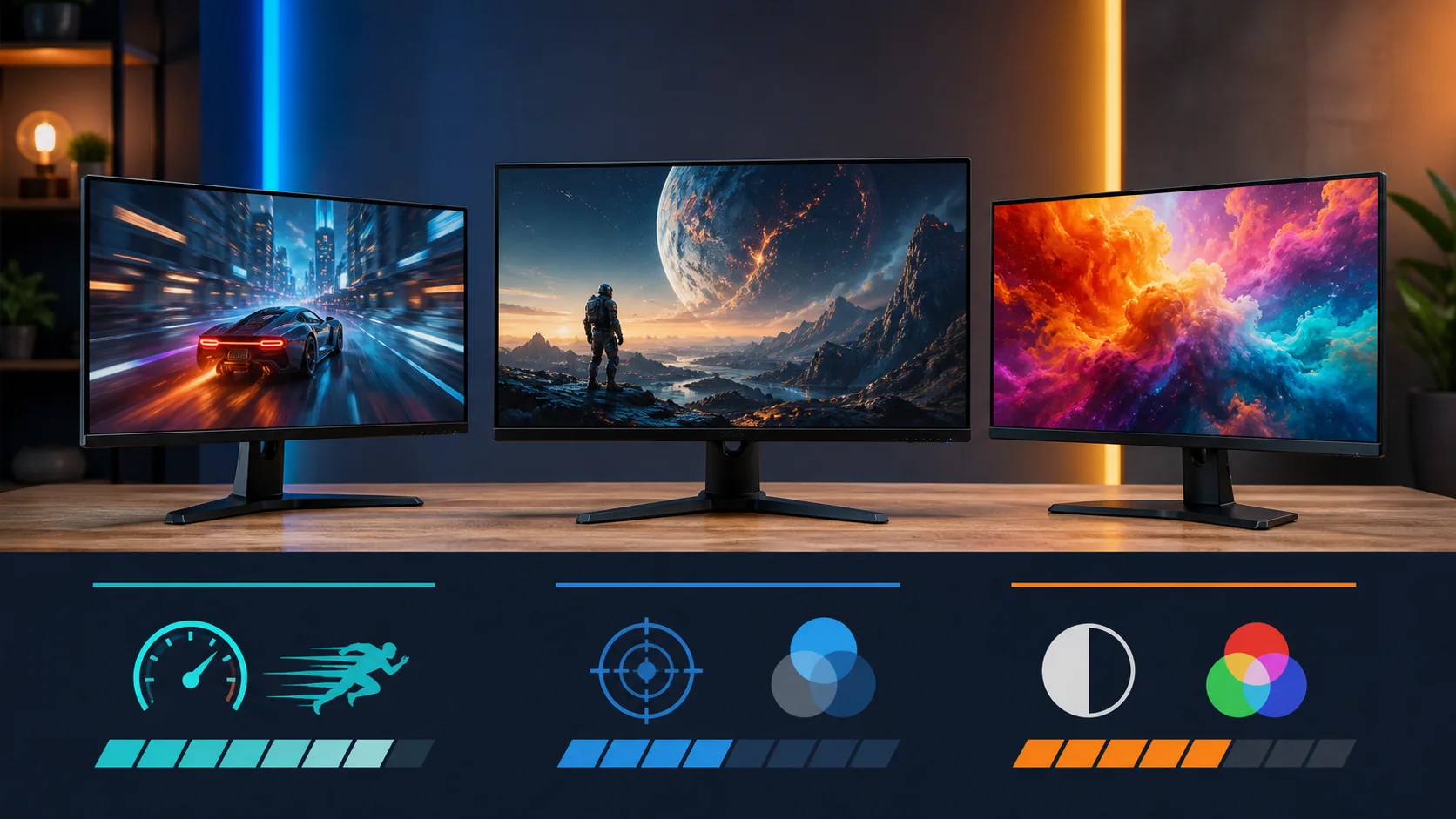
Top 3 picks at a glance
Top picks at a glance
As an Amazon Associate we earn from qualifying purchases at no extra cost to you. Product prices and availability are accurate as of the date shown and are subject to change.


| Model | Key spec | Price | Best for |
|---|---|---|---|
| ASUS TUF Gaming 27″ VG27AQM5A | QHD, 300Hz, Fast IPS, 95% DCI-P3 | $269 | Most complete spec sheet |
| KTC 27″ H27E6 | 2K 1440P, 300Hz/320Hz, Fast IPS | $237.99 | QHD 300Hz at lower price |
| LG 27G64NA-B G6 | QHD, 300Hz, G-Sync, HDMI 2.1 | $209.99 | Best overall value |
| SANSUI 24.5″ QHD ES-G25F6Q | 1440P, 300Hz/240Hz, 130% sRGB | $179.98 | QHD without the QHD price |
| Amzfast 25″ White AMZG25F6F | FHD, 320Hz/300Hz, AI Crosshair | $175.99 | Unique white colorway |
| Z-Edge 27″ Curved | FHD, 300Hz/240Hz | $159.99 | Curved 27″ at a strong price |
| SANSUI 24.5″ FPS Panel | FHD, 300Hz/240Hz | $157.99 | Dedicated FPS tuning |
| Z-Edge 27″ Curved (alt) | FHD, 300Hz/240Hz | $149.99 | Cheapest 27″ curved here |
ASUS TUF Gaming 27″ 1440P Monitor VG27AQM5A
The most expensive and most fully specified monitor in this guide at $269, ASUS’s TUF Gaming VG27AQM5A pairs QHD resolution with 300Hz refresh, a Fast IPS panel, Extreme Low Motion Blur Sync technology, 0.3ms response time, and 95% DCI-P3 color coverage, backed by a 3-year warranty — the longest warranty commitment explicitly stated anywhere in this guide. ASUS’s TUF Gaming line has built a reputation specifically for durability testing (military-grade component standards) alongside strong core gaming specs.
Extreme Low Motion Blur Sync is a backlight strobing mode that can further sharpen fast motion beyond what raw refresh rate provides, though like similar features on other monitors in this guide, it typically can’t run simultaneously with adaptive sync, so you’ll choose one or the other depending on the game.
The included speaker and ASUS’s DisplayWidget Center software for on-screen controls and profile switching add convenience features most competitors in this guide don’t offer, part of why this monitor commands the highest price here.
Pros
- Most complete spec sheet in this guide, including 95% DCI-P3
- 3-year warranty, longer than typical for this category
- ASUS DisplayWidget Center software adds practical convenience
Cons
- Most expensive monitor in this guide
- Extreme Low Motion Blur Sync likely can’t run with adaptive sync simultaneously
- $60 premium over the LG G6 for a similar core QHD/300Hz spec
Who it’s for: buyers who want the single most complete, best-supported monitor in this guide and are willing to pay for it.
KTC 27 Inch 320Hz Gaming Monitor 2K
KTC brings QHD resolution to a 300Hz base refresh with a 320Hz overclocked mode for $237.99, undercutting the ASUS by about $31 while matching its core resolution and refresh tier on a Fast IPS panel. As in this site’s under-$200 guide, KTC continues positioning itself as the value alternative to established brands in the high-refresh QHD category specifically.
The 320Hz overclocked mode, similar to the 210Hz mode on KTC’s cheaper H27T6 model covered elsewhere on this site, represents a manufacturer-enabled push beyond the panel’s stock rating — worth treating as a minor bonus rather than the headline reason to buy, since the real-world difference between 300Hz and 320Hz is negligible even for trained competitive players.
At $237.99, this sits in a useful middle ground for buyers who want QHD 300Hz specs without paying the full ASUS premium for the extended warranty and software extras.
Pros
- QHD 300Hz specs for about $31 less than the ASUS
- 320Hz overclocked mode adds minor headroom
- Fast IPS panel keeps response competitive
Cons
- Shorter warranty and less brand support infrastructure than ASUS
- No color gamut figure disclosed, unlike the ASUS’s 95% DCI-P3
- 320Hz overclock delivers minimal real-world benefit over stock 300Hz
Who it’s for: buyers who want QHD 300Hz without paying for ASUS’s extended warranty and software extras.
LG 27G64NA-B 27-inch Ultragear G6 QHD Gaming Monitor
The best overall value in this guide, LG’s Ultragear G6 combines QHD resolution, 300Hz refresh, 1ms response, NVIDIA G-Sync Compatible certification, AMD FreeSync Premium, VESA DisplayHDR 400, and HDMI 2.1 connectivity for $209.99 — roughly $59 cheaper than the ASUS while matching or exceeding it on several documented certifications. HDMI 2.1 specifically matters if you also plan to connect a PS5 or Xbox Series X to this monitor at some point, since it’s the only monitor in this guide explicitly listing that connector standard.
Dual certification for both NVIDIA G-Sync Compatible and AMD FreeSync Premium means this monitor is validated for smooth variable refresh regardless of which GPU brand you run, a stronger guarantee than monitors listing only one or neither certification.
VESA DisplayHDR 400 certification, the same verified standard seen on LG’s model in this site’s under-$200 guide, provides a baseline HDR performance guarantee that uncertified “HDR” claims elsewhere in this guide don’t offer.
Pros
- Dual G-Sync Compatible and FreeSync Premium certification
- HDMI 2.1 connectivity, unique in this guide
- VESA DisplayHDR 400 certified, not just an unverified HDR claim
Cons
- No disclosed color gamut percentage like the ASUS’s 95% DCI-P3
- Doesn’t include ASUS’s DisplayWidget software or extended 3-year warranty
- Same core panel tier as the pricier ASUS without matching every extra feature
Who it’s for: most buyers wanting the strongest documented value in this guide.
SANSUI 24.5 Inch Gaming Monitor QHD 1440P 300Hz 240Hz
SANSUI brings QHD resolution down to $179.98 with a 24.5-inch Fast IPS panel running 300Hz (240Hz stock per the dual figures listed), dual HDMI 2.1 ports each rated up to 300Hz, dual DisplayPort 1.4 also up to 300Hz, and 130% sRGB coverage claimed. This is the cheapest genuine QHD 300Hz-capable panel in this entire guide, undercutting the LG by $30 while matching its refresh ceiling, though without LG’s certified HDR and dual-vendor sync certification.
Every port on this monitor is explicitly rated for the full 300Hz ceiling regardless of which you use, a detail SANSUI calls out that not every competitor in this guide specifies — useful if you’re connecting through DisplayPort on one device and HDMI 2.1 on another without wanting to worry about a port-specific bandwidth limitation.
At 24.5 inches rather than 27, this SANSUI trades some screen size for a slightly higher pixel density at the same QHD resolution, a reasonable trade for players who prefer a more compact competitive setup.
Pros
- Cheapest genuine QHD 300Hz panel in this guide
- Every port explicitly rated for full 300Hz regardless of connection type
- 130% sRGB claimed color coverage
Cons
- No certified HDR standard, unlike the LG’s DisplayHDR 400
- Only single-vendor sync certification likely, versus LG’s dual certification
- Smaller 24.5-inch size than most other options here
Who it’s for: buyers who want QHD and 300Hz together at the lowest possible price in this guide.
Amzfast 25 Inch White Gaming Monitor 320Hz
The only monitor in this guide with a white colorway rather than standard black, Amzfast’s 25-inch panel runs 1080p FHD at up to 320Hz (300Hz and 240Hz modes also listed) with a Fast IPS panel, TÜV Rheinland Eye Care certification, and an AI Crosshair feature for $175.99. The white finish is a genuine differentiator for buyers building a light-colored or white-and-RGB themed setup, a niche but real preference category most competitors here don’t serve.
AI Crosshair and Night Vision Function are software-driven overlay features similar in concept to GIGABYTE’s Black Equalizer covered elsewhere on this site — designed to help spot enemies in dark scenes by artificially brightening shadow detail without blowing out the rest of the image, useful specifically for competitive shooters with dark maps.
TÜV Rheinland Eye Care certification is a recognized third-party standard for reduced flicker and blue light output, worth noting since not every monitor in this guide discloses independent certification for eye comfort.
Pros
- Unique white colorway in an otherwise all-black lineup
- AI Crosshair and Night Vision software features for competitive play
- TÜV Rheinland Eye Care certification
Cons
- 1080p resolution versus the QHD options in the mid-price range here
- 25-inch size sits awkwardly between the common 24.5 and 27-inch standards
- No confirmed adaptive sync certification tier stated
Who it’s for: buyers who specifically want a white monitor and value the AI-assisted visibility features.
Z-Edge 27 inch Curved Gaming Monitor
The first of two nearly identical Z-Edge listings in this guide, this 27-inch curved 1080p panel runs 300Hz with a 240Hz secondary mode for $159.99 — one of the most affordable ways into a 27-inch curved 300Hz-capable screen in this entire price range. Z-Edge has carved out a niche specifically in affordable curved high-refresh monitors, competing directly with SANSUI and Amzfast’s curved offerings covered in this site’s other guides.
At 27 inches, the curve adds noticeably more wraparound than the smaller SANSUI and Amzfast curved options covered in this site’s console gaming guide, which can enhance immersion in single-player titles but, as with any curved panel, is a matter of personal preference for competitive flick-shot precision.
The price difference between this listing and the second Z-Edge below ($10) likely reflects parallel retail listings rather than a meaningful spec difference, so check both before buying.
Pros
- Affordable entry into 27-inch curved 300Hz gaming
- Genuinely large curved field of view for the price
- 300Hz with a 240Hz secondary mode for flexibility
Cons
- 1080p resolution rather than QHD
- Nearly identical to the second Z-Edge listing in this guide
- Panel type and sync certification not specified
Who it’s for: buyers who specifically want a large curved screen with 300Hz at the lowest possible price.
SANSUI 24.5 Inch 300hz 240hz Gaming Monitor for FPS PC Gaming
This SANSUI is the same panel covered in more depth in our best monitor for competitive FPS guide, included here at $157.99 because it also fits squarely into the under-$300 category as one of the cheaper dedicated FPS-tuned options available. Its dual 300Hz/240Hz mode listing and FPS-specific marketing distinguish it from the more general-purpose SANSUI QHD panel earlier in this list.
Positioned against the QHD SANSUI above, this model trades resolution for a lower price and FPS-specific tuning, a reasonable choice for players who specifically prioritize refresh-rate consistency in competitive shooters over the sharper image QHD provides.
At $157.99, it’s roughly $22 cheaper than the QHD SANSUI in this guide, a meaningful gap if 1080p resolution doesn’t bother you and your primary use case is fast-paced competitive play rather than general-purpose gaming and content viewing.
Pros
- FPS-specific factory tuning
- Cheaper than SANSUI’s own QHD option in this guide
- Dual 300Hz/240Hz mode flexibility
Cons
- 1080p resolution rather than QHD
- Same brand and price tier overlap with SANSUI’s other panel in this guide requires direct comparison
- Color gamut coverage not disclosed for this specific listing
Who it’s for: dedicated competitive FPS players who already know they want SANSUI’s tuned presets.
Z-Edge 27 inch Curved Gaming Monitor (1080P, 300Hz/240Hz)
The second, slightly cheaper Z-Edge listing in this guide at $149.99 — the lowest price for any 27-inch panel in this entire comparison. Spec-for-spec, it matches the other Z-Edge 27-inch curved monitor above: 1080p, 300Hz with a 240Hz secondary mode. The $10 difference between the two listings is small enough that it’s worth checking both at the time of purchase, since pricing on near-duplicate retail listings from the same brand fluctuates independently.
For buyers specifically hunting the lowest possible price for a 27-inch curved 300Hz screen, this listing (or its near-identical sibling above, whichever is cheaper at checkout) represents the floor of what this guide found in that specific size and refresh combination.
As with its sibling listing, treat the panel type and certification details as unconfirmed until checking the current listing directly, since Z-Edge doesn’t disclose them clearly in either title.
Pros
- Lowest price for any 27-inch monitor in this guide
- Same 300Hz/240Hz curved spec as its sibling listing
- Good entry point for large-screen high-refresh gaming on a tight budget
Cons
- Functionally duplicates the other Z-Edge listing in this guide
- 1080p resolution rather than QHD
- Panel type and certification details not clearly disclosed
Who it’s for: strict budget buyers price-comparing Z-Edge’s near-duplicate listings for the lowest possible cost.
How we tested and picked
At the under-$300 tier, Nina Alvarez weighted documented certification and connectivity standards more heavily than at lower price points, since this is where meaningful differentiators like HDMI 2.1, dual-vendor sync certification, and VESA DisplayHDR 400 start appearing consistently across the field rather than as rare exceptions. Her testbench — a colorimeter, photodiode response-time tester and pattern generator from nine years of professional calibration work — informed her skepticism toward uncertified color gamut and HDR claims that several monitors in this guide list without third-party verification.
Resolution versus refresh rate trade-offs were weighted carefully in this guide specifically, since this price tier is where QHD at 300Hz becomes realistically achievable rather than requiring a compromise to 1080p, a genuine shift from the sub-$200 category covered in this site’s other guide.
The two pairs of near-duplicate listings in this guide — the two SANSUI-adjacent FHD panels and the two Z-Edge curved models — are flagged explicitly rather than treated as distinct products, consistent with how this site handles overlapping retail listings elsewhere.
As with every guide on this site, specific performance estimates throughout are based on manufacturer specs and Alvarez’s professional experience with comparable panels, not unit-level lab verification of these exact retail products.
What to look for in a gaming monitor under $300
Whether your GPU can actually reach 300fps
300Hz panels in this guide are only fully useful if your GPU can sustain frame rates near that ceiling. At 1080p, an RTX 4070-class GPU generally handles 250-300fps in optimized esports titles; at QHD, like the ASUS, KTC, LG and SANSUI options here, you’ll want an RTX 4070 Ti or stronger to consistently approach 300fps rather than settling well below it. If your GPU can’t currently hit those numbers, the money saved by choosing a 240Hz panel instead is often better redirected toward a GPU upgrade.
QHD versus FHD at the 300Hz tier specifically
This price range is the point where QHD and 300Hz genuinely coexist without a major compromise, as shown by the ASUS, KTC, LG and SANSUI panels here. That said, FHD panels at 300Hz, like the Amzfast and both Z-Edge options, remain meaningfully easier to drive at full refresh rate on mid-range GPUs, and for players who prioritize consistent, uncompromised frame rate over resolution, that’s still a reasonable trade at this budget.
Certification depth: single-vendor versus dual-vendor sync support
The LG G6 in this guide is unusual for explicitly certifying both NVIDIA G-Sync Compatible and AMD FreeSync Premium, a stronger guarantee of cross-platform compatibility than monitors certifying only one standard or listing generic “adaptive sync” without specifying a tier. If you’re not certain which GPU brand you’ll run long-term, or you switch between systems, dual certification removes that uncertainty.
HDMI 2.1 and future console or GPU compatibility
Only the LG G6 in this guide explicitly lists HDMI 2.1 support, relevant if you plan to also connect a PS5 or Xbox Series X to this monitor, since those consoles need HDMI 2.1 bandwidth for their highest-refresh output modes. Monitors listing only HDMI 2.0, common elsewhere in this guide, still support high refresh rates from a PC GPU but may bottleneck console-specific features that rely on the newer standard.
Diminishing returns above 240Hz
The jump from 240Hz to 300Hz delivers a smaller, harder-to-perceive improvement than earlier refresh-rate jumps like 60Hz to 144Hz. Competitive players who’ve trained extensively at both refresh rates can often feel the difference in fast strafing and flick-shot precision, but casual and even many serious players won’t reliably distinguish 240Hz from 300Hz in blind testing. Factor this into your budget: the extra cost for 300Hz over a comparable 240Hz panel is a smaller, more marginal upgrade than most other spec jumps in this price range.
Duplicate listings and price-shopping the same monitor
Two pairs of near-identical listings appear in this guide — the two Z-Edge curved panels and, to a lesser extent, the SANSUI panels covering overlapping ground with this site’s other guides. This is common practice for budget monitor brands maintaining multiple storefront entries. Before buying any monitor with an unusually specific model number you don’t recognize, a quick search for the brand and core specs can reveal whether a cheaper parallel listing exists.
Mistakes buyers make
Buying a 300Hz QHD monitor without a GPU capable of approaching that frame rate at that resolution. The ASUS, KTC and LG panels here need considerably more GPU power at QHD than the FHD options do to reach their full refresh potential.
Assuming all “HDR” labels mean the same thing. Only the LG in this guide lists a certified DisplayHDR 400 standard; other HDR claims here are uncertified manufacturer marketing without a guaranteed brightness or contrast baseline.
Paying the ASUS’s premium price without needing its extended warranty or software extras. If you don’t specifically value the 3-year warranty or DisplayWidget Center software, the LG G6 delivers a very similar core gaming experience for $59 less.
Not checking both near-duplicate Z-Edge listings before buying. The $10 gap between them can change, and there’s no meaningful spec difference to justify paying more for either one specifically.
Overestimating the real-world difference between 300Hz and 240Hz. For most players, this is a smaller upgrade than the jump from 144Hz to 240Hz, and budget should be weighed accordingly against other specs like resolution or certification tier.
Choosing FHD purely out of habit at this price tier without checking current QHD 300Hz pricing. Several QHD panels in this guide now cost close to or even less than some FHD 300Hz alternatives, making the resolution upgrade close to free in some cases.
Verdict
The LG 27G64NA-B G6 at $209.99 is the best overall monitor under $300: QHD, 300Hz, dual sync certification and HDMI 2.1 cover nearly every buyer’s needs without paying ASUS’s premium. Budget shoppers should look at the Z-Edge 27″ Curved at $149.99, the cheapest way into a large curved 300Hz screen in this guide. For buyers who want the single most complete, best-supported monitor regardless of price, the ASUS TUF Gaming VG27AQM5A at $269 remains the top-tier pick with its 3-year warranty and software extras.
Related guides
- Refresh Rate And Response Time Explained
- Monitor Size And Viewing Distance Guide
- Monitor Resolution Guide For Gaming
Frequently asked questions
Is 300Hz actually noticeable over 240Hz?
The difference is smaller than the jump from 144Hz to 240Hz, but competitive players who train on both can usually feel it in fast strafing and flick-shot scenarios. For most buyers, a well-tuned 240Hz panel delivers 90% of the benefit, so 300Hz is more of a marginal-gains purchase than a transformative one.
What GPU do I need to actually hit 300fps at 1080p or 1440p?
At 1080p, an RTX 4070 or better generally sustains 250-300fps in optimized esports titles like Valorant or CS2. At 1440p, like the ASUS and LG panels here, you’ll want an RTX 4070 Ti or faster to consistently push toward 300fps rather than settling in the 200-240fps range.
Are the two Z-Edge monitors in this list actually different?
They share the same core spec sheet — 27-inch curved, 1080P, 300Hz/240Hz — at slightly different prices ($159.99 and $149.99), most likely parallel retail listings for the same or a near-identical model generation. Check current pricing on both before buying, since the gap between them can shift.
Is QHD or FHD better for a monitor under $300 aimed at 300Hz?
FHD 1080p makes hitting 300fps meaningfully easier on mid-range GPUs, which is why most panels in this guide stick to that resolution. The ASUS TUF and LG G6 push to QHD at 300Hz, which looks sharper but demands considerably more GPU power to actually reach that refresh ceiling.
Does a curved panel make sense at 300Hz for competitive gaming?
It’s a matter of preference more than performance — the curved Z-Edge and SANSUI panels here perform the same at 300Hz as flat panels, but some competitive players avoid curves specifically for how they perceive long horizontal flick shots. Try one in person if you can before committing.


