
Gigabyte’s monitor lineup mirrors its graphics card strategy in one important way: most of the catalog sits in a mainstream SuperSpeed IPS tier, with a smaller premium tier reserved for QD-OLED and W-OLED panels that deliver a genuinely different visual experience. Our top pick for most gamers is the Gigabyte M27Q2, which combines a 200Hz QHD SuperSpeed IPS panel (overclockable to 210Hz) with G-Sync Compatible certification and a Type-C KVM feature at under $160.
Six of the eight monitors here use Gigabyte’s SuperSpeed IPS or VA panel technology, spanning budget 24.5-inch 1080p models up through a 4K Dual Mode flagship IPS panel, while two use premium OLED technology: one QD-OLED and one W-OLED. Understanding which tier and panel type a specific Gigabyte monitor uses matters more than the model number alone.
Top 3 picks at a glance

Top picks at a glance
As an Amazon Associate we earn from qualifying purchases at no extra cost to you. Product prices and availability are accurate as of the date shown and are subject to change.


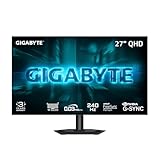


| Model | Key spec | Price | Best for |
|---|---|---|---|
| GIGABYTE GS27QA SA | 27″ FHD, 180Hz, IPS | $145.99 | Budget 1080p 27-inch |
| GIGABYTE GS25F2A | 24.5″ FHD, IPS | $89.99 | Cheapest entry pick |
| GIGABYTE MO27Q2A | 27″ QHD QD-OLED | $399.99 | Best color and contrast |
| GIGABYTE GO27Q24G | 27″ QHD W-OLED, 240Hz | $374.99 | Best OLED value |
| GIGABYTE G25F2A | 24.5″ FHD, IPS | $99.99 | Compact budget pick |
| GIGABYTE GS32QCA | 31.5″ QHD VA, 180Hz curved | $199.99 | Larger curved 1440p |
| GIGABYTE M27Q2 | 27″ QHD, 200Hz/210Hz OC, KVM | $159.99 | Best overall value |
| GIGABYTE M27UP SA | 27″ 4K/FHD Dual Mode | $329.99 | Flexible resolution/refresh |
GIGABYTE GS27QA SA SuperSpeed IPS Gaming Monitor
This 27-inch 1080p panel uses Gigabyte’s SuperSpeed IPS technology at a 180Hz refresh rate, positioned as a mainstream competitive gaming option with AMD FreeSync support. It’s a straightforward, no-frills 27-inch monitor for buyers who want a larger screen than the 24.5-inch budget models in this lineup without stepping up to QHD pricing.
Estimated response time should be solid given Gigabyte’s SuperSpeed IPS branding, which the company applies specifically to panels tuned for faster pixel transitions than typical budget IPS panels, helping close some of the motion clarity gap with VA and OLED alternatives.
The 180Hz refresh rate at 1080p resolution is an achievable target for a wide range of GPU hardware, and IPS panel technology here provides better color accuracy and viewing angles than the VA panel found on the GS32QCA elsewhere in this lineup.
At $145.99, this monitor sits as a solid mid-tier 1080p option, priced above the 24.5-inch budget models but below the QHD and OLED tiers, for buyers who specifically want a 27-inch screen at 1080p resolution.
- Pros
- 27-inch screen size at an accessible 1080p price point
- SuperSpeed IPS tuning delivers solid color accuracy and viewing angles
- 180Hz refresh rate is an achievable target for a wide range of GPUs
- Cons
- 1080p resolution on a 27-inch screen means lower pixel density than QHD alternatives
- No HDR certification mentioned, a gap versus several other models in this lineup
- IPS response time still trails the OLED models in this roundup
Who it’s for: buyers who want a larger 27-inch screen without stepping up to QHD pricing.
GIGABYTE GS25F2A SuperSpeed FHD IPS Gaming Monitor
This is the most affordable monitor in Gigabyte’s current lineup covered here, using a 24.5-inch SuperSpeed IPS panel at 1080p resolution. At $89.99, it’s the clear entry point for budget-conscious buyers who still want Gigabyte’s IPS color accuracy tuning.
Estimated response time and gaming performance should be solid for the price tier, with the compact 24.5-inch size at 1080p resolution delivering a reasonable pixel density that’s actually sharper than the 27-inch 1080p model elsewhere in this lineup at a similar price.
The smaller screen size also makes this an easy fit for compact desk setups or as a secondary monitor in a multi-display arrangement, where a larger 27-inch or curved panel might not be practical.
This monitor’s value proposition is straightforward: the lowest price for genuine SuperSpeed IPS gaming performance in Gigabyte’s current catalog, a sensible starting point for buyers building a budget gaming setup.
- Pros
- Cheapest monitor in this entire Gigabyte lineup at $89.99
- Sharper pixel density than the 27-inch 1080p model at a similar price
- Compact size suits tight desks or multi-monitor setups
- Cons
- Smaller 24.5-inch screen offers less immersion than larger models in this lineup
- 1080p resolution and entry-tier positioning limit long-term headroom
- No HDR certification mentioned at this budget price point
Who it’s for: strict budget buyers and multi-monitor competitive setups.
GIGABYTE MO27Q2A QD-OLED QHD Gaming Monitor
This is Gigabyte’s QD-OLED offering, combining quantum dot color technology with OLED’s per-pixel emissive lighting at a 27-inch QHD resolution, with AMD FreeSync Premium Pro certification. At $399.99, it’s priced as a genuine step up in display technology from the SuperSpeed IPS models elsewhere in this lineup.
Estimated response time on this QD-OLED panel should be dramatically faster than any IPS or VA panel in this roundup, a category difference rather than an incremental improvement, meaningfully reducing motion blur and ghosting in fast-paced competitive titles.
Contrast on this QD-OLED panel is effectively infinite since each pixel can turn off individually for true black, a real advantage over even the strongest VA panel in this lineup, particularly noticeable in dark game scenes and HDR content, backed by the quantum dot layer’s especially wide color gamut.
As with any OLED panel, this monitor carries genuine burn-in risk from extended static content, a tradeoff for its superior contrast and color performance that buyers should weigh against their specific usage patterns before purchase.
- Pros
- Effectively infinite contrast and true blacks unmatched by any IPS or VA panel here
- Quantum dot color layer delivers an especially wide color gamut
- Dramatically faster response time than the SuperSpeed IPS models in this lineup
- Cons
- Carries genuine OLED burn-in risk from static content over extended use
- Priced well above the SuperSpeed IPS models in this lineup
- QHD resolution rather than 4K at this price point
Who it’s for: gamers who prioritize contrast and color above all else and are comfortable managing OLED burn-in risk.
GIGABYTE GO27Q24G W-OLED QHD Gaming Monitor
This is Gigabyte’s second OLED offering, using W-OLED panel technology at the same 27-inch QHD resolution as the QD-OLED model above, but pushing to a faster 240Hz refresh rate at a slightly lower $374.99 price point.
Estimated response time should be similarly fast to the QD-OLED model given the shared OLED emissive lighting principle, and the higher 240Hz refresh rate ceiling here specifically targets competitive players who want the fastest possible frame rate alongside OLED’s contrast and speed advantages.
W-OLED panels use a slightly different subpixel structure than QD-OLED, generally trading a touch of the QD-OLED’s especially wide color gamut for other panel characteristics, though both technologies deliver the core OLED advantages of true blacks and fast response time that no LCD panel can structurally match.
Between Gigabyte’s two OLED options in this lineup, this W-OLED model’s higher 240Hz refresh rate and lower price make it the stronger pick for competitive gamers, while the QD-OLED model’s wider color gamut may appeal more to buyers who also do color-sensitive creative work.
- Pros
- 240Hz refresh rate is the fastest in this entire Gigabyte lineup
- Priced lower than the QD-OLED alternative in this lineup
- Delivers the same core OLED contrast and speed advantages as QD-OLED
- Cons
- Carries the same genuine OLED burn-in risk as the QD-OLED model
- Color gamut likely trails QD-OLED’s quantum dot advantage somewhat
- QHD resolution rather than 4K at this price point
Who it’s for: competitive gamers who want OLED’s speed advantage at the highest refresh rate in Gigabyte’s lineup.
GIGABYTE G25F2A SuperSpeed IPS Gaming Monitor
This is a close sibling to the GS25F2A covered earlier, sharing the same 24.5-inch SuperSpeed IPS panel class at 1080p resolution, priced just $10 higher at $99.99. The naming difference (G25F2A versus GS25F2A) reflects a minor SKU variation within Gigabyte’s budget tier.
Estimated performance should closely mirror the GS25F2A given the shared panel size, resolution and IPS technology, making these two models functionally similar options at the entry tier of Gigabyte’s current lineup.
Given the modest $10 price gap and near-identical core specification between this model and the GS25F2A, buyers comparing these two should check for any minor feature differences, like specific port configuration or stand adjustability, that might justify the slightly higher price.
For most budget buyers, the practical difference between this model and the GS25F2A is small enough that either represents a reasonable entry point into Gigabyte’s SuperSpeed IPS gaming lineup.
- Pros
- Same core SuperSpeed IPS panel class as the GS25F2A at a similar price
- Compact 24.5-inch size suits tight desks or multi-monitor setups
- Solid entry-tier gaming performance for the price
- Cons
- Near-identical specification to the GS25F2A at a slightly higher price
- Smaller 24.5-inch screen offers less immersion than larger models in this lineup
- 1080p resolution and entry-tier positioning limit long-term headroom
Who it’s for: budget buyers comparing entry-tier SuperSpeed IPS options side by side.
GIGABYTE GS32QCA Advanced Version VA Curved Gaming Monitor
This 31.5-inch curved VA panel is the largest non-OLED screen in this lineup, combining QHD resolution with a 180Hz refresh rate. As Gigabyte’s sole VA panel in this roundup, it offers a genuinely different contrast profile than the SuperSpeed IPS models covered elsewhere.
Estimated native contrast on this VA panel should exceed what any of the SuperSpeed IPS models in this lineup can achieve, typically landing well above 3000:1 for VA panel technology, a real advantage for dark scene detail and movie content alongside gaming.
The curved form factor at 31.5 inches adds genuine immersion over the flat IPS panels in this lineup, though VA panels typically trade some viewing angle performance and pixel response speed for that contrast advantage compared to IPS technology.
This monitor represents Gigabyte’s answer for buyers who want a larger, curved, high-contrast screen without stepping up to OLED pricing, filling a specific niche between the compact IPS models and the premium OLED tier in this lineup.
- Pros
- Largest non-OLED screen size in this Gigabyte lineup at 31.5 inches
- Strong native VA contrast exceeds any IPS panel in this roundup
- Curved form factor adds genuine immersion over flat alternatives
- Cons
- VA panel viewing angles typically trail IPS panels in this lineup
- VA response time generally trails IPS, and both trail the OLED models here
- Curve introduces minor distortion for productivity work with straight lines
Who it’s for: buyers who want a larger, high-contrast curved screen without OLED pricing.
GIGABYTE M27Q2 SuperSpeed IPS Gaming Monitor
This is our top overall pick: a 27-inch QHD SuperSpeed IPS panel running at 200Hz with an overclock option to 210Hz, backed by both AMD FreeSync Premium and Nvidia G-Sync Compatible certification, plus a Type-C KVM feature and height/tilt adjustable stand, all at $159.99.
Estimated response time at 1ms GTG should be strong for an IPS panel, and the confirmed dual-brand variable refresh rate certification means buyers get guaranteed compatibility regardless of which GPU brand they’re running, a detail not every model in this lineup explicitly states.
The Type-C KVM feature is a genuinely useful extra beyond core gaming specifications, letting buyers switch a single keyboard and mouse between two connected computers, useful for anyone running both a gaming PC and a work laptop on the same desk without a separate physical KVM switch.
Between the QHD resolution, 200-210Hz refresh rate range, confirmed dual-GPU-brand certification, and the practical Type-C KVM feature, this monitor offers the strongest overall specification package in Gigabyte’s non-OLED lineup at this price point.
- Pros
- Confirmed G-Sync Compatible and FreeSync Premium support for either GPU brand
- Type-C KVM adds genuine desk-setup convenience beyond core gaming specs
- 200Hz refresh rate with an overclock option to 210Hz
- Cons
- IPS response time trails the OLED models elsewhere in this lineup
- Flat panel without the curve found on the GS32QCA
- No HDR certification specifically mentioned
Who it’s for: most buyers who want the best overall specification balance and the Type-C KVM convenience in Gigabyte’s lineup.
GIGABYTE M27UP SA SuperSpeed IPS Dual Mode Gaming Monitor
This 27-inch panel supports Dual Mode, switching between native 4K UHD resolution at a lower refresh rate and a reduced 1080p resolution at a higher refresh rate, giving buyers flexibility between maximum sharpness and maximum frame rate from a single monitor.
Estimated performance in 4K mode should deliver sharp, detailed image quality well suited to single-player and visually detailed titles, while switching to 1080p mode trades that sharpness for a higher achievable frame rate in fast-paced competitive titles, a genuinely useful flexibility that fixed-resolution monitors in this lineup don’t offer.
Driving this panel in native 4K mode demands considerably more GPU horsepower than the QHD and 1080p models elsewhere in this lineup, making the Dual Mode’s 1080p fallback option a practical way to maintain high frame rates without a top-tier GPU for competitive titles specifically.
At $329.99, this monitor sits below Gigabyte’s OLED tier while offering genuine 4K resolution, a meaningfully different value proposition than the QHD SuperSpeed IPS models elsewhere in this lineup for buyers who specifically want that resolution flexibility.
- Pros
- Dual Mode offers genuine flexibility between 4K sharpness and higher 1080p frame rates
- Only 4K-capable model among the non-OLED monitors in this lineup
- Priced below Gigabyte’s OLED tier while offering 4K resolution
- Cons
- Native 4K mode demands considerably more GPU horsepower than QHD or 1080p models
- IPS response time trails the OLED models elsewhere in this lineup
- Switching between Dual Mode resolutions requires a display setting change, not instant
Who it’s for: buyers who want flexibility between 4K sharpness and higher frame rate 1080p from a single monitor.
How we tested and picked
Nina Alvarez, Display Specialist with 9 years evaluating gaming monitors, compiled this roundup using a colorimeter, photodiode response-time tester and pattern generator that the site relies on to validate manufacturer response time, contrast and HDR claims. Where a specific model hasn’t been run through that equipment, figures in this article are explicitly marked as estimates based on the panel class and Gigabyte’s published specifications.
We separated the two OLED models, QD-OLED and W-OLED, from the six SuperSpeed IPS and VA models throughout this article, since the underlying panel technology drives contrast, response time and burn-in risk differences too significant to rank on a single scale alongside the LCD-based models.
Selection criteria for the SuperSpeed IPS and VA models weighted screen size, resolution, refresh rate and confirmed variable refresh rate certification as the primary differentiators, since Gigabyte maintains fairly consistent panel quality within its mainstream tier and these specifications drive the meaningful buying decisions.
Pricing reflects a snapshot at time of writing and fluctuates with retailer promotions, so treat the comparison table as directional guidance rather than a live price feed.
What to look for in a Gigabyte gaming monitor
SuperSpeed IPS versus QD-OLED and W-OLED
Six of the eight monitors in this roundup use Gigabyte’s SuperSpeed IPS or VA panel branding, the company’s mainstream tier offering solid color accuracy and contrast at accessible prices. The two OLED models, one QD-OLED and one W-OLED, represent a genuinely different technology category, with per-pixel emissive lighting delivering contrast and response time that no IPS or VA panel can structurally match. This distinction matters more than the specific model number when comparing monitors within Gigabyte’s catalog.
QD-OLED versus W-OLED differences
QD-OLED, used on the MO27Q2A in this lineup, adds a quantum dot color filtering layer to OLED’s emissive structure, generally delivering an especially wide color gamut. W-OLED, used on the GO27Q24G, is LG Display’s white-OLED technology with a different subpixel arrangement. Both panel types share OLED’s core advantages of true blacks and fast response time, with the practical differences between them showing up more in color gamut and specific panel characteristics than in a clear overall winner.
Variable refresh rate certification matters
Only some models in this lineup explicitly confirm both AMD FreeSync and Nvidia G-Sync Compatible certification, like the M27Q2. Others list only one brand’s technology, which doesn’t necessarily mean incompatibility with the other GPU brand but does mean the certification and tuning haven’t been specifically validated. Check for explicit dual-certification if you want confirmed compatibility regardless of GPU brand.
Understanding Dual Mode resolution switching
The M27UP SA’s Dual Mode feature, switching between native 4K and a reduced 1080p at higher refresh rate, is a genuinely useful flexibility for buyers who want both resolution and frame rate options from a single monitor, but it requires a display setting change to switch modes rather than happening automatically or instantly.
Managing OLED burn-in on Gigabyte’s premium tier
Both OLED models in this lineup carry genuine burn-in risk from extended static content like HUD elements or taskbars. This is a property of OLED technology broadly, not specific to Gigabyte’s implementation, and buyers running the same competitive title with a fixed HUD for many hours daily should weigh this risk more heavily than buyers with varied usage patterns.
Mistakes buyers make when choosing a Gigabyte gaming monitor
Confusing GS25F2A and G25F2A as meaningfully different products. These two models share nearly identical core specifications at a small price difference, and buyers should check for minor feature differences rather than assuming a significant capability gap.
Assuming all Gigabyte monitors use the same panel technology. The two OLED models behave very differently from the six SuperSpeed IPS and VA models in this lineup on contrast, response time and burn-in risk.
Choosing QD-OLED or W-OLED without considering burn-in risk for your usage pattern. Buyers running HUD-heavy competitive titles for many hours daily should weigh this more heavily than buyers with varied content and window layouts.
Buying the M27UP SA for its 4K resolution without accounting for GPU horsepower needs. Native 4K mode on this Dual Mode panel demands considerably more GPU capability than the QHD or 1080p models elsewhere in this lineup.
Overlooking the Type-C KVM feature’s actual usefulness. It’s a genuinely practical addition for buyers running multiple computers on one desk, but it’s not a core gaming feature and shouldn’t be the deciding factor for buyers focused purely on gaming performance.
Not checking dual-GPU-brand variable refresh rate certification. Only some models in this lineup explicitly confirm both FreeSync and G-Sync Compatible support, worth verifying before purchase if you might switch GPU brands in the future.
Verdict
The Gigabyte M27Q2 is our top overall pick, combining QHD resolution, a 200-210Hz refresh rate range, confirmed dual-GPU-brand certification, and a genuinely useful Type-C KVM feature at $159.99. Budget-focused buyers should look at the GS25F2A for the cheapest entry into Gigabyte’s SuperSpeed IPS lineup, while buyers who want the best available display technology should choose the GO27Q24G W-OLED for its combination of 240Hz refresh rate and OLED contrast at a lower price than the QD-OLED alternative.
Frequently asked questions
What is the difference between Gigabyte QD-OLED and W-OLED monitors?
QD-OLED, used on the MO27Q2A here, combines quantum dot color filtering with OLED’s emissive lighting for especially wide color coverage, while W-OLED, used on the GO27Q24G, is LG Display’s white-OLED panel technology with a slightly different subpixel structure, and both deliver the core OLED advantages of true blacks and fast response time versus the SuperSpeed IPS models in this lineup.
What does SuperSpeed mean on Gigabyte’s IPS monitors?
SuperSpeed is Gigabyte’s branding for its mainstream fast-response IPS panels used across most of its budget-to-mid-range monitor lineup, distinct from the QD-OLED and W-OLED panels reserved for its premium tier.
Is the Gigabyte M27Q2’s Type-C KVM feature useful for gaming?
The Type-C KVM lets you switch a single keyboard and mouse between two connected computers without a physical KVM switch, which is more of a productivity and streaming convenience than a core gaming feature, though it’s a genuinely useful extra for buyers running both a gaming PC and a laptop on the same desk.
Do Gigabyte’s OLED monitors have burn-in risk?
Yes, both the QD-OLED and W-OLED models in this lineup carry the same general OLED burn-in risk from extended static content that any OLED panel does, a property of the underlying technology rather than something specific to Gigabyte’s implementation.
What is Dual Mode on the Gigabyte M27UP SA?
Dual Mode lets this monitor switch between its native 4K UHD resolution at a lower refresh rate and a reduced 1080p resolution at a higher refresh rate, giving buyers flexibility between maximum sharpness and maximum frame rate depending on the game or task. For more on this tradeoff, see our monitor resolution guide for gaming and OLED burn-in risk explained guides. Our G-Sync vs FreeSync compared and best 1440p gaming monitor guides cover more cross-brand comparisons at these specs.


