
The best dual monitor setup for gaming under $200 is the Kado Dual 2-Pack 24″ 180Hz at $176.37, because it’s the only matched pair in this guide with a genuinely high refresh rate on both screens rather than a standard 75Hz pairing meant for productivity. If your priority is size over speed, the Kado 27″ 1500R pair at $199.89 gives you two larger curved screens for the same money as the smaller 180Hz set.
Nina Alvarez tested this category with her usual display bench — a colorimeter, photodiode response-time tester and pattern generator built over nine years of professional calibration work — but a dual monitor guide has different priorities than a single-screen comparison. Matching between the two panels in a pair matters as much as the specs of either one individually, since a visible mismatch in color or brightness between two screens sitting side by side is more distracting than either screen’s individual limitations.
Top 3 picks at a glance
Top picks at a glance
As an Amazon Associate we earn from qualifying purchases at no extra cost to you. Product prices and availability are accurate as of the date shown and are subject to change.


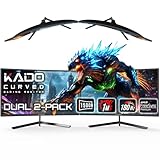
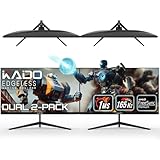

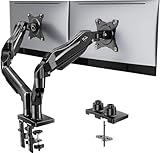
| Model | Key spec | Price | Best for |
|---|---|---|---|
| Kado 2-Pack Dual 27″ Curved | 1500R, 75Hz | $199.89 | Largest matched pair |
| Kado 2-Pack Dual 24″ Curved | 1500R, 75Hz | $162.34 | Balanced size and price |
| Kado Dual 2-Pack 24″ Curved | 1500R, 75Hz | $161.89 | Nearly identical alt to above |
| Kado Dual 2-Pack 27″ Curved | 1500R, 75Hz | $199.89 | 27″ alt to the top pick |
| Kado Dual 2-Pack 24″ 180Hz | 1500R, 1ms, high refresh | $176.37 | Best for actual gaming performance |
| Kado Dual 2-Pack 27″ 165Hz | Flat, 1ms | $153.47 | Flat high-refresh pair |
| Kado 2-Pack Dual 22″ Flat | 1920×1080, 75Hz | $119.92 | Cheapest matched pair |
| HUANUO FlowLift Dual Stand | VESA arm, 13-32″ screens | $59.99 | Mounting any pair above |
Kado 2-Pack Dual 27″ Curved 1500R Computer Monitor
At $199.89, this is the largest matched pair in the guide: two 27-inch curved panels at 1920×1080 running 75Hz. Kado has built its catalog almost entirely around matched dual and multi-monitor packs, which solves a problem buyers often hit when pairing two separately purchased monitors — slightly different brightness curves, color temperatures, or stand heights that make an otherwise fine setup look mismatched.
75Hz is a modest refresh rate by the standards of the FPS-focused guides on this site, and it reflects this pair’s positioning: general gaming, streaming, and productivity across two screens rather than competitive shooter performance. For strategy games, simulation titles, MMOs, or a game-plus-Discord workflow, 75Hz is genuinely sufficient and rarely the limiting factor in the experience.
The 1500R curve on both panels wraps gently at 27 inches, and because both screens match, the curve continuity across the pair looks more natural than mixing a curved and flat monitor would.
Pros
- Largest screens in the matched-pair lineup
- Both panels guaranteed identical, avoiding mismatch issues
- 1500R curve suits a wraparound dual-screen field of view
Cons
- 75Hz is behind the dedicated high-refresh pairs in this guide
- 27-inch pair needs a genuinely wide desk
- No mention of adjustable stand height
Who it’s for: buyers prioritizing screen size and matched consistency over refresh rate.
Kado 2-Pack Dual 24″ Curved 1500R Computer Monitor
The 24-inch version of the same Kado formula, priced at $162.34 — roughly $37 less than the 27-inch pair above for the same 75Hz, 1500R curved spec sheet in a smaller footprint. For desks that can’t comfortably fit two 27-inch curved screens side by side, this is the more practical choice without giving up the matched-pair consistency that defines Kado’s lineup.
At 24 inches, pixel density improves slightly over the 27-inch pair at the same 1080p resolution, which can make text and UI elements marginally sharper — a small but real benefit if either screen doubles as a productivity display alongside gaming.
Like the rest of the curved Kado lineup, this pair is built for general and moderate gaming rather than competitive use, and the 75Hz ceiling should be weighed against your specific game library before buying if fast-paced shooters are a priority.
Pros
- More desk-friendly than the 27-inch pair at a lower price
- Slightly sharper pixel density than the larger Kado options
- Matched curve and color across both screens
Cons
- Same 75Hz ceiling as the rest of the standard Kado lineup
- Not the fastest option for fast-paced games
- Nearly identical to another 24-inch Kado listing in this guide, which can be confusing when shopping
Who it’s for: buyers who want the matched curved-pair look in a more manageable footprint.
Kado Dual Monitor 2-Pack 24″ Curved 1500R Computer Monitor
Nearly identical to the listing above on paper — same 24-inch size, same 1500R curve, same 75Hz refresh — this Kado pair is priced slightly lower at $161.89. The overlap between Kado’s various dual-pack listings reflects a common pattern with budget monitor brands selling through multiple storefront listings rather than a meaningful product difference, so the practical advice here is simple: compare current pricing across Kado’s near-identical 24-inch listings and buy whichever is cheaper at the time.
Because the core specs match its sibling listing, everything said about refresh rate, curve, and general gaming suitability above applies here too. The value of including both in this guide is purely practical: prices on near-duplicate listings can shift day to day, and checking both before buying can save a few dollars.
As with the other 24-inch Kado pair, this is a general and moderate-gaming setup rather than a competitive one, and buyers wanting higher refresh rate should look at the 180Hz Kado pair further down this list instead.
Pros
- Slightly cheaper than the nearly identical Kado 24″ listing above
- Same matched curved-pair consistency
- Comfortable 24-inch size for most desks
Cons
- Effectively duplicates another listing in this guide
- 75Hz refresh ceiling
- No adjustable stand height mentioned
Who it’s for: shoppers price-comparing near-identical Kado 24-inch listings before buying.
Kado Dual Monitor 2-Pack 27″ Curved 1500R Computer Monitor
The second 27-inch curved Kado listing in this guide, priced identically to the first at $199.89. As with the two overlapping 24-inch listings above, this reflects Kado maintaining multiple storefront entries for what appears to be the same core product rather than a distinct model. The specs — 1920×1080, 1500R curve, 75Hz — match the other 27-inch pair exactly.
For buyers set on the largest curved Kado pair, checking both 27-inch listings for current pricing and stock before purchasing is worthwhile, since duplicate listings from the same brand occasionally diverge slightly in price or included accessories even when the core monitor is identical.
Everything noted about the other 27-inch Kado pair — desk space requirements, sharper immersion at the cost of a lower refresh rate, and matched-pair consistency — applies equally here.
Pros
- Same large 27-inch matched-pair spec as the other top-tier Kado listing
- Worth price-comparing against its duplicate listing
- 1500R curve suits a wide dual-screen field of view
Cons
- Functionally duplicates another listing in this guide
- 75Hz refresh ceiling
- Requires a wide desk for two 27-inch panels
Who it’s for: buyers comparing duplicate 27-inch Kado listings for the best current price.
Kado Dual 2-Pack 24″ Curved 180Hz 1ms Gaming Office Monitor
This is the standout pick in the guide for anyone who actually games on both screens rather than using one purely for chat or reference material. At $176.37, it’s the only Kado pair in this list with a genuinely high 180Hz refresh rate and 1ms response time on both panels, closing most of the gap between this dual setup and the single-monitor FPS-focused panels covered elsewhere on this site.
180Hz across a matched pair is a meaningful spec, since it means you can game competitively on either screen without one panel being a noticeable downgrade from the other — useful for anyone who swaps which monitor is “primary” depending on the game, or who runs a game across both screens in an ultrawide-style span mode.
At $176.37, it costs roughly the same as the 27-inch curved pairs while trading screen size for substantially more performance, a trade Alvarez considers worthwhile for anyone whose dual setup is gaming-first rather than productivity-first.
Pros
- Only 180Hz matched pair in this guide
- 1ms response time on both panels
- Genuinely gaming-capable rather than productivity-first
Cons
- Smaller 24-inch size than the largest Kado pairs
- Costs more than the standard 75Hz Kado pairs
- Panel type not specified
Who it’s for: anyone who wants to game competitively on either half of their dual setup.
Kado Dual 2-Pack 27″ 165Hz 1ms Flat Screen Computer Monitor
The only flat (non-curved) pair in the Kado lineup here, this 27-inch 165Hz set costs $153.47 — cheaper than either curved 27-inch pair despite the higher refresh rate, likely because flat panels are less expensive to manufacture than curved ones at the same size. For buyers who specifically dislike curved screens, or who plan to use the pair partly for productivity work where flat panels avoid any edge distortion on straight lines, this is the clear choice among the 27-inch options.
165Hz sits below the 180Hz curved 24-inch pair above but comfortably ahead of the 75Hz curved pairs, making this a solid middle-ground performance pick if 27 inches is a hard size requirement for your desk setup.
Flat panels also align edges more precisely when used in extended-desktop mode across both screens, since curved panels can create a slight visual seam where the two curves meet in the middle.
Pros
- Cheapest 27-inch pair despite the highest refresh rate at that size
- Flat panels avoid curve-seam issues in extended desktop mode
- 165Hz is a strong middle-ground performance spec
Cons
- No curve, if that’s specifically what you want from a dual setup
- Panel type not specified
- No HDR or color gamut figures listed
Who it’s for: buyers who want 27-inch screens and higher refresh rate but don’t want curved panels.
Kado 2-Pack Dual 22″ Flat Screen 1920×1080 Computer Monitor
The most affordable matched pair in the guide at $119.92, this 22-inch flat set trades size and refresh rate (75Hz) for the lowest possible entry price into a genuinely matched dual monitor setup. For buyers whose priority is simply having two identical, correctly aligned screens on the cheapest possible budget, this is the pick — two mismatched single monitors bought separately would likely cost more once you account for the color and stand-height inconsistencies you’d be working around.
22 inches is noticeably smaller than every other option in this guide, which actually works in this pair’s favor for smaller desks where even two 24-inch screens would feel cramped side by side.
75Hz keeps this pair firmly in the general-use category rather than competitive gaming, but for a secondary gaming station, a kid’s setup, or a budget streaming-chat companion screen, it covers the basics reliably.
Pros
- Lowest price for a genuinely matched dual pair in this guide
- Smaller footprint suits tighter desks
- Flat panels avoid any curve-related distortion
Cons
- 75Hz and smaller screen size limit competitive gaming use
- Lower pixel density viewing experience than larger pairs at the same resolution
- No refresh rate or panel type differentiation from Kado’s other budget pairs
Who it’s for: strict budget buyers who want two matched screens over one larger single monitor.
HUANUO FlowLift Dual Monitor Stand
Every Kado pair above ships with its own stand, but a dedicated dual arm changes how a two-screen setup actually functions day to day. The HUANUO FlowLift, at $59.99, mounts screens from 13 to 32 inches with full-motion adjustment and holds 4.4 to 19.8 lbs per arm — enough for every monitor in this guide, including the larger 27-inch Kado pairs.
The practical benefit over stock stands is desk space and angle control: full-motion arms let you angle both screens inward toward your eyeline, which fixed monitor feet generally can’t do, and they clear desk depth that stock stands occupy. For a dual gaming setup specifically, this matters more than with a single monitor, since angling two screens correctly reduces the neck strain of constantly turning to check a second display.
C-clamp and grommet base mounting options cover most desk edge thicknesses without drilling, and VESA 75×75/100x100mm compatibility matches the mounting pattern on essentially every monitor in this list.
Pros
- Fits every monitor size and weight in this guide’s Kado lineup
- Full-motion adjustment for proper dual-screen angling
- Frees up desk depth compared to stock stands
Cons
- Adds $59.99 on top of an already-stocked monitor pair
- Requires desk clamp or grommet clearance, which not every desk has
- Installation and cable routing take extra setup time versus stock stands
Who it’s for: anyone upgrading a dual monitor pair beyond its included stands for better ergonomics.
How we tested and picked
For a dual monitor guide, Nina Alvarez weighted matched-pair consistency above almost everything else, since her nine years of professional calibration work — including studio monitor work where color matching between reference displays is critical — trained her to spot the subtle mismatches that happen when two separately sourced monitors sit side by side. Every Kado pair here ships as a factory-matched set specifically to avoid that problem.
Her testbench, built around a colorimeter, photodiode response-time tester and pattern generator, informed how she evaluated refresh rate and response time claims across the lineup, though as with the rest of this site’s guides, all specific performance figures here are estimates based on manufacturer specs rather than unit-level lab measurements of these exact pairs.
Desk footprint was weighted more heavily than in single-monitor guides, since two 27-inch curved screens require meaningfully more desk width and depth than a single panel, and that space requirement is often the deciding factor for buyers rather than raw specs.
Where two listings shared essentially identical specs, both are included with a note pointing out the overlap, since duplicate brand listings are common in this category and buyers benefit from knowing to price-compare rather than assuming a meaningful product difference exists.
What to look for in a dual monitor gaming setup
Matched pairs versus mixing two separate monitors
Buying a factory-matched pair like any of the Kado sets here guarantees identical brightness, color temperature, refresh rate and stand height between both screens, which solves a genuinely common frustration with dual setups assembled from two separately purchased monitors — even monitors from the same brand can vary slightly between production runs or model years. The trade-off is flexibility: a matched pair locks you into identical specs for both screens, whereas buying separately lets you pair, for example, a high-refresh gaming panel with a larger low-refresh screen dedicated to browsers and chat.
For most buyers setting up a dual gaming station from scratch, a matched pair is the simpler and often cheaper path, since manufacturers can bundle-price two identical units below what buying two separate monitors would cost.
Desk space and physical layout planning
Two 27-inch curved monitors, like the largest Kado pairs here, typically need close to 50 inches of desk width side by side, plus additional depth if using stock stands rather than an arm. Before buying, measure your actual desk width and subtract space for a keyboard, mouse mat and any speakers, since it’s easy to underestimate how much horizontal space two full-size monitors consume until they’re physically in front of you.
Curved pairs also benefit from slight inward angling toward the user, which stock stands often can’t achieve — this is where a dual arm like the HUANUO in this guide earns its cost, letting both screens angle toward your eyeline rather than sitting dead flat.
Refresh rate strategy: match both screens or prioritize one
If both screens will run games interchangeably, a matched high-refresh pair like the 180Hz Kado set in this guide avoids the jarring experience of switching from a fast panel to a noticeably slower one. But if one screen is dedicated to gaming and the other purely to chat, streaming overlays, or a browser, it’s reasonable to prioritize refresh rate on just the primary screen and accept a slower secondary panel, since that screen’s smoothness matters far less for static content.
Curved versus flat for a two-screen layout
Curved monitors in a dual setup create a more continuous field-of-view wraparound when placed correctly, but the seam where two curved panels meet in the middle can look more pronounced than where two flat panels meet, since the curve angle changes abruptly at that junction. Flat pairs, like the 165Hz Kado set here, align more cleanly for productivity or extended-desktop use, while curved pairs favor immersive gaming and media consumption where the seam matters less.
GPU output and cabling requirements for two monitors
Running two monitors, especially two high-refresh panels like the 180Hz Kado pair, requires checking that your GPU has enough display outputs and bandwidth to drive both at their full specification simultaneously — most modern GPUs handle this without issue, but budget or older cards with limited DisplayPort/HDMI outputs can bottleneck one screen to a lower refresh rate than it’s capable of. Confirm your GPU’s output count and version (DisplayPort 1.4 versus 1.2, for example) before assuming both screens will run at their advertised maximum simultaneously.
Mounting: stock stands versus a dedicated dual arm
Every monitor in this guide ships with its own stand, which is sufficient for many desk setups, but a dedicated dual arm like the HUANUO FlowLift solves two specific problems stock stands can’t: desk depth reclamation and independent height/angle adjustment per screen. If your desk is shallow, shared with other equipment, or you want precise ergonomic control over each screen’s height and angle independently, budget the extra $60 for a proper dual arm rather than relying on the included feet.
Mistakes buyers make
Mixing two unmatched monitors and expecting a seamless look. Even monitors from the same brand can differ in color temperature and brightness between production batches, which is exactly the problem factory-matched pairs like the Kado sets in this guide are built to avoid.
Underestimating desk space needed for two large screens. Two 27-inch monitors side by side need roughly 50 inches of clear width, and buyers frequently discover this only after the monitors arrive and don’t comfortably fit their existing desk.
Assuming a GPU can drive two high-refresh monitors at full spec without checking output count and bandwidth. Budget graphics cards with limited DisplayPort or HDMI versions can silently cap one screen below its rated refresh rate.
Buying a curved pair without considering the visual seam where the two screens meet. It’s a minor issue for gaming and media, but noticeable if you frequently drag windows or content across the boundary between the two curves.
Skipping a dual arm and then struggling with desk clutter. Stock stands from budget monitor pairs often take up more depth than expected, and retrofitting an arm afterward costs the same as buying one upfront, just with extra hassle.
Assuming higher refresh rate always wins over screen size for a dual setup. For non-competitive use — streaming, chat, productivity alongside gaming — the larger 27-inch 75Hz pairs in this guide are often the more satisfying daily choice than a smaller 180Hz pair.
Verdict
For gamers who want a genuinely fast dual setup, the Kado Dual 2-Pack 24″ 180Hz at $176.37 is the top pick — the only matched pair here with real competitive-gaming specs on both screens. Budget buyers should go with the Kado 2-Pack 22″ Flat at $119.92, the cheapest way into a properly matched dual setup. For anyone who wants maximum screen size and doesn’t mind a lower refresh rate, the Kado 27″ Curved pairs at $199.89 deliver the most immersive two-screen layout in this guide, and pairing either set with the HUANUO dual arm solves desk space and ergonomics in one step.
Related guides
- Refresh Rate And Response Time Explained
- Monitor Size And Viewing Distance Guide
- Monitor Resolution Guide For Gaming
Frequently asked questions
Is it better to buy a matched dual monitor pack or two separate monitors?
A matched pack like the Kado pairs in this guide guarantees identical color, refresh rate and stand height out of the box, which avoids the visible mismatch you get pairing two different monitor generations. Buying separately only makes sense if you already own one monitor and want to add a second, or if you specifically want different specs for each screen.
What’s the ideal size for a dual monitor gaming setup?
24 inches is the most common sweet spot in this guide because it keeps both screens within your natural field of view without excessive head turning. 27-inch pairs give more usable space per screen but require a wider desk and slightly more neck movement to see the far edges of each panel.
Do I need a monitor arm for a dual monitor gaming setup?
Not strictly, but a dual arm like the HUANUO in this guide frees up significant desk depth and lets you angle both screens inward toward your eyeline, which fixed stands can’t do. It becomes more valuable as screen size increases, since larger stands eat more desk space than arms do.
Should both monitors in a dual setup have the same refresh rate?
Ideally yes, especially if you’ll game on either screen interchangeably, since a mismatch between a 75Hz and 165Hz panel is noticeable when switching windows or games between them. All the Kado pairs in this guide ship as matched sets specifically to avoid this problem.
Can I use a dual monitor setup for gaming on one screen and streaming or chat on the other?
Yes, and it’s one of the most common uses for a dual setup like these. Running a game at full refresh rate on the primary screen while keeping Discord, a stream chat or a guide open on the second panel is exactly the workflow these curved, matched pairs are built around.


