
Top 3 picks at a glance
The Short Answer
To mount two 27-inch monitors side-by-side, you need a dual monitor arm rated for a minimum screen size of 27 inches, though choosing an arm rated for up to 30 or 32 inches is highly recommended. The critical measurement is the mount’s total arm span: you require a minimum horizontal reach of 48 to 54 inches (24 to 27 inches per arm) to allow both screens to sit flush or angle slightly inward without overlapping.
Additionally, you must match the stand’s weight capacity to your monitors. A standard 27-inch monitor weighs between 9 and 15 pounds (4 to 6.8 kg) once you remove its original desk stand. Your chosen dual monitor arm should support at least 15 to 20 pounds per arm to prevent drooping. Budget-friendly options ranging from $30 to $50, such as heavy-duty steel clamps or mechanical articulating arms, easily accommodate these specifications while clearing up valuable desktop space.
As an Amazon Associate we earn from qualifying purchases at no extra cost to you. Product prices and availability are accurate as of the date shown and are subject to change.
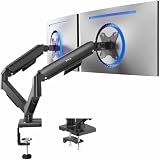

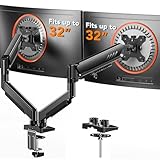

Standard Sizes
When shopping for a dual monitor arm, you will encounter several standard configurations. Selecting the right physical dimensions and weight ratings ensures your desk setup remains stable and highly adjustable. Below is a breakdown of standard dual monitor arm sizes and their compatibility with dual 27-inch screens.
| Arm Type & Build | Max Screen Size (Per Arm) | Weight Capacity (Per Arm) | Max Horizontal Span (Inches / cm) | Average Price Range |
|---|---|---|---|---|
| Standard Steel Articulating (e.g., VIVO STAND-V002) |
Up to 30 inches | 22 lbs / 10 kg | 31 inches / 78.7 cm | $30 – $45 |
| Mechanical / Gas Spring (e.g., ErGear Dual Arm, VIVO STAND-V002O) |
Up to 32 inches | 19.8 lbs / 9 kg | 36 inches / 91.4 cm | $35 – $65 |
| Free-Standing Desktop Mount (e.g., VIVO STAND-V002F) |
Up to 27 inches | 22 lbs / 10 kg | 29 inches / 73.6 cm | $35 – $50 |
| Premium Heavy-Duty Gas Spring | Up to 35 inches | 33 lbs / 15 kg | 40 inches / 101.6 cm | $100 – $250 |
How to Measure Your Space
Before purchasing a dual monitor arm, taking precise measurements of your monitors and your desk will prevent installation headaches. Follow these steps to ensure a perfect fit:
- Weigh Your Monitors (Without Stands): Unbolt your monitors from their original factory stands and weigh the screen panels alone. A dual arm rated for 19.8 lbs per arm (like the ErGear Dual Monitor Arm or VIVO STAND-V002O) is more than sufficient for modern 27-inch LED/LCD panels, which typically weigh between 9 and 13 lbs.
- Measure the VESA Pattern: Look at the back of your monitors. Locate the four screw holes arranged in a square. Measure the distance between them in millimeters. Most 27-inch monitors use a standard 75x75mm or 100x100mm VESA pattern. Ensure your chosen mount supports these exact patterns.
- Check Desk Thickness and Under-Desk Clearance: If you plan to use a C-clamp, measure the thickness of your desktop. Most standard clamps require a desk thickness between 0.4 inches and 3.5 inches. Additionally, look under your desk to ensure there are no metal support beams or modesty panels blocking the clamp from flush contact with the underside of the desktop.
- Calculate Wall Clearance: Articulating and gas-spring monitor arms require “elbow room” to bend. If your desk is pushed flush against a wall, you will need to pull it forward 2 to 6 inches to allow the arm joints to fold backward properly without hitting the wall.
By Room or Use Case
As we look forward to the ergonomic standards of 2026, maximizing desktop real estate has become the primary goal for professionals and gamers alike. Depending on how you utilize your desk, your layout requirements will shift.
Home Office & Remote Work
For a dedicated home office, productivity and clean aesthetics are paramount. A mechanical articulating dual arm (priced around $35 to $50) is ideal here. These arms allow you to easily rotate one 27-inch monitor to portrait mode for reading long documents or spreadsheets, while keeping the other in landscape mode for daily tasks. Opt for models with integrated cable management channels to hide power and HDMI cords, keeping your home workspace clutter-free.
Gaming Setups
Gamers typically require a perfectly flush, seamless alignment of their two 27-inch screens to avoid gaps during immersive gameplay. A heavy-duty steel mount with a C-clamp base (such as the VIVO STAND-V002) offers the rigid stability needed to handle intense movements or desk vibrations. Look for arms that offer micro-adjustments at the VESA plate, allowing you to fine-tune the height of each screen by a fraction of an inch so they align perfectly top-to-bottom.
Shared Workspace / Hot-Desking
In shared offices or multi-user home workstations, a free-standing desk stand (like the VIVO STAND-V002F) or a tool-free gas-spring mount is the best fit. Since different users require different screen heights and viewing distances, gas-spring arms allow effortless, tool-free height adjustments on the fly. Free-standing bases are also ideal for leased offices where drilling holes or clamping onto delicate glass or thin veneer desks is prohibited.
Common Sizing Mistakes
Even with careful planning, it is easy to overlook a few structural details when setting up dual 27-inch screens. Avoid these frequent missteps:
- Buying an Arm Rated “Up to 27 Inches” with Thick Bezels: If your monitors are older or have exceptionally thick outer frames (bezels), they will occupy more physical width than modern bezel-less screens. An arm rated for exactly 27 inches may not have enough span to let you angle these wider screens inward. Buy an arm rated for up to 30 or 32 inches to guarantee adequate panning range.
- Ignoring Desk Material Strength: Clamping two heavy 27-inch monitors (a combined weight of 25 to 35 lbs including the mount) onto a hollow-core desk (such as those filled with honeycomb paper) can crush the desktop. If using a hollow or glass desk, use a reinforcement plate or opt for a free-standing desktop base.
- Forgetting Cable Slack: When routing your cables through the arm’s internal channels, leave 3 to 5 inches of extra slack near the monitor hinges. If the cables are too tight, adjusting or rotating the screens can strain and damage the monitor ports or the cables themselves.
FAQ
Can I use a dual monitor arm if my two 27-inch monitors are different brands?
Yes, you can use different brands, provided both monitors feature standard VESA mounting holes (75x75mm or 100x100mm) on the back. However, keep in mind that because different manufacturers place their VESA holes at different heights on the chassis, you may need a dual arm with individual, height-adjustable VESA plates to ensure the screens align perfectly at the center.
Is a C-clamp or a grommet mount safer for dual 27-inch monitors?
Both mounting styles are highly secure, but they suit different desks. A C-clamp is excellent for quick, damage-free installation on standard desks with open edges. A grommet mount, which bolts directly through a hole in the desktop, is much sturdier for heavy setups, thin desks, or desks placed completely flush against a wall.
Do I need a gas spring or a mechanical spring dual arm?
If you plan to adjust your monitor heights multiple times a day (for instance, switching between sitting and standing), a gas spring or mechanical counter-balance arm is superior because it adjusts with a gentle touch. If you plan to set your monitor heights once and leave them in place, a static, bolt-secured steel pole mount is more cost-effective and highly stable.
What should I do if my 27-inch monitor doesn’t have VESA holes?
If your monitor has a smooth back with no mounting holes, you can purchase a VESA mount adapter kit (typically priced between $15 and $25). These adapters feature padded brackets that grip the outer corners of your monitor, allowing you to safely attach the screen to any standard dual monitor arm.

