
Setting up a productive, comfortable home office is no longer just about finding a sturdy desk and a reliable computer. Today, serious remote workers, creatives, and gamers focus heavily on desk ergonomics. Floating your screen on an adjustable bracket is one of the quickest ways to reclaim desk surface area and prevent neck strain. However, once you start shopping, you will quickly face a fundamental mechanical choice: a gas spring monitor arm vs mechanical spring monitor arm.
This decision is not merely academic. It dictates how your workspace feels every single day. Do you want a screen that glides with the touch of a single finger, or do you want a heavy-duty setup that will outlast your current computer, your next monitor, and perhaps even the desk itself? Choosing incorrectly can lead to a monitor that constantly sags under its own weight, or conversely, one that is so stiff it requires two hands and a foot braced against the wall just to tilt the screen.
As an Amazon Associate we earn from qualifying purchases at no extra cost to you. Product prices and availability are accurate as of the date shown and are subject to change.
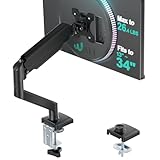


Below, we break down the engineering, the daily usability, and the financial reality of these two technologies to help you choose the perfect support system for your home.
Top 3 picks at a glance
Quick Verdict
If your daily routine involves constantly adjusting your monitor—such as shifting from sitting to standing, or rotating your screen to show clients or family members—a gas spring monitor arm is your best choice. It offers unmatched, silent, fluid movement. However, if you prefer a “set-it-and-forget-it” configuration, or if you are mounting heavy, ultrawide, or expensive curved displays, a mechanical spring monitor arm is the superior option. Mechanical springs offer vastly superior durability, maintain their tension indefinitely, and represent a better long-term investment.
Side by Side
To help you visualize how these two mounting styles compare, we have compiled their core attributes into a direct comparison table. This covers everything from initial out-of-pocket costs to physical performance over time.
| Feature | Gas Spring Monitor Arm | Mechanical Spring Monitor Arm |
|---|---|---|
| Adjustment Comfort | Ultra-smooth, fluid, near-weightless movement. | Framer, slightly stiffer, requires more manual effort. |
| Durability & Lifespan | Moderate (typically 3 to 5 years before gas pressure degrades). | Exceptional (often 10+ years; steel coils do not leak). |
| Price Range | Generally higher ($35 to $150+). | Generally lower ($25 to $90+). |
| Maintenance | None required, but cannot be repaired if the cylinder leaks. | Occasional tension adjustments; may need light lubrication. |
| Space Needed | Slightly bulkier joints to house the gas cylinder. | Can be slimmer, though heavy-duty models are robust. |
| Aesthetic Look | Sleek, modern, and high-tech. | Industrial, mechanical, and utilitarian. |
| Resale Value | Depreciates faster as the internal gas cylinder ages. | Retains value well due to indestructible steel components. |
| Best For | Active sit-stand desks, shared desks, and frequent adjustments. | Heavy monitors, static setups, and budget-conscious buyers. |
Where Gas Spring Monitor Arm Wins
The magic of a gas spring system lies inside its sealed cylinder. This mechanism operates similarly to the shocks that hold up the hatchback of an SUV. Compressed nitrogen gas resides inside a chamber; when you push the arm down, the gas compresses further, storing energy. When you lift the monitor, the expanding gas assists you, making a 20-pound piece of glass feel as light as a piece of paper.
This fluid motion is the primary reason users choose gas options. If you frequently transition between sitting and standing throughout the workday, a gas arm moves with a silent, premium sweep. There are no sudden jerks, no metallic creaks, and very little physical effort required. Popular options like the HUANUO FlowLift™ Single Monitor Mount (priced around $35.99 for screens from 13 to 32 inches) showcase this fluid dynamics concept beautifully, allowing effortless height and tilt adjustments within a 4.4 to 19.8 lbs weight window.
Additionally, because the tension is regulated by gas pressure, these arms are incredibly precise. Once you find the sweet spot of tension via the adjustment screw, the screen feels like it is floating in zero gravity. For high-end aesthetics, premium aluminum builds like the monTEK Deluxe Aluminum Monitor Arm (priced around $89.99 for large 17 to 40-inch curved screens) leverage advanced gas-assist technology to keep massive displays perfectly balanced without looking bulky or industrial.
Where Mechanical Spring Monitor Arm Wins
While gas springs rely on chemistry and sealed seals, mechanical spring arms rely on pure, simple physics. Inside these arms sits a heavy-duty steel coil spring. When you pull the arm down, you physically stretch or compress the steel coil. This mechanical simplicity is its greatest strength.
The absolute biggest advantage of a mechanical spring arm is its longevity. Gas cylinders will, eventually, lose pressure. No seal is perfectly airtight forever; over several years, nitrogen molecules slowly escape, causing the arm to sag. A steel coil spring, however, does not leak. It will retain its structural tension for decades. If you purchase a mechanical arm today, it will likely perform exactly the same way a decade from now.
Because steel coils are incredibly resilient, mechanical arms are also exceptionally good at handling heavy, static loads. They do not suffer from the slow “micro-sagging” that can affect older gas arms left in the same position for months. The HUANUO FlowLift™ Pro Monitor Arm (priced at $29.99, featuring their specialized MechaSpring technology) demonstrates how mechanical springs can deliver robust, reliable support for 13 to 32-inch displays up to 19.8 lbs at a very competitive price point.
Furthermore, mechanical arms are highly cost-effective. Because they do not require expensive gas-tight manufacturing processes, manufacturers can pass those savings on to you. You can secure a heavy-duty mechanical mount, such as the WALI Adjustable Single Monitor Arm (supporting screens up to 34 inches and 26.4 lbs for just $25.49), for a fraction of the cost of a comparable high-weight-capacity gas arm.
Cost Over 5 Years
When setting up a home office, it is wise to think about the total cost of ownership rather than just the initial checkout price. As we look ahead to workspace planning in 2026, sustainability and long-term value are becoming major buying factors.
A high-quality gas spring arm will cost you between $35 and $100 upfront. Over a five-year period, there is a moderate chance that a heavily used gas cylinder will begin to lose its pressure, especially if subjected to temperature swings in a home attic or basement office. If the cylinder fails, the entire arm must be replaced, as these sealed units are not user-serviceable. This brings your five-year cost to potentially double your initial investment if a replacement is required.
Conversely, a mechanical spring arm costing between $25 and $80 upfront will easily last five years—and likely another five after that. The steel coil does not degrade under normal home office conditions. The only maintenance required over half a decade might be a quick drop of household oil on the pivot joints if they begin to squeak, and a minor turn of a hex key to tighten the tension. Financially, the mechanical spring arm is the undisputed winner for long-term value.
Which One for Your Home
Every home workspace has its own unique physical constraints and daily demands. Here is how to choose based on your specific living situation.
Small Apartment
In a tight studio or a corner bedroom workspace, space is at a premium. You want a monitor arm that can fold back almost completely flat against the wall when your desk is not in use. Gas spring arms often have slightly bulkier elbow joints to accommodate the gas cylinder, which can prevent them from sitting completely flush. A slim-profile mechanical spring arm is often easier to tuck away, reclaiming valuable inches of desk surface in a cramped apartment.
Family with Kids/Pets
If your home office double-functions as a playroom, or if you have curious cats that like to jump onto your desk, stability and safety are paramount. A gas spring arm is highly responsive; if a child bumps into the desk, a loosely tensioned gas arm might bounce or swing easily. A mechanical spring arm offers firmer resistance. It takes a deliberate physical effort to move it, meaning your expensive monitor is far less likely to be knocked out of alignment or swung into a nearby wall by an energetic pet.
Rental
If you are renting, you likely want a non-permanent setup that uses a C-clamp rather than drilling a hole through your desktop. Because rentals often feature lightweight, inexpensive desks (such as hollow-core cardboard-filled desks), you must be careful with weight distribution. A lightweight mechanical spring arm exerts less continuous downward static pressure on the clamp point compared to a heavily tensioned gas cylinder, making it a safer bet for temporary, delicate furniture.
Long-Term Home
If you own your home and have invested in a premium, solid-wood standing desk, you want an arm that matches that level of quality. Here, a premium gas spring arm mounted via a permanent grommet hole is the gold standard. It provides that luxurious, high-end design aesthetic, allowing you to fluidly glide your monitor out of the way when you want to use your solid-wood desk for offline drafting, crafting, or reading.
FAQ
Can a gas spring monitor arm leak or explode?
While gas spring arms contain highly pressurized nitrogen gas, they are incredibly safe. They are manufactured under strict industrial standards, meaning physical explosions are virtually unheard of in home office environments. If a seal does fail, the gas will slowly and silently seep out over several weeks or months. You will only notice because the arm gradually loses its ability to hold up your monitor, causing the screen to gently sink to the desk surface.
Do mechanical spring monitor arms make noise?
Because they rely on a physical metal coil expanding and contracting, mechanical arms can occasionally produce a slight metallic creaking or clicking sound when adjusted. This is completely normal. If the noise becomes annoying, a quick application of silicone lubricant spray to the internal spring housing will usually silence the arm completely.
Can I use a mechanical spring arm for heavy curved ultrawide monitors?
Yes, in fact, mechanical spring arms are often preferred for heavy curved ultrawide monitors. Curved screens project their center of gravity forward, which puts extra torque on the VESA mounting plate. Mechanical systems handle this continuous, uneven strain exceptionally well without slipping. Just ensure you check the maximum weight rating of the arm before purchasing.
How do I adjust the tension on both types of arms?
Both types of arms are adjusted using a simple hex key (usually included in the box). To adjust, locate the tension screw—typically located at the main elbow joint. If your monitor is sagging down, turn the screw toward the “+” symbol (clockwise on most models) to increase the counter-balancing tension. If the arm is springing upward uncontrollably, turn the screw toward the “-” symbol (counter-clockwise) to reduce the tension.
Related guides
- 49 Inch Super Ultrawide vs Dual 32 Inch Monitors: Which Is Right for Your Home
- Stacked Dual Monitors vs Side By Side Gaming Monitors: Which Is Right for Your Home
- 27 Inch 1440p vs 32 Inch 4k for Gaming: Which Is Right for Your Home
- Desk Clamp Monitor Mount vs Grommet Monitor Mount: Which Is Right for Your Home

