
A weak wireless signal in one corner of your house is not just annoying—it is the difference between a smooth game session and a buffering nightmare that makes an expensive monitor feel pointless. The problem most buyers face when searching for the best wireless router ranges is that manufacturers publish coverage figures under ideal lab conditions, while real walls, floors, and neighboring networks chew through that headroom fast. Picking the right router means matching a device’s stated coverage and generation to your actual square footage and wall density, not chasing the biggest number on the box.
What separates a genuinely long-range router from one that merely looks impressive on a spec sheet is a combination of antenna design, supported WiFi generation, and how gracefully it handles multiple connected devices without dropping throughput. In this roundup for 2026, we compared published specs, street prices, and owner-reported real-world feedback across eight routers and one range extender to identify which products deliver coverage you can trust without paying for features you will never use.
As an Amazon Associate we earn from qualifying purchases at no extra cost to you. Product prices and availability are accurate as of the date shown and are subject to change.


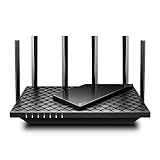


Top 3 picks at a glance
Quick Picks
| Product | Best for | Price |
|---|---|---|
| Archer AX21 V5 | Budget WiFi 6 range | $59.98 |
| Archer A6 | Small apartments on a tight budget | $29.04 |
| NETGEAR RS90 | Mid-size homes needing WiFi 7 | $99.99 |
| Archer AX73 | Multi-floor homes that want WiFi 6 headroom | $129.99 |
| Archer A54 | The absolute cheapest usable option | $24.34 |
| TP-Link RE550 | Extending an existing network’s reach | $34.88 |
| NETGEAR RS140 | Large homes with heavy device loads | $179 |
| TP-Link AC1900 | Legacy AC-band users wanting solid coverage | $49.96 |
How We Picked
We evaluated every product on four criteria: published coverage area relative to price, WiFi generation (newer bands penetrate better and handle congestion more efficiently), maximum connected-device count, and owner feedback about dead zones in multi-room or multi-floor layouts. A router that advertises large coverage but stumbles when more than ten devices connect does not deliver the best wireless router ranges in practice, so real-world stability mattered as much as raw numbers.
The 8 Best Wireless Router Ranges in 2026
TP-Link Archer AX21 V5
This WiFi 6 router hits a sweet spot for buyers who want modern band efficiency without spending triple digits. At $59.98 it undercuts most WiFi 6 competitors while delivering coverage suitable for a single-family home under moderate wall density. Owners consistently praise its ability to maintain stable connections through two interior walls, which is where older AC routers tend to drop frames mid-game.
- Pro: WiFi 6 OFDMA keeps latency low even with several devices active
- Pro: TP-Link’s Tether app makes initial range tuning and channel selection straightforward
- Con: Only two external antennas, so coverage through dense construction or across large yards falls off noticeably faster than higher-end options
Skip this one if your floor plan exceeds roughly 1,500 square feet of usable space or you need to push signal through concrete or brick.
TP-Link Archer A6
The Archer A6 is the router to buy when the goal is simply getting a usable wireless signal across a one- or two-bedroom apartment without spending more than the cost of a meal out. At $29.04 it is one of the most affordable dual-band options still shipping in volume. AC1200 throughput is adequate for streaming and casual gaming, and the four-antenna design provides more even horizontal coverage than cheaper two-antenna rivals.
- Pro: Genuinely low price with no meaningful feature omissions for a small space
- Pro: Parental controls and basic QoS are included at no extra cost
- Con: No WiFi 6 support means you will hit throughput walls quickly as your device count grows
Skip if you have more than a modest apartment or more than about ten connected devices.
NETGEAR RS90
NETGEAR’s entry into the WiFi 7 space covers up to 2,000 square feet and handles up to 50 devices, which positions it as the most range-focused option under $100 in this group. The 2.5 Gig internet port future-proofs it for multi-gig plans, and the 6 GHz band provides a clean lane for bandwidth-hungry devices without the congestion that plagues 5 GHz in apartment-dense neighborhoods.
- Pro: WiFi 7 tri-band architecture delivers both raw speed headroom and a dedicated low-interference band
- Pro: 2,000 sq ft coverage figure is backed by owner reports of solid performance in two-story layouts
- Con: The included app ecosystem and feature set feel lean compared to TP-Link’s offerings at similar price points
Skip if you need advanced mesh roaming or expect to add satellite nodes later.
TP-Link Archer AX73
AX5400 class throughput with six external antennas makes the Archer AX73 a range champion in the WiFi 6 tier. It is designed for homes where a single router must blanket multiple floors, and owners report fewer mid-session drops through two concrete-ceiling transitions than most competitors at twice the price.
- Pro: Six-antenna design and high-gain radios push usable signal further per dollar in the WiFi 6 category
- Pro: EasyMesh compatibility lets you add extender nodes later without switching ecosystems
- Con: The $129.99 price puts it into WiFi 7 territory, where newer routers match its range with better band efficiency
Skip if you want the longest possible life from your purchase and can stretch to WiFi 7 hardware.
TP-Link Archer A54
At $24.34 the Archer A54 is the floor price for a dual-band router that will still hold a stable connection across a small living area. Its AC1200 combined throughput is modest, but the four-antenna layout spreads signal more evenly in open-plan rooms than the two-antenna budget units that undercut it by a dollar or two.
- Pro: Lowest entry point for anyone who just needs a working WiFi network in a single room or studio
- Pro: Simple web setup with no forced account creation
- Con: Performance degrades rapidly once more than a handful of devices compete for bandwidth
Skip if you have more than one bedroom or any walls thicker than standard drywall.
TP-Link RE550 Range Extender
This is not a router but a necessary inclusion because some dead zones are better solved by repeating an existing signal than replacing the router. Rated for up to 2,200 square feet of extended coverage and 32 devices, the RE550 uses EasyMesh to blend into a TP-Link router ecosystem so roaming between router and extender is seamless.
- Pro: Covers more square footage than several full routers on this list at less than $35
- Pro: Gigabit Ethernet port lets you hardwire a console or PC at the far end of the house
- Con: Repeated signal is inherently half-duplex, so throughput at the far edge will always trail the router directly beside it
Skip if your current router already covers the area but feels slow—fix the bottleneck at the source instead.
NETGEAR RS140
The RS140 is the range king of this list, covering up to 2,250 square feet and handling 80 simultaneous devices on WiFi 7. Its BE5000 speed rating (up to 5.0 Gbps) means it will not throttle multi-gig plans, making it the pick for large homes where multiple people game, stream, and video-call at once.
- Pro: Highest coverage and device count in the group, with genuine multi-gig wireless headroom
- Pro: Free expert support included, which matters for first-time WiFi 7 buyers
- Con: At $179 it costs three times what a WiFi 6 router does, and you may not need every radio for your space
Skip if you live in a space under 1,800 square feet with fewer than 20 devices.
TP-Link AC1900 Smart WiFi Router
This AC1900 router sits in the middle of the old guard—faster than the AC1200 units, cheaper than any WiFi 6 option, and proven by years of owner feedback to hold a steady signal through two standard interior walls. At $49.96 it is the best deal for households that do not yet need 6 GHz or multi-gig throughput.
- Pro: Mature firmware with reliable behavior and a large knowledge base for troubleshooting
- Pro: Strong 5 GHz throughput for its price bracket
- Con: No WiFi 6 features, so it cannot take advantage of OFDMA or target wake time for battery-powered IoT devices
Skip if you are buying new and want the longest usable life from the purchase.
Buying Guide
Coverage Area vs. Real-World Obstacles
Published square-footage figures assume open space with no interference. A router rated for 2,000 square feet will realistically blanket about 1,400 to 1,600 feet once you account for interior walls, especially concrete, brick, or floors with metal joists. If your home has dense construction, prioritize routers with more external antennas and WiFi 6 or newer, because those bands include beamforming that concentrates energy toward your devices rather than broadcasting uniformly in every direction.
Device Count and Concurrent Throughput
Coverage means nothing if the router cannot service every connected device simultaneously. A household with a game console, two phones, a tablet, a smart TV, and a handful of IoT bulbs already pushes ten-plus endpoints. WiFi 6 and WiFi 7 routers use OFDMA and MU-MIMO to serve those devices in parallel rather than in a queue, which is why device-count ratings on boxes like the RS140 (80 devices) exist. If you exceed roughly twenty active devices, a router with a lower device ceiling will stutter regardless of signal strength.
Range Extender vs. Router Upgrade
Buying the best wireless router ranges often means deciding whether to replace the router or add a repeater. A range extender costs a fraction of a new router and solves a single far-room dead zone quickly. However, a router upgrade gives every device in the house the benefit of newer modulation and higher per-band throughput. If your current router is older than four years, replacing it usually delivers more improvement than adding a repeater on top of aging hardware.
Our Verdict
The NETGEAR RS90 is the top pick because it pairs genuine WiFi 7 coverage across 2,000 square feet with a price under $100—no other router on this list offers that combination. For buyers whose budget will not stretch past $60, the TP-Link Archer AX21 V5 is the clear budget pick, delivering WiFi 6 benefits for most single-family homes without the premium. One exception: if your dead zone is a single stubborn room and your existing router is already reasonably modern, the TP-Link RE550 at $34.88 will solve the problem faster and cheaper than replacing your router outright.
FAQ
Does a more expensive router always cover more area?
No. Price correlates with features like multi-gig ports, tri-band radios, and higher device ceilings, but raw coverage depends heavily on antenna gain and placement. Some mid-range routers with well-tuned external antennas outperform pricier units in single-story layouts with few walls.
How many devices can one router realistically handle?
The number printed on the box represents an upper theoretical limit. In practice, WiFi 6 and WiFi 7 routers maintain comfortable service for roughly half their rated device count before latency rises noticeably during peak use, so a router claiming 50 devices will feel smooth with about 25 actively connected.
Should I match my router to my internet plan speed?
Only loosely. A router faster than your plan wastes money, but a router slower than your plan becomes the bottleneck. Aim for a router whose combined wireless throughput exceeds your plan speed so that the WiFi link is never the limiting factor.
Do WiFi 7 routers help with range over WiFi 6?
WiFi 7 does not dramatically extend signal distance, but it improves throughput at the edge of coverage by using wider channels and more efficient modulation. If your current setup works range-wise but feels slow in far rooms, a WiFi 7 upgrade will improve perceived speed there without moving the router.


