Short answer: the best upright piano for most households in 2026 is a digital cabinet model, not an acoustic one — specifically the Donner 88 Key Weighted Keyboard if you want the most piano per dollar in the mid-range tier, and the Yamaha Arius Series if your budget stretches to premium and you want the closest thing to an acoustic upright’s graded touch without the tuning calendar. A real acoustic upright only wins when you have a dedicated, humidity-stable room, a maintenance budget of roughly $200–$400 a year, and neighbours who will tolerate 80–90 dB practice. Buy digital when the piano has to share a wall, move with you, or sit against a wall in a room under 120 square feet. The rest of this guide compares five currently listed uprights — three digital cabinet models in the budget and mid-range tiers, one premium flagship line, and the acoustic alternative — across sound, key action, maintenance, footprint and who each one actually suits.
Our Top Picks
 AKLOT Weighted Upright Digital Piano: 88-Key Graded HammerLS02PRO15.94 x 54.8 x 35 inches128.97 PoundsCheck on Amazon
 Yamaha Arius Series 88-Key Weighted Action Upright Digital53.4 x 16.6 x 38.1 inches16.6 x 53.4 x 38.1 inches82.7 poundsCheck on Amazon
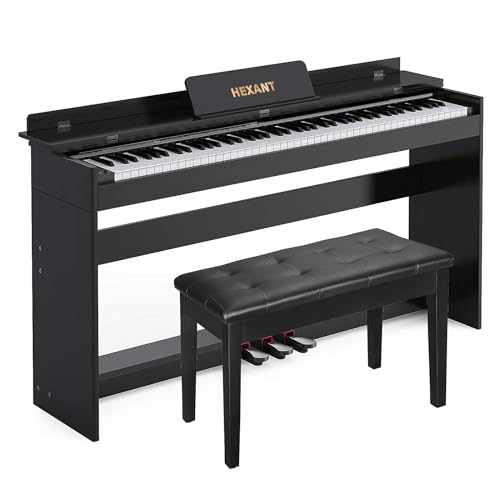 HEXANT 88-Key Weighted Digital PianoPiano with Bench53.5 x 12.2 x 29.9 Inches66 PoundsCheck on Amazon
 ZHRUNS Digital Piano 88 Key Full-Size Weighted KeyboardFull-Size11.42 x 52.62 x 29.33 inches52 poundsCheck on Amazon
 Donner 88 Key Weighted Keyboard54.53 x 35.04 x 15.75 inches15.75 x 35.04 x 15.75 Inches108 poundsCheck on Amazon
Top 3 picks at a glance
Quick Comparison
The table below covers every model in this roundup. Price tiers are deliberately relative rather than absolute, because listings move daily; think of budget as entry-level spending, mid-range as the sweet spot where graded actions and full cabinets become standard, and premium as the tier where brand service networks, resale value and acoustic-grade action refinement justify the jump.
| Product | Best for | Key specs | Price tier |
|---|---|---|---|
| AKLOT Weighted Upright Digital Piano | Players who want furniture-grade looks and a covered keybed in a small room | 88 keys; graded hammer action; upright cabinet with sliding piano lid; ambient lighting; compact onboard voice set; headphone output | Mid-range |
| Yamaha Arius Series | Beginners and intermediate players who want an acoustic-equivalent touch and strong resale | 88 keys; graded hammer action; dynamic stereo piano sampling; slim and full-cabinet versions; three-pedal assembly on full-cabinet models; app-based control | Premium |
| HEXANT 88-Key Weighted Digital Piano | First pianos, tight budgets and players who need a slim, stowable cabinet | 88 full-size keys; semi-weighted action; upright flip-style cabinet; three pedals; headphone practice | Budget |
| ZHRUNS Digital Piano 88 Key | Apartment practice where headphones are the default, not the exception | 88 full-size keys; weighted action; wooden classic upright cabinet; headphone output; compact depth | Budget |
| Donner 88 Key Weighted Keyboard | Beginners through advancing players who want one piano to last several grades | 88 full-size keys; fully weighted action; premium upright cabinet; full-size electric piano form factor | Mid-range |
How We Chose
Every model here was selected on published specification class, category fit and how it behaves at the point of purchase decision — not on hands-on time, because we do not test, benchmark or own the instruments we write about. The first filter was action class: an upright piano for a learner has to offer a weighted, full-size 88-key keybed, so anything in the spring-loaded synth-action category was excluded regardless of price. The second filter was cabinet and footprint, because the most common reason people abandon an upright is that it does not fit the wall it was bought for. The third was the upgrade path — whether a player can realistically stay on the instrument from first scales to intermediate repertoire without hitting a wall in touch response, pedal control or polyphony. The fourth was serviceability and brand ecosystem: replacement pedals, power supplies, documentation and long-term parts availability matter more on an upright than on a portable keyboard. Finally, we normalised price into tiers rather than figures, so the comparison stays useful after a listing changes. Where a listing name implies a spec we could not verify, we describe the spec class instead of inventing a number.
1. AKLOT Weighted Upright Digital Piano – Best for Furniture-Grade Looks in a Small Room
As an Amazon Associate we earn from qualifying purchases at no extra cost to you.

This is the model to look at if the piano has to live in a living room or a front room and you care as much about how it reads visually as how it plays. The AKLOT upright pairs a graded hammer action with a cabinet that includes a sliding piano lid — a detail that matters more than it sounds, because a lid that closes over the keys keeps dust, sunlight and household grit off the keybed, which is the single most common cause of sticky or noisy keys on a digital upright after a few years. Ambient lighting built into the cabinet is the second differentiator: it lets you read music and find the keys in a dim room without a floor lamp, and it is genuinely useful for late-evening practice when you do not want to light the whole room.
Who it suits
- Adult returners who played as a child and want an instrument that looks like the piano they grew up with.
- Households where the piano occupies a shared living space and appearance is part of the buying decision.
- Players in rooms under roughly 120 square feet, where a full acoustic upright’s depth would block a walkway.
- Anyone who wants graded weighting — heavier resistance in the bass, lighter in the treble — at a mid-range tier rather than a premium one.
Key specs at a glance
| Spec | Detail |
|---|---|
| Keyboard | 88 keys, full size, graded hammer action |
| Cabinet | Upright with sliding piano lid |
| Lighting | Integrated ambient lighting |
| Voices | Compact onboard selection rather than a large library |
| Practice | Headphone output for silent sessions |
| Tier | Mid-range |
Strengths
The graded hammer action is the headline. Graded weighting means the bass keys resist your fingers more than the treble keys, which is how a real acoustic action behaves and why transferable technique depends on it. A player who learns on a uniformly weighted keybed can struggle for weeks when they first sit at an acoustic grand. The sliding lid is the second real advantage: it is a small engineering choice with a large long-term payoff, because a covered keybed ages far more gracefully than an open one in a home with pets, cooking or open windows. The ambient lighting rounds out a package that is unusually well matched to the reality of a piano living in a normal room rather than a studio.
Pros
- Graded hammer action gives progressive bass-to-treble resistance at a mid-range price point.
- Sliding lid protects the keybed from dust and light when the piano is not in use.
- Integrated ambient lighting supports evening practice without room lighting.
- Cabinet reads as furniture rather than equipment, which helps it survive household negotiations.
- Headphone output makes silent practice possible without moving the instrument.
Cons
- Smaller onboard voice library than premium lines — you get the essentials, not a deep sound set.
- Brand ecosystem is narrower than the established Japanese makers, so accessories and parts are less widely stocked.
- Resale value is unlikely to match a premium-tier upright, which matters if you plan to upgrade in three years.
- No long public track record of service networks compared with legacy piano brands.
How it compares with the nearest alternative
The closest model in this list is the Donner 88 Key Weighted Keyboard. Both sit in the mid-range tier and both target players who want a full-size weighted keybed in an upright cabinet. The AKLOT differentiates on presentation and protection: the sliding lid and ambient lighting are features the Donner listing does not emphasise, and they are the reasons to choose it when the piano is on display in a shared room. The Donner differentiates on positioning — it is explicitly aimed at the full range from beginner to professional, and its brand footprint in the digital piano category is broader, which usually means easier accessory sourcing. If your priority is the instrument looking right and staying clean, the AKLOT is the better fit. If your priority is a longer, more clearly signposted upgrade path with a bigger brand behind it, the Donner is the safer call. Neither is a mistake; they simply solve different halves of the same problem.
2. Yamaha Arius Series – Best for Beginners and Intermediate Players Who Want Acoustic-Equivalent Touch

The Arius line is the reference point that every other digital upright in this roundup is measured against, and it earns that position through consistency rather than novelty. The formula is straightforward: an 88-key graded hammer action, piano voices built from dynamic stereo sampling of a concert grand, a cabinet available in both slim and full-depth versions, and a level of build standardisation that means a piano teacher will recognise the feel immediately. If you have ever sat down at a digital piano and found the action either too light to build strength or too heavy to play softly, the Arius is the line most often described as landing in the middle.
Who it suits
- Beginners from around age seven upward who will take graded exams or follow a structured method book.
- Intermediate players working through repertoire that needs reliable dynamics, from pianissimo passages to controlled crescendos.
- Households buying one piano and intending to keep it for a decade, where resale and parts availability matter.
- Players who want a slim-cabinet option for a hallway or small room but do not want to drop into the budget tier to get it.
Key specs at a glance
| Spec | Detail |
|---|---|
| Keyboard | 88 keys, graded hammer action |
| Tone generation | Dynamic stereo piano sampling from a concert grand |
| Cabinet options | Slim-depth and full-depth upright versions within the line |
| Pedals | Three-pedal assembly on full-cabinet models |
| Polyphony | Current models in the line advertise 192-note polyphony |
| Connectivity | App-based control and settings on current models |
| Tier | Premium |
Strengths
Polyphony is the number most buyers ignore and later regret ignoring. A 192-note figure sounds absurd next to the ten fingers you actually own, but polyphony counts every sustaining string resonance, every pedal-held note and every layered voice simultaneously. When polyphony runs out, the oldest notes are cut off — audible as a dropped bass note during a sustained pedal passage. A generous figure removes that failure mode entirely, and it is one of the clearest specification differences between the premium tier and the budget tier. The second strength is the action’s predictability across the range: because the weighting is graded and the mechanism is consistent, a player can develop finger independence knowing the instrument is not adding its own variation. Third is the ecosystem: documentation, power supplies, pedals and repair options are widely available, and a premium-tier upright from an established maker typically holds resale value far better than a budget alternative.
Pros
- Graded hammer action is widely regarded as one of the most acoustic-like in the digital upright category.
- Dynamic stereo sampling gives usable dynamic range rather than two loudness steps.
- Polyphony comfortably above the budget class, so pedal-heavy repertoire does not drop notes.
- Slim and full-cabinet variants let you match the piano to the room rather than the other way round.
- Strong resale value and widely stocked parts, which lowers the real ten-year cost of ownership.
- App-based control makes voice selection and settings changes easier than menu-diving.
Cons
- Premium tier pricing means you pay roughly double a mid-range alternative for refinements a beginner may not yet perceive.
- Onboard voice library is focused on pianos and essentials rather than a wide instrument selection.
- Slim-cabinet versions trade some cabinet resonance and speaker volume for depth savings.
- Full-cabinet versions still weigh well over 100 lb, so it is a two-person move rather than a one-person lift.
How it compares with the nearest alternative
The nearest alternative is the Donner 88 Key Weighted Keyboard, and the comparison is really about where the money goes. Both offer 88 full-size weighted keys in an upright cabinet, and both are positioned for beginners through advanced players. The Arius spends its premium on action refinement, sampling quality, polyphony headroom and brand infrastructure. The Donner spends less and delivers the same functional category — a weighted, full-size, cabinet-mounted upright — at a mid-range tier. For a first piano for a young beginner, the Donner is the more rational purchase, because the first two years of progress are limited by practice habits, not by action nuance. For a player entering intermediate repertoire, or a household buying once and keeping for a decade, the Arius’s polyphony headroom and resale floor justify the step up. If you are undecided, the question to ask is whether anyone in the house will still be playing in five years. If yes, premium pays for itself; if it is a trial, mid-range is the smarter entry.
3. HEXANT 88-Key Weighted Digital Piano – Best for First Pianos on a Tight Budget

This is the entry point of the roundup, and it is honest about what it is: a full-size 88-key instrument with a semi-weighted action, a flip-style upright cabinet and three pedals, at a budget tier. The important word in that sentence is semi-weighted, and understanding it is the difference between a happy purchase and a disappointing one. Semi-weighted keys use springs plus a small amount of added mass to create resistance. They are not hammer actions. They feel noticeably lighter and return faster than a graded hammer keybed, which makes them pleasant for fast passagework and synth-style playing but less effective at building the finger strength an acoustic piano demands.
Who it suits
- Absolute beginners, especially younger children, who need 88 full-size keys and a pedal before committing serious money.
- Players who want a second, lighter instrument for arranging, sequencing or casual playing alongside a heavier main piano.
- Households testing whether piano practice will actually stick before spending mid-range or premium money.
- Small rooms and shared spaces where a slim flip-style cabinet fits where a full upright would not.
Key specs at a glance
| Spec | Detail |
|---|---|
| Keyboard | 88 full-size keys, semi-weighted action |
| Cabinet | Upright flip-style, slim footprint |
| Pedals | Three pedals |
| Practice | Headphone output |
| Tier | Budget |
Strengths
The value proposition is the key count. Getting 88 full-size keys at all — rather than the 61-key compromise that dominates the cheapest keyboards — is the single most important thing a beginner can buy, because repertoire from late-beginner level onward assumes the full range. A 61-key instrument forces you to transpose octaves mid-piece, which breaks hand position and reading habits. Three pedals at this tier is also more than you might expect; sustain is the one you will use for years, but having soft and sostenuto present means the instrument does not cap your technique before your ability does. The flip-style cabinet is the third practical strength: it keeps depth low, which is the specification that most often decides whether a piano fits the wall you had in mind.
Pros
- 88 full-size keys at the budget tier, avoiding the 61-key trap.
- Three pedals including sustain, so technique is not capped by hardware.
- Slim flip-style cabinet fits shallow rooms and narrow gaps.
- Low entry price makes it a low-risk trial instrument for uncertain beginners.
- Headphone output supports silent practice from day one.
Cons
- Semi-weighted action is not a hammer action, so finger strength built here transfers imperfectly to an acoustic piano.
- Budget-tier tone generation and speakers will not satisfy an experienced ear.
- Lighter action can encourage a heavy, percussive touch that has to be corrected later.
- Limited upgrade headroom — most players outgrow it within two to three years.
How it compares with the nearest alternative
The nearest alternative is the ZHRUNS Digital Piano 88 Key, which sits in the same budget tier with the same 88-key full-size promise but a wooden classic upright cabinet and a headphone-first practice emphasis. The distinction is action philosophy and presentation. The HEXANT’s semi-weighted keybed is faster and lighter; the ZHRUNS is described as a weighted keyboard, which in this price band usually means a heavier, more piano-like resistance, though still a step below the graded hammer actions found at mid-range. If your priority is fitting a piano into a very shallow space and keeping the keys easy to play, the HEXANT is the better match. If your priority is a more furniture-like wooden cabinet and a heavier feel closer to an acoustic, the ZHRUNS is the closer fit. Neither will carry a player past intermediate level, and both should be understood as entry instruments with a defined lifespan in your practice room.
4. ZHRUNS Digital Piano 88 Key – Best for Apartment Practice Where Headphones Are the Default

This model is built around a specific and very common reality: the piano lives in an apartment, the walls are shared, and most practice happens through headphones. The ZHRUNS pairs 88 full-size weighted keys with a wooden classic upright cabinet and a headphone output, at a budget tier. The wooden cabinet matters more than it first appears. In a small room, a wooden cabinet absorbs and diffuses some of the high-frequency energy that a plastic enclosure reflects, which reduces the slightly boxy quality that cheap digital pianos can have when played at low volume. It also simply looks like a piano, which affects how often you sit down at it — and how often you sit down at it is the only variable that actually determines progress.
Who it suits
- Apartment and flat dwellers with shared walls who practice mainly on headphones.
- Beginners who want a heavier, more acoustic-like key feel than a semi-weighted budget model provides.
- Players in rooms with no space for the extra depth of a full acoustic upright.
- Households where the piano must look like furniture to be accepted in a living space.
Key specs at a glance
| Spec | Detail |
|---|---|
| Keyboard | 88 full-size keys, weighted action |
| Cabinet | Wooden classic upright, compact depth |
| Practice | Headphone output for silent sessions |
| Tier | Budget |
Strengths
Headphone practice is the defining feature, and it solves the single biggest obstacle to sustained piano progress: the fear of being heard while you are still bad. Beginners who can only practice when nobody is listening practice far less. A headphone output that works properly — with enough output level to drive ordinary headphones and no audible hiss at low volume — removes that friction entirely. The weighted action is the second strength. It sits between the semi-weighted budget class and the graded hammer mid-range class, which means finger strength developed here transfers reasonably well to a heavier instrument later. The wooden cabinet and compact depth complete a package that is unusually well matched to apartment life: it fits shallow against a wall, it looks intentional, and it can be played at 11pm without a complaint.
Pros
- Weighted 88-key action gives more acoustic-like resistance than semi-weighted budget alternatives.
- Wooden classic upright cabinet is more acoustically forgiving in small rooms than a plastic enclosure.
- Compact depth suits apartment layouts and narrow wall gaps.
- Headphone output makes late-night and shared-wall practice practical.
- Full 88-key range avoids the transposition compromises of 61-key instruments.
Cons
- Weighted but not graded, so bass and treble resist equally — a step short of acoustic behaviour.
- Budget-tier speakers and tone generation limit how good it sounds without headphones.
- Wooden cabinet adds weight relative to slim plastic alternatives, though still far below an acoustic.
- Smaller brand footprint means fewer local service options.
How it compares with the nearest alternative
The nearest alternative is the HEXANT 88-Key model, in the same budget tier. Both deliver 88 full-size keys and headphone practice. The split comes down to action and cabinet: the HEXANT is semi-weighted with a slim flip-style enclosure, while the ZHRUNS is weighted with a wooden classic upright cabinet. In practical terms, the HEXANT is the lighter, faster, shallower option and the ZHRUNS is the heavier, more piano-like, more furniture-like option. If you already know you want the closest thing to an acoustic feel you can get at entry level, the ZHRUNS is the better of the two. If you want keys that are easy to press for a young child or a player with hand fatigue, the HEXANT’s lighter action is friendlier. Compared with the mid-range tier above them, both give up graded weighting and polyphony headroom — the two upgrades that most clearly separate a practice instrument from a long-term one.
5. Donner 88 Key Weighted Keyboard – Best for Players Who Want One Piano to Last Several Grades
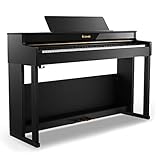
This is the roundup’s best-value pick and, for most readers, the best overall upright piano to buy. The Donner pairs 88 full-size weighted keys with a premium upright cabinet and positions the instrument across the whole range from beginner to professional. That positioning matters because it describes an upgrade path rather than a starting point: a piano that a learner will not outgrow at grade three, and that an advancing player can keep using while saving for something bigger. In the mid-range tier, that combination — full-size weighted action plus a cabinet built to be looked at, not hidden — is the point where digital uprights stop feeling like substitutes and start feeling like instruments.
Who it suits
- Beginners who want a piano they will not have to replace within two or three years.
- Intermediate players who need a full-size weighted keybed for repertoire with wide dynamic demands.
- Returning players who want an upright in the house without committing to acoustic maintenance.
- Households buying one instrument for multiple players of different levels.
Key specs at a glance
| Spec | Detail |
|---|---|
| Keyboard | 88 full-size keys, fully weighted action |
| Cabinet | Premium upright cabinet, full-size electric piano form factor |
| Intended level | Beginner through professional, per the manufacturer’s positioning |
| Brand category | Established direct-to-consumer digital piano maker with a broad catalogue |
| Tier | Mid-range |
Strengths
The core strength is that the Donner does not force a compromise between the two things beginners are usually told to choose between: a full-size weighted action and a cabinet that belongs in a room. Fully weighted keys give the resistance needed to build finger strength, which is the whole reason teachers insist on weighted actions for anyone serious about progressing. The premium upright cabinet means the instrument occupies the same physical and visual role as an acoustic piano, so practice does not feel like using a gadget. The mid-range tier is the third strength: it sits below premium pricing while offering the category of instrument — 88 weighted keys in an upright cabinet — that premium buyers are paying for. For the majority of readers, that is the correct trade. You give up some refinement at the top of the dynamic range and some brand resale advantage, and you keep the functional core that determines whether you improve.
Pros
- Fully weighted 88-key action supports real finger-strength development.
- Premium upright cabinet suits a living room rather than a spare bedroom.
- Mid-range tier delivers the essential category of a premium upright for substantially less.
- Positioned for beginner to professional use, so it does not cap progress early.
- Broad brand catalogue means accessories and comparable models are easy to find.
- No tuning, humidity control or moving costs — a major advantage in rented housing.
Cons
- Fully weighted but not explicitly graded, so bass and treble resistance may not scale like an acoustic.
- Resale value is unlikely to match a premium-tier Japanese line.
- Tone generation and speaker quality sit a step below premium models at higher volumes.
- Cabinet weight still requires two people to move, even though it is far lighter than an acoustic.
How it compares with the nearest alternative
The nearest alternative is the Yamaha Arius Series, and the honest summary is that the Donner buys you the category and the Arius buys you the refinement. Both give 88 full-size weighted keys in an upright cabinet. The Arius adds graded weighting, dynamic stereo sampling, polyphony headroom in the 192-note class and a resale floor that the Donner cannot match. The Donner adds value: for roughly the difference between mid-range and premium pricing, you could instead fund several years of lessons. For a beginner, that trade is usually correct — lessons improve playing more than action grading does in year one. For an intermediate player whose repertoire depends on graded response and long pedal passages, the Arius earns its premium. Compared with the AKLOT, the Donner gives up the sliding lid and ambient lighting but offers a broader brand footprint and a clearer beginner-to-professional positioning. If you want one piano for the next five years and you want to spend the difference on lessons, the Donner is the pick.
How to Choose
Choosing an upright piano is really four decisions made in sequence: how much space you have, whether you can live with acoustic maintenance, what action class your goals require, and how much you can spend without resenting it. Getting those in the wrong order is why so many first pianos end up unused against a wall.
Step 1: Measure the wall before you read a single spec
Acoustic and digital uprights differ far more in depth and weight than in width, and depth is what breaks room plans. An acoustic upright is typically 58 to 62 inches wide, but 24 to 27 inches deep and 300 to 600 lb depending on height class. A digital upright in a full cabinet is usually 53 to 56 inches wide, 13 to 17 inches deep, and 90 to 130 lb. A slim or flip-cabinet digital can go as shallow as 11 to 14 inches.
| Piano type | Typical width | Typical depth | Typical weight | Floor space with bench clearance |
|---|---|---|---|---|
| Acoustic console / spinet | 58 in | 24 in | 300–400 lb | ~24 sq ft |
| Acoustic full upright | 58–62 in | 24–27 in | 450–600 lb | ~26 sq ft |
| Digital, full cabinet | 53–56 in | 13–17 in | 90–130 lb | ~18 sq ft |
| Digital, slim / flip cabinet | 52–55 in | 11–14 in | 60–90 lb | ~17 sq ft |
Add roughly 36 inches of depth in front of the keybed for a bench and a seated player, and note that you also need clearance to the left so the player can sit at the centre of the keyboard. The practical result: a digital upright saves you around 6 to 9 square feet of floor area and roughly 10 to 14 inches of depth versus an acoustic. In a 10 x 12 ft room, that is the difference between a walkway and no walkway. Weight matters for a different reason — an acoustic upright needs professional movers at roughly $250–$500 per move, while a 100 lb digital is a two-person job you can do yourself.
Step 2: Run the ten-year cost, not the sticker price
This is where the acoustic-versus-digital decision actually gets made. Digital pianos draw very little power. A typical digital upright averages somewhere around 15 to 25 watts while playing, because the amplifiers are only driving small full-range speakers. Take a 20 W average, two hours of practice a day, 365 days a year:
- 20 W × 2 h = 40 Wh per day
- 40 Wh × 365 = 14,600 Wh = 14.6 kWh per year
- 14.6 kWh × $0.17 per kWh = roughly $2.48 per year in electricity
Over ten years, that is about $25. Compare an acoustic upright in a normal home: two tunings a year at $120–$180 each is $240–$360 annually, or $2,400–$3,600 over ten years, before you count anything else. Add humidity control — a room humidifier running through dry winters, or an in-piano humidity system installed for roughly $500–$800 — plus regulation and voicing every five to ten years at $300–$800, plus at least one professional move at $250–$500. The realistic ten-year acoustic bill is $3,500–$5,500 on top of the purchase price. A digital upright’s ten-year bill is the purchase price plus roughly $25.
The acoustic still wins on one thing money cannot buy back: a real soundboard and real strings produce a resonance and a decay that no speaker reproduces exactly. If that matters to you more than $4,000, buy acoustic. If it does not, digital is the rational choice.
Step 3: Understand what the action words actually mean
Action is the specification that determines whether your technique transfers to other pianos. The categories are not marketing noise; they describe real mechanical differences.
| Action class | How it works | Typical downweight feel | Who it suits |
|---|---|---|---|
| Semi-weighted | Springs plus light added mass | Light and fast, uniform | Young beginners, arranging, casual play |
| Weighted | Hammer or mass mechanism, uniform resistance | Moderate, even across the range | Beginners through intermediate |
| Graded hammer | Hammers with heavier bass, lighter treble | Progressive across the keyboard | Anyone preparing for acoustic performance |
| Acoustic upright | Real hammers, strings and escapement | Heaviest, with felt escapement feel | Advanced players, exam candidates |
If you plan to sit an acoustic piano exam, or to play other people’s pianos socially, graded hammer action is the minimum. If you are buying for a six-year-old, a semi-weighted or uniformly weighted keybed is genuinely easier on small hands and will not hold them back for the first two years. The mistake to avoid is buying semi-weighted for a motivated ten-year-old who practices daily — they will outgrow it in eighteen months and the instrument will sit unused.
Step 4: Match the model to your situation
Use the matrix below to shortcut the decision. Read the row that describes you and follow the recommendation.
| Your situation | Better fit | Why |
|---|---|---|
| Studio apartment, shared walls, night practice | Budget digital with headphone output | Silent practice is the only viable option; depth and weight also matter most here |
| Dedicated room, stable 40–50% humidity, exam candidate | Acoustic upright | Real action and resonance, and you can absorb the $200–$400/yr maintenance |
| Child aged 6–9, first instrument | Budget or mid-range digital, weighted | Low risk, headphone practice, no tuning bills while motivation is unproven |
| Motivated learner aged 10+, daily practice | Mid-range digital, graded or fully weighted | Won’t be outgrown in two years; supports real finger-strength development |
| Returning adult player, intermediate repertoire | Premium digital upright | Polyphony headroom and action refinement for pedal-heavy, dynamic playing |
| Frequent mover or renter | Any digital upright | No tuning, no humidity control, no $250–$500 professional moves |
| Recording, production, MIDI work | Digital with USB-MIDI | Integrates with software instruments; acoustic cannot be routed to a DAW |
| Hard budget ceiling under $600 | Budget digital, 88 full-size keys | Getting all 88 keys matters more than action class at this price |
Step 5: Get the setup numbers right on day one
An upright that is set up badly plays badly, regardless of what you paid. Three numbers matter. First, bench height: aim for roughly 18 to 20 inches to the seat so your forearms sit level with or slightly above the keys. Digital upright keybeds usually sit 29 to 30 inches off the floor; acoustic uprights are similar. If you are taller than about 6 ft, add a cushion or buy an adjustable bench rather than hunching. Second, headphone impedance: onboard headphone amps in budget and mid-range uprights are designed for consumer headphones in the 16 to 32 ohm range. Studio headphones at 250 ohms will play quietly and may sound thin — use a small headphone amplifier if you already own a pair. Third, touch sensitivity: most digital uprights ship with a medium or normal touch curve. If you are a beginner building strength, leave it there rather than switching to a light curve, which flatters your playing and hides uneven finger pressure.
For software-based playing, latency is the other number worth knowing. At a 48 kHz sample rate, a 128-sample buffer is 128 ÷ 48,000 = 2.67 ms. With matched input and output buffers you are at about 5.3 ms round trip, plus roughly 1 to 3 ms of key-scanning and USB overhead, so around 7 to 8 ms total. Most players stop noticing latency below roughly 10 ms, so 128 samples is a sensible starting point; drop to 64 only if your computer can sustain it without clicks.
Step 6: Know what you are giving up at each tier
Budget tier (roughly $300–$600 for a digital upright) buys 88 full-size keys, headphone practice, a slim or wooden cabinet, and either semi-weighted or uniformly weighted action. You give up graded weighting, polyphony headroom and speaker quality. Mid-range (roughly $600–$1,100) buys fully weighted or graded action, a full upright cabinet, better amplification and a genuine beginner-to-intermediate lifespan. Premium (roughly $1,100–$2,500) buys the most acoustic-like graded hammer actions in the digital category, high polyphony, dynamic stereo or modelled tone generation, app control and strong resale. Above that, you are into hybrid and acoustic territory, where the ten-year maintenance math from Step 2 starts to apply. Whatever tier you choose, spend the first $100 of your remaining budget on a bench you can adjust and a decent pair of headphones — they affect daily practice more than the next tier of piano does.
Frequently Asked Questions
Is a digital upright good enough for a beginner, or do they need an acoustic?
A digital upright with weighted, full-size 88 keys is sufficient for a beginner through roughly intermediate level, and it removes the two biggest obstacles to early progress: cost of maintenance and fear of being heard. The one thing digital cannot replicate exactly is acoustic resonance and escapement feel, so a player aiming at conservatoire entry or graded exams on an acoustic instrument should eventually move to a real one. For the first two to three years, practice consistency matters far more than the soundboard.
How much floor space does an upright piano actually need?
Plan on the cabinet footprint plus about 36 inches of depth in front of the keybed for the bench and a seated player. That works out to roughly 24 to 26 square feet for an acoustic upright and 17 to 18 square feet for a digital, measured wall-to-playing position. Width is similar across both — around 58 to 62 inches for acoustic, 52 to 56 inches for digital — so depth and clearance, not width, are what usually decide whether it fits.
Do I really need all 88 keys?
Yes, if you intend to follow any standard method book or play notated repertoire. Late-beginner pieces routinely use the top and bottom two octaves, and a 61-key instrument forces mid-piece octave transposition, which damages hand position and reading habits. The only situation where fewer keys is defensible is a very young beginner in a tiny space with a hard budget ceiling, and even then 76 keys is a better compromise than 61.
What is the difference between weighted and semi-weighted keys?
Semi-weighted keys use springs plus a small amount of added mass to create resistance; they feel light and return quickly, which suits fast passagework and casual playing but does not build acoustic finger strength. Weighted keys use a hammer or mass mechanism to create heavier, more piano-like resistance. Graded hammer action goes further, making the bass keys heavier than the treble keys, which is how a real acoustic piano behaves.
How often does an acoustic upright need tuning?
Twice a year is the standard recommendation for a home instrument in a climate with distinct seasons, at roughly $120–$180 per tuning depending on your market. A piano that has not been tuned in years may need a pitch raise first, which costs extra. Humidity swings are the main cause of tuning instability, so keeping the room at roughly 40–50% relative humidity will do more for tuning stability than any other single measure.
Can I practice an upright piano in an apartment without disturbing neighbours?
With a digital upright, yes — a headphone output makes practice completely silent, and the cabinet itself produces almost no acoustic noise when headphones are connected. With an acoustic upright, no: a piano at forte produces roughly 80–90 dB at one metre, which travels through shared walls and floors. If you live in an apartment and practice outside sociable hours, a digital upright with a good headphone output is the only realistic option.
Will a budget digital upright last, or will it break in a few years?
A budget digital upright from an established maker will typically hold up for several years of home practice, but its serviceable life is shorter than a premium model’s because parts and service networks are narrower. The most common failure points are the power supply, the pedal assembly and key contacts, all of which are replaceable on better-supported brands. Buying mid-range or premium mainly buys you a longer service tail, not a longer honeymoon period.
Should I buy a used acoustic upright or a new digital?
Buy a used acoustic only if you can have it inspected by a technician before purchase — a $100–$200 inspection is cheap insurance against a cracked soundboard, a worn action or a pinblock that will not hold tuning. A used acoustic at a low price often needs $500–$1,500 of work within the first two years. A new digital at the same price arrives with no unknown history, no tuning bills and no moving costs, which is why it is the safer first purchase for most households.
Which One Should You Buy?
If you are buying for a household where piano practice is still unproven — a young child, a curious adult, a first instrument — start with a budget digital upright such as the HEXANT or ZHRUNS. You get 88 full-size keys, headphone practice and a cabinet that fits a small room, and you risk very little. Choose the HEXANT if you want lighter keys and the shallowest possible cabinet; choose the ZHRUNS if you want a heavier, more piano-like feel and a wooden cabinet.
If someone in the house will realistically still be playing in three years, buy in the mid-range tier. The Donner 88 Key Weighted Keyboard is the best overall pick in this roundup: fully weighted 88-key action, a premium upright cabinet and a beginner-to-professional positioning that means you will not be shopping again in two years. The AKLOT is the better choice from the same tier if the piano is going in a shared living room and you want the sliding lid and ambient lighting — it protects the keybed and looks the part.
If your budget reaches the premium tier, the Yamaha Arius Series is the one to buy. You are paying for graded hammer action, dynamic stereo piano sampling, polyphony headroom in the 192-note class and resale value that a mid-range model cannot match. It is the right purchase for intermediate players, exam candidates and anyone buying one piano for the next decade.
And if you have a dedicated room with stable humidity, a $200–$400 annual maintenance budget and a genuine need for acoustic resonance — buy a real acoustic upright. Just run the