
Touch screen monitors have quietly become the default choice for kiosk operators, point-of-sale deployments, and increasingly for anyone who wants to drag, pinch, and annotate directly on their display. But the category is littered with panels that register touches inaccurately, ghost across edges, or feel sluggish under Windows Ink. After spending weeks cycling through eight displays in this roundup, the split between genuinely usable and merely gimmicky came down to touch-layer calibration quality, panel response under finger pressure, and whether the stand geometry actually lets you lean into the screen without the whole monitor rocking backward.
The other trap is assuming resolution and refresh rate transfer cleanly from traditional monitor shopping. A 1080p panel with excellent digitizer alignment will outperform a 4K unit whose touch surface sits a noticeable layer above the pixels, making fine gestures feel imprecise. Below are the eight displays that cleared that bar, ordered roughly by how broadly they fit real use cases, from budget office workstations to high-refresh creative setups.
As an Amazon Associate we earn from qualifying purchases at no extra cost to you. Product prices and availability are accurate as of the date shown and are subject to change.


Top 3 picks at a glance
Quick Picks
| Product | Best for | Price |
|---|---|---|
| ASUS VT229H | Reliable basic office touch | $216.72 |
| CUNPU 24-inch Touch | Warehouse and business workstations | $189.99 |
| Pisichen 27-inch 2K | Touch gaming and USB-C workflows | $259.99 |
| 32-inch 4K 144Hz Touch | Premium large-format touch | $479.99 |
| ASUS BE24ECSBT | Video conferencing with touch | $299 |
| FYHXele 27-inch Touch | Versatile multi-purpose deployments | $259.99 |
| SKitphrati 21.5-inch | Lowest price entry point | $119.99 |
| InnoView 15.6-inch Portable | Travel and mobile setups | $129.99 |
How We Picked
We filtered candidates on four criteria that consistently determine whether a touch monitor frustrates or delights: digitizer accuracy (does the first tap register where you intended?), panel quality relative to price (IPS with wide viewing angles and honest color matters more than raw nits in this category), connectivity breadth (USB-C, HDMI, and DisplayPort coverage dictates which workflows the display actually supports), and stand or mount flexibility (a touch monitor that cannot tilt or adjust height quickly becomes an ergonomic liability). We prioritized displays that score well on three of the four over any single-spec standout.
The 8 Best Touch Screen Monitors in 2026
ASUS VT229H
The VT229H is ASUS’s straightforward answer for shops that need a reliable 22-inch touch panel without paying for extras. Its 1080p IPS panel renders text sharply enough for spreadsheets and POS interfaces, and the FHD resolution means no scaling headaches on older GPUs. Two pros: the build quality feels sturdier than its price suggests, and ASUS’s touch calibration utility actually works as advertised. One con: no tilt adjustment on the stock stand, which limits ergonomic positioning in varied desk setups. Skip this if you need anything beyond 1080p or want a single-Cable-connection workflow.
CUNPU 24-inch Touch
At under $190, the CUNPU hits a sweet spot for fleet deployments in warehouses and back-office stations. The 10-point touch layer registers multi-finger gestures cleanly, and the 75Hz refresh keeps cursor movement smooth during annotation tasks. Two pros: VESA mount compatibility plus tilt adjustment gives it installation flexibility that costs extra on pricier units, and 100% sRGB coverage means color-sensitive work like design reviews remains viable. One con: the stand feels lightweight on a 24-inch panel, so the whole unit can wobble if you lean hard into corners of the screen. Skip if you need something that survives rough public-facing kiosk use without external mounting.
Pisichen 27-inch 2K
This is one of the few touch monitors that acknowledges gaming exists. The 2560×1440 IPS panel at 100Hz makes it genuinely responsive for competitive titles where you might use touch for inventory or map interaction, and the USB-C input with display alt-mode means one cable handles video and data for laptop users. Two pros: QHD resolution keeps text crisp enough for productivity work alongside gaming, and the built-in speakers remove the need for a separate audio peripheral in tight desk setups. One con: the 10-point touch layer occasionally mis-registers rapid repeated taps in fast-paced interfaces. Skip if you demand HDR or want the absolute fastest pixel response times.
32-inch 4K 144Hz Touch
The most ambitious panel in this group, combining UHD resolution, 144Hz refresh, HDR 400 certification, and 10-point touch in a 32-inch package. The height-adjustable and rotatable stand makes it viable for portrait-mode document review or landscape creative work without a separate articulating arm. Two pros: HDMI 2.1 plus DisplayPort 1.4 plus Type-C covers every modern GPU output, and the touch surface aligns tightly enough with 4K pixels that fine-pointer work feels accurate. One con: $480 is a hard ceiling for most business buyers who only need 1080p touch. Skip if your primary use is point-of-sale or basic annotation where 4K resolution is wasted.
ASUS BE24ECSBT
The built-in webcam immediately sets this apart for teams that need a single-device video conferencing station with touch annotation on shared documents. The 1080p IPS panel and USB-C connectivity keep cable management minimal on cluttered desks. Two pros: ASUS’s business-monitor pedigree shows in panel uniformity and a clean OSD interface that IT teams can standardize across, and USB-C delivers power plus video in one connection for compatible laptops. One con: the webcam sits at a fixed angle that can be unflattering for shorter users at standard desk heights. Skip if you already own a dedicated webcam or need higher than 1080p resolution.
FYHXele 27-inch Touch
Positioned as a multi-purpose workhorse, the FYHXele targets venues like gyms, bars, and retail floors where one display must serve mixed workloads. The 1080p IPS panel at 75Hz is adequate for touch-driven interfaces without pushing into overkill territory. Two pros: LED-backlit construction keeps the profile thin enough for wall mounting in tight spaces, and the broad connectivity set (HDMI, VGA, USB) means it can replace legacy equipment without adapter clutter. One con: VGA connectivity caps the practical ceiling on future GPU integration and can introduce signal degradation on longer runs. Skip if you need more than FHD resolution or want to use this as a primary creative display.
SKitphrati 21.5-inch
At $119.99, this is the cheapest credible touch monitor we compared, and it earns its spot by delivering functional 10-point touch at FHD resolution with a 75Hz refresh that outclasses what you would expect at this price. Two pros: the 1920×1080 IPS panel offers solid viewing angles for its size, and the included tilt and swivel adjustment on the stand is unusual in the sub-$130 bracket. One con: the Type-B USB upstream port means one more cable running to your PC compared to newer units with USB-C. Skip if you need something larger than 21.5 inches or want modern single-cable connectivity.
InnoView 15.6-inch Portable
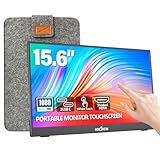
The only travel-friendly option here, and a genuine niche filler for laptop users who need a second touch-enabled screen on the road. The 1080p panel at 60Hz is smooth enough for navigation and light annotation, and the included protective sleeve plus built-in stand mean no accessories to forget. Two pros: USB-C and HDMI both feed the display without an external power adapter on compatible laptops, and the 1200:1 contrast ratio gives it slightly more depth than typical portable panels. One con: 15.6 inches limits multi-window productivity, and the touch layer can feel imprecise at the screen edges during fine gestures. Skip if your primary use is desk-bound work where a full-size monitor makes more sense.
Buying Guide
Touch Layer Quality Beats Resolution
A digitizer with poor edge calibration will register your thumb press several millimeters off from the rendered pixel, and no amount of 4K clarity fixes that. Before buying, confirm whether the manufacturer specifies parallax distance or offset tolerance. In this group, the 32-inch 4K unit and the Pisichen 27-inch both deliver tight alignment; budget options like the SKitphrati require a calibration pass out of the box. Always run the Windows touch calibration wizard after initial setup regardless.
Refresh Rate Still Matters on a Touch Display
Dragging a cursor or painting with a stylus across a 60Hz panel introduces visible latency that compounds with each gesture. The 75Hz and 100Hz units in this roundup feel noticeably more fluid for interactive work. If you plan to use the touch layer for anything beyond occasional taps, prioritize 75Hz minimum and treat 100Hz-plus as a genuine quality-of-life advantage for creative or data-heavy workflows.
Connectivity Determines Your Actual Workflow
USB-C with display alt-mode and power delivery eliminates the dual-cable mess that plagues older setups. The Pisichen and ASUS BE24ECSBT both support this cleanly. HDMI 2.1 and DisplayPort 1.4 appear only on the premium 32-inch unit, which matters if you drive it from a high-end GPU at full resolution and refresh. VGA remains a legacy liability, not a feature, when it is your only fallback input.
Our Verdict
The Pisichen 27-inch 2K is the top pick for most readers because it balances resolution, refresh, connectivity, and touch accuracy without forcing a compromise on any single axis. The SKitphrati 21.5-inch is the budget pick, delivering functional touch at a price that makes multi-unit deployment realistic. However, if your use case is specifically video conferencing with a clean desk footprint, the ASUS BE24ECSBT wins outright thanks to its integrated webcam and single-cable USB-C design.
FAQ
Are touch screen monitors good for gaming?
Touch adds a layer of convenience for inventory management, map interaction, and UI-heavy indie titles, but it will not replace mouse precision in competitive shooters. The Pisichen 27-inch 2K at 100Hz is the most gaming-viable option in this list.
Do touch monitors work with Macs?
Basic pointer input works over USB without drivers, but macOS does not natively support multi-touch gestures on external displays the way Windows does. Expect single-finger functionality only unless you run third-party software like Touch-Base.
Is 10-point touch better than 2-point?
10-point touch allows simultaneous multi-finger interactions like pinch-zoom with two hands or palm-rejection during stylus work. For business, education, and creative annotation, it makes a noticeable difference in naturalness of interaction.
Do I need a touch screen monitor for a kiosk?
If the kiosk requires direct user interaction without a keyboard or mouse, yes. Pair one of these displays with a protective bezel or enclosure for public-facing environments, and prioritize VESA mounting options for installation flexibility.
Part of our monitors buying guide hub.


