The best rock sliders for a Jeep Wrangler are frame-mounted steel sliders for repeated hard trail use, while aluminum sliders are a better fit when reducing weight and resisting corrosion matter more than taking the heaviest impacts. Before choosing, match the slider to your Wrangler’s generation, verify its mounting points, and compare usable step width and clearance—not just the product’s advertised weight or appearance.
As an Amazon Associate we earn from qualifying purchases at no extra cost to you.


Our Top Picks


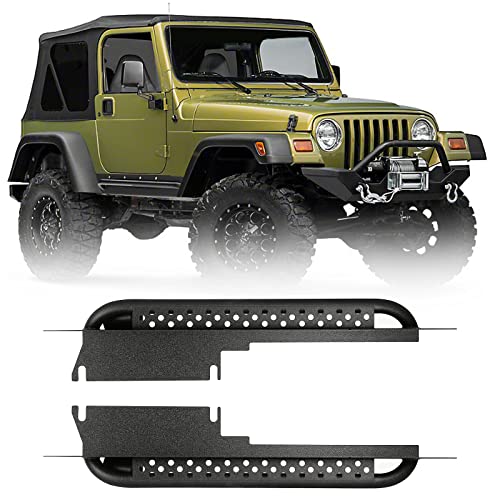

Top 3 picks at a glance
Steel vs. aluminum: choose for the kind of contact you expect
Rock sliders take hits that would otherwise damage the rocker panels, doors, or body mounts. Their job is to transfer that force into the Jeep’s structure, so construction and mounting matter more than whether a slider doubles as a convenient step.
| Construction | Typical weight per pair | Best suited to | Trade-off to check |
|---|---|---|---|
| Steel, frame-mounted | About 50–100 lb | Frequent rock contact, vehicle recovery or use as a pivot point | Added weight and the need to protect chipped coatings from rust |
| Aluminum, frame-mounted | About 30–65 lb | Weight-conscious builds, wet climates and moderate trail contact | Alloy, wall thickness and attachment design vary; confirm the maker’s impact-use guidance |
| Body-mounted step or guard | About 25–60 lb | Street access and protection from light scrapes | Not a substitute for a frame-mounted slider when the rocker may carry the Jeep’s weight |
These are broad product-class ranges, not guaranteed specifications. Slider weight changes with length, material thickness, kick-out design and mounting hardware. A thick steel tube can still be a poor rock slider if its brackets load only the body, while a carefully engineered aluminum design can be trail-capable. Look for documented frame attachment and clear guidance on whether the product is intended to support vehicle weight.
What to compare before buying
Frame mounting and attachment points
Prioritize sliders that bolt to the frame or use a manufacturer-designed combination of frame and body mounts. Check how many mounting points each side uses, whether the brackets attach to existing holes, and whether installation requires drilling or cutting. More bolts alone do not prove a stronger design: bracket shape, fastener size, frame contact and load path all matter.
Be especially cautious about treating a running board as armor. A wide step can be useful for passengers but may bend upward if it catches a rock. If you expect to slide along ledges or lift one side of the Jeep against a slider, select a product explicitly designed for that kind of load.
Ground clearance and protrusion
A slider cannot improve clearance beyond the Jeep’s lowest relevant point, but its shape can make an obstacle easier—or harder—to clear. A flat, tucked-in design generally presents less to snag than a slider that hangs below the frame. A kick-out at the rear can help guide the back of the body away from trees or rocks, but it also adds width.
Compare the slider’s lowest point with the frame and rocker on your own suspension and tire setup. If the slider sits below the frame, it may become the first contact point; that can be intentional protection, provided the structure is built to take the impact. Also consider the added width: a protruding step can catch on narrow trails even when the center section has good clearance.
Step width and access
Step width is a balance between foot space and trail exposure. A narrow top surface is less likely to snag and is usually easier to keep tucked close to the body. A wider platform is more comfortable for children, older passengers and roof access, but can reduce clearance around rocks and trees.
Check the usable flat surface rather than the outermost measurement. A round tube may be advertised as a step but provide little stable footing, especially when muddy. If access is the priority, look for a broad, textured step surface; if rock protection is the priority, favor a compact design with a strong frame-mounted structure.
Fitment by Wrangler generation
“Fits a Wrangler” is not enough. Door count, wheelbase, body shape, frame layout and factory equipment can change which slider works. Confirm the exact year range and body style in the manufacturer’s fitment list before ordering.
| Wrangler generation | Common fitment checkpoints | What to verify |
|---|---|---|
| YJ (1987–1995) | Two-door body and older frame; substantial age and modification variation | Exact model year, frame condition, and whether prior repairs or modifications affect mounting |
| TJ (1997–2006) | Two-door configuration; mounting and rocker shape differ from newer Wranglers | Year range, body or frame modifications, and compatibility with factory or aftermarket flares |
| JK (2007–2018) | Two-door and four-door Unlimited versions have different lengths | Door count, model year, and whether the slider is specifically for a JK or JK Unlimited |
| JL (2018–present) | Two-door and four-door versions; equipment and body details can vary by year | Exact year, body style, and interference with factory steps or other installed accessories |
| JT Gladiator (2020–present) | Pickup frame and cab/bed layout differ from a Wrangler | Buy a Gladiator-specific product, not a Wrangler slider, even if the front mounting area looks similar |
Generation dates identify the broad platform, not guaranteed product fitment. Model-year transitions, trim equipment, aftermarket body armor and previous modifications can all affect installation. Treat the manufacturer’s current fitment chart as the final check, and contact the maker with your VIN or exact year, body style and trim if the listing leaves an ambiguity.
Match the slider to your use
| Your situation | Best starting choice | Why |
|---|---|---|
| Frequent rocky trails; slider may carry vehicle weight | Heavy-duty, frame-mounted steel | Common choice for repeated hard contact; confirm the maker’s stated load use |
| Mixed trails and road driving; weight matters | Frame-mounted aluminum or lighter steel | Can reduce added mass while retaining a structural attachment; compare construction details |
| Mostly pavement; passengers need an easy step | Wide step-style slider, with mounting type clearly specified | Prioritizes access, but should not be assumed to withstand hard rock impacts |
| Narrow trails or tight wooded routes | Compact, close-fitting slider with minimal kick-out | Less likely to snag on obstacles; check how much step area you give up |
| Wet or coastal environment | Aluminum, or coated steel with repairable corrosion protection | Material and finish both matter; inspect steel after scratches expose bare metal |
Estimate the weight penalty before committing
Use the pair weight to estimate how much mass the sliders add to the Jeep, then compare that with your remaining payload—not just the vehicle’s published maximum. For example, if a steel pair weighs 80 lb and an aluminum pair weighs 48 lb, the steel option adds 32 lb more. That is a modest difference beside occupants and cargo, but it still counts toward payload and sits low on the vehicle. If your build is already near its payload limit, account for sliders alongside bumpers, a winch, spare tire, roof rack, passengers and recovery gear.
Do not choose by weight alone. A lighter slider that cannot tolerate the contact you expect is a poor trade; a heavier one that hangs low or sticks far out may also be a poor fit for your trails. Compare the pair weight, mounting design, lowest point and outer profile together.
Installation and final checks
- Confirm exact fitment: Match generation, year, two-door or four-door body, and any stated trim restrictions.
- Inspect the mounting area: Rust, bent frame sections, previous repairs or aftermarket armor may prevent a safe fit.
- Check for interference: Verify clearance around factory steps, fender flares, doors and other accessories before final tightening.
- Use the specified hardware and torque: Follow the product instructions; do not substitute fasteners or guess torque values.
- Recheck after installation: Inspect fasteners after the first drive or trail outing as directed by the manufacturer, and touch up coating damage on steel.
For most trail-focused Wranglers, start with a frame-mounted slider matched precisely to the generation and body style. Choose steel when repeated hard impacts are likely; consider aluminum when weight and corrosion resistance have greater value. Then make the final call based on how far the slider hangs down or sticks out, and whether its usable step width suits the people who ride in your Jeep.
Frequently asked questions
Can rock sliders also work as recovery points?
Only use a slider for recovery or as a pivot point if its maker explicitly says it is designed for that kind of load. A frame-mounted design alone does not establish that it can support the Jeep’s weight. Check the product’s stated load use and attachment design before relying on it.
Will rock sliders improve my Jeep’s ground clearance?
No, a slider cannot improve clearance beyond the Jeep’s lowest relevant point. Its shape can affect how easily obstacles pass beneath or beside the vehicle: a tucked-in design generally presents less to snag, while a slider that hangs below the frame may become the first contact point.
Are tubular rock sliders comfortable to stand on?
Not necessarily. A round tube may be advertised as a step but offer little stable footing, especially when muddy. For easier access, look for a broad, textured surface and compare its usable flat area; a wide platform can be more comfortable but may be more exposed to rocks and trees.
Can I install sliders over my factory steps?
It depends on the product and your Jeep’s equipment. Check the fitment information and verify that the sliders will not interfere with factory steps or other accessories before tightening them. Some listings specify compatibility with factory equipment, while other combinations may require a different product or installation plan.
What should I do if my Wrangler has frame rust or previous repairs?
Inspect the mounting area before installation, because rust, bent frame sections, previous repairs or aftermarket armor may prevent a safe fit. If the mounting area or fitment is uncertain, contact the manufacturer with your exact year, body style and trim rather than assuming the product will fit.