The best portable inverter generators for RV air conditioner use are 3,000–4,500 starting-watt models: a 2,000-watt unit may run some 13,500 BTU air conditioners only after startup demand is reduced, while a 15,000 BTU unit is usually better matched with a 3,000-watt generator or a parallel-generator pair.
As an Amazon Associate we earn from qualifying purchases at no extra cost to you.



Our Top Picks
 WEN 6800-Watt Dual Fuel RV-Ready Electric Start Portable22.8 x 16.6 x 19.7 inches99.2 PoundsCheck on Amazon
 WEN Quiet and Lightweight 3600-Watt Dual Fuel RV-ReadyDual Fuel + CO Alarm18 x 11.63 x 19.68 inches49 poundsCheck on Amazon
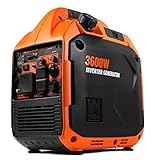
 WEN 3600-Watt Portable Inverter GeneratorSingle Fuel17.9 x 11.6 x 19.7 inches46.3 PoundsCheck on Amazon
 Champion 4000-Watt RV Ready Portable Inverter Generator17.9 x 11.7 x 19.7 inches48.1 PoundsCheck on Amazon
Top 3 picks at a glance
Quick picks by RV air-conditioner size
| RV AC and situation | Practical generator target | Suitable generator class | Why |
|---|---|---|---|
| 13,500 BTU, soft-start installed, light electrical load | 1,800–2,200 running watts; 2,200–3,000 starting watts | Honda EU2200i, Yamaha EF2200iS, or similar 2,000-watt inverter | Efficient and relatively quiet, but little reserve remains for a microwave or coffee maker. |
| 13,500 BTU, no soft start, reliable all-around use | 2,800–3,200 running watts; 3,500–4,500 starting watts | Honda EU3200i or similar 3,000-watt inverter | More starting headroom and better tolerance for hot-weather compressor starts. |
| 15,000 BTU, soft-start installed | 2,800–3,500 running watts; 3,500–4,500 starting watts | Honda EU3200i, Champion 4500-watt dual-fuel inverter, or similar | Handles the compressor with useful capacity left for RV appliances. |
| 15,000 BTU, no soft start or multiple appliances | 3,500–4,500 running watts; 4,500–6,000 starting watts | 4,500-watt inverter or two parallel-capable generators | Provides a safer margin when compressor inrush and household loads overlap. |
How much generator power does an RV AC actually need?
The BTU rating describes cooling capacity, not electrical consumption. A typical 13,500 BTU rooftop air conditioner may draw about 12–15 amps while running on 120 volts. That equals approximately 1,440–1,800 running watts:
120 volts × 13 amps = 1,560 watts
A 15,000 BTU unit commonly uses about 13–17 amps, or roughly 1,560–2,040 watts while the compressor is operating. Actual values vary with the model, outside temperature, voltage, altitude, dirty filters, and compressor condition.
Starting demand is the difficult part. A compressor can briefly require two to three times its normal running power. For example, a 13,500 BTU unit drawing 1,560 watts may momentarily need approximately 3,500–4,500 starting watts. A 15,000 BTU unit may reach 4,000–5,000 starting watts without a soft-start device.
Worked power-budget example
Suppose a 13,500 BTU AC uses 1,560 watts while running. Add an RV refrigerator on electric mode at 350 watts, a battery charger using 250 watts, and a television using 100 watts:
1,560 + 350 + 250 + 100 = 2,260 running watts
A 2,200-watt generator is already overloaded in this example, even if the air conditioner starts successfully. A 3,000-watt model leaves about 740 watts of operating reserve. During startup, turn off the microwave, coffee maker, induction cooktop, and other high-draw equipment rather than relying only on the generator’s brief surge rating.
Best generator choices by use case
Best compact choice: Honda EU2200i or Yamaha EF2200iS
These 2,000-watt-class inverter generators are appropriate for a 13,500 BTU air conditioner when the unit has a compatible soft-start and the RV’s simultaneous electrical load is controlled. Their advantages are portability, clean inverter power, and relatively low noise. Their limitation is capacity: they are not a comfortable choice for a 15,000 BTU AC or for running the air conditioner alongside a microwave.
Honda’s EU2200i is rated at 1,800 running watts and 2,200 starting watts. Yamaha’s EF2200iS is in the same general power class. Verify the generator’s current specifications before purchase, especially if comparing models sold in different markets.
Best single-generator balance: Honda EU3200i
The EU3200i is a stronger match for many RVs because its 3,200-watt maximum output gives a 13,500 BTU air conditioner meaningful starting and running reserve. It is also a more sensible single-generator choice for a soft-start-equipped 15,000 BTU unit, provided the RV is not simultaneously using several heating appliances.
A generator in this class is heavier and generally more expensive than a 2,000-watt model, but the extra capacity can prevent overload shutdowns when the compressor starts in hot weather or when the battery charger is active.
Best high-capacity and fuel-flexible class: 4,500-watt dual-fuel inverter
Models such as the Champion 4500-watt dual-fuel inverter and Westinghouse iGen4500 class provide considerably more reserve for a 15,000 BTU air conditioner. Dual-fuel operation can be useful when propane storage is already part of the RV setup, although gasoline commonly provides higher peak output and longer practical cooling performance per container.
Check the exact gasoline and propane running-watt ratings. “4,500 watts” often refers to peak output, while continuous output may be closer to 3,600 watts. The continuous rating is the number to compare with the AC and the rest of the RV load.
Noise matters more than the headline decibel number
Inverter generators usually throttle down when the load is light, but an air conditioner keeps them under substantial load for long periods. A generator advertised at 50–60 dB in economy mode may be noticeably louder while producing 2,000 or more watts.
- Under 55 dB at a stated distance: a strong choice for quiet campgrounds, but confirm the measurement conditions.
- 55–65 dB under load: common for compact and mid-size models and usually acceptable when positioned thoughtfully.
- Above 65 dB under load: workable for dispersed camping, but more intrusive near neighboring sites.
Compare sound measurements taken at the same distance and load. Never place a generator inside the RV, under the RV, in a storage compartment, or beneath an enclosed awning. Carbon monoxide can accumulate even when doors and windows appear closed. Use the manufacturer’s clearance requirements and a functioning carbon-monoxide alarm.
Runtime: compare fuel use at the AC load
Advertised runtimes are often measured at 25% load, which is not representative of continuously running an RV air conditioner. A 13,500 BTU AC can keep a generator near 60–80% load depending on its electrical draw and the generator’s size. A smaller generator may therefore use fuel faster than a larger generator running at a lower percentage load.
| Generator class | Typical AC operating load | Approximate gasoline runtime with AC running | Best application |
|---|---|---|---|
| 2,000-watt inverter | 1,400–1,800 watts | About 3–6 hours, depending on tank size and throttle behavior | 13,500 BTU AC with soft start and minimal additional load |
| 3,000–3,200-watt inverter | 1,500–2,300 watts | About 5–10 hours | 13,500 BTU AC, or a carefully managed 15,000 BTU setup |
| 4,000–4,500-watt inverter | 1,700–2,600 watts | About 6–12 hours | 15,000 BTU AC with appliance reserve |
These are planning ranges rather than guarantees. Temperature, altitude, eco-throttle settings, fuel quality, maintenance, and cycling behavior all change runtime. Propane generally produces less output than gasoline, so use the propane-specific ratings when calculating capacity.
When a soft-start kit changes the recommendation
A soft-start device reduces the compressor’s brief inrush demand. It does not make the air conditioner consume less power while running, but it can turn an unreliable startup into a manageable one. For example, a 13,500 BTU unit that previously demanded roughly 4,000 starting watts may start with substantially less surge after installation.
With a properly installed soft start, a quality 2,000-watt inverter may operate a 13,500 BTU AC by itself. That still does not guarantee success: low voltage, high altitude, a weak capacitor, a dirty condenser, or another appliance starting at the same moment can cause an overload. A soft start is most useful when paired with load management, not used as a substitute for adequate continuous wattage.
Selection checklist before buying
- Read the AC data plate and record running amps, not just BTUs.
- Multiply volts by amps to estimate running watts.
- Add the refrigerator, converter or battery charger, lights, fans, and electronics that will operate at the same time.
- Choose a generator whose continuous rating exceeds that total, preferably with 20–30% reserve.
- Compare peak or starting watts separately; peak watts do not replace continuous capacity.
- Check whether the generator supports parallel operation if future expansion matters.
- Confirm the RV connection: a 30-amp RV plug can carry up to 3,600 watts at 120 volts, while a 50-amp RV has two 120-volt legs and needs appropriate wiring and generator equipment.
- Look for overload protection, CO shutoff, low-oil protection, an electric start if desired, and a service network.
Frequently asked questions
Can I run an RV air conditioner and microwave from the same generator?
Possibly, but the generator needs enough continuous capacity for both, and the microwave should be off while the compressor starts. The article’s example shows a 13,500 BTU AC, refrigerator, battery charger, and television using 2,260 running watts together, which overloads a 2,200-watt generator. A 3,000-watt model leaves about 740 watts of reserve in that example.
Does a soft-start kit reduce the air conditioner’s running power?
No; a soft-start reduces the compressor’s brief startup demand, not the air conditioner’s power use while running. It may let a quality 2,000-watt inverter start a 13,500 BTU AC by itself, but that does not guarantee success. Low voltage, high altitude, a weak capacitor, a dirty condenser, or another appliance starting at the same time can still cause an overload.
Can I use a generator with a 50-amp RV connection?
A 50-amp RV has two 120-volt legs and needs appropriate wiring and generator equipment. The article does not specify which generator models or adapters provide that setup, so check compatibility before buying. It also notes that a 30-amp RV plug can carry up to 3,600 watts at 120 volts.
Will a dual-fuel generator provide the same output on propane as on gasoline?
No; propane generally produces less output than gasoline, so compare the generator’s propane-specific ratings with your RV’s needs. The article also notes that gasoline commonly provides higher peak output and longer practical cooling performance per container. Check both the gasoline and propane running-watt ratings rather than relying on the headline peak-watt figure.
Where should I place a portable generator while running the air conditioner?
Never place it inside the RV, under the RV, in a storage compartment, or beneath an enclosed awning. Carbon monoxide can accumulate even when doors and windows appear closed. Follow the manufacturer’s clearance requirements and use a functioning carbon-monoxide alarm.
Bottom line
Choose a 2,000-watt inverter only for a soft-start-equipped 13,500 BTU AC with disciplined appliance use. A 3,000–3,200-watt inverter is the best general-purpose match for a 13,500 BTU unit and a credible option for a soft-start-equipped 15,000 BTU unit. For a 15,000 BTU AC without a soft start, or for cooling while using kitchen appliances, step up to a 4,500-watt-class inverter or use two compatible generators in parallel.