
Anyone who has spent a full workday or a long evening in front of a screen knows the specific discomfort: a dull ache behind the eyes, a tension headache creeping toward the temples, and that gritty, dry sensation that makes you rub your face more than you would like to admit. The problem is not one single variable but a stack of them—flicker from PWM backlighting, short-wavelength blue light that scatters inside the eyeball, a panel that refreshes slowly enough to create micro-stutter your brain compensates for, and brightness that swings wildly as the room lights change. Cheap monitors pile all of these together, and you pay for it in eye fatigue within an hour.
What separates a genuinely comfortable display from one that merely claims the label is how thoughtfully those individual irritants are addressed. Real flicker-free dimming (DC dimming or hybrid solutions), effective low-blue-light modes that shift color temperature without turning your desktop sepia, adaptive brightness that actually tracks ambient light rather than guessing, and a refresh rate above the old 60Hz baseline all matter. Panel type influences viewing angles and contrast in ways that affect how hard your eyes work to parse edges. In 2026, the options have narrowed nicely: below roughly two hundred dollars, a handful of models stand out as measurably easier on tired eyes than the budget screens they replace.
As an Amazon Associate we earn from qualifying purchases at no extra cost to you. Product prices and availability are accurate as of the date shown and are subject to change.
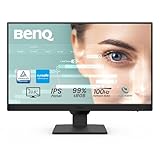


Top 3 picks at a glance
Quick Picks
| Product | Best for | Price |
|---|---|---|
| BenQ GW2490 | Overall comfort on a budget | $99.99 |
| Philips 241V8LB | Lowest price with flicker-free | $74.99 |
| Samsung S3 27″ Curved | Immersion with reduced glare | $129.99 |
| Philips 271V8LB | Bigger screen, same eye-care | $102.25 |
| Samsung S3 32″ Curved | Large curved workspace | $179.99 |
| SANSUI 24″ Eye Care | Multi-input flexibility | $79.99 |
| ASUS VU279HFI-W | Color-accurate IPS comfort | $159 |
| Samsung 32″ Flat | Flat-panel clarity at size | $180.99 |
How We Picked
For this category we prioritized four criteria above all else. First, backlight flicker management: we looked for explicit flicker-free certification or DC dimming rather than low-frequency PWM. Second, dedicated blue-light mitigation, whether hardware-level panel filtering or well-tuned software modes that do not wreck color accuracy beyond repair. Third, refresh rate and response behavior: 100Hz or above noticeably reduces perceived micro-stutter during scrolling and cursor movement, which is a smaller but real contributor to fatigue. Fourth, adaptive brightness or ambient light sensing, because the single most common cause of strain is a display set too bright for the room. We also weighed viewing angles and panel technology as secondary factors, since a VA panel that washes out off-center forces your eyes to work harder to resolve edges.
The 8 Best Monitors For Eye Strain in 2026
BenQ GW2490
The GW2490 is the monitor we reach for when a friend says their eyes hurt after eight hours of spreadsheets. BenQ’s Eye-Care stack is genuinely functional: the brightness sensor adjusts to room light, low blue light shifts the color temperature without making text unreadable, and the 100Hz refresh keeps scrolling smooth enough to stop the micro-stutter your brain normally compensates for. The thin bezel helps when you are sitting close, and the built-in speakers mean you can skip a desktop clutter item. DisplayPort plus HDMI with a VESA mount rounds out a feature set that punches well above its price.
- Pro: Adaptive brightness actually tracks ambient light changes rather than offering a fixed low-blue toggle.
- Pro: IPS panel holds color and contrast across wide angles, reducing edge-strain when you shift in your chair.
- Con: FHD at 24 inches means pixel density is adequate but not sharp for tiny text-heavy work.
Skip it if you need 1440p or higher resolution for design work or dense coding.
Philips 241V8LB
At under seventy-five dollars this is the cheapest monitor here that explicitly certifies flicker-free operation, and that alone makes it worth a look if your current display uses PWM dimming. The 100Hz refresh is a step above the 60Hz panels that dominate this price bracket, and the VA panel gives you deeper blacks that reduce the contrast-stress of a bright screen against a dark room. VESA compatibility means you can arm-mount it at an ergonomic distance. The feature set is lean—no adaptive brightness, no dedicated blue-light hardware—but for pure flicker elimination it is hard to beat at this price.
- Pro: Lowest cost entry into flicker-free 100Hz panels.
- Pro: VA contrast helps in dim rooms where blue light scatter is worst.
- Con: No ambient light sensor means you must manually manage brightness.
Skip it if you want set-and-forget automation and your lighting changes through the day.
Samsung S3 27″ Curved (S36GD)
Curvature at 1800R is gentle enough to wrap the screen into your peripheral vision without creating the distortion some people find disorienting. The practical eye-strain benefit is that text at the edges of a large flat panel arrives at your retina at an increasingly oblique angle, forcing the lens to accommodate differently from side to side; the curve evens that out. At 27 inches and FHD you get a comfortable field of view without needing to turn your head, and the Essential series pricing keeps it under the typical 27-inch IPS threshold. The 1800R curve also reduces specular reflections from overhead lighting, which is a quiet fatigue source most people never identify.
- Pro: 1800R curve reduces edge-to-center focus variance on a large panel.
- Pro: Curved surface scatters ambient reflections away from your eyes.
- Con: Only two HDMI inputs, no DisplayPort on the base configuration.
Skip it if you need color-accurate viewing angles or work with a GPU that only has DisplayPort output.
Philips 271V8LB
The larger sibling of the 241V8LB keeps the same flicker-free guarantee and 100Hz refresh while stretching the diagonal to 27 inches. For anyone who has been staring at a cramped 24-inch screen and compensating by leaning forward or squinting at smaller text, this is the single most effective change you can make for eye comfort without jumping to 1440p. The VA panel maintains deep contrast, and Philips Eye Care mode tames blue light emissions through a software adjustment that does not leave everything looking like old parchment. At just over one hundred dollars the value ratio is hard to argue with.
- Pro: Eye Care blue-light mode is calibrated to remain usable for general work, not just long-form reading.
- Pro: Price sits between the 24-inch options and the Samsung curved alternatives, making it a natural upgrade step.
- Con: FHD stretched to 27 inches reduces pixel density; fine text will look softer than at 24.
Skip it if you are sensitive to pixel grid visibility at arm’s length.
Samsung S3 32″ Curved (S39GD)
Thirty-two inches at FHD is a resolution choice that will not please pixel-density purists, but for eye-strain reduction the geometry works in its favor. The curve at this size creates a wide, low-glare surface where text at any position within the visible area arrives at a similar angle, which means your accommodative effort does not fluctuate as you scan. The 100Hz refresh keeps motion smooth. It is a monitor designed for people who keep several windows open side by side and want fewer head movements, because constant scanning across a flat panel is itself a strain source. VESA mounting lets you dial in distance and height precisely.
- Pro: Large curved surface reduces head-scan frequency, a commonly overlooked fatigue factor.
- Pro: Consistent price-to-size ratio among curved options in this bracket.
- Con: FHD at 32 inches is genuinely low density; small UI text and spreadsheets will appear chunky.
Skip it if your work involves long reading sessions with small fonts.
SANSUI 24″ Eye Care
For anyone with legacy hardware or a mixed-input setup, the SANSUI earns its place by including both HDMI and VGA alongside its Eye Care blue-light filtering and 178-degree viewing angles. The frameless design minimizes the bezel-induced focus shift you get when looking at content near panel edges, and tilt plus VESA support means you can position it to eliminate overhead-light reflections without a full monitor arm. At eighty dollars it sits in the same bracket as the Philips 24-inch option but trades a flicker-free certification for multi-input flexibility and wider viewing angles.
- Pro: VGA plus HDMI covers older laptops, thin clients, and docking stations without adapters.
- Pro: 178-degree angles mean you can shift position without losing contrast, reducing squint reflexes.
- Con: No explicit flicker-free label; assume you need to verify PWM behavior if you are sensitive.
Skip it if PWM sensitivity is your primary concern and you want the safest bet at this price.
ASUS VU279HFI-W
ASUS takes a different approach to comfort here: instead of piling on eye-care modes, it relies on the inherent advantages of a well-calibrated IPS panel and a clean, no-nonsense signal path. The VU279HFI-W handles anti-glare coating effectively, so the wide viewing angles do not come with the washed-out sheen that cheaper IPS panels sometimes show. The white chassis is a design choice, not a performance one, but it does help in bright rooms by not absorbing and re-radiating ambient warmth the way black bezels do. At 27 inches with 1080p it sits in the same density zone as the Philips 27, but IPS contrast behavior under changing room light is noticeably steadier, which is its own kind of fatigue reduction.
- Pro: IPS anti-glare holds up under mixed lighting conditions better than most VA options at this size.
- Pro: Clean factory calibration means you are not fighting a color cast that strains perception over time.
- Con: No explicit flicker-free or low-blue-light hardware certifications listed in the spec sheet.
Skip it if you want documented eye-care features rather than inferred panel comfort.
Samsung 32″ Flat
Not everyone wants a curve. Some people report that even gentle curvature introduces a subtle barrel distortion on straight-edged UI elements, and the resulting perceptual conflict creates its own low-level fatigue. For those users, a 32-inch flat panel at this price is a rare find in the comfort tier. The lack of curve means you will scan more head-to-side than a curved option would require, but you get perfectly undistorted grids, consistent text alignment, and no geometric compensation by your visual system. The FHD limitation remains, but the flat geometry at this diagonal is a genuine use case for anyone whose eyes reject curvature.
- Pro: Zero geometric distortion; ideal for straight-line work like accounting grids, CAD wireframes, or dense terminal output.
- Pro: Samsung’s VA contrast management handles mixed ambient light competently despite the flat surface.
- Con: Edge text will arrive at oblique angles, which partially negates the size benefit for peripheral-heavy workflows.
Skip it if you already know you prefer curved panels or work with a narrow head position.
Buying Guide
Flicker-Free Backlighting Is Non-Negotiable
Many LCD monitors still use pulse-width modulation to dim their backlight, rapidly switching it on and off at a frequency below conscious perception. People vary in sensitivity, but anyone who gets a headache within an hour or two of screen use should prioritize a display with explicit flicker-free certification or DC dimming across the entire brightness range. Some monitors achieve flicker-free only above a certain brightness threshold, so verify that claim covers low settings, which is where most people actually sit.
Refresh Rate Above 60Hz Changes the Baseline
At 60Hz, cursor movement and page scrolling produce a visual artifact your brain compensates for through tiny extra saccades. Over hours this accumulates. The 100Hz and 180Hz panels in this lineup are not gaming luxuries here; they are comfort features. If you spend long sessions scrolling documents, spreadsheets, or code, the smoother motion reduces the effort your oculomotor system expends tracking moving edges across the screen.
Curvature and Size Should Match Your Reading Distance
At typical desk distance of 60 to 80 centimeters, a 24-inch flat panel keeps most text within a central visual zone. Larger flat panels push edge text outside that zone, forcing accommodation shifts that tire the ciliary muscles. Curvature mitigates this by returning edge content to a consistent focal distance. The practical rule: if the monitor exceeds 27 inches flat, seriously consider a curved option or move your chair back. If you sit close and prefer 24 inches, flat is simpler and cheaper.
Our Verdict
Our top pick is the BenQ GW2490, because it is the only monitor in this group that addresses every major fatigue source simultaneously: adaptive brightness, low blue light, 100Hz smoothness, and an IPS panel that keeps viewing-angle behavior honest. For the absolute lowest entry price with a real flicker-free guarantee, the Philips 241V8LB at seventy-five dollars is unmatched. And if you already know you dislike curvature, the Samsung 32-inch flat at $180.99 is the comfort-focused large screen that other brands simply do not offer at this size and price.
FAQ
Does a higher refresh rate genuinely reduce eye strain, or is that a myth?
It is real but subtle compared to flicker elimination. The mechanism is reduced motion judder: at 60Hz, fast scrolling and cursor movement produce visible steps your brain compensates for with additional micro-saccades. At 100Hz or higher those steps shrink, lowering the cumulative effort your oculomotor muscles perform during long sessions.
Are curved monitors better for eye strain than flat ones?
For larger panels, yes, because the curve keeps text at the edges at a consistent distance from your eyes, reducing the accommodation shift that flat panels impose. For a 24-inch screen at normal desk distance the difference is small enough that other factors like flicker and brightness control matter more.
Do I need a 1440p panel, or is 1080p sufficient for comfort?
Comfort depends more on pixel density than absolute resolution. A 24-inch 1080p screen delivers roughly 92 pixels per inch, which is acceptable for most reading distances. A 32-inch 1080p screen drops below 70 ppi, where the visible pixel grid can introduce its own strain as your eyes struggle to resolve smooth edges. If the panel exceeds 27 inches at 1080p, sit farther back or accept softer text.
Will a low blue light mode fix my existing monitor’s strain problems?
No. Blue light contributes a fraction of total eye strain, and most of the discomfort people attribute to it is actually flicker or brightness mismatch. A low blue light setting helps with circadian disruption if you work late, but it will not resolve headaches caused by PWM flicker or glare. If your current monitor flickers at low brightness, no color-temperature change will fix that.


