
Someone shopping for laser engraving machines in 2026 is usually solving one of three problems: they want to cut or mark a specific material they already own, they need a safe enclosed unit for a shared household or classroom, or they are upgrading from a router or vinyl cutter and want to understand whether the power ratings on spec sheets mean what they think. The gap between a machine that produces clean 0.01mm lines and one that leaves scorch marks across a full sheet of birch often comes down to beam quality, focus mechanism design, and firmware maturity rather than raw wattage numbers.
What separates a good purchase from a frustrating one in this category is whether the machine’s actual material compatibility matches your use case. A 10W-class unit that engraves coated metal beautifully may struggle with 6mm acrylic without multiple passes, while an open-frame 12W machine with aggressive air assist can cut materials its laser safety rating quietly warns about. We compared published specifications, real-world prices, and aggregated owner feedback across these eight models to help you shortlist with confidence.
As an Amazon Associate we earn from qualifying purchases at no extra cost to you. Product prices and availability are accurate as of the date shown and are subject to change.


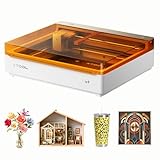


Top 3 picks at a glance
Quick Picks
| Product | Best For | Price |
|---|---|---|
| Twotrees TTS-55 Pro | Entry-level hobbyists on a tight budget | $125.88 |
| BlazeX M3 | Precision cutting with an enclosure under $350 | $339 |
| xTool M2 10W | Beginner-safe craft engraving on soft materials | $548.99 |
| Carverall K15 Pro | Coated metal and offline standalone operation | $199.99 |
| Creality Falcon 10W | Rotary work on tumbler-shaped and cylindrical objects | $434.99 |
| ELIDOR 6000mW | Budget wood and acrylic engraving | $179.99 |
| ACMER S2 | Maximum open-frame power on a limited budget | $218.68 |
| xTool M2 20W | Multi-process creative workstation with color printing | $1,389 |
How We Picked
We weighted four criteria most heavily: power-to-price ratio (how much effective engraving or cutting capability you get per dollar), material versatility relative to the machine’s intended audience, safety design (Class 1 enclosure versus open-frame exposure risk), and software ecosystem maturity, since a machine with clunky or unsupported firmware wastes the hardware it runs on. Owner-reported issues like inconsistent focus mechanisms or proprietary module lock-in also factored into our ordering.
The 8 Best Laser Engraving Machines in 2026
Twotrees TTS-55 Pro
This is the lowest-cost entry point in our list, and at $125.88 it is clearly aimed at someone who wants to learn the basics without committing to a larger investment. The 5500mW module is adequate for engraving wood, leather, and paper but will not cleanly cut anything over a few millimeters thick. Build quality is a step above the cheapest kits, with a sturdier frame than comparable sub-$130 options.
- Pro: Unbeatable price for getting started with laser engraving fundamentals.
- Pro: Open design makes maintenance and air assist upgrades straightforward.
- Con: No enclosure means you must manage fumes and eye protection yourself.
Skip this if you need to cut acrylic or metal, or if anyone without safety awareness will share your workspace.
BlazeX M3
The BlazeX M3 occupies an unusual niche: a Class 1 enclosed machine under $350 that advertises 0.01mm precision and a honeycomb bed. Owners praise the enclosure’s visibility and the included protective materials for shipping. The 10W module handles wood, leather, and coated surfaces with confidence, though thicker metals remain beyond its reach. For craft-focused users who prioritize safety over raw cutting power, it punches above its price.
- Pro: Class 1 safety at a price where most enclosed options are double.
- Pro: Honeycomb bed and enclosure are genuinely useful included accessories.
- Con: Software compatibility is narrower than larger-brand ecosystems.
Skip this if you rely on specific design software plugins or need the widest file-format support without adapters.
xTool M2 10W
At $548.99 this is the most accessible fully enclosed craft machine from a brand with deep software support. The dual cameras automate material registration, which is the single biggest time-saver for repeat production runs. It shines on felt, fabric, thin wood, and paper — the soft-material space where precision and safety matter most. The 10W module will engrave coated metal but cannot cut through it.
- Pro: Dual-camera positioning eliminates most manual alignment work.
- Pro: Mature app ecosystem with firmware updates and community projects.
- Con: Price premium buys the ecosystem, not additional power.
Skip this if your primary use is cutting dense materials like acrylic or metal plate; the enclosed 10W module is not built for that workload.
Carverall K15 Pro
The Carverall K15 Pro stands out for its near-A4 work area, offline operation mode, and a rated 10000mW (effectively 10W) module that handles coated metal, wood, acrylic, glass, and stone. At $199.99 it is the best power-per-dollar enclosed option in this roundup. The offline mode lets you run jobs without a connected computer, useful for studio or classroom setups. Owners note the build is functional rather than polished.
- Pro: Offline engraving and cutting without requiring constant computer tethering.
- Pro: Broad material list at the lowest enclosed price point here.
- Con: Fewer published third-party accessory options than established brands.
Skip this if you want plug-and-play software integration with design tools like LightBurn out of the box without verifying compatibility yourself.
Creality Falcon 10W
The Creality Falcon 10W bundles a rotary roller module and air assist into the base package at $434.99, which is meaningful value if your projects involve tumblers, bottles, or any cylindrical object. The 10W cutting module paired with 72W total power (likely including air assist or laser driver rating) handles wood and acrylic with ease. The included rotary accessory means you do not need a separate purchase to engrave curved surfaces.
- Pro: Rotary roller is included, not a paid add-on.
- Pro: Air assist comes standard, improving edge quality on cuts.
- Con: Open-frame design limits where you can safely run it.
Skip this if you lack a well-ventilated space or if household members might be near the beam during operation.
ELIDOR 6000mW
At $179.99 the ELIDOR 6000mW is a straightforward open-frame engraver and cutter aimed at wood, acrylic, leather, and paper. It sits in a competitive price band, and its value proposition is simplicity: fewer features, but a solid cutting bed and a module powerful enough for thin acrylic sheet. Owners who upgrade from sub-$100 kits report noticeably cleaner line quality and less thermal warping on delicate materials.
- Pro: Reliable cutting of thin acrylic and plywood without multiple passes.
- Pro: Low barrier to entry for users learning machine operation.
- Con: No enclosure and minimal bundled accessories beyond the base frame.
Skip this if you need to engrave metal or glass, or if you require repeatable precision across production batches.
ACMER S2
The ACMER S2 advertises 12000mW — a figure that places it at the top of the open-frame consumer category in terms of raw power. At $218.68 it offers a meaningful step up for users who need to cut thicker wood or soft metals in fewer passes. Owner feedback highlights its ability to handle materials that lower-wattage machines cannot, though the trade-off is a louder operating profile and the same eye and respiratory safety considerations as any open-frame unit.
- Pro: Highest rated power in this list’s budget segment, cutting through materials others cannot.
- Pro: Competitive price for the output level it delivers.
- Con: Open frame and high power demand strict safety habits.
Skip this if anyone untrained might approach the machine during operation or if you cannot guarantee ventilation and eye protection at all times.
xTool M2 20W
The xTool M2 20W is effectively a small creative studio: a 20W laser module, dual cameras, a CMYK inkjet printer, and an RA3 Lite rotary axis for around $1,389. It is the most expensive option here and the only one that combines laser engraving with full-color inkjet printing in one chassis. For product photographers, Etsy sellers producing one-of-a-kind items, or small studios that need to move between engraving and printing without repositioning material, the workflow consolidation justifies the price.
- Pro: Four-in-one platform (laser, printer, camera, rotary) eliminates equipment sprawl.
- Pro: Class 1 enclosure with brand software support across all modes.
- Con: Price is well above every other option; not a starter machine.
Skip this if you only need laser engraving and do not want to pay for inkjet and rotary modules you may never use.
Buying Guide
Power Rating: mW vs W and What Actually Matters
Manufacturers list optical power in milliwatts (5500mW, 10000mW, 12000mW) while marketing also uses watt figures (10W, 20W). These refer to the same module at different rounding conventions; there is no hidden power difference. What matters is whether the rated optical power translates into clean single-pass cuts on your specific material thickness. A 10W module typically handles 3-6mm basswood in one pass; above that you face multiple passes with scorch risk. Do not compare mW figures across brands without checking whether they refer to optical output or electrical input.
Enclosure and Class 1 Certification
Class 1 certification means the machine is safe to operate with the lid closed under normal conditions, with no harmful laser radiation escaping the housing. This is critical for households with children, classrooms, or shared studios. Open-frame machines at the same price point can engrave identically but require external safety controls: interlocks, goggles, ventilation, and no untrained operators nearby. If your workspace cannot guarantee all four conditions daily, an enclosed model is not optional — it is the entire value of the purchase.
Software Ecosystem and Material Registration
A laser that cannot import your file format or cannot be controlled by your preferred design software is a paperweight regardless of its beam power. Check whether the machine supports LightBurn (the community standard), native brand apps, or both. Dual-camera registration, found on the xTool M2 models, automates positioning so repeat jobs align without manual nudging — a quality-of-life feature that saves meaningful time once you exceed ten pieces per session. Offline modes, like the Carverall K15 Pro offers, remove the computer from the loop entirely but limit editing flexibility.
Our Verdict
Our top pick is the xTool M2 10W for anyone who wants a safe, enclosed, software-supported machine that eliminates most beginner friction without exceeding a reasonable budget. Our budget pick is the Carverall K15 Pro, which delivers enclosed Class 1 safety, broad material compatibility, and offline operation for under $200. The exception: if your work revolves around curved objects like tumblers and water bottles, the Creality Falcon 10W wins because its bundled rotary roller saves you a separate accessory purchase that would otherwise close most of the price gap.
FAQ
Can a 10W laser engrave or cut bare metal?
No. Diode-based machines in the 10W optical range can mark coated metals (anodized aluminum, painted steel) but cannot cut or deeply engrave bare metal without a fiber or CO2 source. Metal cutting requires significantly higher power or a fundamentally different laser type.
Do I need air assist on a budget laser engraver?
Air assist is not strictly required but it dramatically improves cut edge quality on wood and acrylic by clearing molten debris from the kerf and reducing flame risk. On open-frame machines it is a near-universal recommendation; several units in this list include it or support retrofit.
What is the real difference between 6000mW and 12000mW?
Twice the rated optical power roughly halves the number of passes needed to cut the same material, but it also generates proportionally more heat, smoke, and fire risk if your technique and ventilation do not keep up. The higher figure does not let you safely ignore enclosure or air assist.
Are enclosed laser engravers safe for a home office?
Yes, a Class 1 certified enclosed machine with an active exhaust path (even venting out a window via a short duct) is safe for a home office during operation. The enclosure prevents beam escape; exhaust handles the fumes. You still need to maintain clear filter or tube service intervals.


