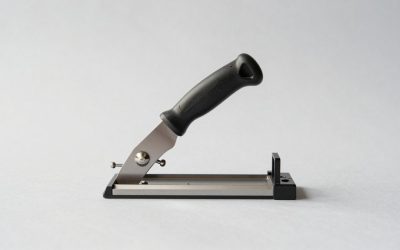
The best JBC compact professional soldering stations for 2026 are the JBC CD-2BE (C245) for general SMD and through-hole work, the JBC CD-1BE (C210) for precision micro-soldering under a microscope, and the JBC HD-2BA (C470) for high-mass power electronics, with the JBC DDE-2C dual-tool compact unit as the best choice if you need C210 and C245 on one bench footprint.
As an Amazon Associate we earn from qualifying purchases at no extra cost to you.


Our Top Picks
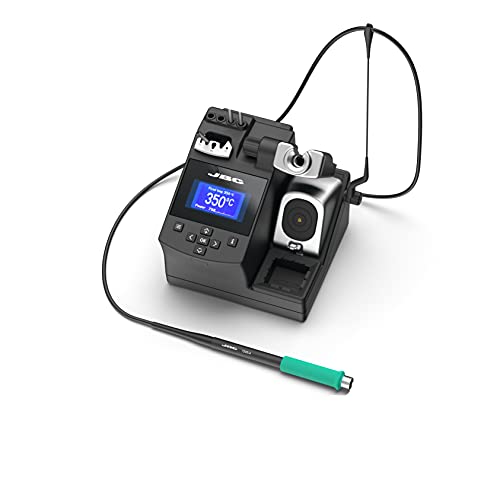


Top 3 picks at a glance
How to Choose by Cartridge Series, Not Just Wattage
JBC’s system is built around the cartridge, not the tip. The heater, sensor, and tip are one integrated cartridge, which is why heat-up time and thermal recovery are measured in seconds rather than tens of seconds. Your task determines the cartridge series, and the cartridge series determines the station.
- C210 cartridges use the T210-A handle. Smallest thermal mass, finest geometry down to 0.1mm conical and 1.8mm chisel. Designed for 0201, 01005, QFN, and rework under magnification.
- C245 cartridges use the T245-A handle. The universal standard. Wide range from 0.6mm conical to 4.8mm chisel and drag-solder blades. Covers 90% of professional assembly.
- C470 cartridges use the T470-A handle. Very high thermal mass for large ground planes, bus bars, XT60/XT90, D2PAK, and heavy copper pours.
If you try to use a C245 to do C210 work, you lose visibility and risk pad lifting on 0.4mm pitch. If you try to use a C245 to do C470 work, you get cold joints on large terminals because the system cannot sustain power delivery.
The 4 Compact Professional Stations Compared
All four fit a compact bench footprint and use JBC’s Intelligent Heat Management with sleep, hibernation, and auto-off to extend cartridge life. The difference is power delivery and cartridge compatibility.
| Station | Handle / Cartridge Series | Peak Power | Heat-Up to 350°C | Footprint (W x D x H) | Best For |
|---|---|---|---|---|---|
| JBC CD-1BE (CD-1BQF kit) | T210-A / C210 | 40W | ~2.5 seconds | 150 x 175 x 145 mm | 01005, 0201, 0.4mm pitch QFP, microscope work, flex PCB |
| JBC CD-2BE (CD-2BQF kit) | T245-A / C245 | 130W | ~2 seconds | 150 x 175 x 145 mm | General SMD, 0603-1206, SOIC, QFN, through-hole, drag soldering |
| JBC HD-2BA | T470-A / C470 | 250W | ~3.5 seconds | 148 x 184 x 140 mm | D2PAK, TO-247, large ground planes, heavy connectors, power boards |
| JBC DDE-2C | T210-A + T245-A / C210 + C245 | 150W total (shared) | ~2 seconds (both ports) | 148 x 232 x 148 mm | Two-tool bench: precision + general without swapping stations |
All stations operate from 90-265V, have a 2.8-inch display, USB-B for firmware and station software, and use the same JH-2 stand included in BQF kits. Price ranges in 2026 are usually $450–$600 for CD-1BE, $550–$750 for CD-2BE, $700–$900 for HD-2BA, and $950–$1,200 for DDE-2C, before cartridges and accessories.
Worked Calculation: Do You Need 40W, 130W, or 250W?
Spec-sheet wattage is peak power, but what matters is sustained power into the joint. A large copper pour acts as a heatsink that drains heat faster than a small tip can supply it. You can estimate the shortfall.
Example scenario: soldering a D2PAK tab to a 4-layer board with 2oz copper and a large ground plane. The pad plus plane has an effective thermal mass of about 12 J/°C. To raise that pad from 25°C idle to 250°C reflow temperature you need:
Energy = mass factor x delta T = 12 J/°C x 225°C = 2,700 J. If you want that heating to happen in 4 seconds to avoid overheating neighboring parts, required average power = 2,700 J / 4 s = 675W instantaneous, but most of that energy is lost to the plane spreading sideways. In practice, you need sustained tip power of 80–120W to hold 350°C at the joint while the plane sinks 40–60W continuously.
This is why a C210/40W cartridge will stall at ~180–200°C on that joint and never achieve wetting, a C245/130W will recover but requires a large 4.8mm chisel cartridge (C245-903) and 380–400°C setpoint, and a C470/250W with a C470-106 chisel will hold 350°C without overshoot because it has 2.5x the copper mass at the tip and can deliver 150W continuously to the joint. The calculation explains why power electronics labs keep an HD-2BA even if 95% of their boards could be done on a CD-2BE.
For contrast, soldering 0603/0402 on a 1.6mm FR4 board without planes needs only 2–5W sustained. Any C210 or C245 will hold temperature, so choosing C210 there gives you better tip visibility and lower risk of bridging.
Decision Matrix: Match Your Daily Tasks to the Station
| If Your Typical Work Is… | Choose This | Why |
|---|---|---|
| Phone repair, drone boards, wearables, 0.5mm pitch, 0201 and smaller, 405nm flex cables | JBC CD-1BE + C210 | Finest tips, lightest handle (31g), lowest thermal overshoot, best control under microscope |
| General PCB assembly, prototyping, QFP/QFN, SMA, headers, through-hole rework, drag soldering | JBC CD-2BE + C245 | Largest cartridge catalog (180+ shapes), best balance of power and precision, fastest recovery for lead-free |
| Power supplies, ESCs, automotive, solar controllers, XT60, D2PAK, TO-247, 4-layer 2oz ground planes | JBC HD-2BA + C470 | Only series that sustains >120W at the tip without temperature sag; prevents cold and fractured joints |
| Mixed work: you switch between microscope SMD and general rework many times per day | JBC DDE-2C + T210-A & T245-A | Two ports, two cartridges instantly available; no handle swap, shared compact footprint saves bench space |
| High-volume drag soldering or selective connector soldering | JBC CD-2BE with C245-029 / C245-741 blades | C245 drag blades hold solder volume and use high power for consistent bridging-free joints |
Recommended Settings and Cartridges by Task
JBC Intelligent Heat Management sleeps at 180°C and hibernates at ~100°C when in the stand, which is why cartridge life is long even at lead-free temperatures. Use these as starting points, then adjust by ±15°C based on thermal load:
1. Lead-free precision SMD (C210)
- Cartridges: C210-002 (0.2mm conical) for 01005/0201, C210-008 (1.3mm chisel) for 0402/0603
- Temperature: 320–330°C for Sn96.5Ag3Cu0.5, 280–290°C for leaded Sn63Pb37
- Reasoning: Low mass joint needs lower temperature to avoid pad lift; C210 recovers instantly so higher heat is not needed.
2. General purpose rework (C245)
- Cartridges: C245-741 (0.8mm chisel) for general, C245-903 (4.8mm chisel) for large pads, C245-029 (drag blade) for QFP
- Temperature: 350°C standard, 370–380°C for 2-layer boards with ground pour
- Reasoning: Lead-free needs +20–30°C over leaded to maintain wetting at 3-4 sec contact time without extending dwell.
3. High-mass power joints (C470)
- Cartridges: C470-106 (6.6mm chisel), C470-032 (5.2mm bevel)
- Temperature: 350–380°C, use the largest cartridge that fits the pad to maximize contact area
- Reasoning: Contact area transfers watts more effectively than raising temperature, which only oxidizes flux and damages boards.
Bench Footprint and Workflow Trade-offs
The single-tool CD-1BE and CD-2BE share the smallest compact footprint and are ideal for a 600mm deep bench or an ESD trolley. The HD-2BA is the same width but slightly deeper. The DDE-2C is about 55mm wider because it houses two transformers and two front ports, but it replaces two separate stations. If your bench is under 900mm wide, one DDE-2C is more space-efficient than a CD-1BE + CD-2BE side by side, and it allows you to leave a 0.2mm conical in the T210 and a 2.2mm chisel in the T245 without reconfiguration.
For esports PC building or gaming hardware modding workflows, which often mix SMD LED repair (C210) with XT60/XT90 battery connector and GPU shunt soldering (C470), the practical compact setup is a CD-2BE as primary and a dedicated HD-2BA module only if you regularly solder wires larger than 14 AWG to copper planes.
What to Check Before Buying
- Cartridge inventory cost: C210 and C245 cartridges are usually $35–$60 each, C470 usually $65–$95. Budget for 3–4 shapes you actually use, not the full catalog.
- Stand compatibility: T210-A only fits a C210 stand, T245-A only fits a C245 stand. The DDE-2C requires two matched stands.
- Fume extraction clearance: The compact stations are 145mm tall; leave 250mm above for ergonomic hand rest and extractor arm swing.
- Firmware updates via JBC Net: Compact stations support station profiles, temperature locks, and counter tracking for professional labs.
FAQ
Can a CD-2BE run C210 cartridges with an adapter?
No. C210, C245, and C470 each require their specific handle and control loop. To use both C210 and C245, you need either two stations or a dual-port station like the DDE-2C or DME-2C control unit with the matching T210-A and T245-A tools.
Is the CD-2BE enough for lead-free multilayer boards?
Yes for up to 4-layer boards if you use a large-mass C245 cartridge and 370–380°C. If the board has 2oz copper on multiple planes or large aluminum heatsink pads, the CD-2BE will still profile correctly but will dwell for 6–8 seconds, increasing risk of pad damage. That is when the HD-2BA with C470 cuts dwell to 3–4 seconds.
Why does JBC heat-up speed matter for rework?
Because recovery time determines joint quality. A 2-second heat-up means the tip returns to set temperature before solder oxidation sets in. Slow recovery forces you to raise temperature or extend contact time, both of which degrade flux and FR4. This is why integrated-cartridge stations out-perform separate heater-and-tip stations at the same setpoint.