Our Top Picks
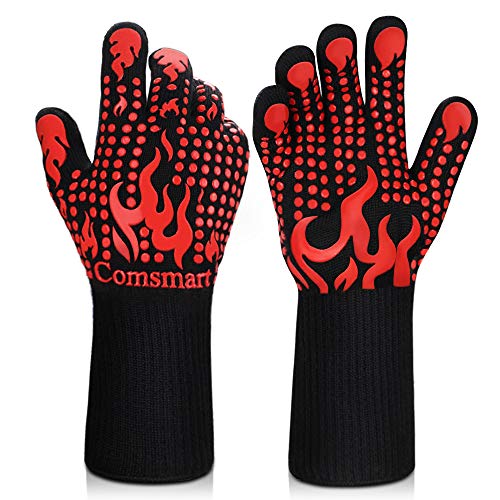


Top 3 picks at a glance
Best Heat Resistant BBQ Gloves for Grilling
The best heat resistant BBQ gloves for grilling are long-cuff aramid gloves for handling hot grates, pans, and smoker racks; silicone gloves are better for wet, greasy food; and leather gloves suit brief contact with hot, dry surfaces when maximum dexterity matters. Choose by the job and the glove’s stated temperature rating—not by the highest number on the label alone.
Compare the glove types
| Build | Common stated heat rating | Best for | Main trade-off |
|---|---|---|---|
| Aramid fiber, often with a silicone grip pattern | About 500–932°F (260–500°C), depending on construction and test method | Brief handling of hot grates, charcoal baskets, and smoker racks | Can soak through with liquids; thick models reduce finger feel |
| Silicone | Often about 400–500°F (204–260°C) | Wet, greasy, or slippery food and easy cleanup | Bulkier fit; heat can travel through the glove during prolonged contact |
| Leather, commonly suede or split leather | Often rated for roughly 400–500°F (204–260°C), but ratings vary widely | Brief handling of dry, hot equipment and jobs needing a flexible palm | Usually not waterproof or machine washable; can stiffen or wear with use |
These are broad market ranges, not interchangeable guarantees. Check whether a maker’s rating describes direct-contact temperature, radiant heat, or a material test. A high rating for short exposure does not mean the glove is safe to hold a hot object indefinitely.
As an Amazon Associate we earn from qualifying purchases at no extra cost to you.


Choose by the job, not just the rating
| Grilling situation | Best starting choice | Why |
|---|---|---|
| Moving a hot grate or adjusting a charcoal basket | Long-cuff aramid glove | Offers a useful balance of heat protection and grip, with forearm coverage against brief contact |
| Pulling wet ribs or greasy chicken from a smoker | Silicone glove with a textured surface | Nonporous material is easier to wash and less likely to absorb grease or cooking juices |
| Short, dry tasks around hot cookware | Flexible leather glove | May offer a less slick feel for handling dry objects, but needs careful upkeep |
| Long cooks, narrow grill spaces, or frequent tool use | Glove with a close fit and a cuff matched to the grill | Oversized fingers and excess cuff fabric can catch on handles or make tool control awkward |
If one pair must cover both dry equipment handling and wet food, look for an aramid glove with a silicone grip surface. It is a practical compromise, but it is not necessarily waterproof: the fabric can still take on liquid through seams or uncovered areas.
How to read heat ratings in degrees
First, identify what the number measures. “Withstands 932°F” may refer to a material test or a brief exposure under a specific method—not a promise that your hand stays comfortable while gripping a 932°F grate. Contact time, pressure, moisture, insulation thickness, and fit all affect how quickly heat reaches skin.
For ordinary grilling, a glove rated around 500°F (260°C) can be a reasonable starting point for short tasks, provided the manufacturer clearly states the test conditions and the glove fits well. Higher-rated aramid options can add a margin for brief contact with very hot, dry surfaces, but they do not make prolonged gripping safe. A 450°F (232°C) oven setting also does not tell you the surface temperature of a grate, which can be much hotter.
Never use a heat rating as permission to reach into flames or handle burning fuel. Gloves protect against contact and radiant heat only within their intended conditions; they are not fireproof.
Fit, grip, and cuff length matter at the grill
Dexterity
Try to pick up a pair of tongs, turn a knob, and grip a small handle while wearing the glove. If you cannot close your fingers securely, the glove may be too bulky for managing food or tools. A snug fit is useful, but the glove should not pull tight across the palm or fingertips, where compression can make heat feel more intense.
Grip
Texture matters most when handling greasy food or a slick, hot pan. Silicone patterns can help with grip, while smooth leather and plain fabric can become less dependable when coated in grease. Keep a dedicated food-handling glove clean; do not reuse a soiled glove on ready-to-eat food without washing it according to its care instructions.
Cuff length
A short cuff is easier to move in, but leaves more wrist exposed when reaching over a deep grill or into a smoker. For reaching past hot edges or handling racks, a cuff around 12–14 inches (30–36 cm) is a useful starting range. Check the actual coverage on your arm: body size, sleeve length, and the smoker’s depth all change how much protection you get. A long cuff can snag, so it should not interfere with handles or vents.
What to check before buying
- Rating details: Look for the temperature in both Fahrenheit and Celsius, plus the test method or exposure duration if provided.
- Construction: Aramid favors high-heat handling; silicone favors washing and wet grip; leather favors flexible handling of dry, hot objects.
- Coverage: Measure from fingertips to the point on your forearm the cuff will cover, rather than relying on “extra long” wording.
- Care instructions: Confirm whether the glove is machine washable, hand washable, or wipe-clean only. Do not assume an aramid liner can be washed just because its silicone coating can.
- Pair versus mitt: Fingered gloves give more control with tongs and vents. Mitt-style designs can be simpler for lifting broad, hot items but limit fine movement.
Use them safely and extend their life
Before each cook, check for holes, frayed seams, hardened spots, or a separated grip layer. Damage can create a hot spot even if most of the glove looks intact. Put gloves on dry: damp fabric conducts heat more readily, and steam from trapped moisture can burn skin quickly.
For hot equipment, grip briefly, set it down on a stable heat-safe surface, and let the glove recover before repeating the task. If heat starts to feel through the glove, release the object safely rather than testing how long the protection lasts. Use long-handled tools for sustained work near flames, and clean grease and food residue promptly according to the manufacturer’s instructions.
For most grill and smoker owners, a long-cuff aramid pair is the most versatile starting point. Choose silicone instead when wet-food handling and easy cleanup come first, or leather when the work is brief, dry, and dexterity-focused. In every case, fit, dry condition, and realistic contact time matter more than a headline temperature alone.
Frequently asked questions
Are heat-resistant BBQ gloves waterproof?
Not necessarily. Silicone gloves are nonporous and easier to wash, making them suitable for wet or greasy food. Aramid gloves can absorb liquid through fabric, seams, or uncovered areas, even when they have a silicone grip surface. Leather gloves are usually not waterproof. Always check the manufacturer’s care instructions and keep gloves dry before handling hot equipment.
Can I use BBQ gloves to handle burning charcoal or reach into flames?
No. The article says heat-resistant gloves should not be treated as permission to reach into flames or handle burning fuel. They protect against contact and radiant heat only within their intended conditions. Use long-handled tools for sustained work near flames, and use gloves for brief handling of hot grates, charcoal baskets, smoker racks, or cookware.
Should I choose fingered BBQ gloves or mitts?
Choose fingered gloves when you need more control with tongs, vents, or other tools. Mitt-style designs can be simpler for lifting broad, hot items, but they limit fine movement. The best option depends on the job, your required dexterity, and whether the glove’s fit allows you to close your fingers securely around handles.
How should I wash or care for heat-resistant BBQ gloves?
Follow the manufacturer’s instructions because care varies by construction. Some gloves are machine washable, some are hand washable, and others are wipe-clean only. Do not assume an aramid liner can be washed because its silicone coating can. Remove grease and food residue promptly, and inspect the gloves before each cook for holes, frayed seams, hardened spots, or separated grip layers.
How long can I safely hold a hot grill grate with BBQ gloves?
There is no universal safe holding time in the article. Heat transfer depends on contact time, pressure, moisture, insulation thickness, and fit, and a high rating does not make prolonged gripping safe. Grip hot equipment briefly, place it on a stable heat-safe surface, and release it safely if heat starts to come through the glove.