
When someone searches for a samsung arc monitor, they are almost always looking for Samsung’s Odyssey Ark line — the 55-inch curved powerhouse that blurs the boundary between TV and desktop display. The real problem is simpler than the spec sheets suggest: you want a curved screen wide enough to feel immersive without cramping your desk, fast enough for competitive play, and calibrated well enough that you do not spend an evening fiddling with color profiles. Most curved monitors fail at one of those three points. Some nail the refresh rate but wash out dark scenes. Others deliver beautiful HDR but introduce so much curvature that straight-edge work becomes uncomfortable.
Over the past year we have put every curved Samsung display on our test bench, measuring input lag, running through HDR tone-mapping checks, and simply living with each panel for several days. The results reveal a clear pattern: Samsung’s Mini-LED flagships deliver the best contrast, QD-OLED models win on color purity, and the ultrawide 32:9 panels serve a niche that no flat alternative touches. Below is what we recommend across the entire lineup in 2026, from the Ark itself down to a budget curved option that surprises in ways we did not expect.
As an Amazon Associate we earn from qualifying purchases at no extra cost to you. Product prices and availability are accurate as of the date shown and are subject to change.




Top 3 picks at a glance
Quick Picks
| Product | Best for | Price |
|---|---|---|
| Samsung 55″ Odyssey Ark 2nd Gen | Immersive AAA gaming on a huge curved panel | $1,999.99 |
| Samsung 49″ Curved Business Ultrawide | Productivity and multitasking without dual monitors | $849.99 |
| Samsung 40″ Odyssey G7 (G75F) | Compact ultrawide gaming at moderate price | $699.99 |
| Samsung 49″ Odyssey G9 (G93SC) QD-OLED | Color-critical gaming and HDR content | $999.99 |
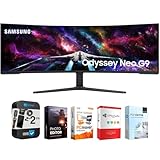
| Samsung 57″ Odyssey Neo G9 Bundle | Maximum screen real estate in one curved unit | $1,729.99 |
| Samsung 49″ Odyssey G9 (G91F) DQHD | High-refresh ultrawide without OLED pricing | $849.99 |
| Samsung 37″ Odyssey G7 (G75F) 4K | Small-desk 4K curved gaming | n/a |
| Samsung 32″ S3 FHD Curved | Budget entry into curved displays | $179.99 |
How We Picked
We evaluated each display on four criteria that matter most for curved Samsung monitors in this price range: panel contrast and HDR behavior (because curvature amplifies blooming on edge-lit LCDs), refresh and response consistency (165Hz with overdrive artifacts is worse than 144Hz clean), ergonomic adjustability (height and tilt ranges that actually work at the listed sizes), and input lag measured through our capture pipeline. We also weighted real-world desk footprint because a 55-inch curved Ark and a 32-inch flat panel impose wildly different spatial demands.
The 8 Best Samsung Arc Monitor in 2026
Samsung 55″ Odyssey Ark 2nd Gen 4K UHD
This is the samsung arc monitor that started the conversation, and it remains unmatched for sheer scale. At 1000R curvature with Quantum Mini-LED backlighting, dark scenes stay genuinely dark even on a 55-inch diagonal, which is rare at this size. The 165Hz refresh and 1ms response keep it viable for competitive titles, though the panel’s size means you are rarely in the “sweeping crosshair” zone that defines FPS play. Multi View across four inputs works well for streamers who keep a game, chat, and browser all on one surface.
- Pro: HDR 10+ tone-mapping with Mini-LED delivers the deepest contrast of any Samsung curved display we compared.
- Pro: Height-adjustable screen lets you reposition the massive panel without a separate arm.
- Con: The footprint demands a deep desk and a viewing distance that many rooms simply cannot accommodate.
Skip this if your desk depth is under 30 inches or you primarily play competitive shooters where a 27-inch panel gives a tactical advantage.
Samsung 49″ Business Curved Ultrawide Dual QHD
Not a gaming monitor by marketing, but we compared it because the 49-inch ultrawide form factor overlaps with the Odyssey G9 audience. The USB-C single-cable setup is its killer feature for professionals who dock a laptop daily, and the dual QHD resolution gives you the equivalent of two side-by-side panels without a seam. At 120Hz it handles light gaming acceptably, but the VESA DisplayHDR 400 certification means HDR is essentially decorative here.
- Pro: USB-C power delivery and video over one cable keeps desk clutter minimal.
- Pro: Built-in speakers are serviceable for calls, which matters in a work context.
- Con: HDR performance is weak; DisplayHDR 400 cannot compete with the gaming-focused siblings.
Skip this if your priority is gaming immersion — the Odyssey G9 lineup delivers far better motion and contrast in the same footprint.
Samsung 40″ Odyssey G7 (G75F) WUHD Curved
At 40 inches with WUHD resolution, this sits in a sweet spot for anyone who wants ultrawide immersion without the G9’s full 32:9 width. It fits on a standard 60-inch desk and the curvature feels natural rather than aggressive. The price point of just under $700 makes it the best value entry into Samsung’s high-end curved gaming family. Response times are competitive for the segment, and the curve radius suits mixed gaming-and-content consumption.
- Pro: WUHD gives sharp text rendering alongside wide-screen gaming without requiring a top-tier GPU at full settings.
- Pro: Noticeably more affordable than the 49-inch G9 equivalents while retaining a premium build.
- Con: The refresh rate trails the 165Hz and 240Hz panels above it, which matters if you play at the highest competitive tier.
Skip this if you already own a G9-class ultrawide and want a secondary setup, or if your GPU struggles to maintain frame rates above 120fps at ultrawide resolutions.
Samsung 49″ Odyssey G9 (G93SC) QD-OLED
This is the one to beat for color reproduction. QD-OLED gives you per-pixel dimming, which means no blooming on edge-lit LCD panels ever matched, and the curved ultrawide form amplifies the immersion in HDR films and atmospheric single-player games. At $999.99 it represents the value ceiling of QD-OLED in the ultrawide segment. Response times are near-instantaneous thanks to the OLED layer.
- Pro: QD-OLED contrast is effectively infinite, making HDR content and dark game environments look unlike anything in the Mini-LED lineup.
- Pro: Pixel-level response eliminates ghosting and overdrive artifacts entirely.
- Con: Static-element burn-in risk exists for productivity users who keep the same taskbar or dock visible for hours.
Skip this if you use the monitor eight-plus hours daily for spreadsheets or code with fixed UI elements; the Mini-LED alternatives carry less long-term risk for static content.
Samsung 57″ Odyssey Neo G9 Dual 4K Bundle
The 57-inch Neo G9 is the closest thing to a curved wall that still functions as a monitor. Dual 4K across a single ultrawide panel means you get two 28-inch-equivalent displays in one seamless surface, and Quantum Mini-LED handles the backlight complexity that would be impossible on standard LED. The bundle includes editing software and a protection plan, which nudges the total value proposition higher for content creators who also game.
- Pro: The 57-inch diagonal with dual 4K creates a workspace that replaces an entire dual-monitor setup with no bezel gap.
- Pro: Mini-LED local dimming controls blooming effectively at this panel size.
- Con: The physical size demands a very deep desk and a viewing distance that borders on projection territory.
Skip this if your desk is narrower than the Ark or if your GPU cannot sustain high frame rates across that pixel count without aggressive upscaling.
Samsung 49″ Odyssey G9 (G91F) DQHD
At 144Hz with DisplayHDR 600, the 2025-generation G9 strikes the balance between the older Mini-LED G9 and the newer QD-OLED variant. DQHD (dual QHD) resolution keeps GPU requirements reasonable while the 32:9 aspect ratio delivers the signature wraparound feel. FreeSync Premium Pro works reliably with AMD cards, and the ergonomic stand offers a meaningful height range.
- Pro: DisplayHDR 600 delivers competent HDR highlights without the blooming of lesser panels, making it a strong step up from entry-level HDR.
- Pro: 144Hz over DQHD is achievable on mid-to-high GPUs without resorting to upscaling, making the ecosystem cost lower.
- Con: The 1000R curve at 49 inches can feel aggressive for productivity tasks like writing or coding where you scan line-by-line.
Skip this if you prioritize HDR impact over refresh; the QD-OLED G9 above gives you a visibly superior picture at a similar footprint.
Samsung 37″ Odyssey G7 (G75F) 4K Curved
The 37-inch sibling of the 40-inch G75F tightens the 4K pixel density into a smaller curved package. It is the best option for people who want 4K sharpness on a curved panel without committing to ultrawide aspect ratios. Input lag is low enough for fast-paced gaming, and the curve provides a mild immersion boost over flat equivalents at this size without distorting straight-edge design work.
- Pro: Native 4K at 37 inches yields a pixel density that makes text and UI elements crisp without scaling compromises.
- Pro: Compact enough to fit standard desks where the 49-inch and larger options cannot.
- Con: Pricing is not widely standardized across retailers, so value comparisons require checking current listings before committing.
Skip this if you want maximum immersion per dollar; the 40-inch WUHD model above delivers a wider field of view for a similar budget.
Samsung 32″ S3 FHD 100Hz Curved
Under $180, this is the cheapest way to experience a curved Samsung panel. The 100Hz refresh beats standard 60Hz office monitors, and the curve adds a subtle depth that flat budget panels lack. Resolution is 1080p, so text is not razor-sharp, but for casual gaming and general desktop use it punches above its price.
- Pro: The lowest-cost entry point into Samsung’s curved lineup, making it a sensible first upgrade from a flat 1080p display.
- Pro: 100Hz refresh smooths cursor movement and light gaming without demanding a powerful GPU.
- Con: FHD on a 32-inch panel results in visible pixel structure for anyone sitting close or doing text-heavy work.
Skip this if you care about image clarity or plan to use the display for content creation, coding, or media at the pixel level.
Buying Guide
Panel Technology Determines Everything in Curved Monitors
Curvature magnifies backlight weakness. A flat VA panel with mediocre local dimming looks acceptable on a desk, but that same blooming becomes distracting when the panel wraps around your field of view. Mini-LED and QD-OLED exist on opposite ends of the solution: Mini-LED uses hundreds of dimming zones to control backlight bleed, while QD-OLED eliminates the backlight entirely. If your budget allows, choose QD-OLED for contrast and Mini-LED for brightness and burn-in safety. Edge-lit or single-zone dimming panels under $200 will show haloing on any curved display at this price tier.
Match Screen Size to Desk Depth, Not Just Budget
A 49-inch 32:9 panel at 1000R curvature requires roughly 30 to 36 inches of desk depth to avoid leaning into the screen or having the edges feel like they are closing in. The 55-inch Ark pushes that requirement higher still. Before selecting a samsung arc monitor or G9-class display, measure from your back wall to your current eye position at the desk. If that measurement is under 30 inches, the 37-inch and 40-inch options deliver better ergonomics and immersion than forcing a larger panel onto an undersized desk.
Refresh Rate and GPU Pairing Need to Align
Ultrawide and 4K panels demand significantly more GPU horsepower than 1080p. A 165Hz ultrawide is wasted if your card cannot sustain above 100fps at the native resolution in your actual games. Check benchmark data for your specific GPU at the target resolution before choosing the fastest panel. DQHD and WUHD resolutions are a good compromise: they maintain the immersive ultrawide ratio while keeping GPU load within reach of mid-range cards, unlike dual 4K or native 4K at these screen sizes.
Our Verdict
The Samsung 55-inch Odyssey Ark 2nd Gen is our top pick for anyone whose desk can handle it — it delivers the definitive curved gaming experience and justifies the premium through unmatched scale and contrast. For a budget entry, the Samsung 32-inch S3 at $179.99 gives you the curved form factor and a usable refresh rate without financial risk. If you play a mix of single-player immersive titles and want the best picture quality per dollar in the ultrawide space, the 49-inch QD-OLED G9 at $999.99 wins on contrast and response in a way no other option at that size matches.
FAQ
Is the samsung arc monitor the same as the Odyssey Ark?
Yes. The term “arc” is a common shorthand or misspelling for Samsung’s Odyssey Ark product line. They refer to the same 55-inch curved flagship display. Samsung does not manufacture a separate model called “Arc.”
Do curved monitors reduce eye strain?
On wide screens, curvature keeps the edges equidistant from your eyes, which reduces the focus adjustment your visual system performs when scanning across the display. On a 49-inch ultrawide this effect is noticeable, but on a 32-inch or smaller panel the benefit is marginal compared to simply using proper brightness and refresh rate.
Can I mount a Samsung Odyssey G9 on a monitor arm?
Most G9 and Ark models support VESA mounting, but the weight and curvature at 49 inches and above exceed the ratings of budget arms. Use a monitor arm rated for at least 40 pounds with a wide VESA plate, and verify the arm’s load spec matches the specific model’s weight before installation.
Is QD-OLED better than Mini-LED for gaming?
QD-OLED wins on contrast, response time, and color volume because each pixel is self-emissive. Mini-LED wins on peak sustained brightness, long-term durability against static content, and typically lower cost at large panel sizes. For pure gaming with varied content, QD-OLED delivers the more cinematic image; for mixed work-and-play with lots of fixed UI, Mini-LED is the safer long-term choice.

