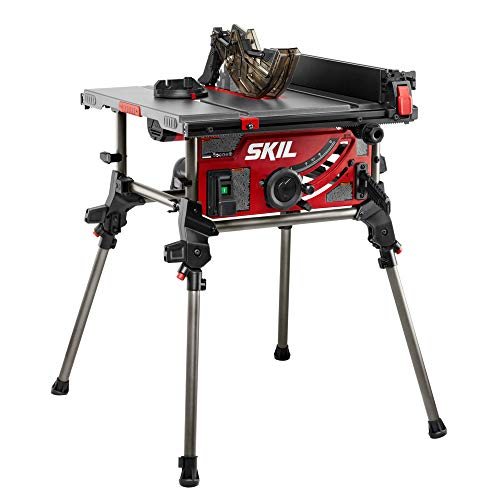
For most home workshops, the best table saw is the SKIL 15 Amp 10-Inch Jobsite Table Saw with Folding Stand (TS6307-00). It is the one saw in this group that hits the three constraints that actually decide the question for a home shop: it runs on a standard 120-volt outlet, it folds up and rolls out of the way when the car needs the garage back, and its 10-inch blade and mid-20-inch-class rip capacity cover the overwhelming majority of real home projects — ripping 2x material, cutting plywood and MDF to width, trimming doors, and building shop jigs and cabinets. It suits the weekend furniture maker, the remodeler working out of a one-car garage, and the homeowner who wants one saw to do framing, shelving and trim without dedicating a permanent 8-foot wall to it. If your shop has a dedicated 240-volt circuit and 250 square feet or more, a cabinet-style saw will beat it on vibration and fence rigidity — but that is a different budget and a different room. If you cut aluminum, mild steel or reclaimed lumber with embedded fasteners, the Evolution R8MTS is the better single-saw answer. Everyone else should start with the Skil.
Our Top Picks
 Evolution R8MTS 8-1/4" Convertible Miter/Table Saw8-1/4 in15.7 x 16.5 x 12.8 inches28.6 poundsCheck on Amazon
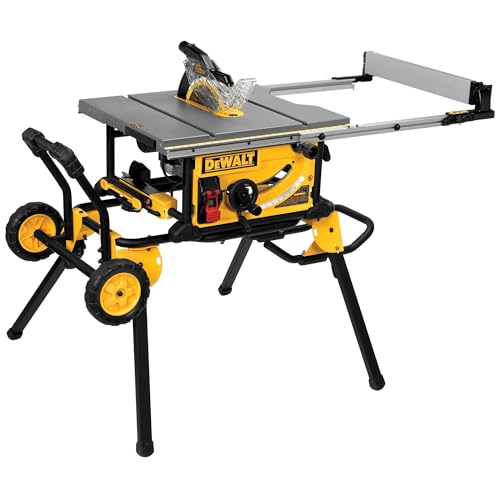


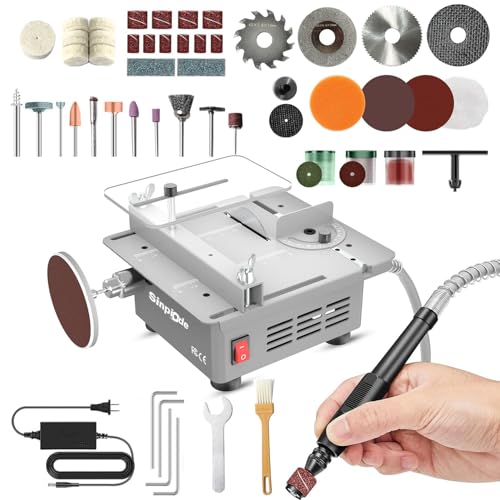
Top 3 picks at a glance
Quick Comparison
The table below maps every item in this roundup to the job it does best. Price tiers are relative bands, not quotes — listings move daily, and the tier tells you more about where a tool sits in the market than a number that will be stale by the time you read it.
| Product | Best for | Key specs | Price tier |
|---|---|---|---|
| SKIL TS6307-00 10-Inch Jobsite Table Saw with Folding Stand | Most home workshops; garages that share space with a car | 10-inch blade; 15-amp motor; folding stand; rip capacity in the 25-inch class; standard 5/8-inch arbor | Premium |
| DEWALT 10-Inch Table Saw with Foldable Rolling Stand | Sheet-goods work; breaking down full 4×8 panels | 10-inch blade; 15-amp motor; 4,800 RPM; 32-1/2-inch rip capacity; rolling folding stand | Premium |
| Evolution R8MTS 8-1/4-Inch Convertible Miter/Table Saw | Mixed-material cutting: wood with nails, aluminum, mild steel | 8-1/4-inch blade; 0–45° bevel; ±45° miter; converts between table-saw and miter-saw modes; multi-material blade | Premium |
| Hoteche 8-Inch Portable Benchtop Table Saw | Small-shop ripping; apartments, balconies, tight benches | 8-inch blade; 720 W motor (roughly 6 amps at 120 V); 20-tooth carbide-tipped blade; compact benchtop footprint | Mid-range |
| POWSTR 10-Inch Portable Jobsite Table Saw with Stand | Budget-minded buyers who still want 10-inch capacity | 10-inch blade; 15-amp motor; 5,000 RPM; portable stand included | Premium |
| Sinpiode Mini Table Saw | Craft and model work; cutting thin stock on a desk | Desktop scale; adjustable speed; adjustable cutting angle; multi-functional craft platform | Budget |
| MXBAOHENG Mini Table Saw S3 | Precision craft cuts where fence repeatability matters | Portable precision craft saw; small-diameter blade class; fine-adjustment fence and angle setting | Budget |
| ZUSKYZU Mini Table Saw | Crafters who want cutting, sanding and engraving in one unit | Desktop scale; multi-functional cutting/sanding/engraving platform; adjustable settings | Budget |
| WEN BL1060 10-Inch 60-Tooth Fine-Finish Saw Blade | Upgrading a stock blade for clean crosscuts and plywood | 10-inch diameter; 60 teeth; carbide-tipped; 5/8-inch arbor; fine-finish grind | Budget |
| Pony Portable Folding Work Table, Workbench & Sawhorse | Outfeed and infeed support that folds flat | Folding table/sawhorse hybrid; steel legs; mid-duty work surface | Mid-range |
| WORX Portable Folding Workbench WX051 (Pegasus) | A second work surface that also clamps workpieces | 2-in-1 workbench and sawhorse; folding design; integrated clamping; holds stock for crosscutting | Mid-range |
| WDOT Portable Folding Work Bench with 2 Clamps & 6 Bench Dogs | Assembly, clamping and hand-tool work beside the saw | 2-in-1 folding bench; 2 clamps; 6 bench dogs; dog-hole work surface | Mid-range |
How We Chose
This roundup is built from published specifications, manufacturer documentation and the established conventions of the category — not from a testing lab. Every pick had to clear four filters.
Category fit first. A jobsite saw, a benchtop saw, a convertible multi-material saw and a mini craft saw are not competitors; they are answers to different problems. Each entry is judged against the class it belongs to, so a compact benchtop saw is not penalized for lacking the rip capacity of a full-size jobsite saw.
Specifications that change outcomes. Blade diameter, motor amperage, RPM, rip capacity, arbor size, bevel range and cutting depth at 90° and 45° are the numbers that decide whether a saw can complete a given cut. Fence design, table material and the presence of a riving knife or splitter were weighted heavily because they govern accuracy and kickback risk more than raw wattage does.
Realistic home-workshop use cases. Most home shops are one- or two-car garages, basements or spare rooms with a single 120-volt branch circuit. Portability, storage footprint, noise and dust handling were treated as first-class criteria rather than afterthoughts.
Upgrade path. A saw that accepts a standard 5/8-inch-arbor blade, an aftermarket miter gauge and a stacked dado set stays useful for years. We favored platforms with standard consumables and a clear route to better blades, better fences and better dust collection.
1. SKIL TS6307-00 – Best for Most Home Workshops
As an Amazon Associate we earn from qualifying purchases at no extra cost to you.
The TS6307-00 is a 10-inch, 15-amp jobsite saw built onto a folding stand, and it is the saw most home woodworkers should buy first. It occupies the middle of the jobsite category — not the cheapest, not the largest — and that middle position is exactly where a garage shop wants to sit.
Who it suits. The homeowner with a one-car garage who still parks a car inside. The furniture hobbyist who rips 1x and 2x stock, cuts plywood and MDF to width, and builds jigs and shop cabinets a few weekends a month. The trim carpenter who wants a saw that lives on a shelf and comes out for a project. If your shop has no dedicated 240-volt circuit and no permanent 8-foot infeed lane, this is the class to be in.
Key specs (class-typical for this model):
- 10-inch blade on a standard 5/8-inch arbor — the most widely supported size in woodworking, with the deepest blade selection
- 15-amp, 120-volt motor turning a direct-drive blade in the 4,800 RPM class
- Rip capacity in the mid-20-inch range, enough to rip a sheet of plywood to a usable width and to handle dimensional lumber
- Folding stand that collapses with the saw mounted, so storage footprint approaches the saw’s own table size
- Bevel capability to 45° with the blade tilted left, typical of the class
- Cutting depth in the 3-1/4-inch class at 90° and roughly 2-1/4 inches at 45°
Where it shines. The folding stand is the whole argument. A saw that takes two minutes to set up and thirty seconds to put away gets used; a saw that requires clearing a permanent footprint does not. The 15-amp motor is also the practical ceiling for a standard household circuit — see the power math in the How to Choose section, because a 15-amp saw on a shared 15-amp circuit will trip breakers no matter how good the saw is. Pair this saw with a decent 60-tooth blade and a shop vacuum on the blade guard and it will produce glue-ready crosscuts in plywood and clean rips in hardwood.
Pros
- Folds and stores in a footprint a one-car garage can absorb
- 10-inch blade platform with the widest blade and accessory ecosystem available
- 15-amp motor sits at the top of what a 120-volt household circuit can realistically feed
- Standard 5/8-inch arbor means cheap, easy blade upgrades
Cons
- Rip capacity in the mid-20s means you cannot rip a full 4×8 sheet at 32 inches without a track saw or a circular saw for the first cut
- Aluminum table and stamped extensions flex more than cast iron under heavy stock
- Direct-drive universal motor is loud — expect the 95–100 dB class rather than the 85 dB class of an induction motor
- Dust collection is a blade-guard hose at best; the cabinet is not sealed and fine dust escapes below
How it compares. Against the DEWALT with the rolling stand, the Skil trades 32-1/2 inches of rip capacity for a smaller storage footprint and a lower entry point into the premium tier. If you routinely break down full sheets, the DEWALT’s extra rip width pays for itself in one kitchen cabinet project. If you mostly rip 2x stock and half-sheets, the Skil’s smaller stand is the more livable tool. Against the POWSTR, the Skil is the more established platform with a longer track record of parts and accessory support; the POWSTR is the value play with similar headline numbers.
2. DEWALT 10-Inch Table Saw with Foldable Rolling Stand – Best for Full Sheet Goods
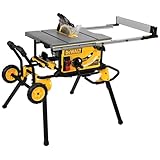
The DEWALT 10-inch saw with the folding rolling stand is the sheet-goods specialist of this group. Its headline number — 32-1/2 inches of rip capacity — is the single most consequential spec in this entire roundup, and it is worth understanding why before you decide it is overkill.
Who it suits. Anyone who regularly handles 4×8 plywood, MDF or melamine. Cabinet and built-in builders. Garage-shop woodworkers who want to rip a sheet down the middle and then crosscut it to final size without dragging out a track saw. It also suits the person who wants a rolling stand: the folding stand on this saw is built to be wheeled into position rather than carried, which matters if you are moving a 60-plus-pound saw and stand combination across a driveway.
Key specs (as listed):
- 10-inch blade; 15-amp, 120-volt motor
- 4,800 RPM no-load blade speed — the standard for direct-drive 10-inch jobsite saws
- 32-1/2-inch rip capacity to the right of the blade, the widest in this roundup
- Foldable rolling table saw stand included
- Cutting depth in the 3-1/8-inch class at 90°, roughly 2-1/4 inches at 45°
- Standard 5/8-inch arbor
The rip capacity math. Sheet goods come 48 inches wide. Ripping a sheet exactly in half needs 24 inches of capacity. Cutting a 48-inch sheet into three equal panels needs 16 inches. But cutting a sheet to 30 inches — a common cabinet-depth dimension — needs 30 inches of capacity plus clearance, which is precisely why 32-1/2 inches matters. With a mid-20s rip capacity you cut that panel with a circular saw against a straightedge and accept the edge quality that comes with it. With 32-1/2 inches you do it on the saw, once, accurately.
Where it shines. The rolling stand turns a heavy saw into something you can position single-handed, and the wide rip capacity eliminates the most common reason home woodworkers keep a second cutting tool. The fence on this class of saw is a rack-and-pinion design that stays parallel across its travel, which is the single biggest determinant of whether a rip cut comes out straight.
Pros
- 32-1/2-inch rip capacity handles full sheet goods and wide panels without a second tool
- Rolling stand makes a heavy saw movable by one person
- 15-amp motor with 4,800 RPM blade speed is the proven standard for the class
- Strong parts and accessory availability thanks to the platform’s popularity
Cons
- Larger stand footprint than a compact folding saw; it still needs a wall or corner when stored
- Same universal-motor noise and cabinet-dust limitations as every direct-drive jobsite saw
- Premium tier pricing for a saw that is still fundamentally a portable
- Fence rail length makes the saw wide, which can be awkward in narrow garages
How it compares. Against the SKIL TS6307-00, the DEWALT wins decisively on rip capacity and on stand mobility, and loses on storage footprint and cost. Against the POWSTR, which also lists a 10-inch, 15-amp, high-RPM configuration, the DEWALT’s differentiator is the 32-1/2-inch rip and the rolling stand rather than the motor. If you cut sheet goods weekly, buy the DEWALT. If you cut them twice a year and rip lumber weekly, the Skil is the better allocation of money.
3. Evolution R8MTS – Best for Mixed Materials and Two Saws in One

The R8MTS is the odd one out in the best possible way. It is an 8-1/4-inch convertible saw that works as both a table saw and a miter saw, and its multi-material blade is designed to cut wood with embedded nails, aluminum and mild steel — materials that would ruin a standard carbide woodworking blade and, more importantly, would be genuinely unsafe to cut on a wood-only saw at 4,800 RPM.
Who it suits. The renovator working on older buildings where reclaimed lumber hides nails. The metal-fabricator-adjacent hobbyist who cuts aluminum extrusion, angle iron and steel tubing alongside wood. The small-shop owner who genuinely cannot store both a table saw and a miter saw and needs one machine to cover both roles. It is not the right first saw for a furniture maker who only ever cuts clean domestic hardwood.
Key specs (as listed):
- 8-1/4-inch multi-material blade
- 0–45° bevel capability
- ±45° miter capability
- Convertible configuration: operates as a table saw and as a miter saw
- Designed for cutting wood, wood with embedded nails, aluminum and mild steel
- Lower blade RPM than a wood-only saw, which is what makes metal cutting viable
Why the RPM difference matters. A 10-inch woodworking saw spins at roughly 4,800 RPM, which gives a rim speed suitable for shearing wood fibers. Cutting mild steel at that speed generates heat faster than the tooth can dissipate it, and the blade dulls or grabs. Multi-material saws in this class run substantially slower and use a tooth geometry with a hardened tip that survives contact with ferrous metal. That is the entire engineering premise of the category — not a marketing claim but a rotational-speed requirement.
Where it shines. Converting between modes means one machine, one footprint, one power cord. For a garage that already holds a car, that consolidation is worth more than any individual spec. The multi-material blade also means you stop worrying about what is inside a board, which changes how you work with reclaimed material.
Pros
- Two saws in one machine, with a single storage footprint
- Cuts wood with embedded nails, aluminum and mild steel without a blade change
- Full bevel and miter range for compound cuts
- Slower blade speed is safer for metal and reduces burning on plastics and composites
Cons
- 8-1/4-inch blade limits cutting depth compared with a 10-inch saw
- Smaller table surface than a dedicated jobsite saw, which makes wide rips awkward
- Multi-material blades rarely leave the glass-smooth edge a dedicated 60-tooth woodworking blade produces
- Convertible mechanisms add setup steps compared with a fixed-role saw
How it compares. Against the DEWALT, the R8MTS gives up rip capacity and table size and gains material versatility and mode conversion. If every cut you make is in clean wood, the DEWALT is the more accurate and more capable woodworking tool. If a meaningful share of your cuts involve metal, fasteners or composite material, the Evolution is the only saw in this roundup that does that job safely at all.
4. Hoteche 8-Inch Portable Table Saw – Best for Small Shops and Tight Benches

The Hoteche 8-inch benchtop saw is the compact, low-amperage answer to a small-space problem. At 720 watts — roughly 6 amps at 120 volts — it draws less than half the current of the 15-amp saws in this roundup, which changes what else you can run on the same circuit.
Who it suits. Apartment and condo woodworkers. Anyone working on a balcony, in a spare bedroom, or on a bench that doubles as a desk. Crafters and modelers who cut thin stock and small-dimension lumber rather than full sheets. It is also the right saw for someone whose only available outlet is on a 15-amp circuit already shared with lighting and a garage door opener.
Key specs (as listed):
- 8-inch blade diameter
- 720 W motor — approximately 6 amps at 120 V
- 20-tooth carbide-tipped blade included
- Compact benchtop form factor with a portable footprint
- Precision-adjustable fence and blade height for the class
The circuit math that makes this saw attractive. A 15-amp branch circuit at 120 volts has a continuous-load budget of about 1,440 watts once you apply the standard 80 percent derating rule. The Hoteche’s 720 W leaves roughly 700 W of headroom on that circuit — enough for a small shop vacuum drawing 4–5 amps, which is exactly what you need to control dust in a room you also live in. A 15-amp table saw would consume the entire circuit by itself. That single calculation is often the difference between a workable apartment setup and one that trips a breaker every ten minutes.
Where it shines. Small, light, quiet-adjacent and cheap to run. An 8-inch blade is also easier to spin up and less intimidating to new users. The 20-tooth blade that ships with it is a ripping blade — it clears waste fast but leaves a rougher edge, so budget for a 40- or 60-tooth 8-inch blade if finish quality matters to you.
Pros
- 720 W draw fits comfortably on a shared 15-amp circuit alongside a small vacuum
- Compact benchtop footprint stores on a shelf or under a bench
- Lighter and easier to move than any 10-inch jobsite saw
- Mid-range tier pricing makes it an easy entry point
Cons
- 8-inch blade limits cutting depth and rip capacity compared with 10-inch saws
- Included 20-tooth blade is a ripping blade, not a finish blade
- Small table surface makes long stock and sheet goods difficult to control
- Lower power means slower feed rates in thick hardwood — forcing the cut invites burning and kickback
How it compares. Against the POWSTR and the SKIL, the Hoteche gives up blade diameter, rip capacity and cutting depth in exchange for a fraction of the electrical demand and a much smaller footprint. If your constraint is space or circuit capacity, that trade is correct. If your constraint is budget alone and you have a 20-amp circuit and a garage, spend up to a 10-inch jobsite saw instead — the extra blade diameter buys you real cutting depth you cannot add later.
5. POWSTR 10-Inch Portable Jobsite Table Saw – Best for Value Seekers Who Want Full Size

The POWSTR jobsite saw lists the full-size headline spec set: 10-inch blade, 15-amp motor, 5,000 RPM, and a stand in the box. It exists in the value band of the premium tier — the same capability envelope as the established brands, at a lower entry point, with a shorter track record behind it.
Who it suits. The buyer who needs genuine 10-inch cutting depth and standard 5/8-inch-arbor blade compatibility but cannot justify the established-brand premium. The occasional user who wants one saw that can do framing, decking and light cabinetry. The second-saw buyer who wants a portable to keep alongside a larger stationary saw rather than replace it.
Key specs (as listed):
- 10-inch blade diameter, standard 5/8-inch arbor
- 15-amp, 120-volt motor
- 5,000 RPM no-load blade speed — slightly higher than the 4,800 RPM class standard
- Portable stand included
- Jobsite form factor: movable, collapsible, garage-friendly
What 5,000 RPM buys you. Rim speed is blade diameter times rotational speed. Going from 4,800 to 5,000 RPM is a roughly 4 percent increase in rim speed, which translates into a marginally faster, cleaner cut in softwood and a slightly higher risk of burning in resinous or green stock. It is not a dramatic difference, but it does mean this saw rewards a steady, moderate feed rate rather than a fast one — around one inch per second in 1-inch hardwood is the right pace for any 15-amp saw, and pushing past it is how you get scorch marks and kickback.
Where it shines. You get the full 10-inch capability set without paying established-brand prices. That means 3-inch-class cutting depth at 90°, standard blades from any manufacturer, and a saw that can be moved and stored like a jobsite tool. For someone whose annual cutting volume is modest, the value equation is straightforward.
Pros
- Full 10-inch, 15-amp capability at the low end of the premium tier
- Standard 5/8-inch arbor accepts the full range of aftermarket blades
- Stand included, so no separate support purchase
- Higher blade RPM gives slightly faster cuts in softwood
Cons
- Shorter market track record than the established platforms, so long-term parts availability is less certain
- Fence and table flatness quality control varies more in this band than with established brands
- Same circuit constraints as any 15-amp saw — it will not share a 15-amp branch with a shop vacuum
- Dust collection is typically a blade-guard hose only, with an open cabinet below
How it compares. Against the SKIL TS6307-00, the POWSTR matches on blade size and amperage and gives up the Skil’s more mature support ecosystem and refined folding stand. Against the DEWALT, it gives up the 32-1/2-inch rip capacity that defines that saw. Choose the POWSTR when budget is the binding constraint and you are comfortable checking fence alignment yourself on arrival — which you should do on every new saw regardless of brand.
6. Sinpiode Mini Table Saw – Best for Crafts and Model Making
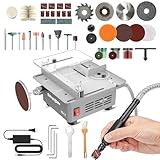
The Sinpiode mini table saw is a desktop craft machine, not a scaled-down jobsite saw. It cuts small stock — dowels, stripwood, plastic sheet, thin plywood and hobby materials — with adjustable speed and adjustable angle, on a footprint that fits on a desk.
Who it suits. Model makers, dollhouse and miniature builders, jewelry and craft workers, and anyone cutting balsa, basswood, styrene or thin acrylic in a room with no workshop. It is also useful as a dedicated precision station in a larger shop for cutting small parts without disturbing a full-size saw’s setup.
Key specs (as listed):
- Desktop-scale mini table saw platform
- Adjustable blade speed
- Adjustable cutting angle
- Multi-functional craft cutting configuration
- Low-power motor in the hobby class, suited to thin stock rather than dimensional lumber
Why adjustable speed matters on a craft saw. Speed control is not a luxury here. Plastics melt and gum at high blade speed, burning the cut edge and welding swarf to the blade. Thin hardwood scorches. Lowering RPM for plastic and raising it for wood is the difference between a clean cut and a ruined part, and it is the single feature that separates a usable craft saw from a toy. Set the blade height so it clears the stock by a sixteenth of an inch and no more — on a small saw, blade exposure is the primary injury risk and there is no reason to expose more tooth than the cut requires.
Where it shines. It does work no full-size saw can do safely. Cutting a half-inch strip of 1/16-inch styrene on a 10-inch saw is genuinely dangerous; on a mini saw with a fine-tooth blade and a small throat plate, it is routine. The small scale also means you can hold your work visually, with a fence you can see past.
Pros
- Desktop footprint — usable in an apartment, spare room or on a workbench
- Adjustable speed handles both wood and plastics without burning
- Adjustable angle covers miters and bevels on small parts
- Very low power draw, safe on any household circuit
Cons
- Cannot cut dimensional lumber, sheet goods or anything resembling a construction task
- Small table surface limits the length of stock you can support
- Fine-tooth hobby blades dull quickly in harder woods
- Fence and miter accuracy are adequate for craft tolerances, not for furniture joinery
How it compares. Against the MXBAOHENG S3, the Sinpiode emphasizes speed and angle adjustability and multi-function versatility, while the S3 leans toward precision and portability. Against the ZUSKYZU, the Sinpiode is the more focused cutting tool, while the ZUSKYZU adds sanding and engraving functions. If you cut a wide range of materials at varying thicknesses, the Sinpiode’s speed control is the feature you will use most.
7. MXBAOHENG Mini Table Saw S3 – Best for Precision Craft Cuts

The MXBAOHENG S3 is a portable precision craft saw — the same category as the Sinpiode and the ZUSKYZU, but positioned around accuracy and repeatability rather than around multiple functions.
Who it suits. Model engineers, instrument makers and crafters who cut the same part repeatedly and need every one identical. Anyone who has outgrown hand tools for small parts and wants a fence they can set once and trust. Also a reasonable choice for a jeweler or small-parts fabricator cutting non-ferrous sheet and rod.
Key specs (as listed):
- Portable precision craft table saw
- Small-diameter blade in the craft-saw class
- Fine-adjustment fence for repeatable width setting
- Adjustable cutting angle for miters and bevels on small stock
- Low-power motor suited to thin stock and non-ferrous soft materials
Where precision actually comes from. On a craft saw, accuracy is not about motor power — it is about three things. First, fence rigidity: a fence that flexes under finger pressure cannot hold a setting. Second, blade runout: a cheap arbor with measurable wobble cuts a wider kerf than the blade’s rating and leaves a rougher edge. Third, repeatability: a fence with a positive lock and a fine adjustment screw lets you set 0.500 inches and come back to it tomorrow. When evaluating any mini saw, press sideways on the fence and watch for deflection — that single check predicts more about real-world accuracy than any spec on the box.
Where it shines. The S3’s positioning is precision and portability together: a machine you can carry to a class, a club meeting or a job site and still get repeatable cuts from. For scale modelers who cut dozens of identical stringers or ribs, that repeatability is the whole point.
Pros
- Fine-adjustment fence supports repeatable, identical cuts
- Portable enough to move between bench, classroom and job site
- Small blade diameter reduces tear-out on thin and brittle materials
- Runs on any household outlet with negligible power draw
Cons
- Cutting depth and material thickness are limited to the hobby class
- Not designed for hardwood in furniture dimensions
- Blade and parts availability are narrower than for full-size saws
- Small table means long stock needs hand support or an auxiliary outfeed
How it compares. Against the Sinpiode, the S3 trades some multi-function versatility for a tighter focus on fence precision and portability. Against the ZUSKYZU, it is the more specialized cutting instrument, while the ZUSKYZU is a broader craft platform that also sands and engraves. If your work is defined by many identical small parts, precision wins over versatility.
8. ZUSKYZU Mini Table Saw – Best for Multi-Function Craft Workstations

The ZUSKYZU mini table saw is a multi-functional craft platform that combines cutting, sanding and engraving in a single desktop unit. Where the Sinpiode and the MXBAOHENG are cutting tools with extras, the ZUSKYZU is organized around doing several small-shop operations on one machine.
Who it suits. Hobbyists with limited bench space who want one unit to cut a part, sand the edge and engrave a mark without switching machines. Beginner crafters who are not yet sure which operations they will use most. Anyone working in a spare room where owning three separate small machines is not realistic.
Key specs (as listed):
- Desktop-scale mini table saw platform
- Multi-functional configuration covering cutting, sanding and engraving
- Adjustable speed and angle settings
- Portable, bench-top form factor
- Low-power motor in the hobby class
The honest trade-off of multi-function machines. A machine that does three jobs does each of them to a good-enough standard rather than an excellent one. That is not a flaw — it is a design decision with a clear use case. If you cut ten parts a month, one machine that handles all three operations is better than three machines you cannot store. If you cut two hundred parts a month, you will want a dedicated saw and separate sanding and engraving tools, because changeover time dominates. Match the machine to your volume, not to your ambition.
Where it shines. Consolidation. One power cord, one footprint, one setup on the bench, and no hunting for a second tool mid-project. For craft work where the operations are small and frequent, that flow matters more than peak capability in any one function.
Pros
- Cutting, sanding and engraving in a single desktop unit
- Very small storage and bench footprint
- Adjustable speed and angle settings cover multiple materials
- Low cost of entry into powered craft work
Cons
- Each function is competent rather than best-in-class
- Changeover between functions costs time on higher-volume work
- Limited cutting depth and material thickness in the hobby class
- Not a substitute for a full-size saw for any construction or furniture task
How it compares. Against the MXBAOHENG S3, the ZUSKYZU offers broader capability and gives up some fence precision. Against the Sinpiode, it adds sanding and engraving while remaining comparable on cutting. Choose it if your projects involve finishing and marking as much as cutting; choose the S3 if cutting precision is the only thing that matters.
9. WEN BL1060 10-Inch 60-Tooth Blade – Best for Clean Crosscuts and Plywood
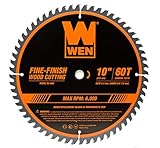
The BL1060 is not a saw — it is the single highest-value upgrade most home workshops can make. It is a 10-inch, 60-tooth, carbide-tipped fine-finish blade on a standard 5/8-inch arbor, sized for both table saws and miter saws.
Who it suits. Anyone running the stock blade that came with a jobsite saw. Stock blades are almost always 24-tooth ripping blades chosen to cut aggressively at low cost. If your crosscuts are fuzzy, your plywood edges splinter, and your melamine chips, the blade is the reason — not the saw.
Key specs (as listed):