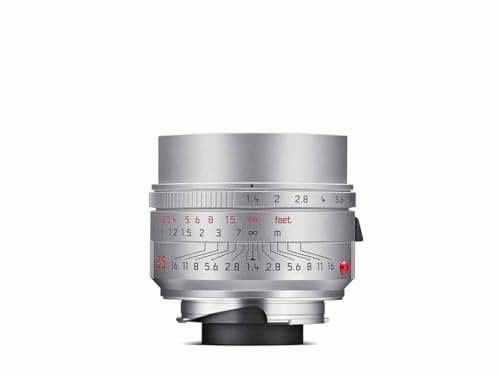
The best Leica lenses depend on your mount: choose compact Summicron-M glass for rangefinder travel, APO-Summicron-SL lenses for maximum correction and autofocus, or a Leica Q with its built-in wide-aperture lens when simplicity matters more than interchangeable glass.
As an Amazon Associate we earn from qualifying purchases at no extra cost to you.


Our Top Picks



Top 3 picks at a glance
Quick picks by Leica system
| System | Best all-round choice | Best for low light | Best for detail or portraits | Typical character |
|---|---|---|---|---|
| M mount | Summicron-M 35mm f/2 ASPH. | Summilux-M 35mm f/1.4 ASPH. | Summilux-M 50mm f/1.4 ASPH. | Compact, tactile, with visible rendering personality |
| SL mount | APO-Summicron-SL 50mm f/2 ASPH. | Summilux-SL 50mm f/1.4 ASPH. | APO-Summicron-SL 90mm f/2 ASPH. | Highly corrected, sharp, autofocus-capable |
| Q system | Leica Q3, 28mm f/1.7 | Leica Q3, 28mm f/1.7 | Leica Q3 43, 43mm f/2 | Fixed-lens simplicity with strong subject separation |
Best Leica M-mount lenses
M lenses are manual-focus rangefinder lenses designed around small size, direct handling, and distinctive optical rendering. They can be used on Leica M cameras such as the M11, M11 Monochrom, M11-P, and other compatible digital or film M bodies. On an adapter, many also work on Leica SL cameras, although autofocus is not available.
Leica Summicron-M 35mm f/2 ASPH.: best everyday M lens
The 35mm Summicron-M is the safest choice for street photography, travel, documentary work, and general family photography. It weighs roughly 250–260g, uses a maximum aperture of f/2, and is small enough to preserve the balanced feel of an M body.
Its rendering is crisp in the centre with controlled distortion and strong contrast, but it does not look clinically flat. At f/2 it can separate a nearby subject from a background, while the 35mm field of view remains practical indoors. Pick this lens if you want one M lens that can stay on the camera most of the time.
Leica Summilux-M 35mm f/1.4 ASPH.: best M lens for low light
The 35mm Summilux-M provides one stop more light than an f/2 lens and usually weighs around 330–340g, depending on the version. That extra stop helps with evening street scenes, available-light interiors, and subject separation without making the lens excessively large.
Modern versions are sharp where focus is placed, while retaining smoother, more expressive out-of-focus rendering than many highly corrected autofocus lenses. Some photographers choose it specifically for the balance between technical performance and character. It is the stronger choice than the Summicron when you frequently shoot after sunset or want more background blur.
Leica Summicron-M 50mm f/2: best compact normal lens
At approximately 195g, the 50mm Summicron-M is among the easiest serious lenses to carry. Its f/2 aperture is sufficient for daylight, street work, travel portraits, and deliberate manual-focus photography. The perspective is natural without feeling as expansive as 35mm.
Rendering is typically sharp, contrasty, and controlled, with enough smoothness for portraits. Choose it when your priority is a light kit and you prefer a normal perspective. It is also a sensible pairing with a 28mm or 35mm lens.
Leica Summilux-M 50mm f/1.4 ASPH.: best M portrait and available-light lens
The 50mm Summilux-M weighs about 335g and adds one stop over the Summicron-M 50mm. That difference is useful for dim interiors and portraits, where f/1.4 can create noticeably shallower depth of field.
Its rendering combines high centre sharpness with softer transitions into blur than an aggressively clinical lens. On a high-resolution M body, precise rangefinder calibration and careful focusing matter at f/1.4. Buy it when the 50mm viewpoint suits you and you want a lens that can produce both clean detail and a recognisable Leica look.
Leica Elmarit-M 28mm f/2.8 ASPH.: best compact wide-angle M lens
The 28mm Elmarit-M is a compact option at roughly 180g. Its f/2.8 aperture is slower than the Summicron and Summilux alternatives, but the lens is easier to carry and well suited to daylight travel, architecture, environmental portraits, and street scenes.
It gives more context than a 35mm without becoming an ultra-wide lens. Choose it for a minimal M kit, especially if you tend to shoot at f/5.6 or smaller and value size more than low-light performance.
Best Leica SL-mount lenses
SL lenses are built for Leica full-frame mirrorless cameras including the SL2, SL2-S, and later compatible SL bodies. They use autofocus, electronic communication, and larger optical designs than M lenses. Their advantages are speed, close-focusing capability on many models, weather-resistant construction, and very high correction. The trade-off is weight.
Leica APO-Summicron-SL 50mm f/2 ASPH.: best SL normal lens
The APO-Summicron-SL 50mm f/2 ASPH. weighs approximately 740g. That is far heavier than the M-mount 50mm Summicron, but it delivers fast, quiet autofocus and extremely high sharpness across the frame.
Its apochromatic design helps control colour fringing, while the f/2 aperture remains useful for portraits and everyday work. Rendering is neutral, clean, and highly resolved rather than overtly vintage. Choose it for commercial, editorial, product, and general-purpose photography when you want maximum detail and dependable autofocus.
Leica APO-Summicron-SL 35mm f/2 ASPH.: best professional wide-normal lens
At roughly 720g, the APO-Summicron-SL 35mm f/2 ASPH. is a substantial lens, but it combines a versatile field of view with excellent edge-to-edge performance. It suits weddings, documentary work, travel, and video where autofocus consistency is more important than a small kit.
The rendering is crisp and restrained, with strong microcontrast and minimal optical distractions. It is a better match than the 50mm for working close to people or including environmental context.
Leica APO-Summicron-SL 90mm f/2 ASPH.: best SL portrait lens
The 90mm APO-Summicron-SL weighs around 1,140g and is designed for portraits, events, detail studies, and compressed perspectives. Its f/2 aperture gives strong separation, while the APO correction preserves colour and fine detail at the focus plane.
This is a lens for photographers who accept a large kit in exchange for autofocus precision and a highly controlled image. For travel, it may be excessive; for portraits and professional assignments, the reach is valuable.
Leica Vario-Elmarit-SL 24-90mm f/2.8-4 ASPH.: best one-lens SL setup
The 24-90mm zoom weighs approximately 1,140g and covers wide-angle, normal, and short-telephoto perspectives. Its variable aperture runs from f/2.8 at the wide end to f/4 toward 90mm, so it is not the best option for maximum background blur or very dark scenes.
It is, however, the practical choice for travel, events, landscapes, and assignments where changing lenses costs time. Choose it when focal-length flexibility matters more than a lighter bag or a constant wide aperture.
Best Leica Q lenses and fixed-lens choices
Leica Q cameras do not have interchangeable lenses, so the “best Q lens” is really a choice between the camera’s fixed focal length and the way its crop modes are used. The Leica Q3 has a 28mm f/1.7 Summilux lens, while the Leica Q3 43 has a 43mm f/2 Summilux lens.
Leica Q3 28mm f/1.7: best Q for travel and context
The Q3’s integrated 28mm f/1.7 lens is suited to street photography, travel, interiors, landscapes, and environmental portraits. The camera weighs roughly 740g with its battery, and the lens offers optical image stabilisation as well as a bright aperture.
Its wide perspective encourages close working and keeps more of a scene visible. The f/1.7 aperture helps in low light, but at close distances you must still focus carefully because depth of field becomes shallow. The Q3’s high-resolution sensor also allows its in-camera crop modes to imitate narrower fields of view, though a crop cannot create the same perspective or light-gathering performance as a true 50mm lens.
Leica Q3 43mm f/2: best Q for natural perspective
The Q3 43 uses a fixed 43mm f/2 Summilux lens and weighs roughly 780g. Its field of view sits between the classic 35mm and 50mm perspectives, making it especially comfortable for portraits, everyday documentary work, and subjects where 28mm feels too expansive.
The rendering is detailed but not merely clinical, with attractive separation at f/2. Choose the Q3 43 if you prefer to frame one subject or a small group rather than include a large amount of surrounding context. It is the better fixed-lens option for photographers who already know they enjoy a normal perspective.
How to match the lens to your situation
| Your priority | Recommended choice | Why | Compromise |
|---|---|---|---|
| Smallest interchangeable-lens kit | M 35mm f/2 or M 50mm f/2 | About 195–260g and excellent manual handling | No autofocus |
| Low-light street photography | M 35mm f/1.4 | One stop more light than f/2 with strong subject separation | More weight and shallower focus tolerance |
| Maximum autofocus detail | APO-Summicron-SL 50mm f/2 | High correction, fast AF, and edge-to-edge resolution | About 740g before the camera body |
| One lens for varied assignments | Vario-Elmarit-SL 24-90mm | Replaces several prime focal lengths | Large, heavy, and variable aperture |
| Simple travel camera | Leica Q3 28 | Bright fixed lens, stabilisation, and no lens-changing decisions | Fixed wide-angle perspective |
| Portrait-oriented fixed-lens camera | Leica Q3 43 | Natural perspective and useful subject separation | Fixed 43mm framing |
One-stop aperture difference: what it means in practice
A lens at f/1.4 admits twice as much light as an otherwise equivalent lens at f/2. For example, if a scene requires 1/60 second at f/2 and ISO 1600, an f/1.4 lens can use approximately 1/60 second at ISO 800, or approximately 1/125 second at ISO 1600. The practical result is either less noise or less motion blur, but focusing becomes more demanding and background blur increases.
This is why the M 35mm Summilux can be a better night lens than the smaller Summicron, while the APO-Summicron-SL 35mm remains attractive for photographers who value autofocus and correction over the extra stop.
Frequently asked questions
Can I use Leica M lenses on an SL camera?
Yes, many Leica M lenses can be used on Leica SL cameras with an adapter, but autofocus is not available. M lenses are designed for manual-focus rangefinder use and are generally smaller than SL lenses. This can be useful if you want to use M glass on an SL body and are comfortable focusing manually.
What is the main difference between Leica M and SL lenses?
M lenses prioritize compact size, direct manual handling, and distinctive rendering, while SL lenses offer autofocus, electronic communication, and high optical correction. SL lenses are typically larger and heavier. The better choice depends on whether you value a small rangefinder kit or autofocus and highly corrected performance.
Which Leica lens is the lightest option listed?
The Leica Elmarit-M 28mm f/2.8 ASPH. is the lightest option listed, at roughly 180g. It is designed for a compact M kit and suits daylight travel, architecture, environmental portraits, and street scenes. Its f/2.8 aperture is slower than the Summicron and Summilux alternatives.
Can the Leica Q3 replace a camera with interchangeable lenses?
Not if you need to change lenses: Leica Q cameras have fixed lenses. The Q3 has a 28mm f/1.7 lens, and the Q3 43 has a 43mm f/2 lens. The Q3’s crop modes provide narrower fields of view, but a crop does not create the perspective or light-gathering performance of a true 50mm lens.
Which lens is best if I want one lens for an SL camera?
The Leica Vario-Elmarit-SL 24-90mm f/2.8-4 ASPH. is the article’s one-lens SL choice because it covers wide-angle, normal, and short-telephoto perspectives. Its variable aperture is f/2.8 at the wide end and f/4 toward 90mm. It is suited to situations where flexibility matters more than a lighter bag or constant wide aperture.
Final buying advice
Choose M glass when size, manual focus, and rendering character are central to the experience. Choose SL glass when autofocus, weather-ready professional construction, and maximum optical correction justify carrying more weight. Choose a Q when the 28mm or 43mm perspective already matches your photography and you want the fastest route from camera bag to finished image.
For most buyers, the best Leica lenses are not the most expensive or technically extreme models. The best match is the focal length you naturally see, the aperture you will actually use, and a weight you will carry often enough to make photographs.