The best folding squat racks for small home gyms are the Rogue RML-3W, PRx Performance Profile PRO, REP Fitness PR-4100, and Titan T-3 Series Folding Rack: all use roughly 11-gauge steel, but their folded depth, hinge design, pull-up options, and stated capacity determine which one fits your garage and your lifting loads.
As an Amazon Associate we earn from qualifying purchases at no extra cost to you.
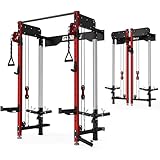


Our Top Picks


Top 3 picks at a glance
Quick comparison: best folding squat racks
| Rack | Steel | Common folded wall depth | Typical height choices | Stated capacity class | Best for |
|---|---|---|---|---|---|
| Rogue RML-3W Fold Back Wall Mount Rack | 11-gauge, 3 x 3-inch uprights | About 5 inches, excluding hardware and bar | 90 or 108 inches, configuration dependent | About 1,000 lb | Heavy lifting and a highly rigid wall-mounted setup |
| PRx Performance Profile PRO | 11-gauge steel | About 5 inches when folded | Commonly 90 or 108 inches | About 1,000 lb | Fast folding with a clean, low-profile garage setup |
| REP Fitness PR-4100 Folding Wall Rack | 11-gauge steel, 3 x 3-inch uprights | Roughly 5–6 inches, depending on hardware | Several height and depth configurations | About 1,000 lb | Buyers who want configuration flexibility and a strong value |
| Titan T-3 Series Folding Power Rack | 11-gauge steel, 3 x 3-inch uprights | Roughly 5–6 inches at the wall, plus folded arms | Usually 82 or 91 inches | About 1,000 lb | Lower ceilings and a lower-cost heavy-duty rack |
These are product-family comparisons rather than interchangeable specifications. Exact depth changes with the selected arm length, pull-up bar, mounting brackets, and whether the manufacturer measures from the wall or from the furthest projecting component. Confirm the current configuration before ordering.
What matters more than the advertised capacity?
1. Folded depth and the real garage clearance
A rack advertised as folding to 5 inches does not necessarily leave 5 inches of usable clearance. The wall brackets, hinge pins, upright handles, safety hardware, and pull-up bar can project farther. If your garage door, vehicle, shelving, or walkway passes close to the rack, measure the furthest point of the folded assembly.
Use this simple clearance calculation:
Required wall clearance = folded rack depth + hardware projection + safety margin.
For example, a rack with a 5-inch folded body, 2 inches of hinge and handle projection, and a 3-inch margin requires at least 10 inches of clear space. If a car mirror could pass within 12 inches of the wall, that leaves only about 2 inches of practical tolerance. In that situation, choose the rack with the smallest documented folded projection rather than relying on the headline depth.
2. Steel gauge and upright size
Eleven-gauge steel is approximately 1/8 inch thick and is the normal target for a folding rack intended for serious barbell training. Thinner 12- or 14-gauge racks can work for lighter training, but they provide less resistance to bending and thread wear.
Upright dimensions also matter. A 3 x 3-inch upright generally offers more stiffness and broader compatibility with heavy-duty attachments than a smaller 2 x 3-inch upright. However, attachment compatibility depends on hole diameter, hole spacing, and the manufacturer’s ecosystem—not only on the outside dimensions.
Steel gauge cannot compensate for poor mounting. A thick rack fastened into drywall, weak studs, or unsuitable masonry is not a heavy-duty rack in practice.
3. Weight capacity versus your actual training load
A 1,000-pound rating sounds comfortably high, but it may refer to the rack structure under specified conditions rather than every exercise and accessory. Dynamic movements, failed reps, spotter-arm loading, kipping pull-ups, and uneven loading can create forces greater than the bar’s static weight.
Estimate your likely peak bar load, then leave a margin:
Minimum useful capacity = heaviest planned bar load × 1.5.
If your heaviest planned squat is 405 pounds, the calculation is 405 × 1.5 = 607.5 pounds. A properly mounted rack rated around 1,000 pounds has substantial nominal headroom. If you expect 700 pounds, rack pulls, frequent missed lifts, or dynamic pull-ups, prioritize the most rigid frame and mounting system rather than choosing solely by folded depth.
Head-to-head: which rack fits your situation?
| Your situation | Most suitable choice | Why | Trade-off |
|---|---|---|---|
| You squat and bench heavy, and the rack will stay on one wall | Rogue RML-3W | Rigid 3 x 3-inch, 11-gauge construction and a mature accessory ecosystem | Usually costs more and requires careful, permanent installation |
| You fold the rack after nearly every workout | PRx Performance Profile PRO | Designed around quick folding and a low-profile wall presentation | Verify the exact pull-up and hinge configuration before buying |
| You want multiple depth, height, or accessory configurations | REP Fitness PR-4100 | Offers a broad configurable system while retaining heavy-duty steel | More configuration choices mean more measurements to check |
| Your ceiling is below about 8 feet | Titan T-3 low-height configuration | Lower height options can fit garages where 90-inch uprights cannot | Shorter uprights may limit overhead pull-up clearance |
| You need the rack to disappear beside a parked vehicle | The model with the smallest measured folded projection | Actual wall clearance matters more than brand or nominal capacity | Some compact configurations provide less interior training space |
How to measure before ordering
- Measure ceiling height. Subtract at least 3 inches for installation tolerance and ceiling obstructions. A 90-inch rack is a poor fit if your ceiling is exactly 90 inches.
- Locate the mounting surface. Find the center of every stud or confirm that the masonry and anchors are suitable for the manufacturer’s instructions. Do not treat drywall anchors as structural mounting.
- Mark the rack’s open footprint. Include the barbell’s sleeve length, plate storage, spotter arms, and the space needed to walk around the uprights.
- Mark the folded envelope. Measure from the wall to the furthest point of the folded arms, brackets, pull-up bar, and pins.
- Check bar clearance. A 7-foot Olympic bar usually needs more than the rack’s nominal width because the sleeves and plates extend beyond the uprights.
- Plan the bench position. Make sure a bench can move out of the rack without hitting a vehicle, workbench, or wall-mounted storage.
Installation details that affect safety
Wall-mounted folding racks transfer squat and bench forces into the wall through the mounting brackets. Use the specified number and type of fasteners, install into structural studs or suitable masonry, and keep the mounting surface flat. A bowed wall or missing washer can prevent the brackets from sitting evenly.
Before loading a newly installed rack, open and close both sides repeatedly. Check that the hinges move without binding, locking pins seat completely, and the uprights are level. Pull firmly on each upright at shoulder height. Any movement at the wall connection should be corrected before adding a barbell.
For a folding rack, the safety arms or straps must be installed at the correct height for the exercise. Set them so a failed squat reaches the safeties before the bar can contact your body, but not so high that they interfere with a normal rep. Test the position with an unloaded bar first.
Which steel and capacity should you choose?
- Up to roughly 300 pounds on the bar: A well-mounted 11-gauge folding rack is more than adequate; prioritize folded depth, height, and ease of use.
- About 300–500 pounds: Choose 11-gauge steel, 3 x 3-inch uprights where available, full-length safeties or robust spotter arms, and a generous mounting margin.
- Above 500 pounds or frequent failed reps: Favor the most rigid configuration, the shortest practical arm span, high-quality safeties, and professional-grade installation. A permanently open half rack may be a better choice if folding is rarely needed.
- Dynamic pull-ups or muscle-ups: Check whether the manufacturer permits dynamic use. Static capacity numbers do not automatically cover swinging or kipping forces.
Frequently asked questions
Can a folding squat rack be mounted to drywall?
No. The article says drywall anchors should not be treated as structural mounting. Install the rack into structural studs or suitable masonry using the specified number and type of fasteners from the manufacturer’s instructions. The mounting surface should be flat, because a bowed wall or missing washer can prevent the brackets from sitting evenly.
How much room should I leave around a folding squat rack?
Leave enough space for the rack’s open footprint, the barbell sleeves and plates, spotter arms, plate storage, and walking around the uprights. When folded, measure to the furthest point of the arms, brackets, pull-up bar, and pins. Also check that a bench can move out without hitting a vehicle, workbench, or wall-mounted storage.
Are all 3 x 3-inch squat racks compatible with the same attachments?
No. Attachment compatibility depends on hole diameter, hole spacing, and the manufacturer’s ecosystem, not only on the upright’s outside dimensions. A 3 x 3-inch upright generally offers more stiffness and broader compatibility with heavy-duty attachments than a smaller 2 x 3-inch upright, but the specific rack and attachment should still be checked before ordering.
Can I use a folding rack for kipping pull-ups or muscle-ups?
Only if the manufacturer permits dynamic use. The article explains that static capacity numbers do not automatically cover swinging or kipping forces. Dynamic movements can create forces greater than the bar’s static weight, so check the manufacturer’s instructions and prioritize a rigid frame and properly installed mounting system for this type of training.
How do I check a newly installed folding rack before loading it?
Open and close both sides repeatedly, then check that the hinges move without binding, the locking pins seat completely, and the uprights are level. Pull firmly on each upright at shoulder height. Any movement at the wall connection should be corrected before adding a barbell. Test the safety position with an unloaded bar first.
Bottom line
The Rogue RML-3W is the strongest all-round direction for a heavy lifter who can dedicate a wall. The PRx Performance Profile PRO is especially compelling when fast folding and a tidy garage are the priority. The REP PR-4100 suits buyers who want more configuration choices, while the Titan T-3 low-height options make sense where ceiling height or budget is restrictive.
Before choosing among the best folding squat racks, compare the complete folded envelope—not just the rack body—then match 11-gauge construction and the stated capacity to your heaviest planned lift. Correct structural mounting and adequate clearance matter more than a small difference in the advertised weight rating.