The best RC planes for most new pilots are the HobbyZone Sport Cub S 2 or a similar gyro-equipped trainer, while experienced pilots should look at the E-flite Apprentice STOL S 700mm for a larger, calmer trainer, the E-flite Timber X 1.2m for sport flying, and a dedicated 3D model such as the E-flite Extra 300 3D 1.3m for aggressive stunt work.
The right choice depends less on top speed than on how much stability, radio range, battery time, and repair tolerance you need. A beginner plane should recover from mistakes; a sport plane should balance predictable handling with aerobatic ability; and a stunt plane should respond immediately, even if that makes it less forgiving.
As an Amazon Associate we earn from qualifying purchases at no extra cost to you.


Our Top Picks
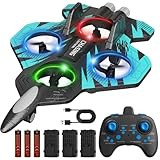
 4DRC RC Planes Remote Control Airplanes for Kids7 inches x 2 inches x 10 inches7 x 2 x 10 inches0.6 poundsCheck on Amazon


Top 3 picks at a glance
Best RC Planes Compared
| Plane type | Suitable examples | Typical control range | Typical flight time | Assembly time | Repairability |
|---|---|---|---|---|---|
| Beginner trainer | HobbyZone Sport Cub S 2, Volantex Ranger 600 | 250–500 m | 7–12 minutes | 10–30 minutes | Excellent; slow foam airframes and inexpensive propellers |
| Larger trainer | E-flite Apprentice STOL S 700mm | 500–1,000 m, transmitter dependent | 8–12 minutes | 30–60 minutes | Very good; larger parts are easier to handle and replace |
| Sport plane | E-flite Timber X 1.2m, FMS Ranger-class models | 500–1,000 m, transmitter dependent | 6–10 minutes | 45–90 minutes | Good, but landing gear and control surfaces cost more to replace |
| 3D or stunt plane | E-flite Extra 300 3D 1.3m, similar 3D foam models | 500–1,000 m, transmitter dependent | 5–8 minutes | 60–120 minutes | Moderate; thin wings and high-control throws are less crash tolerant |
These figures are useful planning ranges rather than guarantees. Actual range depends on the transmitter, receiver, antenna installation, local interference, regulations, and whether the aircraft uses a ready-to-fly system or a separately selected radio. Flight time varies with battery capacity, throttle use, wind, propeller choice, and repeated aerobatics.
Best Beginner RC Planes
HobbyZone Sport Cub S 2
The Sport Cub S 2 is one of the safest starting points for a first-time pilot because its small size, low mass, and stabilized flight modes reduce the consequences of over-controlling. Its beginner, intermediate, and experienced modes let a pilot increase bank and pitch authority gradually. The aircraft can also use a panic-recovery function to return toward level flight after an orientation mistake.
Its main advantages are low assembly time, low battery cost, and easy foam repairs. Its disadvantages are equally important: a small aircraft is more affected by wind, its short wingspan makes orientation harder at distance, and its limited payload and power leave little margin for carrying accessories.
Volantex Ranger 600
A Ranger-class high-wing trainer is a better choice when you have more open space and want a visible, stable aircraft that can glide efficiently. The pusher propeller is protected behind the wing, which can reduce propeller damage during imperfect landings. Many versions include stabilization and are sold in ready-to-fly configurations, but equipment varies by package, so check whether the transmitter, battery, and charger are included.
Choose this style over a micro trainer if your flying site is broad enough for a 500–600 m aircraft and you prefer longer gliding approaches. Choose the smaller Sport Cub instead if you need a compact plane for a small field or want the cheapest path to practice.
E-flite Apprentice STOL S 700mm
The Apprentice STOL S 700mm is a more substantial trainer with a high-wing layout, forgiving low-speed behavior, and stabilization intended to help new pilots. The larger airframe is easier to see than a micro plane and generally handles light wind better. It also gives you more room to work on control linkages and replace damaged components.
It costs more to operate than a small trainer, but the extra size often makes learning easier because the aircraft’s attitude is clearer at a distance. The trade-off is that you need a larger launch and landing area, and a crash carries more momentum.
Best Sport RC Planes
E-flite Timber X 1.2m
The Timber X 1.2m is a strong bridge between trainer and aerobatic aircraft. It combines a STOL-style airframe with a powerful motor, large control surfaces, and the ability to perform rolls, loops, knife-edge flight, harriers, and other sport maneuvers when configured correctly. Its wide landing gear and large wheels are useful on grass, while its foam construction remains more repairable than a lightweight composite airframe.
This is not the best first plane for someone who has never managed throttle, rudder, elevator, and aileron together. In low-rate settings it can be reasonably manageable, but its power and control authority can punish abrupt inputs. It is better as a second aircraft after mastering circuits, coordinated turns, approaches, and dead-stick glides.
The Timber X also illustrates why battery selection matters. Suppose a 3S 2,200 mAh battery is used and the pilot safely consumes about 80% of its rated capacity:
Usable capacity = 2.2 Ah × 0.8 = 1.76 Ah.
If average current during mixed flying is 18 amps, estimated runtime is:
1.76 Ah ÷ 18 A × 60 = about 5.9 minutes.
Gentle cruising may lower average current and produce a longer flight, while repeated full-throttle climbs can shorten it substantially. Set a timer conservatively, land with reserve, and confirm actual consumption with a battery checker or telemetry rather than flying until the motor cuts out.
Best Stunt and 3D RC Planes
E-flite Extra 300 3D 1.3m
The Extra 300 3D 1.3m is designed around aerobatic control rather than trainer stability. Its large control surfaces and high-authority setup make snap rolls, spins, harriers, and inverted flight possible, but those same features make it sensitive to transmitter movement. A pilot moving directly from a beginner trainer may find it twitchy even when the model is mechanically assembled correctly.
For a first flight, use low rates and moderate exponential rather than maximum throws. A practical starting point is approximately 60–70% of the recommended control throw with 20–30% exponential, then increase throw only after the aircraft tracks cleanly. The exact values depend on the transmitter and the manufacturer’s instructions. Too much exponential can also make the center feel vague, so adjust in small increments.
Stunt planes are less tolerant of rough grass, nose-over landings, and incorrect center of gravity. They are best for pilots who can already land consistently, recognize orientation quickly, and repair or replace control linkages without guessing.
Which RC Plane Fits Your Situation?
| Your situation | Best category | Why | What to avoid |
|---|---|---|---|
| No flight experience and a small field | Micro stabilized trainer | Low speed, short assembly, inexpensive mistakes | Fast sport or 3D aircraft |
| Beginner with a large grass field | 600–1,000mm high-wing trainer | Better visibility and wind penetration | Very light micro planes in strong wind |
| Can complete repeatable takeoffs and landings | Sport plane with low and high rates | Provides room to develop aerobatic skills | Maximum control throws on the first flight |
| Wants hovering, harriers, and aggressive aerobatics | Dedicated 3D foam plane | Large control surfaces and high power-to-weight ratio | Using trainer settings or a poorly secured battery |
| Limited repair budget | Common foam trainer | Propellers, wings, and fuselage parts are usually easier to source | Rare composite or proprietary airframes |
What to Check Before the First Flight
- Center of gravity: Balance at the manufacturer’s recommended location before changing rates or adding equipment. A rearward center of gravity can make a trainer unstable and a stunt plane dangerously sensitive.
- Control direction: Move the elevator, rudder, and ailerons by hand or transmitter and verify that every surface moves in the correct direction. Reverse the channel before flying if necessary.
- Control throws: Begin with low rates when available. High throws are useful for 3D maneuvers but increase the chance of a stall or overcorrection.
- Battery security: Use hook-and-loop material and a strap so the battery cannot shift during a loop or abrupt landing. A moving battery changes the center of gravity.
- Wind: Fly a lightweight trainer only in calm conditions. As a practical rule, if the wind is a large fraction of the aircraft’s normal flying speed, select a heavier model or postpone the flight.
- Range check: Follow the radio manufacturer’s reduced-power range-check procedure before the first flight and after installing a new receiver.
Frequently asked questions
Should I choose a small trainer or a larger high-wing model?
Choose a small trainer such as the HobbyZone Sport Cub S 2 if you have a small field, want short assembly, or need inexpensive mistakes. Choose a larger high-wing trainer such as the Volantex Ranger 600 or E-flite Apprentice STOL S 700mm if you have more open space, want better visibility, and expect to encounter light wind. Larger models need more room.
What should I confirm when buying a ready-to-fly RC plane?
Confirm whether the package includes the transmitter, battery, and charger. Equipment varies by package, particularly among Ranger-class aircraft. A ready-to-fly system can differ from an aircraft paired with a separately selected radio, so the advertised configuration does not by itself establish the transmitter, receiver, battery, or charger contents.
How can I make the first flight of an aerobatic plane more manageable?
Use low rates and moderate exponential rather than maximum throws. For the E-flite Extra 300 3D 1.3m, a practical starting point is approximately 60–70% of the recommended control throw with 20–30% exponential, then increase throw gradually after the aircraft tracks cleanly. Confirm the manufacturer’s instructions, because the suitable settings depend on the transmitter and aircraft.
How do I estimate flight time from a battery and average current?
Estimate usable capacity first, using about 80% of the battery’s rated capacity, then divide by average current and multiply by 60. For example, a 3S 2,200 mAh battery provides 1.76 Ah at that reserve level; at 18 amps, the estimate is about 5.9 minutes. Set a conservative timer and confirm consumption with a battery checker or telemetry.
Why should I avoid flying a lightweight trainer in strong wind?
A lightweight trainer is more affected by wind, and a small aircraft can become difficult to control or orient at distance. If the wind is a large fraction of the aircraft’s normal flying speed, select a heavier model or postpone the flight. The E-flite Apprentice STOL S 700mm generally handles light wind better than a micro trainer because its larger airframe is easier to see.
Final Buying Recommendation
For the lowest-risk introduction, choose the HobbyZone Sport Cub S 2 or another stabilized micro trainer. For a more visible aircraft with better wind tolerance, choose the E-flite Apprentice STOL S 700mm or a comparable high-wing trainer. Once landings are reliable, the E-flite Timber X 1.2m offers the broadest sport-flying progression. Choose an Extra 300-style 3D plane only when maximum control authority and aerobatic performance matter more than forgiveness.
The best RC planes are not necessarily the fastest or most powerful models. The best match is the aircraft whose stability, battery cost, repair parts, and required flying space fit your current skills—while leaving enough room to progress without making every mistake expensive.