The best down comforter deal for most shoppers in 2026 is the Saisier Grey Goose Feather Down Comforter in Queen size — it is the only pick in this roundup whose listing publishes an actual fill-power figure (750+) alongside a 1200TC cotton shell claim, and published fill power is the one number that lets you compare warmth per dollar instead of guessing from a product photo. It suits cold sleepers, anyone whose bedroom drops below roughly 65°F overnight, and buyers who want a duvet insert that still lofts after several seasons of use. If your bedroom runs warm, or you only need a light layer for spring and fall, the Hotel Grand Luxury White Goose Feather Down Fiber Comforter and the Cosybay Feather and Down Fiber insert deliver the same hotel-style look for mid-range money. For twin beds, guest rooms and rentals, the two Bedsure quilted inserts cover the basics at budget prices. The rest of this guide explains fill power, fill weight, cover fabric and — the part most buyers get wrong — size math, so you can pick warmth without overpaying.
Our Top Picks
 Serta Goose Feather Down Fiber Comforter King SizeKing106 x 90 x 0.5 inches9.5 poundsCheck on Amazon
 Saisier Grey Goose Feather Down Comforter Queen SizeQueen-90x90"90 x 90 x 1.2 inches7.9 poundsCheck on Amazon


Top 3 picks at a glance
Quick Comparison
| Product | Best for | Key specs | Price tier |
|---|---|---|---|
| Hotel Grand Luxury White Goose Feather Down Fiber Comforter (Full/Queen) | Hotel-style loft on a full or queen bed | White goose feather + down fiber blend; cotton-blend shell class; full/queen sizing; baffle-style quilting | Mid-range |
| Cosybay Feather and Down Fiber Comforter Insert (Queen) | A genuine cotton cover without premium pricing | Feather + down fiber fill; 100% cotton cover; queen; corner tabs; machine-washable class | Mid-range |
| Serta Goose Feather Down Fiber Comforter (King) | King beds and allergy-conscious buyers | Goose feather + down fiber; 100% cotton cover; hypoallergenic claim; king sizing | Mid-range |
| Bedsure Quilted Comforter Duvet Insert (Oeko-TEX) | Lowest-cost all-season layer for any bed | Quilted construction; Oeko-TEX certified; no published fill power (synthetic / alternative fill class); corner tabs | Budget |
| Martha Stewart Luxury White Goose Feathers Down Fiber Comforter (Queen) | A recognisable label on a queen bed | White goose feather + down fiber; hotel-luxury styling; queen; cotton cover class | Mid-range |
| Saisier Grey Goose Feather Down Comforter (Queen) | Best overall — published warmth numbers | 750+ fill power claim; 1200TC cotton shell claim; all-season; grey goose feather + down; queen | Premium |
| Three Geese Pinch Pleat Waterfowl Feathers and Down Comforter (Queen) | A tailored pinch-pleat face used without a duvet cover | Waterfowl feather + down; 1200TC 100% cotton fabric claim; pinch-pleat face; queen | Premium |
| Pacific Coast Goose Feather Down Fiber Comforters (King) | Extra-fluffy king for a master bedroom | Goose feather + down fiber; extra-fluffy loft; breathable build; king sizing | Premium |
| Joysoul Queen Down Comforter | Cheapest hotel-look queen | Goose down + feather fiber fill; all-season; cream colour; queen | Budget |
| Bedsure Quilted Comforter Duvet Insert (Twin) | Twin beds, kids’ rooms, guest rooms | Down alternative fill; quilted; all-season; twin; machine-washable class | Budget |
| THX9ZRNM 75% Canadian Goose Down Comforter (King) | Highest stated down content in a king | 75% Canadian goose down content claim; 100% cotton shell; king sizing | Premium |
| Utopia Bedding Comforter (King, 90 × 102 in) | A big king insert with predictable dimensions | 90 × 102 inches; quilted down-alternative fill; white; king | Budget |
How We Chose
Every pick here earned its place on published listing information and category standards, not on hands-on use. We started with the specs a shopper can actually verify: whether the listing states a fill power, what the fill blend is (down clusters, down fiber, feather fiber, feather, or synthetic alternative), what the shell fabric is, what sizes are offered, and whether the construction is baffle-box, sewn-through or quilted. Products that publish a real fill-power number scored higher than products that only advertise a loft adjective.
Category fit came next. A twin insert and a king insert solve different problems, so we kept the list spread across bed sizes rather than stacking five queen comforters against each other. Use case drove the rest: warm sleepers need a lighter fill weight, cold bedrooms need more loft volume, allergy-conscious buyers need a washable shell and a certification, and guest rooms need something that survives infrequent but rough handling. Finally we looked at upgrade path — whether the product is a sensible first comforter that pairs with a cheap duvet cover, or a long-term insert worth a proper cover and a professional clean. Price tier was assigned from the general market band each product competes in, not from a single day’s listing.
1. Hotel Grand Luxury White Goose Feather Down Fiber Comforter – Best for Hotel-Style Loft on Full and Queen Beds
As an Amazon Associate we earn from qualifying purchases at no extra cost to you.

This is the pick for someone who wants a bed that looks like a mid-tier hotel room without paying hotel-retail prices. The Hotel Grand comforter is a white goose feather and down fiber blend sized for full and queen beds, which means it covers the two most common mattress sizes in one listing. It suits renters, guest rooms, and anyone replacing a flat, dead comforter who wants visible loft back on the bed the same week.
Key specs
- Fill: white goose feather blended with down fiber — a feather-forward blend rather than a pure down cluster fill
- Shell: cotton-blend fabric class, which is lighter and crisper than a brushed microfibre shell
- Sizes: full and queen
- Construction: quilted, box-style stitching that keeps fill from migrating to one end
- Look: bright white, hotel-luxury styling intended to be used with a duvet cover or as a standalone layer
The strength of a feather-and-down-fiber blend is structure. Feather quills give a comforter body, so it holds a crisp edge on the bed and doesn’t collapse into a flat sheet the way a thin synthetic insert does. Down fiber adds softness between the quills. The trade-off is weight: feather-forward fills are heavier per unit of warmth than true down clusters, so this comforter feels substantial rather than airy. For a lot of sleepers that weight is a feature — it’s the “tucked in” feeling people associate with hotel beds — but hot sleepers and people who move a lot at night often find it too much.
The cotton-blend shell is the other meaningful detail. It breathes better than a polyester microfibre shell and doesn’t trap heat against the body as aggressively, and it makes less noise when you roll over. It also means you should use a duvet cover, because bare cotton-blend shells pick up body oils and get grubby faster than a synthetic shell that you can wipe down.
Pros
- Hotel-style loft and a crisp edge that photographs well and stays put on the mattress
- Breathable cotton-blend shell instead of a heat-trapping synthetic face
- One listing covers both full and queen beds, useful for guest rooms
- Feather-forward fill resists flattening better than cheap synthetic batting
Cons
- No published fill power, so you cannot calculate warmth before buying
- Heavier than a true down comforter of comparable warmth
- Feather-forward blends can poke through thin shells over time
- Runs warm for sleepers in bedrooms above roughly 70°F
Nearest alternative in this list: the Martha Stewart Luxury White Goose Feathers Down Fiber Comforter. Both are mid-range queen-sized feather-and-down-fiber inserts with a hotel-luxury angle. The Martha Stewart option leans on a designer label and a luxury positioning, while the Hotel Grand version emphasises the full/queen dual sizing and the hotel-loft look. If you have a full bed rather than a queen, Hotel Grand is the more direct fit; if you want the label and a queen-only purchase, Martha Stewart is the swap.
2. Cosybay Feather and Down Fiber Comforter Insert – Best for a Real Cotton Cover on a Mid-Range Budget

The Cosybay insert is the pick for a shopper who has decided the shell fabric matters as much as the fill. It’s a queen-size feather and down fiber comforter insert with a 100% cotton cover, which is the specification that separates it from the many microfibre-shell inserts at the same price tier. It suits anyone who sleeps warm, anyone who dislikes the plasticky feel of a polyester face, and anyone building a proper duvet-cover setup rather than throwing a bare comforter on the bed.
Key specs
- Fill: feather blended with down fiber
- Shell: 100% cotton cover — the headline spec
- Size: queen
- Construction: quilted insert with corner tabs for securing a duvet cover
- Care class: machine-washable comforter class, though front-loading machines are the safe choice
Why does the cotton cover matter so much? Two reasons. First, cotton is a cellulose fibre that moves moisture vapour; a polyester shell is a plastic film woven into fabric, and it holds warm humid air next to your skin. If you have ever woken up clammy under a comforter that felt perfectly reasonable when you got in, a synthetic shell is usually the culprit. Second, cotton drapes. A cotton-shell insert folds around the mattress edge instead of standing off it, which is why hotel beds look tucked rather than inflated.
The feather-and-down-fiber fill puts this in the “structure first, loft second” category. It holds a square shape inside a duvet cover, so your cover doesn’t bunch into a shapeless lump in the middle of the night — a problem that plagues very soft, very light down inserts. Corner tabs are a small spec that matters more than people expect: without them, a queen duvet cover on a queen insert drifts a full corner’s worth within a week.
Pros
- 100% cotton cover at a mid-range price tier, which is uncommon
- Corner tabs keep a duvet cover aligned
- Feather-forward fill holds its shape and resists clumping
- Breathable enough for three-season use in a normal bedroom
Cons
- No fill-power figure published, so warmth can’t be compared numerically
- Heavier than a comparable all-down insert
- Queen only — no twin or king option in this listing
- Feather content means more weight on your feet than a down-only fill
Nearest alternative in this list: the Serta Goose Feather Down Fiber Comforter. Both pair a feather and down fiber fill with a 100% cotton cover, and both sit in the mid-range tier. The difference is size and positioning: Cosybay is a queen insert aimed at the duvet-cover crowd, while Serta is a king with a hypoallergenic claim. If your priority is a cotton shell and you sleep in a queen bed, Cosybay is the cheaper way in; if you need king coverage or you care about the hypoallergenic framing, Serta is the step across.
3. Serta Goose Feather Down Fiber Comforter – Best for King Beds and Allergy-Conscious Buyers

Serta’s king-size feather and down fiber comforter is the pick for a couple sharing a king bed who want hotel-luxury loft and a shell that’s easier to live with. The listing pairs goose feather and down fiber fill with a 100% cotton cover and a hypoallergenic claim, which is the combination that matters most if someone in the house reacts to dust or to the dust that collects in bedding. It suits master bedrooms, guest suites and anyone upsizing from a queen insert that never quite covered two sleepers.
Key specs
- Fill: goose feather plus down fiber
- Shell: 100% cotton cover
- Size: king
- Positioning: hotel-luxury duvet insert with a hypoallergenic claim
- Construction: quilted insert class with a box-stitch pattern
The hypoallergenic claim deserves a plain-English translation, because it’s one of the most misread specs in bedding. It does not mean the fill is synthetic or that no feathers are present — the listing clearly states goose feather and down fiber. What it typically means is that the fill has been washed and processed to reduce residual dust and dander, and that the tightly woven cotton shell keeps what remains inside the comforter rather than in the air above your pillow. For most allergy sufferers the shell weave does more work than the fill treatment. That’s why a cheap microfibre insert with a loose weave can be worse for allergies than a well-made feather comforter with a tight cotton shell.
King sizing is the other reason to consider this one. A king mattress is 76 × 80 inches, and many king comforters are 90 inches wide, which gives only about 7 inches of drop per side. That’s noticeably less drape than a queen comforter on a queen mattress, and it’s the single most common complaint from couples who buy king bedding. Checking the stated dimensions before buying matters more at king size than at any other size.
Pros
- 100% cotton cover with a hypoallergenic claim — a sensible combination for reactive sleepers
- King sizing for two-adult beds
- Goose feather and down fiber fill holds loft and shape well
- Recognisable brand with long-standing bedding distribution
Cons
- No published fill power, so warmth is a judgement call
- Feather-heavy fills are heavier on the feet than all-down
- Hypoallergenic claims are not a substitute for a washable duvet cover
- King-only listing leaves queen and full sleepers looking elsewhere
Nearest alternative in this list: the Pacific Coast Goose Feather Down Fiber Comforters in king size. Both are king feather-and-down-fiber inserts, and both are pitched at comfort rather than at published warmth numbers. Serta leads on the hypoallergenic claim and the cotton cover; Pacific Coast leads on extra-fluffy loft and a breathable build. If allergies are the deciding factor, Serta is the more defensible pick; if you simply want the puffiest king comforter on the list, Pacific Coast is the alternative.
4. Bedsure Quilted Comforter Duvet Insert (Oeko-TEX) – Best for the Lowest-Cost All-Season Layer

This Bedsure quilted duvet insert is the pick when the goal is spending as little as possible on a layer that looks tidy and washes easily. The listing leads with quilted construction and an Oeko-TEX certification rather than with fill power, which tells you what it is: a synthetic or alternative-fill insert in the quilted-comforter class, not a feather-and-down product. It suits guest beds, student rooms, rentals, sofa-bed setups and anyone who wants a comforter they can wash at high temperature without worrying about what happens to natural fill.
Key specs
- Fill class: synthetic / down-alternative quilting — no fill power published
- Construction: quilted box stitching, corner tabs for duvet covers
- Certification: Oeko-TEX certified, meaning the finished textile has been tested against a restricted-substances standard
- Season: all-season positioning
- Care class: fully machine washable, unlike most natural-fill comforters
Oeko-TEX is worth understanding because it shows up on a lot of budget bedding. It’s a textile certification that tests for harmful substances against a published limit list — it is not a warmth rating, a fill rating, or a durability rating. So when a listing leans on Oeko-TEX instead of fill power, read it as a safety and materials claim, not as a performance claim. That’s fine, as long as you’re choosing it for the right reason.
Where a synthetic quilted insert genuinely wins is turnover. You can wash it in a home machine, dry it in an hour, and not think about it again. A feather and down comforter needs a large-capacity front loader, a low-heat dry cycle, dryer balls to break up clumps, and two to three hours of drying time. For a guest bed used a dozen nights a year, the synthetic route is simply more practical. Where it loses is loft longevity: synthetic batting compresses permanently over a few seasons, whereas feather and down recovers its loft when you shake it out.
Pros
- Budget tier pricing makes it easy to equip several beds
- Fully washable — the practical choice for guest rooms and rentals
- Oeko-TEX certification gives a materials safety reference point
- Corner tabs and quilted construction keep it looking neat under a cover
Cons
- No fill power or fill weight published, so warmth is guesswork
- Loses loft permanently faster than natural fill
- Synthetic fill holds heat and moisture differently from down — clammy for hot sleepers
- Not the choice if you specifically want the weight and drape of a feather comforter
Nearest alternative in this list: the Utopia Bedding Comforter in king size. Both are budget-tier quilted inserts with synthetic fill, and both are best understood as practical rather than luxurious. Bedsure’s edge is the Oeko-TEX certification and the wider range of sizes across its two listings here; Utopia’s edge is a published dimension — 90 × 102 inches — which makes the drape predictable on a king bed. If you want to know exactly how much overhang you’re getting, Utopia’s stated measurements are the more useful listing.
5. Martha Stewart Luxury White Goose Feathers Down Fiber Comforter – Best for a Designer Label on a Queen Bed

The Martha Stewart queen comforter is the pick for a shopper who wants a recognisable name on the label and a luxury-hotel look in a standard queen bedroom. It’s a white goose feather and down fiber comforter with the brand’s luxury positioning, sized for queen beds. It suits anyone furnishing a main bedroom who wants the bedding to read as “finished” — white, plump, and even — without moving into the premium tier.
Key specs
- Fill: white goose feather plus down fiber
- Size: queen
- Positioning: luxury white bedding, hotel-inspired styling
- Shell class: cotton cover fabric
- Colour: white, which is what makes the hotel look work under any duvet cover
The practical argument for a white feather-and-down-fiber queen insert is versatility. White is the only comforter colour that disappears under a duvet cover, which means you can change the look of the bed for the cost of a cover rather than the cost of a new comforter. A feather-forward fill also gives you that dense, weighty drape that reads as expensive from across the room, because it holds a fold instead of sagging flat.
The practical argument against feather-forward fill is weight distribution. Feather quills settle toward the lower edge of a comforter over time, so the part over your feet ends up heavier and warmer than the part over your chest. On a queen bed with two sleepers this is usually tolerable. On a king it becomes a real annoyance, which is why king-sized versions of the same design often get mixed feedback. In queen, it’s a non-issue for most people.
One thing to check on any queen comforter before you buy: the drop. A queen mattress is 60 inches wide. A typical queen comforter is 88 inches wide. That’s (88 − 60) ÷ 2 = 14 inches of drop per side — generous, and enough to cover a mattress plus a topper plus a bit of the bed frame. If a queen listing is narrower than about 86 inches, expect a tighter drape than the photos suggest.
Pros
- Designer label and a clean white luxury look
- Generous queen drop if the width matches the standard 88-inch class
- Feather and down fiber fill holds a firm, hotel-like shape
- White shell works under any duvet cover colour
Cons
- No published fill power or fill weight
- Feather-forward blends shift weight toward the foot of the bed over time
- Queen only in this listing
- Runs warm for sleepers who keep the bedroom above 70°F
Nearest alternative in this list: the Hotel Grand Luxury White Goose Feather Down Fiber Comforter. These two are the closest pair on the entire list — same fill class, same size range, same tier, same white hotel styling. Hotel Grand’s advantage is that a single listing covers both full and queen beds. Martha Stewart’s advantage is brand recognition and the luxury framing. If you own a full bed, take Hotel Grand; if you own a queen and want the label, take Martha Stewart. If neither of those differences matters to you, buy whichever is cheaper on the day.
6. Saisier Grey Goose Feather Down Comforter – Best Overall for Warmth You Can Actually Verify

The Saisier grey goose feather down comforter in queen size is our best overall pick because it is the only product in this roundup that publishes a fill-power number: 750+. It also claims a 1200TC cotton shell and all-season positioning. That combination suits cold sleepers, people in older houses with draughty bedrooms, and shoppers who want to make a purchase decision on data rather than on adjectives. If you have ever bought a “luxury hotel” comforter and been disappointed by how thin it turned out to be, this is the listing that lets you avoid that mistake.
Key specs
- Fill power: 750+ (published) — premium tier, roughly the top 10–15% of what’s sold at retail
- Fill: grey goose feather blended with down
- Shell: 1200TC 100% cotton fabric claim
- Size: queen
- Season: all-season duvet insert
Fill power is the number worth paying for, and it’s worth explaining with arithmetic rather than adjectives. Fill power is measured in cubic inches per ounce: how much space one ounce of down occupies after it’s allowed to loft. A 550 fill power down fills 550 cubic inches per ounce; a 750 fills 750. Multiply fill power by fill weight and you get total loft volume, which is the closest thing the industry has to a warmth number.
Run it on two hypothetical comforters. Comforter A: 550 fill power, 40 ounces of fill → 550 × 40 = 22,000 cubic inches of loft volume. Comforter B: 750 fill power, 30 ounces of fill → 750 × 30 = 22,500 cubic inches. Comforter B is warmer on paper and carries roughly 25% less fill weight. That’s the entire case for higher fill power: same warmth, less weight pressing down on you, and less bulk to store in summer.
Now add cost. Say Comforter A sells for around $220 and Comforter B for around $330 — both realistic band prices in 2026. That’s $220 ÷ 22,000 = $0.0100 per cubic inch versus $330 ÷ 22,500 = $0.0147 per cubic inch. Comforter B costs about 47% more per unit of loft volume. That’s the honest answer to “is premium worth it”: you are paying a premium for the same warmth at lower weight, not for more warmth per dollar. Buy premium for the weight and longevity; buy mid-range for the warmth.
A note on the 1200TC claim. In bedding, thread counts above roughly 600 are frequently calculated using multi-ply counting, where a two-ply 300-count weave is advertised as 600TC. A 1200TC label in a down comforter listing should be read as “very tightly woven, down-proof shell” rather than as a literal 1200 single-ply threads per inch. That’s not a bad thing — a tight weave is exactly what keeps feathers from poking through — but don’t pay a large premium purely for the number.
Pros
- Published 750+ fill power — the only verifiable warmth spec on this list
- Tightly woven cotton shell reduces feather poke-through
- Lower fill weight for equivalent warmth means less pressure on your feet
- All-season positioning makes it usable across three or four seasons in most bedrooms
Cons
- Premium tier pricing, and the cost per unit of warmth is higher than mid-range options
- Grey goose down is rarer than white, so availability fluctuates
- Requires a large-capacity washer and a long low-heat dry cycle to clean properly
- Queen only — no twin or king in this listing
Nearest alternative in this list: the Three Geese Pinch Pleat Waterfowl Feathers and Down Comforter. Both are premium-tier queen inserts claiming 1200TC cotton fabric. The split is purpose: Saisier publishes a fill power and is designed as a hidden insert under a duvet cover, while Three Geese is built as a visible pinch-pleat comforter meant to be used without a cover. If you already own a duvet cover, Saisier is the better engineering; if you want the bed to look styled with no extra purchase, Three Geese is the alternative.
7. Three Geese Pinch Pleat Waterfowl Feathers and Down Comforter – Best for a Tailored Look Without a Duvet Cover

The Three Geese pinch pleat comforter is the pick for someone who wants the comforter itself to be the visible top layer. It’s a queen-size duvet insert made from waterfowl feathers and down with a 1200TC 100% cotton fabric claim and a decorative pinch-pleat face. It suits styled bedrooms, guest rooms that need to look finished without a cover, and anyone who finds duvet covers fiddly and would rather not deal with them at all.
Key specs
- Fill: waterfowl feathers blended with down
- Shell: 1200TC 100% cotton fabric claim
- Face design: pinch pleat — stitched tucks that create a repeating tailored pattern
- Size: queen
- Use mode: designed to be used as a visible comforter, not hidden inside a cover
Pinch pleating is a construction choice with real consequences. The stitched tucks are what create the pattern, and they also create fixed points where fill cannot move. That means less fill migration over time — good — but also less ability for the comforter to redistribute loft where you want it, which makes the surface read flatter and more tailored than a plain quilted insert. If you like the look of a crisp, structured bed, that’s exactly what you want. If you want a cloud you can burrow into, a plain baffle-box insert will feel softer.
The second consequence is cleaning. A comforter used without a duvet cover is exposed to skin oils, sweat and dust every night, so it needs washing far more often than an insert that lives under a cover. Natural feather and down fill does not enjoy frequent home laundering — it needs a large front-loading machine, a gentle cycle, and a long low-heat dry with dryer balls to prevent clumping. Buying a visible comforter without planning for that maintenance is the most common regret in this category.
Waterfowl feather is a broad fill descriptor rather than a specific species claim. In practice it sits in the same family as goose and duck feather blends: heavier per unit of warmth than pure down clusters, structurally supportive, and warmer than a synthetic insert of the same thickness.
Pros
- Pinch-pleat face looks styled with no duvet cover purchase required
- 1200TC cotton fabric claim suggests a dense, down-proof weave
- Stitched pleats limit fill migration
- Premium-tier construction and finish
Cons
- Used uncovered, it needs frequent washing that natural fill tolerates poorly
- No published fill power, so warmth isn’t verifiable
- Structured surface feels firmer and less cloud-like than a plain quilted insert
- Premium pricing for a comforter that most buyers will still want to protect
Nearest alternative in this list: the Saisier Grey Goose Feather Down Comforter. Both are premium queen inserts with 1200TC cotton claims. Saisier wins on verifiable specs — 750+ fill power — and is engineered as a hidden insert. Three Geese wins on presentation, because the pinch-pleat face is meant to be seen. A sensible compromise: buy Three Geese as the visible comforter and keep a cheap cover on hand for the weeks when you’d rather not wash natural fill.
8. Pacific Coast Goose Feather Down Fiber Comforters – Best for an Extra-Fluffy King Bedroom

The Pacific Coast king comforter is the pick when the goal is maximum puffiness on a king bed. It’s a goose feather and down fiber comforter described as extra fluffy and breathable, in white, sized for king beds. It suits master bedrooms where the bed is the visual centrepiece, and sleepers who want the comforter to sit high off the mattress rather than lying flat.
Key specs
- Fill: goose feather plus down fiber
- Loft: extra-fluffy build — the defining characteristic of this listing
- Size: king
- Colour: white
- Breathability: marketed as breathable, which matters because high-loft comforters trap more air
Extra loft is a double-edged specification, and it’s worth being precise about why. Loft works by trapping air, and trapped air is the actual insulator — down isn’t warm on its own, it’s a structure that holds still air in place. More loft means more trapped air, which means more warmth. But more loft also means more thickness between you and the room, so heat has a harder time escaping. In a bedroom at 62–66°F that’s ideal. In a bedroom at 72°F or above, an extra-fluffy king comforter is often the reason someone wakes up sweaty at 3 a.m.
King sizing deserves a second look here, because fluffiness and width interact. A king mattress is 76 inches wide. If a king comforter is 90 inches wide, the drop is only (90 − 76) ÷ 2 = 7 inches per side — half the drape you’d get from a queen comforter on a queen mattress. Combine a shallow drop with a very high loft and the comforter can look like it’s perched on top of the bed rather than covering it. If you want generous king drape, look for a comforter width of 104–108 inches; if the listing doesn’t state a width, assume the standard 90-inch class.
Down fiber, as used in this listing, is a processed feather-derived material rather than whole down clusters. It’s softer than raw feather and cheaper than true down, and it’s the reason a comforter in this class can be fluffy and affordable at the same time. It will not loft as durably as high-fill-power down clusters, so expect to shake it out regularly.
Pros
- Extra-fluffy loft gives the bed a high, hotel-suite silhouette
- Goose feather and down fiber fill is warmer than a synthetic insert of similar thickness
- Breathable build mitigates some of the heat retention that comes with high loft
- Premium-tier finish on a king-sized bed
Cons
- No published fill power or fill weight
- Extra loft runs hot in bedrooms above about 70°F
- King drop is typically shallow unless the width is stated as 104 inches or more
- Premium tier pricing without a verifiable warmth number
Nearest alternative in this list: the THX9ZRNM 75% Canadian Goose Down Comforter, also king size. Both are premium king inserts with natural fill. Pacific Coast leads on loft and the extra-fluffy look; THX9ZRNM leads on stated down content — 75% Canadian goose down — which is a more specific fill claim than “feather and down fiber”. If you want the fluffiest bed, Pacific Coast. If you want the highest stated proportion of actual down clusters, THX9ZRNM is the better-answered listing.
9. Joysoul Queen Size Down Comforter – Best Budget Hotel-Look Queen
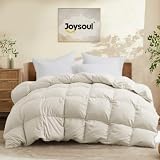
The Joysoul queen comforter is the pick for a shopper who wants the hotel look on a queen bed at the lowest possible price. It’s an all-season queen-size comforter filled with goose down and feather fiber, finished in a cream tone with luxury-hotel styling. It suits first apartments, spare rooms, and anyone furnishing a bedroom on a tight budget who still wants the bed to look intentional.
Key specs
- Fill: goose down blended with feather fiber
- Size: queen
- Season: all-season
- Colour: cream — softer than bright white, which hides light soiling better on an uncovered comforter
- Positioning: luxury hotel styling at budget tier
The cream colour is a more useful spec than it first appears. A bright white comforter used without a duvet cover shows every mark, and it has to be washed far more often than most people expect. A cream or off-white tone tolerates normal use far better, which extends the interval between washes — a real benefit for natural fill, which doesn’t enjoy frequent laundering. If you plan to use this uncovered, cream is the smarter finish.
Down-and-feather-fiber fill sits below feather-and-down blends in the fill hierarchy, because “feather fiber” is a processed material rather than intact feather. In practice that means a lighter, softer, less structurally supportive comforter: it drapes rather than holds a fold, and it will flatten faster than a quill-containing blend. At budget tier, that’s the expected trade. It’s still warmer and more breathable than a synthetic insert of the same thickness.
One expectation to set: at this price tier, fill weights are usually lower than mid-range and premium inserts. That’s how the price is achieved. A budget queen comforter typically works well in a bedroom kept at 66–72°F, and it will feel thin in an unheated room in January. If your bedroom is genuinely cold, a higher fill weight is the spec to prioritise, and that means moving up a tier.
Pros
- Budget tier pricing for a queen-sized natural-fill comforter
- Cream finish hides everyday marks better than bright white
- Down and feather fiber is breathable and warmer than synthetic fill of the same thickness
- All-season positioning works in a normally heated bedroom
Cons
- No published fill power or fill weight
- Feather fiber lacks the structural support of a quill-containing blend
- Lower fill weight than mid-range and premium options — thin in a cold room
- Queen only
Nearest alternative in this list: the Cosybay Feather and Down Fiber Comforter Insert. Both are queen comforters with feather-family fill, but Cosybay sits a tier higher and leads with a 100% cotton cover and corner tabs, while Joysoul leads on price and a cream finish. If you want a duvet-cover-ready insert with a cotton shell, Cosybay is the upgrade. If you want the cheapest credible queen comforter that still uses natural fill, Joysoul is the one.
10. Bedsure Quilted Comforter Duvet Insert (Twin) – Best for Twin Beds, Kids’ Rooms and Guest Rooms

The Bedsure twin quilted comforter is the pick for any bed that needs to be made quickly, washed often and replaced cheaply. It’s a twin-size all-season duvet insert with quilted construction and down-alternative fill, positioned as gentle and soft. It suits kids’ rooms, bunk beds, dorm rooms, camper beds and guest rooms where the comforter is going to be laundered more than it’s going to be admired.
Key specs
- Fill class: down alternative — synthetic, no fill power published
- Size: twin
- Construction: quilted, box-stitched to prevent fill shifting
- Season: all-season
- Care class: machine washable and quick drying, which is the main functional advantage over natural fill
Twin sizing is the reason this listing matters. A twin mattress is 38 × 75 inches. A typical twin comforter is about 68 × 88 inches, giving (68 − 38) ÷ 2 = 15 inches of drop per side and roughly 6 inches of overhang at the head and foot. That’s more relative drape than any other standard size gets, which is why twin comforters look so generous in photos. It also means a twin comforter will hang low enough to touch the floor on a low bed frame — worth checking if you have a platform bed with under-bed storage.
For kids’ rooms, the practical case for synthetic fill is strong. It’s washable at higher temperatures, it dries in a normal cycle, and it doesn’t develop the musty smell that poorly dried natural fill can. It also weighs less, so a child can pull it up without fighting it. The cost is loft life: synthetic batting compresses permanently within two or three years of nightly use, while a feather and down comforter recovers its shape when shaken.
Down alternative is not a lesser version of down in every respect. It’s hypoallergenic by nature, it doesn’t harbour the dust that natural fill can, and it costs a fraction as much. If the sleeper is a child with asthma, or the bed is used by rotating guests, that trade is often the right one.
Pros
- Budget pricing makes it easy to equip multiple beds
- Machine washable and fast drying
- Down alternative fill is naturally hypoallergenic and light
- Generous twin drape at roughly 15 inches of drop per side
Cons
- Loses loft permanently within a few seasons
- No warmth specification published
- Synthetic fill can feel clammy for warm sleepers
- Twin only in this listing
Nearest alternative in this list: the Bedsure Quilted Comforter Duvet Insert with Oeko-TEX certification. They come from the same brand and the same quilted-insert family, and the practical difference is certification and size coverage. If a third-party materials certification matters to you — for a child’s bed, for instance — the Oeko-TEX listing is the better choice. If you specifically need a twin, this listing is the one to take, since the Oeko-TEX version is not offered in twin here.
11. THX9ZRNM 75% Canadian Goose Down Comforter – Best for the Highest Stated Down Content in a King

The THX9ZRNM king comforter is the pick for a buyer who cares about down content specifically. Its listing states 75% Canadian goose down with a 100% cotton shell, in king size. That’s the most specific fill claim in this roundup short of a published fill power, and it suits shoppers who want a king comforter dominated by down clusters rather than by feather, plus anyone who wants a cotton shell they can trust to be down-proof.
Key specs
- Fill: 75% Canadian goose down content claim, with the remainder being feather-family material
- Shell: 100% cotton
- Size: king
- Fill class: down-dominant blend — the closest thing here to a true down comforter in king size
- Construction: quilted insert class
Why does down percentage matter more than most people realise? Because down clusters and feathers behave completely differently. A down cluster is a three-dimensional puff with no quill — it traps a large volume of air per unit of weight and compresses to almost nothing. A feather has a quill and a flat structure — it’s heavier, it holds shape rather than loft, and it provides warmth mainly by bulk. A 75% down fill is dominated by clusters, so it should feel light, compress small for storage, and recover its loft when shaken. A feather-dominant fill of the same warmth will weigh noticeably more.
Canadian goose down is a regional origin descriptor. The general claim behind it is that colder climates produce larger, more mature down clusters, which is why northern-origin down is often associated with higher fill power. That said, origin is not a substitute for a fill-power number — two comforters can both say “Canadian goose down” and differ substantially in measured loft. Treat origin as a positive signal, not a specification.
The 100% cotton shell is the spec that makes the fill claim usable. Tightly woven cotton keeps fine down clusters from working their way through the fabric, which is the main failure mode of down-dominant comforters with cheap shells. If you’ve owned a down comforter that shed feathers for years, the shell was the problem, not the fill.