The best portable projector screens for outdoor movies are folding-frame screens when you want a faster, sharper, more wind-tolerant setup, while inflatable screens are the better choice when a very large image and compact packed size matter more than setup time.
As an Amazon Associate we earn from qualifying purchases at no extra cost to you.


Our Top Picks
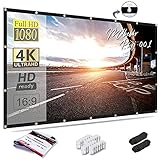
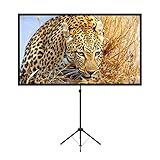
 120inch Projector Screen with Stand: Portable Projector Screen1200 x 106 x 76 inches12.5 poundsCheck on Amazon
 Mdbebbron 120 inch Projector Screen 16:9 Foldable Anti-Crease104 x 58 x 0.2 inches1.7 PoundsCheck on Amazon

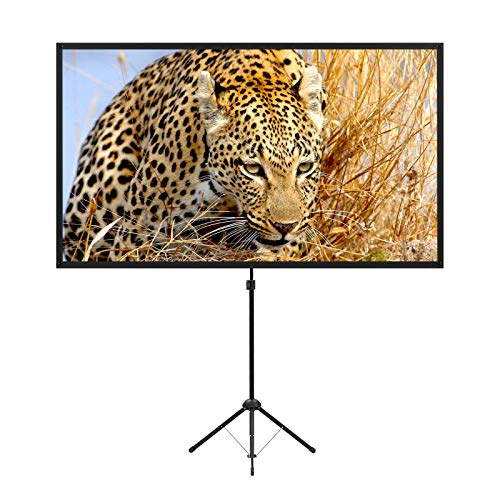
Top 3 picks at a glance
Folding vs. inflatable: the short answer
A folding screen uses a rigid or semi-rigid frame with a fabric surface stretched across it. It normally produces the flatter, more consistently tensioned image and can be ready in roughly 5–15 minutes, depending on the frame and whether it includes a rear support or ground stakes.
An inflatable screen uses a blower to hold an air-filled frame upright. The screen fabric and air frame can pack into a surprisingly small bag relative to the displayed image, but the blower must run throughout the movie. Setup commonly takes 10–25 minutes, including anchoring and allowing the frame to inflate fully.
For most backyards, a folding frame is the safer all-round recommendation. Choose an inflatable model for a 120-inch-plus presentation, frequent transport in a small vehicle, or situations where the folded frame length would be inconvenient.
Head-to-head comparison
| Characteristic | Folding-frame screen | Inflatable screen |
|---|---|---|
| Typical image sizes | 80–150 inches diagonal | 100–220 inches diagonal |
| Typical packed shape | Long case, commonly 3–6 feet | Soft bag, commonly 1–3 feet |
| Setup time | About 5–15 minutes | About 10–25 minutes |
| Screen tension | Usually excellent if the frame is assembled correctly | Good to very good; depends on air pressure and fabric attachment |
| Wind resistance | Good with wide feet, stakes, and correctly fitted fabric | Good only with proper guy lines and ballast; the large surface catches more wind |
| Viewing angle | Usually broad with matte-white fabric | Broad with matte-white fabric; rear projection requires a compatible surface |
| Image quality | Typically the most uniform and wrinkle-free | Can be excellent, but wrinkles, seams, or low air pressure are more noticeable |
| Noise | Silent after setup | Continuous blower noise, often audible during quiet scenes |
| Power requirement | None for the screen itself | Usually a small AC blower; check its wattage before using a battery |
Best portable projector screen choices by situation
Choose a folding screen for the most dependable picture
A folding frame is the best portable projector screen design for movie nights where image quality matters more than the smallest packed size. The fabric is pulled into a defined rectangle, so subtitles remain straighter and the picture is less likely to ripple as the evening cools or the breeze changes.
Established folding-screen lines such as the Elite Screens Yard Master 2 illustrate the format: a collapsible frame, a removable fabric surface, and a stand or support system intended for temporary outdoor use. Similar products are sold in front-projection and rear-projection versions, so check which fabric is included rather than assuming the screen supports both.
Look for a frame with positive corner connections, wide feet, a carry case, and separate tie-down points. A low-cost folding frame can still perform well, but flimsy joints and narrow feet make it more likely to twist or tip.
Choose an inflatable screen for a large image in a small car
An inflatable screen is the best choice when packed volume is the limiting factor. A 150-inch or larger screen may fit in a soft carry bag that is easier to load than a long folding-frame case. The trade-off is that the blower remains on, the frame needs more anchoring, and the fabric must be attached evenly before inflation.
Inflatables are particularly useful for community events and large groups, but bigger is not automatically better. A 180-inch screen viewed from only 15 feet away can force viewers to move their heads to follow action, while a 120-inch screen may look more comfortable and brighter with the same projector.
How to choose the right size and aspect ratio
Most modern movies and games use a 16:9 image. Approximate visible screen dimensions are:
- 100-inch diagonal: about 87 inches wide and 49 inches high.
- 120-inch diagonal: about 105 inches wide and 59 inches high.
- 150-inch diagonal: about 131 inches wide and 74 inches high.
- 180-inch diagonal: about 157 inches wide and 88 inches high.
As a practical starting point, place the closest viewer at roughly 1.2–1.5 times the screen width. A 120-inch screen is about 8.75 feet wide, so a comfortable first-row distance is approximately 10.5–13 feet. Move farther back if viewers complain that the picture feels overwhelming or if the projector cannot illuminate the larger surface evenly.
A larger screen also spreads the same light over more area. If you move from a 120-inch diagonal screen to a 150-inch screen, the image area rises by roughly 56 percent because screen area scales with the square of diagonal size. The projector therefore needs substantially more light, not merely a little more.
Screen tension, viewing angle, and image quality
Prioritize tension over gain for backyard seating
Wrinkles and loose fabric are more damaging than a modest difference in advertised gain. A taut matte-white surface keeps text readable and avoids localized bright patches. Folding frames usually win because the perimeter tension is fixed by the frame. Inflatable screens depend on correct air pressure and evenly spaced fabric fasteners.
For groups seated across a lawn, a matte-white surface with a wide viewing angle is generally the safest choice. High-gain gray or directional materials can improve perceived contrast in some conditions, but they may produce a narrower sweet spot or uneven brightness for viewers sitting off-center.
Do not confuse brightness with screen quality
Outdoor image quality is limited by ambient light, projector brightness, resolution, focus, and screen surface together. A premium screen cannot compensate for a projector being used before sunset. Wait until the sky is properly dark, avoid nearby porch lights, and use the projector’s native resolution rather than relying on scaling to fix a soft source.
For a 100–120-inch screen, a projector with around 2,500–3,500 ANSI lumens is a reasonable class to consider for dark conditions with some residual evening light. A 150-inch or larger screen generally benefits from more light. Manufacturer brightness claims are not always measured in identical ways, so treat the rating as a comparison point rather than a guarantee.
Wind resistance and anchoring
Wind is the most important outdoor safety issue. Both designs act like sails, and a large screen can become unstable even when the air feels only mildly breezy at ground level.
- Use every supplied stake, guy line, and ballast point; do not rely on the screen’s feet alone.
- Drive stakes at an angle away from the screen so the pull of the guy line presses them into the ground.
- Use water or sand ballast on hard surfaces, keeping ballast low and close to the support feet.
- Keep electrical connections off wet ground and use outdoor-rated extension equipment.
- Take the screen down if gusts begin moving the frame, bowing the fabric sharply, or lifting the feet.
Inflatable screens are not automatically more wind-resistant because they are soft. Their broad air-filled outline can catch more wind than a smaller folding screen. A folding design with a lower height, broad feet, and effective guy lines may be the better choice for an exposed yard.
Battery planning for an inflatable screen
Check the blower label before choosing a power station. For example, if a blower draws 80 watts and runs for three hours, the basic energy requirement is 240 watt-hours. Allowing for inverter and battery losses of about 20 percent raises the target to approximately 300 watt-hours:
80 watts × 3 hours = 240 watt-hours; 240 ÷ 0.8 = 300 watt-hours.
A power station rated at 300 watt-hours would therefore be marginal, especially if it also powers the projector, speakers, or a streaming device. A 500–700 watt-hour unit gives more practical headroom. Folding screens avoid this extra load, although the projector itself still needs power.
Decision matrix
| Your priority | Better choice | Reason |
|---|---|---|
| Fast setup and silent operation | Folding frame | No blower and usually less fabric adjustment |
| Largest image in a small storage space | Inflatable | Soft packed form factor scales well to large sizes |
| Frequent light wind | Smaller folding frame | Often presents less sail area and has a rigid support structure |
| Rear projection | Either, but only with compatible fabric | Front-only material may produce a dim or incorrect rear image |
| Remote lawn with no mains power | Folding frame | Removes the inflatable blower’s continuous power demand |
| Large audience and easy transport | Inflatable | Large viewing area with a relatively compact packed bag |
What to look for before buying
- Confirm the native aspect ratio, especially if you will watch widescreen movies or connect a gaming PC.
- Check the actual packed length and weight, not only the diagonal screen size.
- Prefer a removable, washable fabric or a replacement-fabric option.
- Verify whether stakes, guy lines, ballast bags, blower, and carry case are included.
- Check whether the screen is front projection, rear projection, or convertible.
- Compare the screen’s usable image area rather than counting the black border as viewing space.
For most home outdoor movie setups, a 100–120-inch matte-white folding screen offers the best balance of setup speed, tension, viewing angle, and image consistency. Select an inflatable screen when its compact packed size or 150-inch-plus image solves a real space problem, and budget for stronger anchoring, continuous blower power, and more careful setup.