Rideshare and taxi driving changes what you need from a dash cam. A normal commuter camera watches the road ahead and that is enough. A driver carrying strangers all day also needs to record the cabin, keep working in the dark at night, and keep recording at the curb while a trip is parked or waiting. That is why almost every serious option for this job is a dual-lens model, with one lens facing the road and an infrared-assisted lens facing the passenger seats.
This guide is for Uber, Lyft, and taxi drivers choosing a front-and-inside camera in 2026, plus part-time drivers who want protection for disputes, claims, or lost-item questions. All comparisons come from the features stated in each product title, so use the list as a shortlist and read the full specifications before you decide. Recording passengers is regulated in many places, so check your local audio and video recording laws and the policy of the platform you drive for, and consider a visible notice in the vehicle.
Our Top Picks
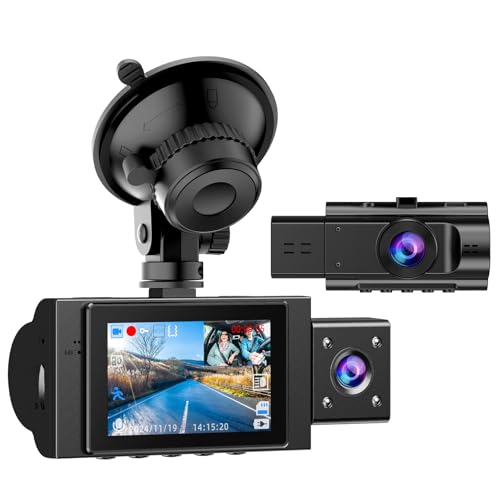 Dual Dash Cam Front and InsideFront and Inside without card4.13 x 1.57 x 1.77 inches0.7 poundsCheck on Amazon


Top 3 picks at a glance
Quick Picks
As an Amazon Associate we earn from qualifying purchases at no extra cost to you.


| Product | Best for | Key spec from the title |
|---|---|---|
| COOAU Dual 2.5K Dash Cam | Full-time rideshare with GPS | 2.5K front plus 1080P inside, GPS, Wi-Fi |
| 1080P Dual Dash Cam with Parking Monitor | Taxi drivers who wait at stands | 24H parking monitor, G-sensor, infrared night vision |
| COOAU D30S 4K | Highest listed video quality | 4K front, supercapacitor, 4 IR LEDs |
| 360 View 4 Channel | Maximum coverage around the car | Front, rear, left, right, and inside channels |
| Front and Inside Dashcam with IPS Screen | Simple, screen-first operation | 3.16-inch IPS screen, loop recording |
| Dual Dash Cam with 64GB Card | Buy-and-install convenience | 1080P, 64GB card included |
| 70mai 4K Three-Channel | Tech-forward drivers | 4K, Wi-Fi 6, voice control, three channels |
| Milerong X25 | Budget dual-camera kit | 1080P, 64GB card, 24H parking mode |
How to Choose
Cabin Camera and Night Vision
The inside lens is the reason to buy a rideshare dash cam. Look for infrared LEDs on the cabin camera, because ordinary sensors turn muddy at night. A listing that names the number of IR LEDs, as the D30S does, tells you more than one that only says night vision.
Front Resolution and Channel Count
A 1080P front camera is the minimum for reading plates at a reasonable distance, while 2.5K or 4K lenses give you more detail to crop. More channels, such as rear, left, and right, widen the evidence you capture, but they add cables and cost. Two channels suit most drivers; three or four suit those who want complete coverage.
Parking Mode and Power
If you wait in a car at airports or pickup stands, 24-hour parking monitoring with a G-sensor matters. Constant recording needs a hardwire kit, and a supercapacitor handles heat better than a battery, which counts in a car that bakes in the sun. Make sure loop recording overwrites old clips but protects flagged incidents.
Storage and Where Budget Models Cut Corners
Dual-channel recording eats memory quickly, so a 64GB card fills in hours at higher resolutions. Buy a high-endurance card and plan to export clips regularly. Budget models trim image sensors, skip GPS, use small batteries, and offer clumsy phone apps. Ignore dramatic wide-angle claims above about 170 degrees; edges distort.
The 8 Best Options
COOAU Dual 2.5K Dash Cam
This COOAU model lists 2.5K front recording plus 1080P for the cabin, built-in GPS and Wi-Fi, night vision, and positioning for Uber and taxi drivers. It suits full-time drivers who want a step up from basic 1080P and need location data attached to clips. Location stamps can help when a trip dispute turns on where the car was and when, and Wi-Fi saves you from pulling the card every time you need a video.
- Strength: 2.5K front camera gives more plate and detail clarity than 1080P
- Strength: GPS and Wi-Fi help with logging and quick clip transfer
- Trade-off: the cabin lens is 1080P, so the interior picture is not as crisp as the front
Skip it if you only want the cheapest dual lens setup.
1080P Dual Dash Cam with Parking Monitor
This unnamed dual-lens camera lists 1080P recording front and inside, infrared night vision, a 24H parking monitor with motion detection, and a G-sensor, and is described as ideal for taxis. It suits drivers who wait at curbs and want the car watched when they step out. Taxi stand queues and airport holding lots are exactly where a motion-triggered record mode earns its place.
- Strength: parking monitor with motion detection adds coverage when parked
- Strength: G-sensor locks footage after a bump
- Trade-off: 1080P on both lenses gives less fine detail than the 2.5K and 4K options
Skip it if you want GPS, high resolution, or a well-known brand name, since the title gives little beyond the basics and support options are unclear.
COOAU D30S 4K
The D30S is listed as a 4K dash cam with a front-and-inside dual setup at 2.5K and 1080P, plus GPS, Wi-Fi, infrared night vision with 4 IR LEDs, a supercapacitor, and a G-sensor. For drivers who want the most detail, it is the strongest hardware listing among the COOAU models. A lens that can pick out faces and belongings in a dark back seat is the main reason to pay for this tier.
- Strength: 4K front capture with a supercapacitor suited to hot cabins
- Strength: four IR LEDs are called out for the cabin lens
- Trade-off: higher resolution fills the memory card faster
Skip it if you want a minimal setup that does not need a larger card, since 4K and dual channels together use storage quickly and call for regular clip exports.
360 View 4 Channel
This four-channel system covers front, rear, left, right, and inside views, adding GPS, 5G Wi-Fi, night vision, a 160-degree wide angle, WDR, and a 24H parking mode. It suits drivers who have been through side-swipe or door-ding disputes and want every side documented. A camera that sees left and right can show who drifted into whose lane, which a front-only unit cannot.
- Strength: side views document angles other cameras miss
- Strength: WDR is listed to balance bright and dark scenes
- Trade-off: more cameras mean more wiring and a longer install
Skip it if you want simple installation in a leased car, because four cameras mean extra cabling through trim panels and more effort to remove later.
Front and Inside Dashcam with IPS Screen
The listing highlights a front and inside setup with infrared night vision, loop recording, wide angle lens, a 3.16-inch IPS screen, and parking features. It suits drivers who like to check footage on the device itself rather than through an app. That helps when you want to confirm the angle right after mounting, before you pull away from the curb.
- Strength: built-in IPS screen makes setup and review simple
- Strength: loop recording keeps the card from filling
- Trade-off: no resolution is clear from the visible title, so verify before buying
Skip it if you need GPS or high-resolution capture, and verify the actual video resolution on the full listing before buying.
Dual Dash Cam with 64GB Card
This 1080P dual-lens model comes with a 64GB card and lists infrared night vision, loop recording, a G-sensor, and positioning for Uber and Lyft. It suits new drivers who want one purchase and no hunting for a compatible card. Pairing the bundle with a fresh clip-export habit keeps the loop from erasing something you wanted.
- Strength: included 64GB card removes a shopping step
- Strength: G-sensor and loop recording cover the essentials
- Trade-off: bundled cards vary in endurance, so replace it if you drive full-time
Skip it if you want GPS stamps or resolution above 1080P, because the title promises basics rather than premium capture.
70mai 4K Three-Channel
The 70mai kit lists 4K recording, front, rear, and inside channels, GPS, Wi-Fi 6, voice control, a parking monitor, and night vision. It fits drivers who want modern features such as hands-free commands and faster wireless transfer. The inside channel is listed alongside front and rear, so it can cover the cabin and both ends of the vehicle.
- Strength: three channels plus 4K deliver strong coverage
- Strength: Wi-Fi 6 and voice control simplify use
- Trade-off: a three-camera system takes longer to install neatly
Skip it if you want a two-wire, minimalist install or you drive a car where routing a rear camera cable is awkward.
Milerong X25
The Milerong X25 is a front-and-inside 1080P kit with a 64GB card, night vision, loop recording, a G-sensor, and 24H parking mode. It is the budget-minded pick for drivers who want the full cabin-camera feature set without chasing 4K. Its included card and parking mode take care of the most common setup gaps for new drivers.
- Strength: parking mode and G-sensor included at a modest tier
- Strength: a card ships in the box
- Trade-off: no GPS is visible in the title
Skip it if you need location data or 4K detail, because plate reading at distance is where 1080P limits show first.
Which One Fits Your Situation
You Drive Full-Time at Night
Choose the COOAU D30S 4K. The four IR LEDs, supercapacitor, and 4K front camera suit long shifts in dark conditions and hot cabins.
You Want Total Coverage
The 360 View 4 Channel system documents all sides of the vehicle, which helps in fault disputes and parking incidents.
You Drive Part-Time and Want Simplicity
Pick the Dual Dash Cam with 64GB Card or the Milerong X25. Both bundle a card and keep the feature list focused.
You Like Modern Features
The 70mai 4K Three-Channel offers voice control and Wi-Fi 6, a sensible match for drivers who care about quick app transfers and want to review a clip before the next ride request arrives.
Common Mistakes
- Skipping the cabin camera and relying only on a front-facing unit.
- Ignoring local recording and consent laws, especially for audio inside the car.
- Using a standard memory card instead of a high-endurance one.
- Forgetting to hardwire the camera, then wondering why parking mode never works.
- Mounting the unit where it blocks the view or covers an inspection sticker.
Related guides
- Can You Power A Portable Monitor With A Power Bank
- Monitors For Digital Signage And Video Walls
- Can A Portable Monitor Work With One Usb C Cable
Frequently Asked Questions
Is a dual dash cam legal for rideshare?
Rules differ by location and platform, so check your local law and the policy of the service you drive for. A visible notice is a common courtesy and often a legal requirement. If audio recording is a concern, look for a model that lets you switch the microphone off in the settings.
Do I need 4K?
Not necessarily. 1080P is adequate for most incidents, while 2.5K or 4K helps with reading plates at a distance.
How big a memory card do I need?
Choose 128GB or more for dual-channel recording at higher resolutions. Use a high-endurance card made for constant rewriting.
Does parking mode drain the car battery?
It can if the camera is plugged into an always-on circuit with no cutoff. Use a hardwire kit with a voltage cutoff to protect the battery. Many drivers also keep parking mode to short windows, since heat and long idle recording are hard on any electronics left in a parked car.