The best bouldering pads in 2026 are the ones that match your landing zone: for most climbers, a mid-size hybrid pad like the Black Diamond Mondo or Metolius Session II covers 90% of situations, while highball-focused climbers should step up to a monster pad like the Organic Big Pad or pair two pads with a gap-filling slider. Below we break down the specs that actually matter — foam layout, hinge type, coverage area, and carry comfort — and map them to the terrain you’re climbing.
As an Amazon Associate we earn from qualifying purchases at no extra cost to you.



Our Top Picks


Top 3 picks at a glance
What Actually Determines Whether a Pad Protects You
Two pads can look identical folded up and perform completely differently on a bad landing. Four variables do the real work:
- Foam layout. Most pads use either a single-density slab, a two-layer system (soft top over firm base), or a baffled/chambered design like the Mad Rock R3. Dual-density is the proven standard: roughly 1 inch of softer open-cell foam on top to spread impact, over 3–4 inches of firm closed-cell foam that stops you bottoming out on rock.
- Hinge design. A taco fold (no hinge) rolls the pad in half — bulky to carry but zero hinge gap for an ankle to punch through. A flat hinge packs small and carries flatter against your back, but the crease is a weak zone on edge landings. Hybrid pads (e.g., Metolius’ angled hinge) split the difference.
- Landing coverage. Total square footage matters more than any single dimension. A 44 x 65 inch pad covers ~20 sq ft; a 48 x 72 inch monster covers 24 sq ft — about 20% more margin for off-center falls.
- Carry system. Padded shoulder straps, a hip belt, and a sternum strap decide whether a 15 lb pad feels fine or miserable on a 40-minute approach. Removable straps that tuck away also keep them out of the mud under the landing.
Head-to-Head: The Top Picks for 2026
| Pad | Open size (in) | Coverage (sq ft) | Thickness | Fold type | Foam layout | Weight | Best for |
|---|---|---|---|---|---|---|---|
| Black Diamond Mondo | 65 x 44 | ~20 | 5″ | Taco | Multi-density, firm base | ~18 lb | Highballs, solo sessions |
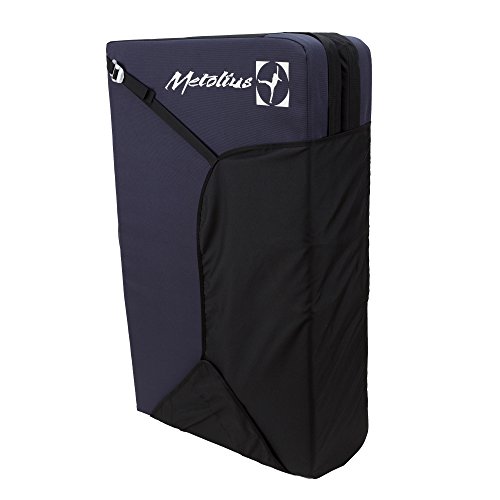
| Metolius Session II | ~48 x 36 | ~12 | 4″ | Angled hinge | Dual-density | ~10 lb | Approach-heavy days, second pad |
| Organic Big Pad | ~48 x 72 | ~24 | 5″ | Taco | Layered hybrid | ~20 lb | Maximum coverage, sketchy landings |
| Mad Rock R3 | ~48 x 36 | ~12 | 4″ | Flat fold | Baffled recycled fill | ~14 lb | Rough/rocky landing zones |
| Petzl Alto | ~46 x 39 | ~12.5 | 4″ | Taco | Triple-density | ~12 lb | All-round use, easy carry |
Prices across this class usually run $150–$450 depending on size — mid-size pads cluster around $200–$280, and full-size monster pads push $350+.
Black Diamond Mondo — the highball default
Five inches of foam with no hinge means there’s no seam to land badly on, and the taco fold swallows shoes, chalk, and layers inside. The trade-off is bulk: it’s a big slab on your back, and it doesn’t fold flat in a small car. If your area has tall lines over uneven ground, this is the coverage-first choice.
Metolius Session II — the workhorse
Lighter and cheaper than the monsters, with an angled hinge that reduces the gap problem of a straight fold. At ~12 sq ft it’s under-sized as a sole pad for serious falls but excels as the pad you actually carry on long approaches — and it’s the natural first purchase to pair with a second pad later.
Organic Big Pad — when you want the whole landing zone
Roughly 24 sq ft of taco-folded foam. Two of these cover a landing zone most climbers would need three mid-size pads for. Custom foam and fabric options exist, and the carry system is better than its size suggests. The catch: heavy, expensive, and awkward on narrow trails.
Mad Rock R3 — the uneven-ground specialist
Instead of solid foam slabs, the R3 uses baffled chambers of recycled fill that conform around rocks and roots in the landing zone rather than bridging over them. It folds completely flat — easiest in the category to strap under a pack or slide into a trunk — but the baffled feel is softer, and some climbers prefer a firmer top sheet for confidence on higher falls.
Petzl Alto — the balanced pick
Triple-density foam in a taco fold with one of the cleaner carry systems out there — straps convert to a suitcase-style handle, and the flap layout keeps gear inside. Sits squarely between the Session’s portability and the Mondo’s coverage.
How Much Pad Do You Actually Need? A Worked Example
A useful rule of thumb: your landing zone should be covered to at least 1 pad-length beyond the climber’s likely fall arc. For a problem topping out at 12 ft, a falling climber can land up to ~4–5 ft from the base depending on movement. If the usable flat landing is roughly 6 x 8 ft (48 sq ft), the math looks like this:
- 1x Mondo (~20 sq ft): covers under half the zone — spotting becomes critical.
- 1x Big Pad + 1x Session II (~36 sq ft): covers the fall arc, gap over a rock still exposed.
- 2x Big Pads (~48 sq ft): full coverage, plus overlap to eliminate seams.
The takeaway: most climbers are one pad short. Buying your second pad as a different size than your first (e.g., a mid-size to fill the gap your taco-fold can’t reach) gives more flexible coverage than two identical pads.
Decision Matrix: Match Your Climbing to a Pad
| Your situation | Priority | Recommended setup |
|---|---|---|
| New climber, single pad, mixed areas | Versatility | Mid-size hybrid hinge (Session II / Alto class) |
| Tall problems, uneven landings | Thickness + coverage | 5″ taco-fold monster (Mondo / Big Pad class) |
| Long approaches, alpine boulders | Weight + carry system | Sub-12 lb pad with hip belt; accept less coverage |
| Rough, rocky landing zones | Ground conformity | Baffled design (R3) or add a thin slider pad |
| Climbing solo frequently | Coverage redundancy | Monster pad + mid-size backup |
| Small car / shared transport | Packability | Flat-folding or mid-size pads over tacos |
Hinge vs. Taco: Which Fold for Which Terrain
Hinged pads shine on flat, cleared landings — they lie flat, cover a predictable rectangle, and stack neatly. Their weakness is the seam: an ankle landing directly on the hinge line gets less support. If your area’s landings are manicured (many popular areas are), the carry convenience wins.
Taco pads eliminate the seam entirely and hold gear inside the fold, but they don’t sit perfectly flat and their rounded edges can tilt on sloped ground. On uneven or rocky landings the continuous foam is the safer bet — just check for a rock poking into the low point of the fold.
Whichever you choose, a thin “slider” pad (~1–2 inches, 24 x 36 in) is the cheapest coverage upgrade available: it bridges hinge gaps, pads over roots, and protects sit-start falls.
FAQ
How long does a crash pad last?
Foam degrades with compression cycles and moisture. Expect 5–8 years of regular weekend use before the foam loses rebound; store it flat or on edge, dry, out of sunlight. If the pad stays compressed where you fold it or bottoms out on falls you’d expect it to handle, it’s done.
Is one big pad better than two small ones?
Two smaller pads are almost always more useful: they cover irregular shapes, let a partner spot a second zone, and split the carry load. One big pad only wins when your local landings are consistently flat and wide.
Does thicker always mean safer?
Up to a point. Past ~5 inches, extra thickness adds weight faster than protection, and overly soft foam can let an ankle roll. Density layering matters more than raw thickness — a firm base layer is what prevents bottoming out.