The best TV antennas for most homes are a non-amplified indoor antenna within roughly 15 miles of the transmitters, an amplified indoor model when cable length or building materials weaken the signal, and an attic or outdoor-rated antenna for difficult terrain or distances beyond about 30 miles.
As an Amazon Associate we earn from qualifying purchases at no extra cost to you.
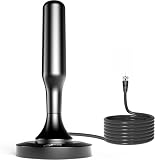


Our Top Picks


Top 3 picks at a glance
Quick comparison: which antenna type fits your home?
| Your situation | Best starting choice | Why | Main limitation |
|---|---|---|---|
| Apartment, strong local signals, within 10–15 miles | Thin indoor antenna such as Channel Master FLATenna 35 | Simple setup, no power adapter, low cost | Walls and low-E glass can block UHF signals |
| Indoor location with several walls or a long coaxial cable | Amplified indoor antenna such as Mohu Leaf 50 or Winegard FlatWave Amped FL5500A | Compensates for cable and splitter losses | Amplification cannot recreate a signal that never reaches the antenna |
| Suburban home, 20–40 miles from towers | Directional attic antenna such as Antennas Direct ClearStream 4MAX | Higher margin against weak signals and multipath interference | Needs correct aim and attic access |
| Hills, dense trees, or stations in different directions | Attic or outdoor-rated directional antenna, selected after checking tower locations | Height and clearer line of sight improve reliability | May need a rotor, second antenna, or professional installation |
What matters more than the advertised range
Antenna range figures are useful for rough comparison, but they are not a guarantee. A “50-mile” indoor antenna placed behind foil-backed insulation may perform worse than a basic antenna near a window. The real variables are distance, terrain, tower direction, frequency band, building materials, and cable loss.
- VHF and UHF support: Most digital broadcast channels use UHF, but some stations still transmit on high-VHF frequencies. A very small UHF-focused panel may miss channels that a larger VHF/UHF antenna receives.
- Height: Moving an antenna from a basement-level TV stand to an upstairs window can help more than adding an amplifier.
- Directionality: A directional antenna rejects some signals from the rear and sides, which can reduce reflections. It is useful when stations are grouped in one direction.
- Multipath interference: Reflections from buildings, metal roofs, and nearby structures can cause pixelation even when the signal-strength reading looks adequate.
- Coaxial cable: Long, thin, damaged, or poorly connected cable reduces the signal before it reaches the tuner.
Indoor antennas: easiest setup, highest location sensitivity
Indoor antennas are the right first purchase for apartments, rentals, and homes close to broadcast towers. The Channel Master FLATenna 35 is a straightforward non-amplified example. The Mohu Leaf 50 and Winegard FlatWave Amped FL5500A are amplified indoor options intended to provide more margin when the antenna location or cable run is less favorable.
Place an indoor antenna as high as practical, preferably on an exterior-facing wall or window that points toward the transmission towers. Keep it away from televisions, Wi-Fi routers, metal shelving, and large appliances. Run a channel scan after every major position change; a scan made before moving the antenna will not reveal the improvement.
When amplification helps
An amplifier is useful when the antenna receives a usable signal but the signal loses strength through coaxial cable, a splitter, or several outlets. For example, assume a passive antenna receives a tuner-level signal of 58 dBµV, the cable loses 5 dB, and a two-way splitter loses about 4 dB including insertion loss:
58 dBµV − 5 dB − 4 dB = 49 dBµV at the tuner.
A distribution amplifier with approximately 15 dB of gain could restore much of that margin, although the amplifier should be installed near the antenna and not after a severely damaged cable. More gain is not automatically better: an overloaded amplifier can create distortion, especially near powerful local stations.
Attic antennas: the reliability upgrade
An attic antenna is often the best compromise between indoor convenience and outdoor performance. It avoids rooftop installation while benefiting from greater height and a clearer view. Models such as the Antennas Direct ClearStream 2MAX or ClearStream 4MAX are directional designs commonly considered for this type of installation; the 4MAX is the more substantial choice when extra signal margin or wider coverage is needed.
Attic materials matter. Asphalt shingles usually cause modest loss, while foil-backed insulation, radiant barriers, metal roofing, solar equipment, and ductwork can significantly weaken or reflect signals. Keep the antenna several feet away from large metal objects, and do not assume that pointing through the shortest part of the roof is best.
If stations are clustered in one compass direction, aim the antenna toward them. If important stations are spread widely apart, a broad-beam antenna may be more convenient than a narrow directional model. A rotor or separate antenna may be necessary when one fixed position cannot cover both groups reliably.
Indoor versus amplified versus attic: head-to-head
| Factor | Non-amplified indoor | Amplified indoor | Attic antenna |
|---|---|---|---|
| Typical installation time | 10–20 minutes | 15–30 minutes | 1–3 hours |
| Best practical distance | About 0–15 miles | About 0–25 miles, depending on obstructions | About 20–50 miles when terrain and tower direction cooperate |
| Power required | None | USB or wall adapter, depending on model | Usually none for the antenna; optional preamplifier may need power |
| Resistance to wall loss | Low | Low to medium | Medium to high |
| Risk of overload | Low | Medium or high near strong towers | Low without an amplifier |
| Best reason to choose it | Simple, inexpensive local reception | Recovering margin lost in cable or splitting | More stable reception in a difficult building |
How to choose the right antenna step by step
1. Check tower direction and distance
Use a reputable broadcast-reception or FCC-based signal lookup with your address. Record the approximate distance and compass bearing for each station you care about. Do not choose based only on the channel number shown in a TV guide: a station branded as channel 5 may transmit on a different physical frequency.
2. Identify obstructions
Count exterior walls between the likely antenna location and the towers. Note hills, tall buildings, dense trees, metal siding, and low-emissivity windows. If the antenna would be in a basement or behind multiple insulated walls, skip the cheapest flat panel and consider an attic location.
3. Start without amplification when possible
A passive antenna provides a cleaner baseline. Add amplification only when the antenna already receives the desired stations but they become unreliable after a long cable run or splitter. A powered amplifier cannot solve a missing line of sight, incorrect direction, or severe multipath.
4. Scan, inspect, and rescan
Connect the antenna directly to the TV first. In the television menu, select “Antenna,” “Air,” or “Broadcast” rather than “Cable,” then run an auto-scan. If channels break up, inspect every F-connector, remove unnecessary splitters, and try positions at least 3 feet apart. Rotate a directional antenna in small increments and rescan after each promising position.
Fixes for common reception problems
- One or two channels pixelate: Move the antenna 2–6 feet, change its angle, and rescan. A small position change can reduce a reflected signal without changing the tower distance.
- Every channel disappears after adding an amplifier: Confirm that the power inserter is connected in the correct direction and that the TV is not already supplying antenna power. If strong local stations are present, remove the amplifier and compare.
- Channels work at one TV but not another: Test the problem TV with a short cable directly from the antenna. If it works, the house wiring, splitter, wall plate, or cable run is the likely cause.
- Reception worsens during rain or wind: Check for loose outdoor connectors, water intrusion, movement of the mast, or branches blocking the path. Weather should not routinely destroy a healthy local signal.
- Only VHF channels are missing: Replace a tiny UHF-only panel with a full VHF/UHF antenna. An amplifier will not compensate for an antenna that is poorly suited to the station’s band.
Best buying decision by budget
For a strong-signal apartment, choose a non-amplified indoor antenna and spend the remaining budget on a better location and quality coaxial cable. For a normal suburban room with moderate cable loss, an amplified indoor model is reasonable, but compare it with a passive antenna before leaving the amplifier connected. For weak or inconsistent reception, put the budget toward an attic-capable VHF/UHF antenna, mounting hardware, and a short, weather-resistant coaxial run rather than buying an indoor antenna with a larger advertised range.
In short, choose the antenna type that improves the weakest part of your signal path: location for an indoor antenna, cable distribution for an amplifier, and height or line of sight for an attic antenna. That approach is more reliable than selecting the largest range number on the package.