The best star projectors for most bedrooms and parties are the SEGA Homestar Flux for accurate, room-filling stars, the BlissLights Sky Lite Evolve for affordable color and app control, and the Pococo Galaxy Star Projector for quiet, disc-based scenes with strong detail.
As an Amazon Associate we earn from qualifying purchases at no extra cost to you.


Our Top Picks
 Northern Galaxy Light Aurora Projector with 33 Light4.3 x 6.3 x 3.9 inches6.5 x 4.5 x 4 inchesCheck on Amazon
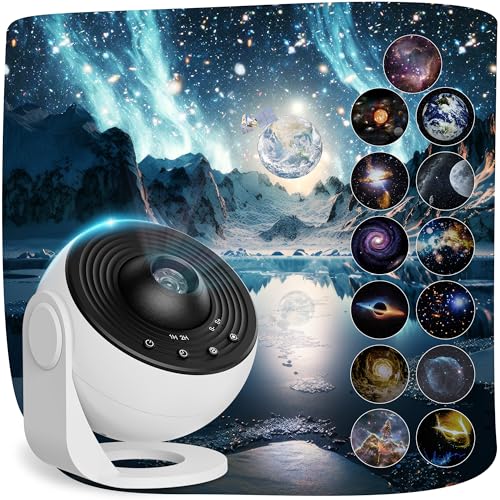


Top 3 picks at a glance
Best Star Projectors Compared
| Rank | Projector | Best for | Room size | Motion and color | Noise and timer | Typical price range |
|---|---|---|---|---|---|---|
| 1 | SEGA Homestar Flux | Realistic stars and large ceilings | Medium to large | Very accurate stars; rotating discs | Low fan noise; built-in timer | Usually $120–$200 |
| 2 | Pococo Galaxy Star Projector | Quiet bedrooms and detailed scenes | Small to medium | Interchangeable discs; gentle rotation | Very quiet; sleep timer varies by version | Usually $60–$130 |
| 3 | BlissLights Sky Lite Evolve | Colorful bedrooms and parties | Small to medium | Animated nebula and laser stars | Quiet solid-state design; app timers | Usually $50–$80 |
| 4 | Govee Galaxy Light Projector 2 Pro | Smart-home party lighting | Medium to large | Animated effects and app scenes | Low operating noise; scheduled controls | Usually $100–$180 |
| 5 | Entry-level LED star projector | Children’s rooms and small budgets | Small | Basic color cycling and rotation | Motor noise varies; simple auto-off | Usually $20–$45 |
1. SEGA Homestar Flux: Best Overall for Realistic Coverage
The Homestar Flux is the strongest choice when “star projector” means a convincing field of pinpoints rather than a colorful laser-and-nebula lamp. Its optical disc system produces sharper, more natural-looking stars than most low-cost LED projectors, and optional discs let you change the sky or add themed imagery.
Coverage: It works best in medium and large rooms where the projector can sit roughly in the center of the ceiling or point at a broad wall. Optical sharpness remains useful across a wide surface, although stars become less bright as the image spreads farther.
Color accuracy: This is its main advantage. White stars look cleaner and less neon than RGB effects. It is not the best pick for saturated party colors because its design prioritizes astronomical detail.
Motion: The disc rotates slowly for a natural drifting effect. That movement is adjustable in the sense that you can enable or disable rotation, but it does not offer the extensive animation controls found in smart RGB projectors.
Noise and durability: The cooling fan is normally quieter than a party speaker but can be audible in a silent bedroom. Keep the air vents clear and avoid placing it on bedding. Its mechanical disc system has more moving parts than a solid-state projector, so it rewards careful handling.
Best settings: For sleep, use the lowest brightness, disable rotation, and set the timer for 30–60 minutes. For a party, increase brightness only after dark and aim the unit at the ceiling rather than a close wall; this reduces visible hotspots.
2. Pococo Galaxy Star Projector: Best Quiet Bedroom Option
The Pococo Galaxy Star Projector is a good middle ground between realistic optical discs and colorful ambient lighting. Its interchangeable projection discs create sharper scenes than simple built-in RGB lamps, while the compact body suits bedside tables and smaller rooms.
Coverage: Choose it for a bedroom, nursery, gaming room, or dorm rather than a large open-plan party space. A ceiling area of about 100–200 square feet is a sensible target for a bright, detailed image.
Color and motion: Disc-based scenes generally look more coherent than randomly generated LED dots. Rotation can be enabled for motion, but slow movement is preferable for sleep because fast animation makes the room feel busier and can expose flicker or mechanical noise.
Controls: Depending on the package and generation, controls may include onboard buttons, a remote, or app support. Check this before buying: a remote is convenient at bedtime, while app control is better for scheduled routines.
Durability: The optical lens should be protected from fingerprints and dust. Do not wipe the lens with a dry paper towel; use a clean microfiber cloth, since small scratches reduce edge sharpness.
3. BlissLights Sky Lite Evolve: Best for Colorful Bedrooms
The Sky Lite Evolve is better suited to people who want a moving blue, green, purple, or multicolor nebula with star-like points. It is not a substitute for a true astronomical projector, but it creates a strong gaming-room or party atmosphere with very little setup.
Coverage: It performs best in small and medium rooms. Put it near a corner and aim diagonally across the ceiling for a broader wash. A close wall produces brighter colors but also makes the projection look smaller and less blended.
Color accuracy: RGB lighting is vivid rather than scientifically accurate. The advantage is flexibility: you can match a game-room color scheme, select a slow fade, or use one color as a night-light.
Motion: App-based controls provide more useful adjustment than many inexpensive projectors. Set nebula movement to slow or medium speed for normal use; reserve rapid transitions for parties, where the surrounding noise and movement make animation less distracting.
Noise and timers: Its solid-state light design avoids the constant fan sound common in brighter optical units. App scheduling and automatic shutoff are particularly useful for bedrooms, provided the phone and projector maintain a reliable connection.
4. Govee Galaxy Light Projector 2 Pro: Best Smart Party Projector
The Govee Galaxy Light Projector 2 Pro is the better choice when the projector needs to participate in a broader lighting setup. It emphasizes animated galaxy effects, color scenes, app control, and synchronization with other smart lights rather than the most realistic star field.
Coverage: Its brighter, more effect-oriented output makes it suitable for medium rooms and some larger party spaces. For a large room, place it high and near a corner, then use a second light source to fill the opposite side instead of expecting one projector to cover every surface evenly.
Controls: App scenes, brightness adjustments, color selection, schedules, and music-reactive modes are its strengths. Voice control can be convenient, but physical controls or a saved scene are safer when Wi-Fi is unreliable.
Motion: Use slow movement for background lighting. Music-reactive effects can become visually tiring when left at maximum sensitivity, so reduce sensitivity or choose a gradual color cycle for longer parties.
Durability: Smart projectors contain electronics that dislike heat and dust. Leave clearance around the vents, avoid enclosing the unit in a shelf cubby, and unplug it before cleaning.
5. Entry-Level LED Star Projectors: Best Budget Choice
Generic LED star projectors can be worthwhile for a child’s bedroom, first apartment, or occasional sleepover when the budget is under $50. They commonly combine colored LEDs, a rotating motor, a remote, and a basic auto-off function.
The trade-off is inconsistency. Projection edges may be soft, stars may look like colored dots rather than points of light, and motor noise varies significantly between models. Treat “room-filling” claims cautiously: a compact projector may illuminate a ceiling, but it will not necessarily produce a bright or even image across it.
Prioritize a real timer, replaceable or standard power input, covered controls, and a stable base. Avoid models that become hot around the lens, have exposed laser apertures, or lack clear electrical safety labeling.
Choose by Room Size and Use Case
| Your situation | Recommended type | Why | Starting settings |
|---|---|---|---|
| Small bedroom or dorm | BlissLights Sky Lite Evolve or compact LED model | Wide ambient color without needing long projection distance | 30–50% brightness; slow motion; 30-minute timer |
| Quiet sleep environment | Pococo or a disc-based optical projector | Detailed scenes and less distracting animation | Low brightness; rotation off; 30–60-minute timer |
| Large ceiling or realistic stars | SEGA Homestar Flux | Sharper optical stars and better wide-area detail | Center placement; low-to-medium brightness; slow rotation |
| Gaming room | BlissLights or Govee | Color matching, scenes, and app control | One static color or slow fade to reduce screen glare |
| Party lighting | Govee or BlissLights | Brighter color effects and faster control changes | 60–80% brightness; medium motion; scheduled shutoff |
How Much Coverage Do You Actually Need?
Estimate the projected area before choosing a model. If a projector creates an image approximately 8 feet wide by 6 feet deep, its coverage is:
8 × 6 = 48 square feet.
A 12-by-14-foot bedroom has 168 square feet of floor area, but you do not need to cover all of it. A ceiling projection covering roughly one-third to one-half of the visible ceiling usually feels immersive. That means a 48-square-foot image can work well in a small room, while a large party room may need a brighter projector, a longer throw distance, or two units.
Brightness also falls as the image expands. If you double both image dimensions, the area becomes four times larger, so the same light is spread across four times as much surface. This is why a projector that looks vivid on a wall may appear faint when aimed at an entire ceiling.
Timer, Controls, and Safety Checklist
- For sleeping: choose a physical 30-, 60-, or 120-minute timer, or verify that the app schedule works without leaving the phone actively connected.
- For parties: prioritize fast brightness and color controls, music modes, and a saved scene that can be restored after accidental changes.
- For children: prefer covered controls, a stable base, low heat, and clear laser-safety information. Never aim a laser-based effect at eyes, mirrors, aircraft, or vehicles.
- For durability: keep the projector on a hard, ventilated surface, leave several inches around cooling vents, and store optical discs in a sleeve rather than loose in a drawer.
- For accurate stars: select a disc-based optical projector. For colorful motion, select an RGB or smart galaxy projector. One category cannot fully replace the other.
Final Recommendation
Choose the SEGA Homestar Flux if projection coverage and realistic stars matter most. Choose the Pococo Galaxy Star Projector for a quieter, smaller bedroom with interchangeable scenes. Choose the BlissLights Sky Lite Evolve for affordable color and simple app control, or the Govee Galaxy Light Projector 2 Pro when smart-home integration and party effects are the priority.