Refresh rate and response time have long been the numbers gamers use to judge how sharp a monitor looks in motion, but neither tells the whole story. VESA’s ClearMR certification is a newer standard designed to measure motion clarity more honestly, describing how blurry or clean moving objects actually appear. If you have seen a “ClearMR 9000” badge and wondered what it means, this explainer breaks it down.
The problem ClearMR tries to solve
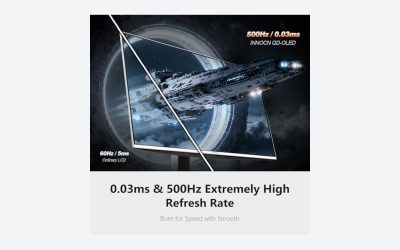
Response-time figures quoted on boxes are notoriously optimistic and measured inconsistently, so two monitors both claiming “1ms” can look very different in a fast game. Refresh rate tells you how many frames per second the panel can show, but not how cleanly each frame resolves during rapid movement. ClearMR was created by VESA, the industry body behind DisplayPort and DisplayHDR, to give buyers a standardized, tested measure of motion clarity instead of marketing numbers.
How ClearMR is measured
ClearMR works from a ratio of clear pixels to blurry pixels when content is in motion. Testing equipment captures how much a moving edge smears, and the panel earns a tier based on that ratio. A higher tier means a higher proportion of clear pixels, which translates to crisper motion. The certification tiers are named by roughly a thousand times that clear-to-blur ratio, so the badge number scales with clarity.
| ClearMR tier | Approx. clear-to-blur ratio | Relative motion clarity |
|---|---|---|
| ClearMR 3000 | ~25-35 to 1 | Entry improvement |
| ClearMR 5000 | ~45-55 to 1 | Good |
| ClearMR 7000 | ~65-75 to 1 | Very good |
| ClearMR 9000 | ~85-95 to 1 | Excellent, top tier |
What the tier names mean
The number in a ClearMR tier is centered on a target ratio: ClearMR 7000, for example, sits around a 70-to-1 ratio of clear to blurry pixels, within a defined tolerance. You do not need to memorize the math; just read it as “higher badge number equals cleaner motion.” It is a comparative shorthand, much like DisplayHDR tiers signal brightness capability.
Why it is more useful than response time alone
Because ClearMR is tested to a common method by an independent standard, it lets you compare motion clarity across brands on a level field, which raw response-time claims never allowed. It captures the combined effect of refresh rate, pixel response, and any blur-reduction features, giving a single result that reflects what your eyes actually see. For fast shooters and racing games, a higher ClearMR tier is a more trustworthy signal of sharp motion than a “1ms GtG” sticker.
What it does not tell you
ClearMR measures motion clarity, not color, contrast, HDR performance, or input lag. A monitor can earn a high ClearMR tier and still have mediocre color or high latency, so treat it as one useful data point among several. It also does not replace refresh rate as a spec; the two are related but distinct, and you still want to match refresh rate to your GPU’s frame output.
Frequently asked questions
Is a high ClearMR tier the same as a high refresh rate?
No. Refresh rate is how many frames per second the panel can display; ClearMR measures how clean each moving frame looks. A high refresh panel usually scores well, but ClearMR also reflects pixel response and blur-reduction, so it is a more complete motion-clarity indicator than refresh rate by itself.
Should I only buy monitors with ClearMR certification?
It is a helpful signal but not a requirement. Many excellent monitors are not submitted for certification, since it is voluntary. When a monitor does carry a ClearMR badge, use it to compare motion clarity with confidence, but judge the whole package including color, contrast, latency, and price.
Bottom line
VESA ClearMR is a standardized, independently researched rating of motion clarity based on the ratio of clear to blurry pixels in motion, with higher tiers like ClearMR 9000 meaning sharper movement. It is a more trustworthy guide to how clean a fast game will look than optimistic response-time claims, and a useful data point to weigh alongside refresh rate, color, and latency.