
The Short Answer
Yes, a heavy-duty monitor arm is absolutely worth buying, but only if your monitor weighs more than 20 pounds or measures over 32 inches diagonally. If you own a massive 49-inch curved ultrawide gaming monitor or a heavy professional color-grading display, a standard monitor arm will fail, causing your screen to sag, tilt forward, or even drop onto your desk.
For large displays, upgrading to a heavy-duty arm is the only way to ensure structural safety, reclaim desk space, and achieve true ergonomic adjustability. However, if you are using a standard 24-inch or 27-inch office monitor that weighs under 15 pounds, a heavy-duty arm is an unnecessary over-engineered expense; a basic, budget-friendly desk mount will serve you just as well.
As an Amazon Associate we earn from qualifying purchases at no extra cost to you. Product prices and availability are accurate as of the date shown and are subject to change.

What You Actually Get
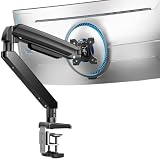
When you step up to a heavy-duty monitor arm, you are not just paying for a larger piece of metal; you are investing in upgraded mechanical engineering designed to combat gravity and leverage. Heavy monitors—especially curved ultrawides—exert an immense amount of forward rotational force on a mount’s tilt joint. Standard arms use friction-based tilt joints that slip under this pressure. Heavy-duty arms utilize reinforced, high-tension mechanical springs or heavy-gas cylinders specifically calibrated to balance heavy loads.
In practice, a heavy-duty arm provides several mechanical upgrades:
- Reinforced Desk Clamps: Standard mounts often rely on a small, single C-clamp. Heavy-duty models use massive dual C-clamps or thick steel grommet plates to distribute up to 44 pounds of weight across a wider surface area, preventing your desk from cracking under the concentrated pressure.
- Industrial-Grade Materials: While cheap arms rely heavily on plastic shrouds and thin structural steel, heavy-duty alternatives are built with die-cast aluminum and heavy-gauge steel alloys to eliminate arm flex.
- High-Capacity Tension Adjustments: These arms feature massive internal springs. On entry-level heavy-duty models like the ErGear Heavy Duty Monitor Arm (priced around $39.99), you get a weight capacity of 37.4 pounds. Premium aluminum options like the HUANUO TitanLift (priced around $97.99) push that capacity up to 44 pounds, offering incredibly smooth height adjustments despite the extreme weight.
- Upgraded Tilt Mechanisms: The tilt joint is the primary failure point for large screens. Heavy-duty arms feature heavy-duty locking bolts or specialized tilt heads designed to keep curved screens perfectly vertical without drooping.
Pros
- Rock-Solid Stability: Standard arms bounce and wobble when you type. A heavy-duty arm anchored with a dual C-clamp dampens vibrations, keeping your massive screen perfectly still even during aggressive typing or gaming sessions.
- Vast Desk Space Reclamation: Large monitors require humongous, deep stock stands that can easily swallow 1.5 square feet of your desk. Elevating the screen on a single heavy-duty pillar completely clears your desktop for keyboards, notebooks, and audio gear.
- Precise Ergonomic Alignment: Large screens are incredibly sensitive to height and tilt adjustments. A heavy-duty arm allows you to easily adjust a 40-pound screen with one hand, helping you position the top third of the screen at eye level to prevent neck strain.
- Future-Proofing Your Workspace: Desktop displays are getting wider and heavier. As display manufacturers release even larger, more immersive panels leading into 2026, investing in a robust mount now ensures your desk setup is prepared for your next major screen upgrade.
- Clean Cable Management: Heavy-duty arms feature deep, integrated routing channels with heavy plastic or steel covers. These safely tuck away thick power bricks and multiple DisplayPort cables that large screens require.
Cons
- High Cost of Entry: While basic monitor arms can be found for $20 to $30, reliable heavy-duty arms generally range from $40 to over $100. Ultra-premium options can easily exceed $300.
- Bulky Visual Profile: To support 40 pounds safely, these arms must be thick. The mounting brackets, heavy dual clamps, and wide articulating joints can look industrial and bulky, which may clash with minimalist home office aesthetics.
- Risk of Desk Damage: Concentrating 30 to 45 pounds of weight onto a tiny section of your desk can warp or crush cheap materials. If you use a hollow-core desk (such as paper-honeycomb filled IKEA tops), a heavy-duty arm can punch a hole straight through the surface without a steel reinforcement plate.
- Difficult and Rigid Installation: Installing these mounts is a two-person job. Holding a 40-pound ultrawide monitor steady while trying to slide its VESA plate into a heavy-duty arm mount requires patience and physical strength.
Who Should Buy It
You should buy a heavy-duty monitor arm if you own an ultrawide or super-ultrawide monitor (such as 34-inch, 38-inch, or 49-inch models like the Samsung Odyssey G9). It is also highly recommended for creative professionals who use heavy, color-accurate 32-inch displays for video editing, design, or architecture. If you frequently transition between sitting and standing at an adjustable desk, a heavy-duty arm is essential to keep your heavy screen from shaking violently every time the desk motor moves.
Who Should Skip It
You should skip this upgrade if you use a standard 24-inch or 27-inch monitor that weighs under 15 pounds. A heavy-duty arm’s internal spring tension is often too strong for lightweight monitors; if your screen is too light, the arm’s gas spring will force the monitor to constantly rise to its maximum height, making it impossible to position correctly. You should also pass on these heavy mounts if your desk is made of thin glass or hollow particleboard, as the clamping force required to secure the arm safely can easily shatter or snap these surfaces.
Cheaper Alternatives
If a premium, heavy-duty articulating arm does not fit your budget, there are alternative ways to mount or elevate your monitor. The table below outlines the most common alternatives, their average costs, and the trade-offs you must accept.
| Option | Cost Range | Key Trade-off |
|---|---|---|
| Standard Gas-Spring Arm | $25 – $35 | Weight capacity tops out around 14 to 18 pounds. Heavy monitors will cause the arm to sag completely, and the tilt joint will slip, forcing the screen to point downward. |
| Static Steel Pole Mount | $30 – $45 | Extremely strong and stable, but lacks dynamic height adjustment. You must manually loosen a hex bolt on the pole collar to adjust height, which is dangerous to do alone with a heavy monitor. |
| Wooden or Acrylic Desk Riser | $15 – $30 | Completely eliminates the risk of desk clamp damage and is very cheap. However, it takes up physical desk space and offers zero screen tilt, rotation, or dynamic depth adjustment. |
| Wall Mount Bracket | $15 – $25 | Incredibly strong and cheap. However, it requires drilling directly into wall studs, completely ruins your ability to easily rearrange your desk layout, and offers limited depth adjustment. |
FAQ
Can I install a heavy-duty monitor arm on an IKEA desk?
It depends on the specific IKEA desk model. Solid wood tops (like the Gerton or Karlby) can easily handle heavy-duty clamps. However, hollow-core desks filled with paper honeycomb (like the Linnmon or Lagkapten) are highly susceptible to cracking under the concentrated pressure of a heavy-duty mount. If you must use a hollow desk, you should install a steel reinforcement plate on the top and bottom of the desk surface to distribute the clamping force.
What is the difference between a gas spring and a mechanical spring arm?
Gas spring arms use a pressurized gas cylinder to counterbalance the weight of the monitor, offering incredibly smooth, silent, and effortless movement. However, gas cylinders can slowly leak over several years, reducing their lifting capacity. Mechanical spring arms use heavy-duty steel coil springs. While they can sometimes be slightly noisier or require more physical effort to adjust initially, mechanical springs are incredibly durable and will never lose their tension over time.
How do I stop my heavy monitor from tilting downward on the arm?
This is the most common issue users face. Heavy-duty arms feature a dedicated tilt tension bolt located directly behind the VESA plate. This bolt is separate from the main arm elevation tension screw. To stop your monitor from drooping, you must use the included hex key to tighten this specific tilt bolt. For heavy monitors, you often have to tighten this bolt much harder than you initially expect to lock the tilt joint into place.
Do I need a dual C-clamp or is a single clamp sufficient?
For any screen weighing over 25 pounds, a dual C-clamp is highly recommended. A single clamp concentrates all the rotational torque onto a very narrow section of your desktop, which can cause the mount to lean or warp the wood. A dual C-clamp spreads this rotational leverage across a wider area, preventing desk damage and significantly reducing screen wobble when you type.
Related guides
- Is 49 Inch Super Ultrawide Worth It for Gaming? An Honest Answer
- Curved Ultrawide vs Flat Ultrawide Monitor for Gaming: Which Is Right for Your Home
- 1440p 240hz vs 4k 144hz Monitor for Gaming: Which Is Right for Your Home
- Gas Spring Monitor Arm vs Mechanical Spring Monitor Arm: Which Is Right for Your Home


