
A pair of heavy 32-inch monitors can turn a home office, gaming nook, or shared worktable into a cramped tangle of stands, cables, and awkward sightlines. The right dual monitor arm clears the desk surface while helping you place both panels at a more comfortable viewing height. But with larger screens, load capacity and desk-mount stability matter more than sleek styling.
For this 2026 roundup, we focused on dual-monitor mounts that support 32-inch screens or go beyond them, with special attention to stated weight limits, VESA compatibility, adjustment style, and layouts ranging from side-by-side workstations to vertical stacks. Before buying, confirm the weight of each monitor without its original stand and make sure your desk can accept the mount’s clamp or grommet setup.
As an Amazon Associate we earn from qualifying purchases at no extra cost to you. Product prices and availability are accurate as of the date shown and are subject to change.
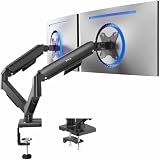

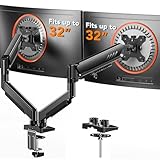


Top 3 picks at a glance
Quick Picks
| Product | Best for | Price |
|---|---|---|
| VIVO STAND-V002O Dual Monitor Stand | Classic adjustable support for standard 32-inch monitors | $49.99 |
| HUANUO Stacked Dual Monitor Stand | Vertical monitor arrangements | $59.99 |
| ErGear Dual Monitor Arm | Value-minded buyers who want tool-free VESA mounting | $34.99 |
| WALI Adjustable Dual Monitor Arm | Higher stated per-arm capacity on a budget | $32.99 |
| WALI Vertical Dual Monitor Mount | Large curved displays in a stacked layout | $94.99 |
| Acer Dual Monitor Arm | Gas-spring adjustment for everyday office setups | $69.99 |
| VIVO STAND-V120K Pneumatic Dual Ultrawide Mount | Dual ultrawides and especially demanding screen loads | $149.99 |
| VIVO STAND-V012K Extra Tall Dual Monitor Arm | Extra-tall positioning for a pair of 32-inch screens | $89.99 |
How We Picked
We ranked these mounts around the needs of buyers using large desktop displays: stated screen-size support, listed weight capacity, VESA fit, adjustment approach, and layout flexibility. A mount that accepts a 32-inch screen is not automatically suitable for every 32-inch model, because display weights vary substantially. We therefore gave extra consideration to options with more generous listed capacity and to mounts designed for ultrawide or curved screens.
We also considered the practical differences between mechanical, gas-spring, and pneumatic adjustment. Mechanical arms can suit a set-it-and-forget-it desk, while gas-spring and pneumatic designs are better aligned with frequent repositioning. Prices below are the provided product prices and should be weighed against the display size, weight, and arrangement you actually plan to use.
The 8 Best Picks
VIVO STAND-V002O Dual Monitor Stand
The VIVO STAND-V002O is a straightforward choice for a home office or gaming desk with a pair of conventional monitors. It supports screens from 17 to 32 inches, uses VESA 75×75 and 100×100 mounting patterns, and has a stated maximum of 19.8 pounds. Its mechanical articulating arms suit buyers who prefer a hands-on, stable adjustment system rather than a spring-assisted design. At $49.99, it lands in a useful middle ground for an uncomplicated dual-display upgrade.
- Pro: Supports screens up to 32 inches.
- Pro: Includes both VESA 75×75 and 100×100 compatibility.
- Con: The 19.8-pound stated maximum may be limiting for heavier 32-inch displays.
Skip it if either monitor exceeds the listed capacity or if you need an extra-tall mount.
HUANUO Stacked Dual Monitor Stand
For desks where width is scarce, the HUANUO dual monitor stand is the layout-focused option. Its stacked configuration keeps one monitor above the other, freeing lateral desk space for speakers, paperwork, or a laptop. It supports 17- to 32-inch screens, VESA 75/100mm mounting, and a stated maximum weight of 19.8 pounds. Tilt, swivel, and rotation adjustments give it useful ergonomic flexibility for coding, writing, editing, or pairing a main display with a secondary reference screen. The $59.99 price reflects its specialized vertical arrangement.
- Pro: Stacked layout conserves side-to-side desk space.
- Pro: Offers tilt, swivel, and rotate adjustment.
- Con: Its 19.8-pound maximum requires careful monitor-weight checking.
Skip it if you strongly prefer two screens positioned side by side.
ErGear Dual Monitor Arm
The ErGear Dual Monitor Arm is the budget pick for buyers who still want a full-adjustment mount for standard desktop displays. It is designed for 13- to 32-inch screens, supports VESA mounting up to 100x100mm, and lists a maximum load of 19.8 pounds. Its tool-free VESA mount is particularly appealing for anyone setting up a workstation without wanting an unnecessarily fussy installation process. At $34.99, it is among the least expensive ways to move two compatible monitors off their original stands.
- Pro: Tool-free VESA mounting can simplify screen installation.
- Pro: Low $34.99 price makes it a strong value option.
- Con: The stated 19.8-pound maximum leaves little room for unusually heavy panels.
Skip it if your displays are heavy, oversized, or require a mount beyond VESA 100x100mm.
WALI Adjustable Dual Monitor Arm
The WALI Adjustable Dual Monitor Arm stands out for its stated 22-pound capacity per arm, a meaningful advantage for shoppers concerned that their 32-inch monitors may sit near the limits of many standard dual mounts. It supports screens from 13 to 32 inches, making it appropriate for a mixed-size setup as well as a matched pair. At $32.99, it combines a notably low price with a higher listed per-arm weight figure than several alternatives here. That makes it a practical candidate for buyers prioritizing load capacity over specialty features.
- Pro: Listed capacity reaches 22 pounds per arm.
- Pro: Offers support for screens from 13 to 32 inches.
- Con: It is not the purpose-built choice for displays larger than 32 inches.
Skip it if you need a vertical arrangement for very large curved or ultrawide screens.
WALI Vertical Dual Monitor Mount
The WALI Vertical Dual Monitor Mount is the specialist pick for a stacked workstation built around larger displays. It supports 17- to 49-inch curved screens and lists support up to 33 pounds, giving it far broader screen-size coverage than a typical dual arm for standard office monitors. This is the mount to consider when a vertical display layout is essential and your setup includes a curved panel or a screen larger than 32 inches. Its $94.99 price is higher than basic mounts, but its stated compatibility is considerably more ambitious.
- Pro: Supports curved screens up to 49 inches.
- Pro: Vertical layout can preserve valuable desk width.
- Con: The $94.99 cost is higher than standard dual-monitor arms.
Skip it if you want a simple, low-cost side-by-side mount for ordinary flat monitors.
Acer Dual Monitor Arm
The Acer Dual Monitor Arm is a sensible fit for office workers who adjust their screens throughout the day. Its gas-spring design is intended to make repositioning more convenient than a fixed mechanical arm, while its VESA mount supports screens from 17 to 32 inches. At $69.99, it is aimed at buyers who value smoother everyday movement and a cleaner desktop setup. It is best considered for conventional dual-monitor arrangements where both displays fall within its stated screen-size range and the desk can support the chosen mounting method.
- Pro: Gas-spring design is well suited to frequent adjustments.
- Pro: Supports common 17- to 32-inch monitor sizes.
- Con: No stated load figure is provided in the product details listed here.
Skip it if you need a clearly stated capacity before mounting particularly heavy screens.
VIVO STAND-V120K Pneumatic Dual Ultrawide Monitor Mount
The VIVO STAND-V120K is the premium heavy-duty choice for users moving beyond standard dual-monitor setups. It is a pneumatic, extra-tall desk mount designed for two ultrawide screens up to 49 inches, with a listed hold of up to 44 pounds. Its heavy-duty clamp makes it especially relevant for a desk supporting large, visually dominant displays used for trading, editing, simulation, or immersive gaming. At $149.99, it costs considerably more than basic arms, but it is also built for a distinctly more demanding category of screens.
- Pro: Designed for two ultrawide screens up to 49 inches.
- Pro: Extra-tall pneumatic design supports more ambitious positioning.
- Con: At $149.99, it is the most expensive pick in this roundup.
Skip it if you only use conventional 32-inch monitors and do not need ultrawide capacity.
VIVO STAND-V012K Extra Tall Dual Monitor Arm
The VIVO STAND-V012K is the best fit for buyers who need more height without stepping up to an ultrawide-focused mount. It supports screens up to 32 inches and uses mechanical height adjustment with full articulation. The included desk C-clamp and grommet mounting options give buyers flexibility when matching the mount to an existing desk. At $89.99, it is a good middle path between standard desktop arms and the more expensive pneumatic ultrawide option. It is especially useful where a tall viewing position is part of the workstation plan.
- Pro: Extra-tall design serves elevated monitor placement needs.
- Pro: Includes both desk C-clamp and grommet mounting options.
- Con: Mechanical height adjustment may not suit frequent repositioning.
Skip it if you want spring-assisted movement or need to mount screens larger than 32 inches.
Buying Guide
Match Capacity to the Actual Monitor Weight
Screen size is only the starting point. A 32-inch monitor can vary greatly in weight depending on its panel, curve, stand design, and built-in features. Check each monitor’s weight without its factory stand, then compare it with the arm’s stated capacity. For a pair of heavier 32-inch monitors, the WALI Adjustable Dual Monitor Arm’s stated 22 pounds per arm is more reassuring than options listed at 19.8 pounds. For large ultrawides, look to purpose-built options such as the VIVO STAND-V120K.
Choose the Right Layout and Adjustment Style
Side-by-side placement is the familiar choice for multitasking, while a stacked mount can be better for narrow desks or workflows centered on one primary display. The HUANUO and WALI vertical models suit that upright format. For adjustment, mechanical arms work well when the screens will mostly stay put. Gas-spring and pneumatic arms are better suited to users who regularly change monitor height or position, such as people switching between seated work, gaming, and collaborative viewing.
Confirm VESA and Desk-Mount Compatibility
Most monitors in this category use VESA mounting, but the pattern must match the arm. The VIVO STAND-V002O supports VESA 75×75 and 100×100, while the ErGear supports VESA mounting up to 100x100mm. Also inspect the desk before ordering. A C-clamp requires a usable desk edge, while a grommet mount requires an appropriate opening. The VIVO STAND-V012K offers both approaches, which can make it easier to adapt to an existing workstation.
Our Verdict
For most buyers seeking the best dual monitor arm for heavy 32-inch monitors, the WALI Adjustable Dual Monitor Arm offers the most compelling blend of price and stated capacity, with support up to 22 pounds per arm for $32.99. Choose the VIVO STAND-V120K when your setup involves ultrawide displays or calls for an extra-tall pneumatic mount. If your priority is a vertical workstation, the WALI Vertical Dual Monitor Mount is the stronger large-screen specialist.
FAQ
Can a dual monitor arm hold two 32-inch monitors?
Yes, provided the mount supports 32-inch screens and each monitor falls within the listed weight capacity. Size compatibility alone is not enough; verify the monitor weight without its original stand and check the VESA pattern before ordering.
What is the best option for especially heavy 32-inch monitors?
The WALI Adjustable Dual Monitor Arm is the strongest budget-oriented choice in this list based on its stated 22-pound capacity per arm. For substantially larger or ultrawide screens, the VIVO STAND-V120K is designed for two ultrawides up to 49 inches and lists a hold of up to 44 pounds.
Is a vertical dual-monitor mount better than a side-by-side arm?
Neither is universally better. A vertical mount saves desk width and works well for reference material above a primary display. A side-by-side layout is often more natural for spreadsheets, timelines, and workflows that require comparing content across both screens.
Do I need a VESA-compatible monitor?
For these mounts, VESA compatibility is central to installation. Check the mounting pattern on the back of each monitor and match it to the arm’s stated VESA support. Common options listed here include VESA 75×75 and 100×100.


