The best crates for German Shepherds are usually 42-inch crates for average adults, 48-inch crates for especially tall males or dogs that need more room, and heavy-duty steel or reinforced travel crates for determined chewers and escape artists.
A German Shepherd should be able to stand without lowering its head, turn around comfortably, lie fully on its side, and stretch out without being pressed against the walls. More space is not automatically better: an oversized crate can make house-training less effective and may be harder to secure in a vehicle.
As an Amazon Associate we earn from qualifying purchases at no extra cost to you.
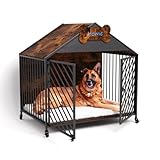

Our Top Picks
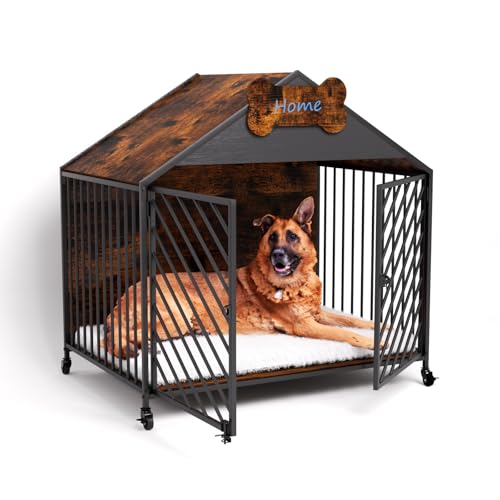 HEAHOLD Heavy Duty Dog Crate Furniture for LargeLarge39.4 x 24.7 x 36.9 inches56.3 PoundsCheck on Amazon
 52" Heavy Duty Dog Crate for German Shepherd47.2"L x 30.0"W x 48.2"H47.2 x 30 x 48.2 inches90 PoundsCheck on Amazon
Quick comparison: the best crate types for German Shepherds
| Crate type | Useful size range | Best for | Main advantage | Main limitation |
|---|---|---|---|---|
| 42-inch wire crate | Approximately 42″L × 28″W × 31″H | Most adult German Shepherds | Ventilation, visibility, divider panels | Can be bent or opened by strong escape artists |
| 48-inch wire crate | Approximately 48″L × 30″W × 33″H | Tall males and dogs that sleep stretched out | Extra length and height | Bulky and often too large for smaller adults |
| Heavy-duty steel crate | Usually 40–48 inches long | Chewers, climbers, and door-benders | Strong frames and reinforced doors | Heavy, expensive, and less portable |
| Impact-resistant travel crate | Choose by interior measurements, not label | Air and car travel | Protective shell and secure tie-down points | Less open ventilation than wire |
| Soft-sided crate | Usually 36–42 inches | Calm adults and temporary indoor use | Lightweight and quick to carry | Unsuitable for scratching, chewing, or escape attempts |
How to choose the correct dimensions
Measure your dog rather than relying only on weight or breed. German Shepherds vary substantially: a compact female and a large male may need different crates even when they are the same age.
- Length: Measure from the nose to the base of the tail, then add 4–6 inches.
- Height: Measure from the floor to the highest point of the head or ears while standing naturally, then add 3–4 inches.
- Width: Measure across the widest part of the body and add enough room for an easy turn, commonly 6–8 inches.
For example, suppose a German Shepherd measures 38 inches from nose to tail base and stands 29 inches tall. Adding 5 inches for length gives a 43-inch minimum interior length; adding 3 inches for height gives a 32-inch minimum interior height. A crate advertised as 42 inches may work if its actual interior is close to those figures, while a 48-inch model provides more stretching room but may be unnecessarily large for resting and training.
Check interior dimensions carefully. Exterior measurements include the frame, door, feet, and hardware, so a “42-inch” crate may have substantially less usable space inside. A thick bed also reduces floor height by several inches.
Best overall choice: a 42-inch wire crate with two doors
For many adult German Shepherds, a 42-inch wire crate with a divider is the most practical starting point. Models such as the MidWest iCrate are widely available in this general format and commonly include a removable plastic pan, folding frame, and front-and-side access.
Two doors matter more than they first appear. The front door works in a hallway or against a wall, while the side door lets you position the crate across a room or inside a vehicle. Multiple access points also make it easier to remove a dog safely during an emergency.
Why wire works well
- Open sides provide strong airflow for a double-coated breed.
- A divider lets a puppy use a smaller sleeping area and expand it as it grows.
- The folding frame is easier to store than a rigid steel kennel.
- Many dogs prefer the visibility because they can see household activity.
Wire is not ideal for every dog. A German Shepherd that repeatedly bites bars, lifts latches, or throws its body against the door needs a stronger crate, not simply a larger one. Covering a wire crate may reduce visual stimulation, but it does not repair a weak latch or prevent a determined escape.
Best for escape artists: reinforced steel crates
A heavy-duty steel crate is the better choice when your dog has already defeated ordinary wire crates. Look for welded panels, narrow bar spacing, protected hinges, a door that cannot be pushed inward, and multiple locking points. Products such as the ProSelect Empire Dog Cage represent this heavier class, although the exact dimensions and door design should still be checked against your dog’s measurements.
Choose a crate with enough headroom rather than buying the largest available model. Extra interior volume increases weight and can give an anxious dog more room to build momentum against a door. Place the crate on a level surface, inspect every fastener regularly, and avoid adding collars or harnesses that could catch on bars.
Heavy-duty crates are usually poor choices for frequent carrying. A large steel model can weigh many times more than a folding wire crate, and its weight may exceed what one person can safely move with a dog inside.
Best for travel: impact-resistant crates
For vehicle or air travel, an impact-resistant plastic or composite crate offers a more enclosed, protective structure than wire. The Gunner G1 Kennel is an example of this category. Travel crates should be selected by their internal length and height, not by the external product name or a general “large dog” label.
For car use, prioritize:
- Reliable tie-down points that align with your vehicle’s cargo anchors.
- A door that cannot be opened by a nose or paw.
- Ventilation on more than one side.
- A leak-resistant floor that can be cleaned after an accident.
- Enough clearance for the dog to stand naturally without touching the roof.
Do not assume that a crate suitable for a car is automatically approved for airline transport. Airlines and jurisdictions can impose specific requirements for ventilation, fasteners, water containers, and dimensions. Confirm the current carrier’s rules before purchasing a travel crate.
Decision matrix: match the crate to your dog’s habits
| Your situation | Recommended crate | Why | Avoid |
|---|---|---|---|
| Healthy adult, calm indoors | 42-inch two-door wire crate | Good airflow, visibility, and flexibility | Oversized 48-inch crate without a reason |
| Growing puppy | 42-inch or 48-inch wire crate with divider | One purchase can accommodate growth | Giving the puppy the entire space immediately |
| Chews bars or opens simple latches | Reinforced steel crate | Resists bending and latch attacks | Soft-sided or lightweight wire models |
| Frequent car travel | Impact-resistant travel crate with tie-downs | Better containment and crash-oriented construction | Unsecured wire crate in the cargo area |
| Calm dog at hotels or events | Foldable soft-sided crate | Light and quick to transport | Using it for unsupervised chewing or anxiety |
Door styles and placement
A single front door is adequate when the crate will stay in one location. A two-door design is more adaptable, especially if you might move the crate between rooms. A top-loading opening can help place a small animal into a crate, but it is not usually important for an adult German Shepherd and can add weight or complexity.
Inspect the door threshold before buying. A raised lip can catch a paw, particularly for a puppy entering quickly. The latch should be easy for a person to operate but impossible for the dog to reach or manipulate through the bars. If the crate will sit near a wall, leave enough space to open the door fully without scraping it.
Materials, floor protection, and comfort
Wire crates generally use coated steel with a removable plastic pan. Plastic pans are quieter and easier to clean than bare metal, but a bored dog may chew exposed edges. Reinforced steel crates are stronger but transmit more noise and can become cold on hard floors. Composite and molded-plastic travel crates are easier to wipe down and block some visual distractions.
Use a thin, washable mat that fits without leaving a large gap around the edges. If your dog destroys bedding, begin with the bare pan and add cushioning after the destructive behavior has been addressed. Never use loose blankets, collars, or harnesses in an unattended crate if they can become tangled.
Frequently asked questions
Can I leave my German Shepherd’s collar or harness on in the crate?
No, avoid leaving a collar or harness on an unattended German Shepherd if it could become tangled. The article specifically warns against collars or harnesses that may catch on crate bars. Loose blankets can also create a tangling risk, so use only crate contents that cannot trap or entangle your dog while unsupervised.
How can I make a crate more comfortable without making it unsafe?
Use a thin, washable mat that fits the crate without leaving a large gap around its edges. If your dog destroys bedding, start with the bare pan and add cushioning after the destructive behavior has been addressed. A removable plastic pan is quieter and easier to clean than bare metal, while thick bedding reduces usable floor height.
Where should I place a crate in a room?
Place the crate on a level surface and leave enough room for the door to open fully without scraping a nearby wall. A two-door crate offers more placement flexibility because the front door works near a wall or hallway, while the side door can help when the crate is positioned across a room or inside a vehicle.
Is a crate that works in a car automatically suitable for flying?
No, a crate suitable for a car is not automatically approved for airline transport. Airlines and jurisdictions may have specific requirements for ventilation, fasteners, water containers, and dimensions. Confirm the current carrier’s rules before purchasing a travel crate, and select its internal length and height rather than relying on an external product name or a general large-dog label.
What should I do if my puppy grows into the crate?
Use a divider so the puppy’s sleeping area can expand as the dog grows. The crate should still provide enough room to stand naturally, turn around comfortably, lie fully on its side, and stretch out without being pressed against the walls. Do not give a puppy the entire space immediately if the extra room could make house-training less effective.
Final buying checklist
- Confirm the interior length and height against your dog’s measurements.
- Choose a divider for a puppy, but do not use it to compensate for an undersized crate.
- Pick two doors if the crate may be repositioned.
- Upgrade to reinforced steel after a real escape attempt, rather than repeatedly replacing light wire crates.
- For travel, prioritize tie-downs, ventilation, door security, and current transport rules.
- Buy a crate that can be moved safely by the people who will actually use it.
For most households, the best crate for a German Shepherd is a correctly measured 42-inch two-door wire crate with a divider. Choose a 48-inch version only when the dog’s measurements or sleeping style justify the extra length, and move to reinforced steel or an impact-resistant travel crate when escape behavior or vehicle safety makes ordinary wire inadequate.