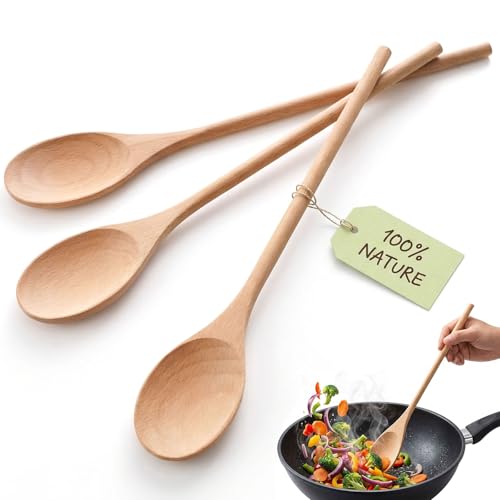
The best wooden spoons for cooking overall are the OXO Good Grips 3-Piece Wooden Spoon Set. Three solid hardwood tools cover the stir, fold, scrape and taste jobs that make up most everyday cooking, the handles are thick enough to grip through a folded towel, and the edges are smooth enough to move across nonstick, enamel and ceramic without leaving marks. If you want one set and no further shopping, that is the one to buy. Cooks who work with bare cast iron, carbon steel or high-heat searing should lean toward teak instead — the Mooues 9-Piece Teak Set and the Zulay Kitchen 6-Piece Teak Set both use a naturally oily hardwood that tolerates repeated moisture and heat cycling better than drier species. Tight budgets are covered by the HANSGO 12-Inch 3-Piece Mixing Spoons and the LorisArm 12/10/8-Inch Set, while anyone outfitting a first apartment should price the Riveira Dark Bamboo 6-Piece, which packs the widest shape range per utensil in this roundup. The rest of this guide compares wood species, spoon geometry, handle comfort and care routines so you can match a set to your pans and your cooking style rather than to a photo.
Our Top Picks



Top 3 picks at a glance
Quick Comparison
| Product | Best for | Key specs | Price tier |
|---|---|---|---|
| Riveira Dark Bamboo 6-Piece | Apartment kitchens and nonstick cookware | 6 pieces, dark carbonized bamboo, spatula plus spoon shapes, nonstick-safe edges | Premium |
| HANSGO 12-Inch 3-Piece Mixing Spoons | Budget deep-pot stirring | 3 mixing spoons, 12 in long handles, solid hardwood, natural finish | Budget |
| HAKSEN 2-Piece Acacia Spoons | A minimal two-tool kit | 2 cooking spoons, natural acacia wood, unfinished food-safe surface | Budget |
| OXO Good Grips 3-Piece Wooden Spoon Set | Everyday all-round cooking | 3 spoons, solid hardwood, contoured handles, tapered bowl edges | Mid-range |
| MORGLES 5-Piece 12-Inch Spoons | Volume cooking and large households | 5 spoons, 12 in handles, assorted bowl sizes | Mid-range |
| Hefild 10-Piece Acacia Utensil Set | Full-kitchen outfitting and gifting | 10 utensils, acacia wood, includes turner, slotted and spatula shapes | Premium |
| Mooues 9-Piece Teak Set with Spoon Rest | Cast iron and high-heat cooks | 9 pieces, natural teak, spoon rest included, oily moisture-resistant hardwood | Premium |
| Riveira Bamboo 3-Piece | Small households and starter sets | 3 pieces, bamboo, spatula plus spoon, nonstick-safe edges | Mid-range |
| OXO Good Grips Corner Spoon & Scraper | Pan scraping and corner work | 2 pieces, corner spoon plus scraper, solid hardwood | Mid-range |
| LorisArm 3-Piece 12/10/8-Inch Spoons | Graduated lengths for varied pots | 3 serving and mixing spoons at 12 in, 10 in and 8 in | Budget |
| Zulay Kitchen 6-Piece Teak Set | Humid kitchens and gifting | 6 pieces, teak wood, mixed spoon and spatula shapes | Premium |
| OXO Good Grips Large Wooden Spoon | Single-spoon replacement | 1 large spoon, solid hardwood, long contoured handle | Budget |
How We Chose
This roundup is built from published product listings, brand documentation and well-established facts about wood as a kitchen material — not from laboratory work or kitchen trials. Every pick had to clear four filters. First, specification clarity: the listing had to state the wood species or a defensible spec class, the piece count and the utensil lengths, because those three numbers determine almost everything about how a spoon performs. Second, category fit: we grouped candidates by the job they are actually shaped for — long-handle mixing, corner scraping, nonstick-safe folding, serving — rather than treating every spoon as interchangeable. Third, cookware compatibility: a tool that is safe on bare cast iron is not automatically the best choice for a coated nonstick pan, and we weighted edge geometry accordingly. Fourth, upgrade path: we favored sets that can be extended or replaced one piece at a time over bundles of near-duplicate shapes, because most cooks end up adding a single corner spoon or ladle later. Where a manufacturer does not publish a species or hardness figure, we describe the tool by spec class instead of guessing a number.
1. Riveira Dark Bamboo 6-Piece – Best for Apartment Kitchens and Nonstick Cookware
As an Amazon Associate we earn from qualifying purchases at no extra cost to you.
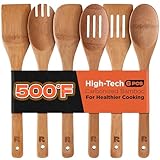
The Riveira Dark Bamboo six-piece set is the pick for anyone cooking in a small kitchen on coated cookware. Bamboo is technically a grass rather than a timber, and that difference matters in a cramped galley: the material is dense, dimensionally stable and far less prone to the seasonal swelling that opens cracks in softer hardwoods. The dark finish comes from a carbonization step that steams the bamboo under heat, deepening the color and slightly reducing the sugar content near the surface. The set is built around the two shapes a nonstick pan actually needs — a spatula-style turner for eggs, fish and crepes, and a spoon for sauces and stirring — then fills out the rest of the six pieces with variations on those themes. For a rental apartment with two pans and one drawer, that coverage is close to ideal.
Key specifications
- Six pieces in one bundle: spatula-style turner plus spoon shapes
- Material: carbonized (dark) bamboo, laminated construction
- Edge profile: rounded and sanded, intended to be safe on coated nonstick
- Finish: food-safe oiled surface, no visible lacquer
- Typical per-utensil weight: light, in the 25–45 g class, so wrist fatigue stays low during long stirs
- Care class: hand wash, dry immediately, periodic re-oiling
The strengths here are consistency and coverage. Buying six pieces from one maker means the handles share a profile and the bowls share a rim thickness, so the set feels like a set rather than a drawer of mismatched tools. Bamboo’s tight grain also resists staining better than open-pored hardwoods — a turmeric-heavy curry or a tomato reduction leaves less permanent color behind on a sealed bamboo surface. Because bamboo laminates are glued from strips, the material is less likely to develop a long split running the length of the handle than a single-piece softwood spoon, though the trade-off is that a hard knock can chip the edge rather than dent it.
The main caveat is heat. Bamboo is hard and relatively brittle compared with teak or olive, so leaving a piece resting in a hot skillet for several minutes is more likely to scorch the surface and leave a permanent dark mark. Treat these as tools you hold, not tools you park in the pan. The dark finish also hides the first signs of wear — light surface fuzzing, the fuzzy “grain raise” that appears when wood absorbs water — longer than a pale finish would, which is convenient but means you should check the edges by feel rather than by eye.
Pros
- Six coordinated pieces cover turn, fold, stir and serve in one purchase
- Carbonized bamboo is dense, stable and resistant to staining
- Light weight keeps long stirring sessions comfortable
- Rounded edges suit nonstick, enamel and ceramic coatings
- Compact enough for a single apartment drawer
Cons
- Bamboo is harder and more chip-prone than teak or olive under impact
- Six pieces include some near-duplicate shapes rather than six distinct tools
- Scorches visibly if left resting in a hot pan
- Laminated construction is less repairable than a single-piece hardwood spoon
Compared with the Riveira Bamboo 3-Piece further down this list, the six-piece version is the better buy for a two-person household that cooks most nights, because it removes the need to wash a single spoon between courses. The three-piece version makes more sense if you already own a turner and only need to add spoon shapes. Against the Hefild 10-Piece Acacia Set, the Riveira bundle is the lighter, cheaper-feeling option with fewer specialty shapes, but it is also easier to store and less intimidating as a first set.
2. HANSGO Wooden Spoons, 12-Inch Long Handle Mixing Spoons, 3 PCS – Best for Budget Deep-Pot Stirring
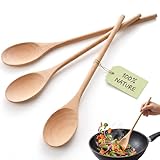
The HANSGO three-piece set is the value pick for anyone who stirs big volumes — stock pots, chili, jambalaya, big batches of tomato sauce. The defining number is the 12-inch handle. That extra length is not a cosmetic choice; it keeps your knuckles clear of a rolling simmer and gives you enough leverage to move a heavy ragù without gripping the bowl of the spoon. If you regularly cook one-pot meals for four or more people, handle length is the specification that matters most, and this set delivers it at the entry price tier.
Key specifications
- Three mixing spoons in one set
- Handle length: 12 in (approximately 30 cm) on each piece
- Material: solid hardwood, natural finish, species not specified in the listing
- Bowl style: rounded mixing spoon, solid (not slotted)
- Finish: food-safe oil, sanded surface
- Care class: hand wash and dry, oil when the surface stops beading water
The case for this set is straightforward economics. Three long spoons at a budget tier cost less than a single premium hardwood spoon, which makes them a sensible choice for a second kitchen, a camper, a rental, or a household where utensils get borrowed and lost. Solid wood is also genuinely better than metal here for one specific reason: it does not conduct heat. A 12-inch stainless spoon left in a simmering pot becomes a burn hazard along its whole length, while a wooden one stays comfortable to grab.
Because the species is not stated, treat this as a generic hardwood set and plan your care routine accordingly. Unspecified hardwoods are often beech or a rubberwood-type material — both perfectly serviceable, both more absorbent than teak or acacia, and both more likely to raise grain and stain if they sit wet. The practical consequence is that these spoons reward discipline: wash, dry immediately with a towel rather than a rack, and re-oil more often than you would a teak set. Do that and they will outlast a plastic spoon by years; skip it and they will gray out and split within a season of heavy use.
Shape-wise, the solid rounded bowl is the right call for stirring and portioning but wrong for lifting food out of liquid — there is no slotting, so a spoonful of vegetables comes up with a spoonful of broth. That is a design limitation, not a defect, and it is exactly why a set like this works best as a companion to a slotted tool rather than as your only utensil.
Pros
- 12-inch handles keep hands clear of splatter and steam
- Three identical-purpose spoons means always having a clean one
- Lowest entry cost of any set in this roundup
- Wood does not conduct heat, unlike a metal spoon of the same length
- Ideal second set for a camper, rental or backup kitchen
Cons
- Wood species is not specified, so durability is a generic-hardwood proposition
- No slotted, corner or spatula shapes in the bundle
- Absorbent wood needs more frequent oiling than teak or acacia
- Three spoons of the same shape is redundant if you only stir occasionally
Against the LorisArm 3-Piece 12/10/8-Inch Set, the HANSGO bundle wins on uniformity — three identical 12-inch spoons — while LorisArm wins on versatility, since its graduated lengths let you match the tool to the pot. If your cooking is dominated by one big stock pot, take the HANSGO. If you move between a saucepan, a skillet and a Dutch oven in the same session, the LorisArm set’s shorter 8-inch spoon will be handier for tasting and finishing.
3. HAKSEN 2 PCS Wooden Cooking Spoons, Natural Acacia Wood – Best for a Minimal Two-Tool Kit

The HAKSEN two-piece acacia set is for the cook who has already decided that two spoons are enough. Acacia is a dense, close-grained hardwood with a pronounced figure — dark streaks running through a lighter field — and it sits at the harder end of the common kitchen-wood range. That hardness translates into resistance to denting and scratching, which is why acacia turns up so often in cutting boards and serving boards. For a small household, a couple of acacia spoons cover stirring, folding, tasting and serving without cluttering a drawer.
Key specifications
- Two cooking spoons per set
- Material: natural acacia wood, stated in the listing
- Finish: natural, food-safe oiled surface, no stain or lacquer
- Grain: dense and closed, with visible natural color variation between pieces
- Density class: high for a kitchen wood, roughly in the 0.60–0.80 g/cm³ range depending on species and grain orientation
- Care class: hand wash, dry immediately, oil every 4–8 weeks with regular use
The main advantage of acacia in a kitchen is that it behaves like a premium wood at a mid-tier price. Its hardness means the bowl edge resists the nicks that accumulate on softer spoons, and its closed grain limits how much liquid and pigment soaks into the surface. Cooks who make a lot of tomato sauce, curry or beet dishes will notice the difference: an acacia spoon stains less readily than beech or a generic soft hardwood, and the natural dark streaks in the grain camouflage the staining that does occur.
Two spoons is a deliberate constraint. There is no slotted spoon, no turner, no corner scraper, so this set is best understood as a supplement to tools you already own rather than a complete answer. The upside is that two well-made spoons get used constantly and wear evenly, and there is nothing in the bundle you will never touch. The downside is that if one is in the sink, you are down to a single tool.
Natural acacia also varies from piece to piece. Two spoons in the same set may differ noticeably in color and even slightly in weight, because the wood is finished rather than stained. That is a feature of the material, not a quality-control failure, but buyers who expect a matched pair should set expectations accordingly. Handle thickness on a two-piece set of this class is typically in the comfortable 18–22 mm range, thick enough for a full-handed grip without feeling like a rolling pin.
Pros
- Dense acacia hardwood resists denting, scratching and staining
- Natural finish with no lacquer or dye to flake off
- Two pieces is a genuinely low-clutter solution
- Closed grain absorbs less liquid than generic soft hardwoods
- Budget tier pricing for a hardwood species usually sold at a premium
Cons
- No slotted, corner or spatula shapes included
- Color and weight vary between individual pieces
- Dense acacia can chip rather than flex if dropped on a hard floor
- Two spoons is not enough for a household cooking multiple dishes at once
Set against the OXO Good Grips 3-Piece Wooden Spoon Set, the HAKSEN pair is the more specialized buy: acacia’s density and figure give it an edge in stain resistance, while the OXO set wins on shape coverage and handle ergonomics. If you want two beautiful, hard-wearing spoons for a small kitchen, take the HAKSEN. If you want a set that handles every stirring job without a second purchase, the OXO three-piece is the more complete answer.
4. OXO Good Grips 3-Piece Wooden Spoon Set – Best Overall for Everyday Cooking
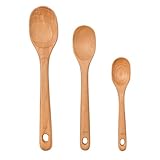
The OXO Good Grips three-piece wooden spoon set is the best all-round choice for most kitchens, and the reason is shape coverage rather than material novelty. OXO’s wooden utensil line uses a solid hardwood — commonly beech — finished smooth and shaped with contoured handles and tapered bowl edges. Three pieces is the sweet spot: enough variety to handle stirring, folding and serving, few enough that every spoon earns its drawer space. If you are replacing a drawer of melted plastic tools and want one purchase to cover the basics, this is it.
Key specifications
- Three wooden spoons in assorted sizes and bowl shapes
- Material: solid hardwood, typically beech in this product line
- Handles: contoured with a flattened profile that resists rolling off a counter
- Bowl edges: tapered and sanded smooth for coated cookware
- Finish: food-safe oil, sanded surface
- Care class: hand wash, dry immediately, oil when water stops beading
Handle comfort is where this set separates itself from cheaper bundles. A contoured handle with a slight flattening along its length gives your thumb and forefinger something to register against, which reduces the grip fatigue that builds up during a long risotto stir. The same flat spot keeps the spoon from rolling when you set it down, a small thing that matters more than it sounds when you are working one-handed at the stove. Bowl edges are tapered thin enough to slide under a fried egg without tearing the yolk, but not so thin that they feel fragile.
Beech is a sensible middle-of-the-road species. It is hard enough to resist denting under normal use, closed-grained enough to clean up easily, and widely available, which keeps replacement cost low. It is not naturally oily the way teak is, so it will absorb water if you leave it soaking, and it will raise a fine fuzz on the surface after its first few washings. That fuzz is normal, harmless, and removable — a light pass with fine sandpaper followed by a re-oil restores the surface completely.
The set’s limitation is that three spoons cannot cover everything. There is no slotted spoon for lifting vegetables out of liquid and no wide turner for flipping. That is why OXO also sells the Corner Spoon & Scraper pair and a standalone Large Wooden Spoon, both covered below, which can be added later as an upgrade path rather than replaced wholesale.
Pros
- Three genuinely distinct shapes cover the majority of cooking tasks
- Contoured, flattened handles reduce grip fatigue and resist rolling
- Tapered bowl edges are safe on nonstick, enamel and ceramic
- Widely available hardwood keeps replacement pieces inexpensive
- Easy to extend later with OXO’s individual wooden tools
Cons
- No slotted spoon or wide turner in the bundle
- Beech is not naturally oil-rich and needs regular re-oiling
- Surface fuzz appears after the first few washings until the grain settles
- Three pieces can feel thin for a household cooking several dishes nightly
The nearest alternative in this list is the MORGLES 5-Piece 12-Inch Set. MORGLES gives you two more spoons and longer handles for volume cooking; OXO gives you better ergonomics and a more considered shape range in a smaller footprint. For a two-person household cooking most nights, the OXO set is the cleaner choice. For a family batch-cooking on weekends, the extra length and count of the MORGLES set is worth the trade in refinement.
5. MORGLES 5-Piece Wooden Spoons, 12-Inch Long Handle – Best for Volume Cooking and Large Households
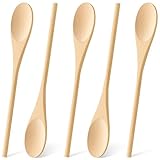
The MORGLES five-piece set targets cooks who work in volume. Five spoons with 12-inch handles means you can stir a big pot, taste with a second spoon and still have a clean tool in reserve without running the sink mid-session. For a household of four or more, or anyone who batch-cooks on a weekend, that redundancy is the whole point. It sits at the mid-range tier, above the bare-budget bundles and below the premium hardwood sets.
Key specifications
- Five wooden spoons per set
- Handle length: 12 in (approximately 30 cm)
- Material: solid hardwood, natural food-safe finish
- Bowl shapes: assorted sizes across the five pieces
- Finish: sanded and oiled, no lacquer
- Care class: hand wash, dry immediately, oil every 4–8 weeks
Five spoons at 12 inches solves a specific logistical problem: the wash-cycle bottleneck. In a household that cooks two dishes a night, a three-piece set spends part of every evening in the drying rack. A five-piece set absorbs that demand without anyone reaching for a metal spoon and scratching a pan. Longer handles also matter more than most buyers expect — at 12 inches you can stir a deep stock pot without your forearm hovering over steam, and you can reach the bottom of a tall pasta pot without submerging your knuckles.
The trade-off with long handles is balance. A 12-inch spoon with a heavy bowl feels tip-heavy in the hand and tires the wrist faster during fine work like folding batter or scrambling eggs. If most of your cooking happens in a 10-inch skillet, these spoons will feel oversized. They are at their best in Dutch ovens, stock pots, woks and large saucepans.
As with any set whose species is not specified, plan for generic-hardwood care: no soaking, no dishwasher, dry with a towel rather than air-drying on a rack, and re-oil on a schedule rather than waiting for visible dryness. The reward for that routine is a set that costs a fraction of a teak bundle and still delivers years of service. Wooden spoons fail from neglect far more often than from material quality.
Pros
- Five spoons keeps a clean tool available through a full cooking session
- 12-inch handles suit stock pots, Dutch ovens and woks
- Assorted bowl sizes give more flexibility than three identical spoons
- Mid-range pricing without a premium-species markup
- Good fit for batch cooking and meal prep
Cons
- Long handles feel tip-heavy for delicate work in small pans
- Wood species is not stated, so longevity depends on care routine
- No slotted or turner shapes included
- Five spoons is more drawer space than a one- or two-person kitchen needs
Against the Hefild 10-Piece Acacia Set, MORGLES is the more focused purchase: five tools you will actually use versus ten that include specialty shapes some cooks never touch. Against the HANSGO 12-Inch 3-Piece, MORGLES is the upgrade — same handle length, two more pieces, better finish consistency. If you are stepping up from a budget set because you keep running out of clean spoons, this is the natural next rung.
6. Hefild 10-Piece Acacia Wood Cooking Utensil Set – Best for Full-Kitchen Outfitting and Gifting

The Hefild ten-piece acacia set is the pick when you want to replace an entire drawer in one order, or when you are buying a housewarming gift that looks considered rather than generic. Ten utensils in acacia wood covers the full working range — spoon shapes, a turner, a slotted piece and a spatula — which means no follow-up purchase and no mismatched odds and ends. Acacia’s density and figure give the set a visual consistency that cheaper mixed-hardwood bundles rarely achieve.
Key specifications
- Ten utensils in one set
- Material: acacia wood, stated in the listing
- Shape coverage: spoon, turner, slotted and spatula-style pieces
- Grain: dense, closed, with natural dark streaking through each piece
- Finish: food-safe oil, sanded surface, no lacquer
- Care class: hand wash, dry immediately, oil every 4–8 weeks
The advantage of buying a large set from a single maker is uniformity of finish and rim thickness. When every utensil shares the same edge geometry, you stop thinking about which tool is safe on which pan — they all are, provided you keep them out of the dishwasher. Ten pieces also means you can dedicate tools to tasks: one spoon for coffee and dry spices, one for sauces, one for serving, without cross-contaminating flavors. Cooks who notice that a spoon used for garlic tastes of garlic the next morning will appreciate the separation.
Acacia is a genuinely good kitchen species. It is dense enough to resist denting, closed-grained enough to resist staining, and hard enough that the edge holds its shape through repeated contact with a hot pan. It does have a brittleness that teak and olive lack: dropped on a tile floor, a dense acacia handle is more likely to chip than to bounce. Treat the set as durable but not indestructible.
The practical risk with a ten-piece bundle is that three or four pieces become drawer ballast — the slotted spoon you never use, the duplicate spatula. Before buying, count the utensil shapes you actually reach for in a typical week. If that number is six, a ten-piece set means four pieces will be stored rather than used, which is not a defect but is worth knowing in advance.
Pros
- Ten pieces replace a full drawer in a single purchase
- Acacia is dense, closed-grained and stain-resistant
- Includes turner and slotted shapes that smaller sets omit
- Uniform finish and edge profile across the whole set
- Strong presentation for a housewarming or wedding gift
Cons
- Several pieces may go unused in a small household
- Dense acacia can chip if dropped on a hard floor
- Ten utensils demand more storage than a standard drawer provides
- Hand-wash-only care multiplied across ten pieces
Compared with the Zulay Kitchen 6-Piece Teak Set, Hefild wins on sheer coverage while Zulay wins on moisture resistance — teak’s natural oils make it the better choice in a humid climate or a kitchen where utensils sit wet more often than they should. Compared with the Mooues 9-Piece Teak Set, Hefild offers one more piece at a similar tier but gives up the included spoon rest, which is a small but genuinely useful accessory if you set spoons down on the counter between stirs.
7. Mooues 9-Piece Natural Teak Wooden Utensil Set with Spoon Rest – Best for Cast Iron and High-Heat Cooks
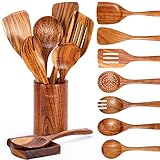
The Mooues nine-piece teak set is the right answer for anyone cooking on bare cast iron, carbon steel or a well-seasoned skillet. Teak is the standout kitchen hardwood because of its natural oil content: the wood carries its own moisture barrier, which slows water absorption and makes it more dimensionally stable across the heat-and-wash cycles that wreck drier species. The included spoon rest is a small addition that solves a real problem — where to put a dripping spoon when the counter is the only free surface.
Key specifications
- Nine utensils plus a spoon rest
- Material: natural teak wood
- Density class: roughly 0.60–0.70 g/cm³, with a naturally oily surface
- Hardness class: moderate for a hardwood, typically around the 1,000–1,150 lbf Janka range depending on species and grain orientation
- Finish: natural, food-safe, no lacquer
- Care class: hand wash, dry immediately, oil less often than beech or generic hardwood
Teak’s defining trait is that it tolerates imperfection in your routine. Where a beech spoon punished a forgotten soak with raised grain and a split, a teak spoon usually comes through with nothing worse than a duller surface. That resilience is why teak is the traditional choice for outdoor furniture and boat decks, and it translates directly to a kitchen where utensils get washed in a hurry. It is also more resistant to odor retention than open-pored softwoods, which matters if you cook with garlic, fish sauce or strong spices.
On bare cast iron, wooden tools are the correct choice for a second reason beyond scratch protection: they do not scrape off seasoning. Metal spatulas and spoons can lift the polymerized layer that makes a cast iron pan nonstick, and the damage is cumulative. A teak spoon or spatula glides across the surface without disturbing it. The included spoon rest reinforces that workflow — set the spoon down on wood rather than on the pan rim, where it will sit in residual heat and scorch.
The set’s trade-offs are weight and cost. Teak is denser and heavier in the hand than bamboo, so a long stir with a large teak spoon is more tiring than the same stir with a light bamboo one. And because teak commands a premium, a nine-piece set sits firmly in the upper tier. If you cook on coated nonstick and wash your utensils promptly, you are paying for durability you may not strictly need.
Pros
- Teak’s natural oils resist water absorption and splitting
- Safe on bare cast iron without disturbing the seasoning
- Spoon rest included solves the dripping-spoon problem
- Resists odor retention better than open-pored softwoods
- Nine pieces covers most cooking and serving tasks
Cons
- Heavier in the hand than bamboo, which tires the wrist on long stirs
- Highest price tier in this roundup
- Teak’s durability advantage is wasted if you already wash and oil diligently
- Nine pieces is more storage than a small kitchen can spare
The closest alternative is the Zulay Kitchen 6-Piece Teak Set, which uses the same species in a smaller bundle. Mooues wins on piece count and the included rest; Zulay wins on drawer economy and is the better choice if you already own a spoon rest or simply set spoons on a plate. Against the Hefild 10-Piece Acacia Set, Mooues trades one piece for a materially more moisture-tolerant wood — a trade worth making in a humid climate or a household that hand-washes in a hurry.
8. Riveira Bamboo 3-Piece – Best for Small Households and Starter Sets

The Riveira three-piece bamboo set is the entry point to the brand’s lineup and the right size for a one- or two-person kitchen that cooks a few times a week. Three pieces — a spatula-style turner and spoon shapes — cover the basics without occupying a whole drawer. Bamboo’s tight, dense structure makes it stable and resistant to staining, and the light finish means wear shows up early, which is arguably a feature: you will notice a drying surface and re-oil it before a crack forms.
Key specifications
- Three pieces: spatula-style turner plus spoon shapes
- Material: bamboo, laminated construction
- Edge profile: rounded and sanded for coated cookware
- Finish: food-safe oil, natural light tone
- Typical per-utensil weight: light, in the 25–45 g class
- Care class: hand wash, dry immediately, oil every 4–8 weeks
Three pieces is the honest minimum for a functioning kitchen. One turner handles eggs, fish and pancakes; one spoon handles sauces and stirring; the third is your spare when the first is in the sink. Because bamboo is light, all three are comfortable to use for extended periods, and because it is dense, they resist the staining that turns cheap softwood spoons gray-brown within weeks. For a first apartment or a dorm kitchen, this is a sensible, low-commitment buy.
The limitation is coverage. There is no slotted spoon, no ladle, no corner scraper. If your cooking is mostly one-pan meals and pasta, that is fine. If you roast, braise and serve from the same kitchen, you will find yourself reaching for tools that are not in the bundle. The three-piece set is best understood as a foundation you extend later rather than a complete kit.
Bamboo also has a specific failure mode worth knowing: because it is a laminated grass product, a hard knock against a pot rim can chip a corner rather than dent it. The chips are usually small and cosmetic, but they create a rough edge that catches on a towel. A few passes with fine sandpaper smooths it out. Bamboo does not split along a long grain the way a single-piece softwood can, which is a real durability advantage in a starter set that will see careless handling.
Pros
- Compact three-piece footprint suits small kitchens and dorms
- Bamboo is dense, stable and stain-resistant
- Light weight makes extended stirring comfortable
- Rounded edges are safe on nonstick and enamel
- Low commitment as a first set
Cons
- No slotted, ladle or corner shapes included
- Bamboo chips rather than dents under hard impact
- Three pieces is a minimum, not a complete kit
- Light finish shows scorch marks quickly
Against the Riveira Dark Bamboo 6-Piece, the three-piece is the smaller commitment and the better fit for a single cook or a couple. The six-piece version justifies its higher tier with double the coverage and a darker finish that hides wear longer. If you are outfitting a kitchen from scratch and expect to cook most nights, spend up for the six-piece; if you are adding to an existing drawer, three is enough.
9. OXO Good Grips Wooden Corner Spoon & Scraper – Best for Pan Scraping and Corner Work

The OXO corner spoon and scraper pair is a specialist purchase, and it earns its place for one reason: the straight-edged corner spoon reaches into the right angle where a pan’s wall meets its base, and that is where fond, roux and pan sauces actually collect. A round spoon physically cannot scrape that junction clean. If you deglaze pans, make gravy from drippings or cook anything that browns, this is the tool that stops you reaching for a metal spatula.
Key specifications
- Two pieces: a corner spoon and a scraper
- Material: solid hardwood, consistent with OXO’s wooden utensil line
- Corner spoon edge: flattened and squared to fit pan junctions
- Scraper: broad, flat blade for folding, lifting and clearing pan sides
- Finish: food-safe oil, sanded edges
- Care class: hand wash, dry immediately, oil when water stops beading
The corner spoon is the more valuable of the two. Squared-off edges let you work a pan’s inside angle without gouging a coated surface, and the flat side doubles as a mini spatula for turning small items. The scraper handles the other half of the job: pushing down browned bits during deglazing, folding stiff batters, and clearing the sides of a saucepan so nothing catches and burns. Together they cover the tasks that a standard round spoon set leaves undone.
The scraper’s broad flat blade is also the most efficient tool in a kitchen for one specific job — getting the last of a sauce out of a pan. A round spoon leaves a film behind; a flat scraper sweeps it. That matters more than it sounds when you are reducing something expensive or trying to get every bit of a pan sauce onto the plate.
Because this is a two-piece specialist set, it is a complement rather than a replacement. Buy it alongside a general three- or five-piece spoon set, not instead of one. The wood is the same class as OXO’s other wooden tools, so it inherits the same care profile: hand wash, dry promptly, oil regularly. The flat, thin edges are also the first place grain raise will show, so watch the scraper’s leading edge for fuzz and sand it lightly if it appears.
Pros
- Corner spoon reaches the pan junction a round spoon cannot
- Flat scraper clears pan sides and sweeps sauces clean
- Safe on coated cookware while doing metal-spatula work
- Extends an existing wooden set rather than duplicating it
- Thin, tapered edges handle delicate turning tasks
Cons
- Not a standalone set — you still need general spoons
- Thin edges are the first place grain raise and wear appear
- Two pieces at a mid-range tier is a specialty purchase
- Hand-wash-only care for tools used in the messiest pans
The natural comparison is the OXO Good Grips 3-Piece Wooden Spoon Set. The three-piece set covers the general work; the corner spoon and scraper cover the pan work. If you can only buy one, buy the three-piece set first, because stirring and serving happen more often than deglazing. If you already own a general set and find yourself scraping pans with a metal tool, this pair is the specific fix.
10. LorisArm 3PC Wooden Spoons, 12″ 10″ 8″ Set – Best for Graduated Lengths Across Different Pots

The LorisArm three-piece set is built around a simple, smart idea: three spoons at three lengths. The 12-inch spoon handles a stock pot, the 10-inch handles a saucepan or Dutch oven, and the 8-inch handles tasting, finishing and serving straight from a skillet. That graduated sizing is more useful than three identical spoons, and it costs about the same. For a cook who moves between vessels in a single session, this is the most practical budget layout on the list.
Key specifications
- Three spoons in graduated lengths: 12 in, 10 in and 8 in
- Intended uses: mixing, stirring and tasting
- Material: solid hardwood, natural food-safe finish
- Shape: rounded serving and mixing bowls across the set
- Finish: sanded and oiled, no lacquer
- Care class: hand wash, dry immediately, oil every 4–8 weeks
The reasoning behind graduated lengths is ergonomic rather than aesthetic. A spoon that is too long for a small pan puts your hand far from the work and makes fine control awkward; a spoon that is too short for a deep pot puts your knuckles in the steam. Matching the tool to the vessel is the single easiest way to make cooking more comfortable, and most budget bundles ignore it entirely by shipping three identical 12-inch spoons.
An 8-inch spoon is also the right size for a job that larger spoons do badly: tasting. Leaning over a pot with a 12-inch spoon to check seasoning is clumsy, and the long handle transfers heat from your hand to the bowl slowly but noticeably. A short spoon makes tasting quick and safe. The 10-inch middle length is the generalist — it works acceptably in almost any vessel and is the one you will reach for most often.
The trade-offs are the usual ones for an unspecified hardwood at a budget tier: expect to oil more often than a teak set, expect the surface to raise a light fuzz after the first few washes, and expect staining to appear sooner on the lighter pieces. None of that is disqualifying at this price. Wooden spoons are consumable tools, and a set that costs a fraction of a premium bundle and lasts three to five years with basic care is good value by any measure.
Pros
- Three lengths match three vessel sizes — genuinely useful design
- Short 8-inch spoon makes tasting and finishing easy
- Budget tier pricing for a considered layout
- Rounded bowls suit stirring and serving
- Natural finish with no lacquer to flake
Cons
- Wood species is not stated, so care requirements are generic
- No slotted, corner or turner shapes included
- Absorbent wood stains and fuzzes sooner than teak or acacia
- Three spoons is minimal for a household cooking multiple dishes
Against the HANSGO 12-Inch 3-Piece Set, LorisArm wins on flexibility: the HANSGO set gives you three identical long spoons, which is better if your cooking centers on one big pot, while LorisArm’s graduated lengths suit a kitchen where you move between a skillet and a saucepan. Against the HAKSEN 2-Piece Acacia Spoons, LorisArm offers one more tool and a wider size range but gives up acacia’s density and stain resistance.
11. Zulay Kitchen 6-Piece Teak Wooden Utensil Set – Best for Humid Kitchens and Gifting

The Zulay Kitchen six-piece teak set is the compact premium option. Six utensils in teak — spoons and spatula-style pieces — give you the moisture resistance of an oil-rich hardwood in a bundle that still fits a normal drawer. Teak is the species that best tolerates a humid climate, a kitchen with no window, or a household where utensils occasionally sit wet in a rack. For a gift, teak’s warm tone and visible grain read as a considered purchase rather than a plastic-kitchen afterthought.
Key specifications
- Six utensils per set
- Material: teak wood
- Shape coverage: mixed spoon and spatula-style pieces
- Density class: roughly 0.60–0.70 g/cm³ with a naturally oily surface
- Finish: natural, food-safe, no lacquer
- Care class: hand wash, dry immediately, oil less frequently than beech or generic hardwood
The central argument for teak is margin for error. Every wooden spoon eventually gets left in the sink or dropped in the dish rack overnight. On a beech or rubberwood spoon, that mistake shows up as raised grain, a dull gray patch and eventually a hairline crack along the grain. On teak, the natural oils slow water uptake enough that the same mistake usually costs you only a slightly rougher surface, which a light sanding and a re-oil corrects. Over a five-year horizon, that difference in forgiveness is worth more than the price gap suggests.
Six pieces is a well-judged middle. It is enough to cover stirring, folding, serving and turning without the drawer ballast that comes with a ten-piece bundle, and it leaves room to add a specialist corner spoon later if you need one. The mixed shape range means you get at least one spatula-style piece for eggs and fish alongside the spoons.
The downsides are weight and cost. Teak is heavier than bamboo or beech, so a long stir with a large teak spoon takes marginally more effort. And at the premium tier you are paying for a species advantage that a careful cook with a cheaper set can largely replicate through discipline. If you always wash and dry immediately, a beech set will last nearly as long for less money.