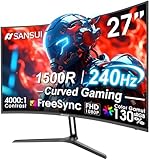
The Sansui 27-inch curved 240Hz monitor is a budget path to very high refresh rate gaming. It pairs a 1920×1080 panel with a 240Hz refresh rate, a 1500R curve, FreeSync and a 1ms MPRT motion figure, for a price that usually sits around $170–$200. If you play fast shooters or competitive titles on a mid-range PC and care more about smoothness than sharpness, it delivers the feature that matters most for that style of play at a low cost.
The catch is resolution. At 27 inches, 1080p works out to roughly 82 pixels per inch, so text and fine detail look softer than on a 24-inch 1080p screen or a 27-inch 1440p screen. If you do a lot of reading, spreadsheet work or slow-paced, visually rich games, a 1440p monitor at 144–170Hz is likely the better buy for similar money.
As an Amazon Associate we earn from qualifying purchases at no extra cost to you.
Who it is for
- Great fit: competitive players in games like Valorant, Counter-Strike 2, Fortnite, Apex Legends or Overwatch 2 whose PCs can push well over 144 fps at 1080p.
- Good fit: players who want an immersive curved screen without paying for a larger ultrawide.
- Poor fit: users who mostly work with text, photo editors who need accurate color, and console players (current consoles top out at 120Hz, so 240Hz goes unused).
Key specs
| Spec | Sansui 27″ Curved 240Hz |
|---|---|
| Screen size | 27 inches |
| Resolution | 1920 x 1080 (FHD) |
| Pixel density | About 82 PPI |
| Refresh rate | 240Hz |
| Curvature | 1500R |
| Motion response | 1ms MPRT |
| Contrast ratio | 4000:1 (listed) |
| Color gamut | 130% sRGB (listed) |
| Adaptive sync | FreeSync |
| Inputs | HDMI and DisplayPort |
| Other | HDR support, low blue light mode, metal stand, cable included |
| Typical price | About $170–$200 |
What stands out
240Hz at a budget price
A 240Hz panel refreshes every 4.2 milliseconds, compared with 6.9 ms at 144Hz and 16.7 ms at 60Hz. In practice, that makes camera pans and quick flicks look noticeably smoother and can make tracking targets easier. The benefit only appears if your PC delivers high frame rates, so pair it with a GPU that can hit 200+ fps in your main games at 1080p.
High contrast for a budget panel
A 4000:1 contrast figure is typical of VA-type panels and is roughly three to four times higher than common IPS monitors. Blacks look deeper, which helps in dark game scenes and movies. VA panels can show some smearing in dark transitions, so how the 1ms MPRT figure translates into real motion clarity depends on overdrive settings.
Curve that suits 27 inches
A 1500R curve is a moderate bend that wraps the edges of the screen slightly toward you. At typical desk distances it helps keep the corners in view and adds a bit of immersion without the distortion some people notice on tighter curves.
Vivid color out of the box
The listed 130% sRGB coverage means colors can look rich and saturated. That is appealing in games, but for accurate photo editing you would want an sRGB clamp mode or calibration, since oversaturated color is not the same as accurate color.
Trade-offs and limits
- Softer image: 82 PPI is the main weakness. Desktop text is readable but not crisp.
- HDR is basic: budget monitors that list HDR usually lack the brightness and local dimming to make HDR look dramatic. Treat HDR as a bonus, not a reason to buy.
- Use DisplayPort for 240Hz: depending on the HDMI version, the full 240Hz may only be available over DisplayPort. Use the included cable and check the manual.
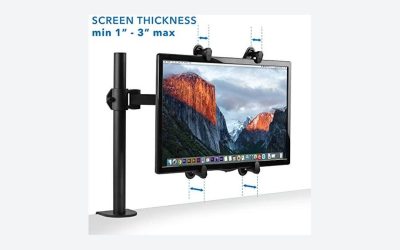
- Stand adjustments: a metal stand is sturdier than plastic, but budget stands often offer tilt only. Check whether height adjustment is included or plan on a VESA arm if the mount supports one.
- Lesser-known brand: Sansui is not a mainstream gaming monitor name, so look closely at warranty terms and dead-pixel policy before buying.
Refresh rate and resolution trade-off in numbers
| Monitor class | Pixel density at 27″ | Frame time | Best for |
|---|---|---|---|
| 27″ 1080p 240Hz (this monitor) | About 82 PPI | 4.2 ms | Competitive shooters |
| 27″ 1440p 165–170Hz | About 109 PPI | About 6 ms | All-round gaming and work |
| 24″ 1080p 240Hz | About 92 PPI | 4.2 ms | Esports at close viewing distance |
Setup tips
- Connect with DisplayPort and confirm 240Hz is selected in Windows display settings under Advanced display.
- Enable FreeSync in the monitor menu and in your GPU control panel. Many NVIDIA cards support FreeSync monitors under the G-SYNC Compatible setting.
- Try overdrive levels: the middle setting often gives the best balance between blur and inverse ghosting.
- Cap frame rate slightly below 240 (for example 237 fps) when using adaptive sync to keep it in range.
- Use a lower color saturation or sRGB mode if skin tones look too red or vivid.
- Sit about 24–32 inches away so the curve feels natural and the lower pixel density is less obvious.
Alternatives to consider
If your graphics card cannot sustain high frame rates, a 27-inch 1440p monitor at 144–170Hz will look sharper and feel nearly as smooth. If you want maximum clarity for esports, a 24-inch 1080p 240Hz monitor packs pixels more densely and keeps the whole screen in your field of view. The Sansui sits between the two: bigger and more immersive than a 24-inch, faster than most budget 1440p screens.
FAQ
Can a mid-range graphics card drive 240Hz at 1080p?
In lighter esports titles, yes. Many current mid-range cards exceed 200 fps at 1080p in games like Valorant and Counter-Strike 2 with competitive settings. Demanding single-player games will run well below 240 fps, which is where FreeSync keeps motion smooth without tearing.
Is this monitor good for consoles?
It will work over HDMI, but current consoles output at most 120Hz, and many games run at 60 fps. You would be paying for refresh rate you cannot use; a 1440p or 4K monitor is a better console match.
Verdict
The Sansui 27-inch curved 240Hz monitor is a sensible budget choice for gamers who want very high refresh rates, deep contrast and a moderate curve without paying premium-brand prices. Accept the softer 1080p image at this size and the basic HDR, and it does exactly what it promises for fast-paced gaming.