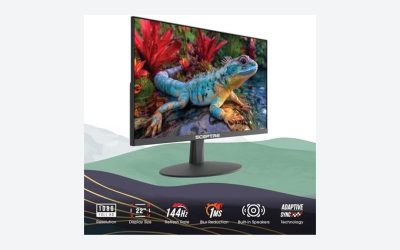
OLED gaming monitors now come in both 240Hz and 480Hz flavours, sometimes in the very same 27-inch 1440p chassis thanks to dual-mode panels. The jump sounds huge on paper, but the real-world gain is smaller and more situational than the doubled number suggests. Here is what actually changes and who should care.
As an Amazon Associate we earn from qualifying purchases at no extra cost to you.


Our Top Picks


Top 3 picks at a glance
What doubling the refresh rate really buys
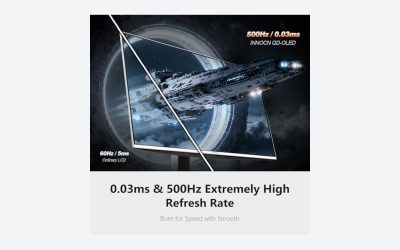
Going from 240Hz to 480Hz halves the time each frame is on screen, dropping the frame interval from about 4.2ms to roughly 2.1ms. On an OLED, where pixel response is already near-instant, that translates to genuinely clearer motion and a touch less input latency. But the perceived difference is far smaller than the 240Hz-over-60Hz leap most people remember.
You must feed it frames
A 480Hz panel only shines when your GPU actually pushes close to 480fps. That is realistic in CS2, Valorant, or Overwatch on strong hardware, but in heavier titles you may hover around 200-300fps, where a 240Hz screen already keeps up. Buying 480Hz for games that never reach it is spending on a number you will not see.
Motion clarity and diminishing returns
Because OLEDs have no LCD-style smearing, the remaining blur is mostly “persistence” blur from your eye tracking a moving object across a sample-and-hold display. Higher refresh reduces that persistence, so 480Hz does look cleaner in fast flicks. The catch is diminishing returns: 60 to 240Hz is transformative, 240 to 480Hz is a refinement most players notice only in direct A/B comparison.
| Metric | 240Hz OLED | 480Hz OLED | Practical impact |
|---|---|---|---|
| Frame interval | ~4.2ms | ~2.1ms | Slightly lower latency |
| GPU needed for full benefit | ~240fps | ~480fps | Big CPU/GPU demand at 480 |
| Best fit | 1440p or 4K play | 1080p/1440p esports | 480 favours light titles |
| Typical price premium | Baseline | +15-30% | Pay more for smaller gain |
Dual-mode panels change the math
Some newer OLEDs run 4K at 240Hz and switch to 1080p at 480Hz on the same screen. That flexibility is compelling: cinematic resolution for single-player, then a flick to high-refresh esports mode. If you can get dual-mode without a huge premium, it sidesteps the either-or decision entirely.
Who should pick which
Serious competitive players with a GPU that hits high frame rates in light titles will appreciate 480Hz. Everyone else, especially those who value resolution and visuals across mixed genres, gets more real enjoyment from a 240Hz OLED and the money saved.
Beyond refresh: what else changes
Chasing 480Hz can quietly cost you elsewhere. Some dual-mode panels reach 480Hz only by dropping to 1080p, so you trade resolution for refresh in that mode; at native 4K they run 240Hz. Factor in that your CPU, not just the GPU, has to sustain those frame rates, since esports titles at 400+ fps are frequently CPU-bound. A mid-range processor may cap you well below 480fps regardless of the graphics card.
There is also the input chain to consider. To feel the latency benefit of 480Hz you want a high-polling-rate mouse and a game engine that renders and presents frames without extra buffering. If any link lags, the theoretical advantage shrinks, which is another reason casual and mixed-genre players get better real value from a 240Hz OLED.
FAQ
Can the human eye even see 480Hz?
You do not see individual refreshes, but you can perceive the reduced motion blur and lower latency in fast movement, particularly during quick flicks and tracking. The effect is real but subtle compared with lower-refresh jumps, and it depends on actually rendering near 480fps.
Is 480Hz worth it if my GPU cannot hit 480fps?
Largely no. Without frame rates approaching the panel’s ceiling you are paying for headroom you never use, and a 240Hz OLED will look and feel almost identical. Prioritize 480Hz only if you play light competitive games on hardware that can feed it.
Bottom line
480Hz OLED delivers a real but modest clarity and latency edge over 240Hz, and only when your GPU can push near 480fps in light competitive titles. For mixed gaming and better value, a 240Hz OLED is the smarter buy; if a dual-mode panel offers both without a big premium, that is the best of both worlds.