Competitive players shopping around a similar price often land on a fork in the road: a 240Hz OLED with gorgeous image quality and near-instant pixel response, or a 360Hz LCD with a higher raw refresh number. More hertz sounds better on paper, but OLED’s response time changes the math. Here is how the two actually compare where it counts.
As an Amazon Associate we earn from qualifying purchases at no extra cost to you.



Our Top Picks
 ASUS ROG XG27AQDMGR 27 Inch 1440p 240Hz Glossy14.5" x 23.8" x 2.5"7.4 x 23.8 x 19.7 inches14.6 poundsCheck on Amazon


Top 3 picks at a glance
Refresh Rate Is Only Half the Story
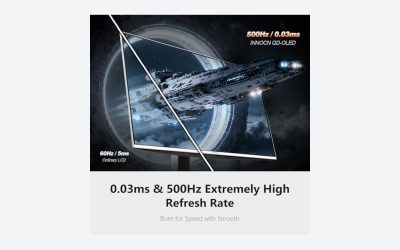
Refresh rate tells you how many times per second the panel updates. Response time tells you how quickly each pixel can change color to keep up. A 360Hz LCD updates more often, but many LCDs cannot fully finish a pixel transition in the time between refreshes, leaving a smear of the previous frame. OLED pixels switch in a fraction of a millisecond, so a 240Hz OLED often shows cleaner motion than its numbers suggest.
Motion Clarity Comparison
| Panel | Refresh | Pixel response | Real motion clarity |
|---|---|---|---|
| 240Hz OLED | 240Hz | ~0.03 ms | Excellent, minimal smear |
| 360Hz fast LCD | 360Hz | ~1-3 ms | Very good, slight smear |
| 360Hz average LCD | 360Hz | ~3-5 ms | Good, visible overshoot possible |
The frame interval at 240Hz is about 4.2 milliseconds; at 360Hz it is roughly 2.8 milliseconds. That difference is real but small, and OLED’s response advantage often offsets it in perceived sharpness.
Which One Wins for You
Pick the 360Hz LCD if
You play at a high level in pure aim-duel titles where the last sliver of latency and the extra frames matter, and you value chasing the highest possible refresh. LCDs also carry no burn-in risk, so a display that lives on the same game HUD for thousands of hours is worry-free. They tend to be cheaper too, freeing budget for other gear.
Pick the 240Hz OLED if
You want one monitor that is elite for competitive play and stunning for everything else. The OLED gives you perfect blacks, vivid HDR, and instant response, so it doubles as a fantastic screen for single-player games and movies. For the vast majority of players, 240Hz is already past the point of diminishing returns, and the image quality upgrade is far more noticeable day to day than the jump from 240 to 360.
Total Cost and Real-World Feel
Beyond the raw numbers, the two options feel different to live with. A 360Hz LCD is the specialist’s tool: it does one job, competitive motion, extremely well, stays cheaper, and never makes you think about burn-in. If your desk exists to win ranked matches and little else, that focus is a strength, and the saved money can go toward a better mouse, keyboard, or GPU that also improves your play.
A 240Hz OLED is the generalist that happens to be elite. The instant pixel response means its motion looks cleaner than the refresh gap would suggest, and the moment you step out of competitive play into a story game or a film, the perfect blacks and vivid HDR are in a different league from any LCD. For most players, the honest truth is that 240Hz is already beyond the point where extra refresh changes results, so the deciding question becomes how much you value everything the OLED does when you are not grinding ranked. If the answer is a lot, pay the premium and accept the mild burn-in caution; if all you care about is the scoreboard, the LCD is the rational pick.
Frequently Asked Questions
Can most people even tell 240Hz from 360Hz?
Trained competitive players can sometimes feel a slight difference in smoothness and latency, but for most gamers the gap is subtle and easy to miss in a blind test. The leap from 60 or 144Hz up to 240Hz is dramatic; from 240 to 360 it is a refinement, not a revolution.
Is OLED burn-in a dealbreaker for competitive gaming?
It is a manageable risk, not a certainty. Static scoreboards and HUDs are the main concern over years of heavy use. Modern OLEDs include pixel-shift, logo-dimming, and panel-refresh routines that greatly reduce the odds, and warranties increasingly cover burn-in for a few years. If you play many hours of the same game daily, factor it in.
Bottom Line
A 360Hz LCD gives you the highest raw refresh and zero burn-in worry for the lowest price, ideal for dedicated aim-focused competitors. A 240Hz OLED delivers motion clarity that rivals it thanks to near-instant pixels, plus far better image quality for everything else. Unless you are chasing every last millisecond, the OLED is the more satisfying all-round choice.